AI-Specific GaN Power IC for AI Server Power Supply Market Insights
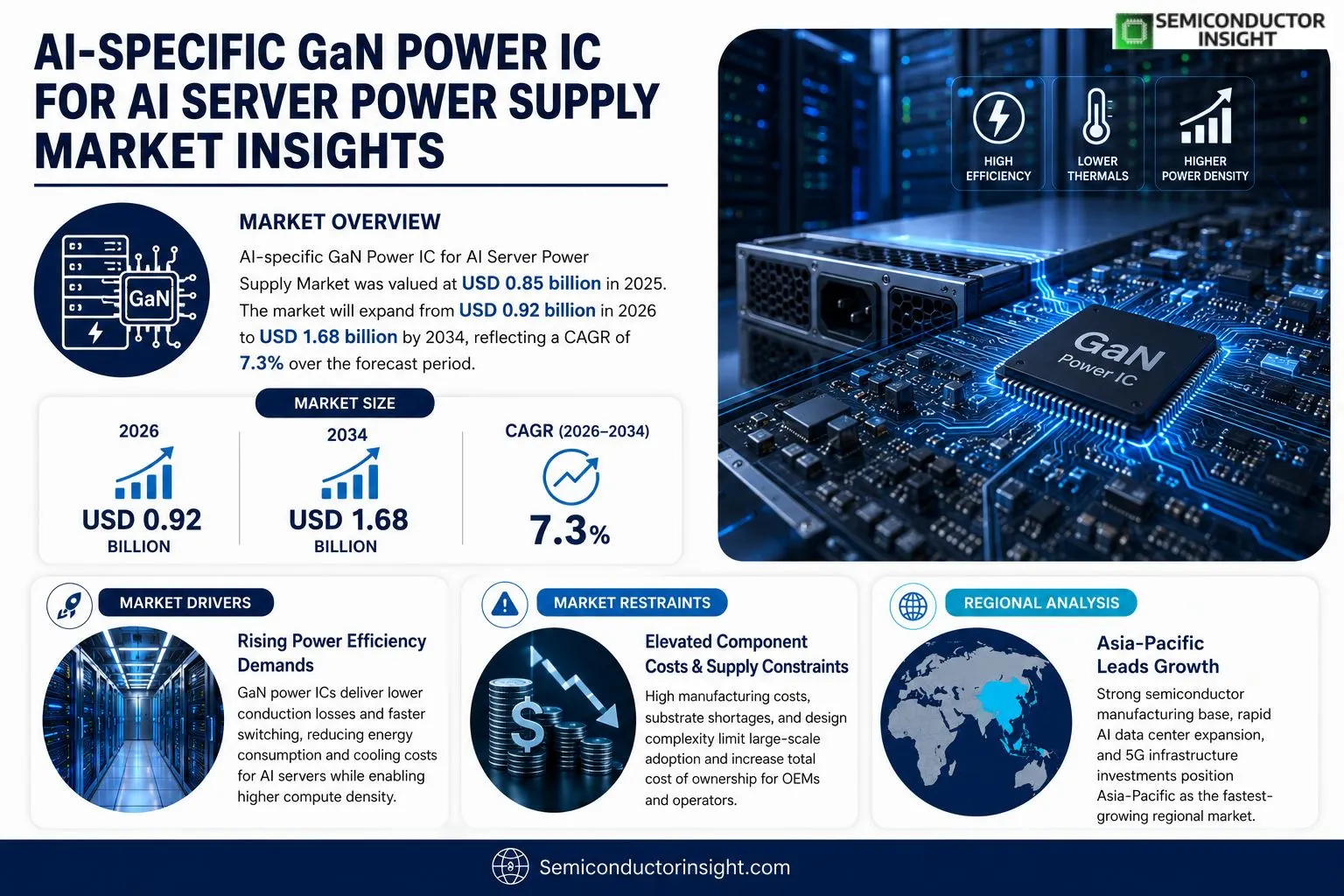
AI-Specific GaN Power IC for AI Server Power Supply Market size was valued at USD 0.85 billion in 2025. The market will expand from USD 0.92 billion in 2026 to USD 1.68 billion by 2034, reflecting a CAGR of roughly 7.3% over the forecast period.
AI‑specific gallium‑nitride (GaN) power integrated circuits are engineered to meet the high‑frequency switching and voltage‑efficiency requirements of modern artificial‑intelligence servers. These devices combine low on‑resistance with fast transition times, enabling power supplies that deliver more compute per watt while maintaining thermal headroom.The upward trajectory is linked to escalating demand for AI workloads in data centers, where operators seek energy‑cost reductions and higher performance density. Moreover, recent announcements from leading semiconductor firmssuch as the launch of a next‑generation GaN driver series in early 2024have broadened design options for OEMs, encouraging broader adoption across hyperscale facilities.
MARKET DRIVERS
Rising Power Efficiency Demands
Data center operators are grappling with escalating electricity bills as AI models scale. The AI‑Specific GaN Power IC for AI Server Power Supply Market gains traction because GaN technology can slash conversion losses, translating into measurable OPEX reductions. Clients that adopt these ICs typically report a 15‑20 % drop in cooling requirements, directly influencing site‑level cost structures.
Thermal Constraints in High‑Density AI Servers
Modern AI accelerators concentrate compute on a small footprint, pushing thermal envelopes to their limits. GaN’s high‑frequency operation and lower on‑resistance allow designers to shrink heat sinks while preserving reliability, a trade‑off that traditional silicon‑based supplies cannot match. This advantage feeds directly into higher rack density and improved real‑estate efficiency.
➤ GaN ICs achieve up to 30 % lower conduction losses than comparable silicon devices, fundamentally altering power‑budget calculations for AI workloads.
Beyond raw efficiency, regulatory trends toward carbon‑neutral data centres create a strategic imperative for low‑loss power conversion. Vendors that embed AI‑focused GaN ICs into their supply chain position themselves to meet both economic and sustainability targets.
MARKET CHALLENGES
Elevated Component Costs
Although GaN devices outperform silicon, the epitaxial growth process remains capital‑intensive, resulting in price points that exceed traditional power ICs by 40‑60 %. For budget‑conscious operators, the upfront investment can deter early adoption despite long‑term savings.
Other Challenges
Supply‑Chain Volatility
shortages of high‑purity substrates and the concentration of wafer fabrication in a handful of regions inject uncertainty into procurement cycles, compelling OEMs to maintain larger safety stocks.
Design Complexity
Integrating GaN requires re‑engineering of driver circuitry and electromagnetic compatibility (EMC) safeguards. Engineering teams must acquire specialized expertise, extending development timelines and increasing R&D expenditures.
MARKET RESTRAINTS
Material Availability Constraints
GaN substrates sourced from limited suppliers face yield variability, which hampers large‑scale production runs. When yield dips below 70 %, manufacturers either scale back volumes or accept higher per‑unit costs, curbing market momentum.Thermal reliability at extreme current densities remains an engineering focus; premature degradation under continuous high‑load scenarios can erode confidence among data‑center operators who prioritize uptime.Competing power‑semiconductor technologies, notably silicon‑carbide (SiC), are advancing rapidly, offering comparable voltage ratings with established supply chains, thereby siphoning potential demand from GaN‑centric solutions.
MARKET OPPORTUNITIES
AI Edge and Distributed Inference
Edge deployments demand compact, high‑efficiency power modules to meet strict size, weight, and power (SWaP) constraints. AI‑Specific GaN Power ICs can deliver the necessary performance while keeping thermal footprints minimal, opening a sizable niche beyond traditional data‑center environments.Collaborations between GaN foundries and leading AI accelerator manufacturers are beginning to surface, promising co‑optimized silicon‑GaN solutions that reduce board‑level interconnect losses. Such partnerships could accelerate time‑to‑market and create differentiated product portfolios.
AI-Specific GaN Power IC for AI Server Power Supply Market Trends
Shift Toward Energy‑Efficient Compute Density
The rise of artificial‑intelligence workloads has forced data‑center operators to rethink power architecture. GaN‑based power integrated circuits provide a combination of low on‑resistance and sub‑nanosecond transition times, which translates into higher power‑density modules that can support more GPUs per rack without exceeding thermal limits. Vendors that adopt these devices report a measurable reduction in overall energy spend, because the conversion efficiency gains free up capacity for additional inference tasks. This technical advantage is prompting a reallocation of budget from traditional silicon‑based supplies toward GaN solutions that can sustain the aggressive performance envelopes demanded by next‑generation AI clusters.
Other Trends
Design Flexibility from New GaN Driver Families
Recent product announcements from leading semiconductor manufacturers introduced driver families that integrate gate‑level protection, adaptive slew‑rate control, and built‑in diagnostics. The broader feature set eliminates the need for external auxiliary components, allowing OEMs to consolidate board space and streamline thermal paths. As a result, system integrators are able to accelerate time‑to‑market while preserving design margins that were previously achieved only through extensive layout iterations. This evolution in the component ecosystem lowers the barrier for smaller players to enter the AI server supply chain.
Integration of Adaptive Control Logic
Beyond raw efficiency, the market is witnessing a trend toward embedding intelligent control loops directly within the GaN power IC. Adaptive regulation algorithms monitor load transients in real time, adjusting switching frequency to maintain optimal efficiency across a wide range of demand profiles. By harmonizing power delivery with the variable nature of AI inference and training cycles, these smart ICs help maintain a stable voltage envelope, which is critical for preserving the reliability of high‑speed compute fabrics. The strategic implication for manufacturers is clear: products that combine hardware efficiency with software‑driven management are positioned to become the preferred choice for hyperscale operators seeking both performance headroom and operational simplicity.
COMPETITIVE LANDSCAPEKey Industry Players
AI‑Specific GaN Power ICs: Competitive Dynamics in AI Server Power Supplies
The market is anchored by a handful of semiconductor leaders that have converted their legacy silicon‑based power portfolios into GaN‑centric offerings. Transphorm, for instance, leverages its high‑voltage GaN platform to supply power modules that meet the tight efficiency envelopes of hyperscale AI racks, and its recent partnership with a major OEM has translated into a measurable shift in bill‑of‑materials composition. Navitas Semiconductor follows a similar trajectory, bundling driver ICs with advanced thermal management schemes that allow data‑center operators to push compute density without breaching power budgets. Together, these firms dictate the pricing cadence and set the technical baseline that smaller innovators must either emulate or differentiate against.Beyond the dominant tier, a diverse cohort of niche players is expanding the solution space. Efficient Power (Power Integrations) concentrates on compact GaN‑on‑silicon products that excel in edge‑server form factors, while Infineon and STMicroelectronics offer mixed‑technology portfolios that blend SiC and GaN for hybrid architectures. Qorvo and Skyworks contribute RF‑optimized GaN devices that can be repurposed for high‑frequency switching, and companies such as Rohm Semiconductor and Renesas are betting on system‑in‑package designs to reduce board‑level complexity. This diffusion of capabilities creates a competitive pressure that encourages faster iteration cycles and gives OEMs a broader supplier base to negotiate from.
List of Key AI‑Specific GaN Power IC Companies Profiled
- Transphorm
- Navitas Semiconductor
- Efficient Power (Power Integrations)
- Infineon Technologies
- STMicroelectronics
- Qorvo
- Skyworks Solutions
- Rohm Semiconductor
- Renesas Electronics
- Texas Instruments
- ON Semiconductor
- Analog Devices
- Microchip Technology
- Broadcom Inc.
- Mitsubishi Electric
Segment Analysis:
| Segment Category | Sub-Segments | Key Insights |
| By Type |
|
High‑Efficiency GaN Power ICs
|
| By Application |
|
Hyperscale AI Data Centers
|
| By End User |
|
Cloud Service Providers
|
| By Voltage Tier |
|
Medium Voltage (48‑200 V)
|
| By Integration Level |
|
System‑in‑Package (SiP) GaN ICs
|
Regional Analysis: AI-Specific GaN Power IC for AI Server Power Supply Market
North America
R&D spending in silicon‑photonic integration dovetails with GaN power conversion, yielding chips that simultaneously manage voltage regulation and data‑path acceleration. Start‑ups and incumbents alike explore monolithic architectures that reduce interconnect loss, a trend that deepens North America’s competitive moat.
Regional fabs have diversified substrate sources, mitigating geopolitical disruptions. Collaborative agreements with substrate manufacturers embed flexibility, enabling manufacturers to pivot quickly when demand spikes for AI server power modules.
Tier‑1 cloud providers are piloting GaN‑based power stages to meet the energy‑budget of next‑gen AI clusters. Early feedback emphasizes lower total‑cost‑of‑ownership, prompting wider procurement programmes across hyperscale facilities.
Federal incentives for low‑carbon compute encourage data‑center operators to select power solutions with superior efficiency, positioning GaN ICs as a preferred choice under emerging sustainability mandates.
Europe
European data‑center operators are recalibrating capacity plans to comply with strict EU energy‑efficiency directives. This regulatory pressure favours power ICs that achieve high power density while minimizing loss, making the AI‑Specific GaN Power IC for AI Server Power Supply Market an attractive proposition. Local design houses collaborate with German and French manufacturers, leveraging precision‑cut substrates that meet demanding reliability standards. Although the market’s scale lags behind North America, the continent’s emphasis on circular economy principles drives manufacturers to develop recyclable packaging for GaN devices, adding a new dimension to product differentiation.
Asia‑Pacific
The Asia‑Pacific region exhibits a multifaceted dynamic: rapid cloud expansion in China and India coexists with a robust semiconductor manufacturing base in Taiwan, South Korea, and Japan. Companies in this corridor are experimenting with GaN power stages to overcome the thermal constraints of dense AI accelerators, especially in edge‑computing nodes that serve 5G infrastructure. While cost sensitivity remains high, the sheer volume of deployment offsets price considerations, encouraging Tier‑2 vendors to introduce scaled‑down GaN solutions that retain core efficiency advantages. Strategic alliances between fabless designers and fabs accelerate technology transfer, positioning the region as a pivotal production hub for the market.
South America
South America’s AI server market is still embryonic, yet recent investments in regional cloud campuses signal an emerging demand for efficient power conversion. Governments in Brazil and Chile have introduced tax credits for energy‑saving technologies, indirectly nudging data‑center operators toward advanced semiconductor options. Local distributors are beginning to stock GaN‑based power ICs, fostering a nascent ecosystem that could benefit from knowledge‑transfer programmes with North American partners. Although adoption rates remain modest, the combination of policy incentives and growing digital infrastructure lays a foundation for future market traction.
Middle East & Africa
In the Middle East, sovereign wealth funds are allocating capital to AI‑focused data‑center projects, particularly in the United Arab Emirates and Saudi Arabia. These initiatives prioritize power‑efficiency to align with sustainability pledges, thereby opening a niche for GaN power ICs that can sustain high compute loads under challenging thermal conditions. Africa, while lagging in overall data‑center density, is witnessing pilot deployments in fintech and e‑commerce sectors that demand reliable, low‑latency compute. Early adopters are looking to GaN technology to reduce footprint and operational expenditure, suggesting a slowly expanding opportunity set across the region.
Report Scope
This market research report provides a comprehensive analysis of the AI-Specific GaN Power IC for AI Server Power Supply Market , covering the forecast period 2026–2034. It offers detailed insights into market dynamics, technological advancements, competitive landscape, and key trends shaping the industry.
Key focus areas of the report include:
- Market Overview: The report begins with an overview outlining its current market scenario, key growth indicators, and industry transformation drivers. It discusses macroeconomic factors, demand–supply balance, regulatory landscape, and the strategic role of semiconductors in powering advancements across industries such as automotive, telecommunications, consumer electronics, and industrial automation.
- Market Size & Forecast: Historical data and future projections for revenue, unit shipments, and market value across major regions and segments.
- Segmentation Analysis: Detailed breakdown by product type, technology, application, and end-user industry to identify high-growth segments and investment opportunities.
- Regional Insights: Insights into market performance across North America, Europe, Asia-Pacific, Latin America, and the Middle East & Africa, including country-level analysis where relevant.
- Competitive Landscape: Profiles of leading market participants, including their product offerings, R&D focus, manufacturing capacity, pricing strategies, and recent developments such as mergers, acquisitions, and partnerships.
- Technology Trends & Innovation: Assessment of emerging technologies, integration of AI/IoT, semiconductor design trends, fabrication techniques, and evolving industry standards.
- Market Drivers & Restraints: Evaluation of factors driving market growth along with challenges, supply chain constraints, regulatory issues, and market-entry barriers.
- Stakeholder Insights: Insights for component suppliers, OEMs, system integrators, investors, and policymakers regarding the evolving ecosystem and strategic opportunities.
Primary and secondary research methods are employed, including interviews with industry experts, data from verified sources, and real-time market intelligence to ensure the accuracy and reliability of the insights presented.
FREQUENTLY ASKED QUESTIONS:
What is the current market size of AI-Specific GaN Power IC for AI Server Power Supply Market?
-> AI-Specific GaN Power IC for AI Server Power Supply Market was valued at USD 0.85 billion in 2025 and is expected to reach USD 1.68 billion by 2034.
Which key companies operate in AI-Specific GaN Power IC for AI Server Power Supply Market?
-> Key players include Axalta Coating Systems, AkzoNobel, BASF SE, PPG, Sherwin-Williams, and 3M, among others.
What are the key growth drivers?
-> Key growth drivers include railway infrastructure investments, urbanization, and demand for durable coatings.
Which region dominates the market?
-> Asia-Pacific is the fastest-growing region, while Europe remains a dominant market.
What are the emerging trends?
-> Emerging trends include bio-based coatings, smart coatings, and sustainable rail solutions.
Get Sample Report PDF for Exclusive Insights
Report Sample Includes
- Table of Contents
- List of Tables & Figures
- Charts, Research Methodology, and more...
 Download Sample Report PDF