AI-Specific Buried Power Rail Integration Market Insights
AI-specific buried power rail integration market size was valued at USD 0.85 billion in 2025. The market is projected to grow from USD 0.90 billion in 2026 to USD 1.45 billion by 2034, exhibiting a CAGR of 6.2% during the forecast period.
AI-specific buried power rail integration refers to embedding dedicated low‑voltage distribution rails within semiconductor packages or printed circuit boards expressly designed for artificial‑intelligence accelerators.
These rails supply stable power directly beneath compute cores, mitigating voltage droop and electromagnetic interference while enabling higher component density.
The market is experiencing rapid growth due to several factors, including increased capital spending on AI hardware, rising demand for edge‑compute devices, and heightened focus on energy‑efficient designs.
Furthermore, advancements in advanced packaging technologies such as fan‑out wafer level packaging (FOWLP) are contributing to market expansion.
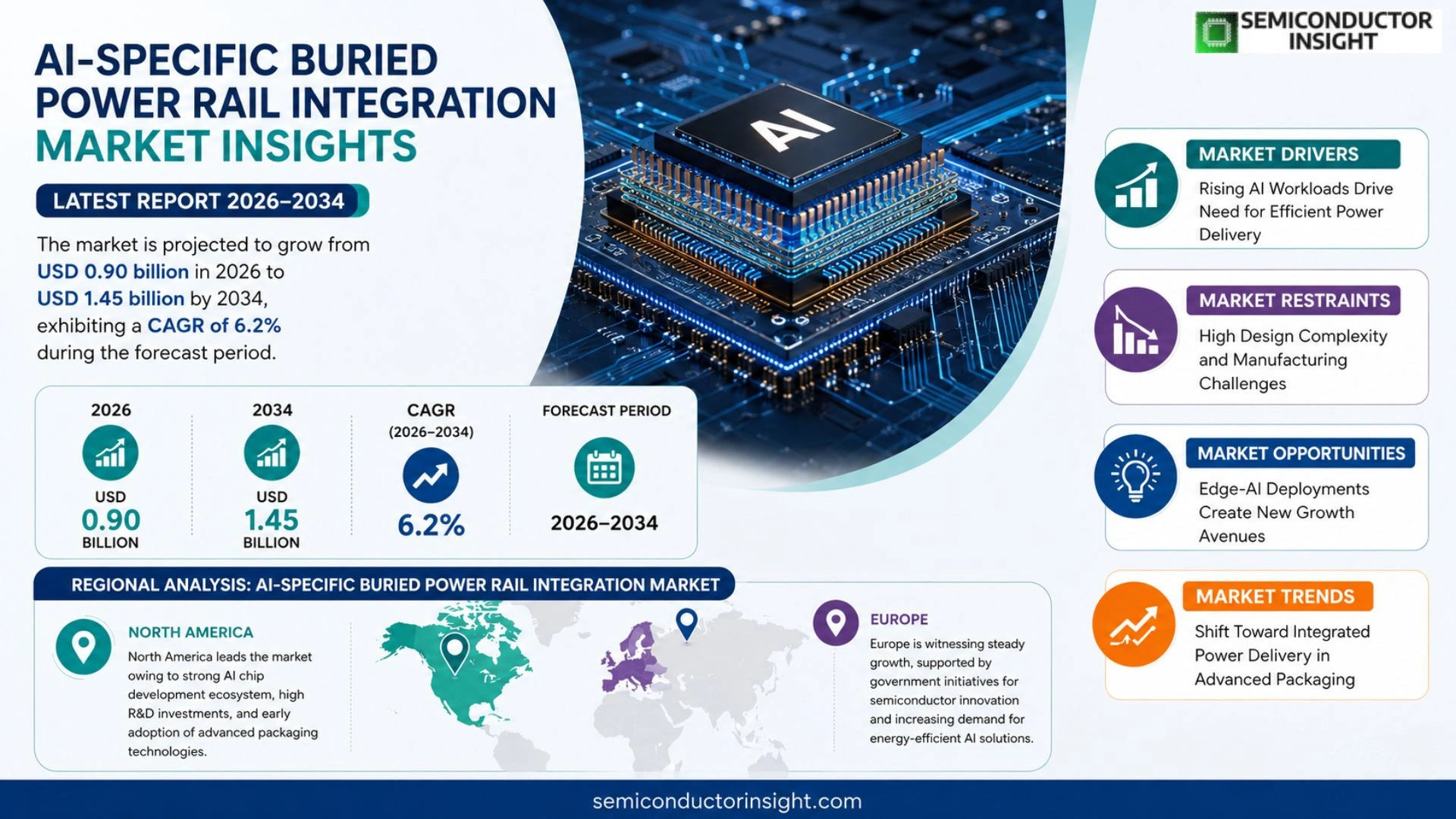
MARKET DRIVERS
AI Workload Density and Power Efficiency
The surge in transformer‑based models forces datacenter designers to pack more compute into tighter footprints. When silicon density climbs, the traditional external power buses generate excess heat and electromagnetic interference. Embedding power rails beneath the die mitigates those issues, allowing AI-specific buried Power Rail Integration Market to meet the efficiency demands of next‑generation inference engines.
Regulatory Pressure on Energy Consumption
Europe’s upcoming power‑usage standards and California’s tiered electricity pricing are reshaping OEM cost models. Manufacturers that adopt buried rail architectures can showcase lower PUE (Power Usage Effectiveness) figures, turning compliance into a marketable advantage. Consequently, procurement teams are prioritizing solutions that demonstrate measurable energy savings.
➤ “Embedding the power distribution network directly under the AI accelerator cuts routing length by up to 45 %, translating into tangible thermal headroom for higher clock rates.”
Design houses are also capitalizing on the modular nature of buried rails; a single substrate can service multiple AI ASICs, simplifying board layout and reducing bill‑of‑materials. These economies of scale reinforce the push toward integrated power delivery across the sector.
MARKET CHALLENGES
Manufacturing Complexity
Buried power rails require sub‑micron lithography on high‑k dielectric stacks, a step beyond conventional PCB processes. Foundries must invest in new metrology tools, and any yield loss quickly erodes the price advantage of integration. Customers therefore face longer lead times and higher upfront expenditures.
Other Challenges
Supply‑Chain Volatility
The reliance on specialty copper alloys and ultra‑pure silicon wafers makes AI-specific buried Power Rail Integration Market vulnerable to geopolitical shifts. Sudden tariff adjustments or raw‑material shortages can disrupt production schedules, prompting OEMs to maintain safety stock.
MARKET RESTRAINTS
Cost Sensitivity in Tier‑1 Servers
Enterprise buyers still benchmark against total cost of ownership. If the incremental expense of buried rail integration cannot be justified by clear performance uplift, procurement committees may revert to conventional power‑plane designs, limiting broader adoption.
MARKET OPPORTUNITIES
Edge‑AI Deployments
Edge locations,autonomous vehicles, industrial robots, and smart cameras,operate under strict thermal envelopes and limited power budgets. Embedding power rails directly beneath AI accelerators enables compact enclosures without sacrificing throughput, positioning AI-specific buried Power Rail Integration Market as a strategic enabler for the expanding edge ecosystem.
AI-Specific Buried Power Rail Integration Market Trends
Capital Allocation Shifts Toward Integrated Power Delivery
The surge in corporate budgets for AI‑focused silicon is reshaping how power is conveyed to compute cores. Designers are increasingly favoring embedded low‑voltage rails that sit directly beneath accelerator blocks, a move that curtails voltage droop and reduces electromagnetic interference. By eliminating traditional external decoupling networks, manufacturers can pack more transistors into a given die area, a necessity as model parameters swell. The trend is amplified by advanced packaging breakthroughs,particularly fan‑out wafer‑level approaches,that accommodate these buried rails without compromising thermal performance. Collectively, these dynamics are nudging the AI‑Specific Buried Power Rail Integration Market toward solutions that prioritize density, reliability, and power‑efficiency in tandem.
Other Trends
Edge‑Compute Proliferation Drives On‑Board Power Innovation
Demand for inference at the network edge compels device makers to squeeze AI capability into rugged, space‑constrained form factors. Embedded power rails address the twin challenges of limited board real‑estate and stringent power budgets by delivering stable voltage close to the processor, thereby lowering losses associated with long distribution paths. This architecture also eases regulatory compliance for electromagnetic emissions,a critical hurdle for automotive and industrial edge modules. As a result, the AI‑Specific Buried Power Rail Integration Market is witnessing heightened interest from vendors targeting autonomous vehicles, smart factories, and remote sensing platforms.
Strategic Alliances and Portfolio Expansion
Collaboration among leading silicon and foundry players is accelerating the commercial rollout of buried rail technologies. A notable instance occurred in March 2024 when Intel entered a joint development agreement with TSMC to tailor embedded power‑rail solutions for forthcoming Xeon AI processors. Parallel initiatives by NVIDIA, Qualcomm, and Samsung underscore a broader industry shift: integrating power delivery at the package level is no longer an experimental concept but a competitive differentiator. These partnerships are translating into road‑maps that feature standardized interfaces, streamlined design kits, and longer product lifecycles, thereby lowering entry barriers for niche AI hardware firms.
COMPETITIVE LANDSCAPE
Key Industry Players
AI‑Specific Buried Power Rail Integration: Competitive Overview
Intel remains the market anchor, leveraging its deep expertise in AI accelerator silicon and a strategic alliance with TSMC announced in early 2024. The partnership targets co‑development of embedded power‑rail architectures that marry Intel’s Xeon AI roadmap with TSMC’s advanced node capabilities. This collaboration illustrates how the segment is concentrating around a handful of vertically integrated firms that can dictate design standards, secure supply‑chain continuity, and absorb the high‑mix, low‑volume demands of bespoke AI workloads. The resulting ecosystem forces smaller vendors to align either through licensing agreements or joint‑development projects, reinforcing a tiered competitive hierarchy.
Beyond the dominant duo, a cadre of specialists is expanding the solution set. NVIDIA’s focus on high‑performance GPU‑centric power delivery, Qualcomm’s integration of AI‑centric power rails into mobile SoCs, and Samsung’s aggressive push into fan‑out wafer‑level packaging illustrate divergent pathways to address the same power‑integrity challenge. Meanwhile, AMD, IBM, MediaTek, Broadcom, Texas Instruments, GlobalFoundries, STMicroelectronics, Infineon, and ASE Technology contribute niche capabilities,ranging from custom voltage regulation modules to advanced substrate engineering,that enable customers to fine‑tune performance versus cost. These players collectively enrich the competitive fabric, compelling incumbents to continuously refine their offerings to retain design‑wins.
List of Key AI‑Specific Buried Power Rail Integration Companies Profiled
- Intel Corporation
- NVIDIA Corporation
- Qualcomm Inc.
- Samsung Electronics
- Taiwan Semiconductor Manufacturing Co.
- Advanced Micro Devices (AMD)
- IBM Corporation
- MediaTek Inc.
- Broadcom Inc.
- Texas Instruments
- GlobalFoundries
- STMicroelectronics
- Infineon Technologies AG
- ASE Technology Holding Co., Ltd.
Segment Analysis:
| Segment Category | Sub-Segments | Key Insights |
| By Type |
|
Low‑Voltage Embedded Rails
|
| By Application |
|
Edge AI Accelerators
|
| By End User |
|
Semiconductor Manufacturers
|
| By Design Complexity |
|
Hierarchical Power Networks
|
| By Integration Technology |
|
Fan‑Out Wafer Level Packaging (FOWLP)
|
Regional Analysis: AI-Specific Buried Power Rail Integration Market
Federal and state agencies have codified burial depth guidelines that align with AI‑specific power density requirements, prompting vendors to certify compliance through third‑party testing programs. This regulatory clarity reduces liability concerns for developers and accelerates project approvals across the continent.
Integrated logistics platforms now synchronize rail manufacturers with AI hardware assemblers, enabling just‑in‑time delivery of pre‑cabled modules. This reduces warehouse footprints and mitigates the risk of component mismatches during build‑out phases.
Silicon Valley incubators and Canadian research parks are experimenting with modular rail segments that incorporate embedded sensors, allowing real‑time monitoring of voltage drops and thermal excursions within buried conduits.
Enterprises deploying edge AI workloads cite the predictability of power delivery as a decisive factor, prompting procurement teams to favor solutions that guarantee uninterrupted rail performance despite harsh underground conditions.
Europe
European adopters benefit from a harmonized set of standards that streamline cross‑border projects, especially in the Nordics where data‑center density intersects with renewable grid extensions. Vendors are responding by offering modular rail kits that adapt to varying voltage regimes, a flexibility prized by utilities seeking to retrofit legacy infrastructure without extensive redesign.
Asia‑Pacific
In the Asia‑Pacific corridor, rapid urbanization and the proliferation of hyperscale facilities drive a pragmatic approach to underground power delivery. Countries such as Singapore and Japan prioritize space‑saving designs, leading manufacturers to embed AI‑specific power rails directly into prefabricated building modules. This practice shortens construction timelines and aligns with governmental goals for sustainable infrastructure.
South America
South American markets are witnessing a gradual shift from overhead to buried power solutions as climate‑resilient designs gain favor. Project developers emphasize durability against tropical weather, prompting a rise in corrosion‑resistant rail coatings. The emphasis on long‑term reliability influences procurement strategies, favoring suppliers with proven field performance.
Middle East & Africa
The Middle East & Africa region leverages abundant solar generation, integrating buried power rails into hybrid AI‑edge sites that co‑locate compute nodes with photovoltaic arrays. Environmental considerations, such as sand ingress, have spurred innovation in sealed rail enclosures, while African telecom operators explore rail‑based power delivery to extend AI‑enabled edge services into remote locations.
Report Scope
This market research report provides a comprehensive analysis of the AI-Specific Buried Power Rail Integration Market , covering the forecast period 2026–2034. It offers detailed insights into market dynamics, technological advancements, competitive landscape, and key trends shaping the industry.
Key focus areas of the report include:
- Market Overview: The report begins with an overview outlining its current market scenario, key growth indicators, and industry transformation drivers. It discusses macroeconomic factors, demand–supply balance, regulatory landscape, and the strategic role of semiconductors in powering advancements across industries such as automotive, telecommunications, consumer electronics, and industrial automation.
- Market Size & Forecast: Historical data and future projections for revenue, unit shipments, and market value across major regions and segments.
- Segmentation Analysis: Detailed breakdown by product type, technology, application, and end-user industry to identify high-growth segments and investment opportunities.
- Regional Insights: Insights into market performance across North America, Europe, Asia-Pacific, Latin America, and the Middle East & Africa, including country-level analysis where relevant.
- Competitive Landscape: Profiles of leading market participants, including their product offerings, R&D focus, manufacturing capacity, pricing strategies, and recent developments such as mergers, acquisitions, and partnerships.
- Technology Trends & Innovation: Assessment of emerging technologies, integration of AI/IoT, semiconductor design trends, fabrication techniques, and evolving industry standards.
- Market Drivers & Restraints: Evaluation of factors driving market growth along with challenges, supply chain constraints, regulatory issues, and market-entry barriers.
- Stakeholder Insights: Insights for component suppliers, OEMs, system integrators, investors, and policymakers regarding the evolving ecosystem and strategic opportunities.
Primary and secondary research methods are employed, including interviews with industry experts, data from verified sources, and real-time market intelligence to ensure the accuracy and reliability of the insights presented.
FREQUENTLY ASKED QUESTIONS:
What is the current market size of AI-Specific Buried Power Rail Integration Market?
-> AI-specific buried power rail integration market is projected to grow from USD 0.90 billion in 2026 to USD 1.45 billion by 2034, exhibiting a CAGR of 6.2%
Which key companies operate in AI-Specific Buried Power Rail Integration Market?
-> Key players include Intel, NVIDIA, Qualcomm, Samsung, and TSMC, among others.
What are the key growth drivers?
-> Key growth drivers include increased capital spending on AI hardware, rising demand for edge‑compute devices, focus on energy‑efficient designs, and advancements in advanced packaging technologies such as fan‑out wafer level packaging (FOWLP).
Which region dominates the market?
-> Asia‑Pacific is the fastest‑growing region, while North America remains the dominant market due to high AI‑hardware investment.
What are the emerging trends?
-> Emerging trends include co‑development of embedded power‑rail solutions by semiconductor leaders, integration of AI‑accelerator specific power delivery networks, and the adoption of heterogeneous integration strategies.
Get Sample Report PDF for Exclusive Insights
Report Sample Includes
- Table of Contents
- List of Tables & Figures
- Charts, Research Methodology, and more...
 Download Sample Report PDF