
AI-Specific Atomic Layer Deposition Precursor Market Insights
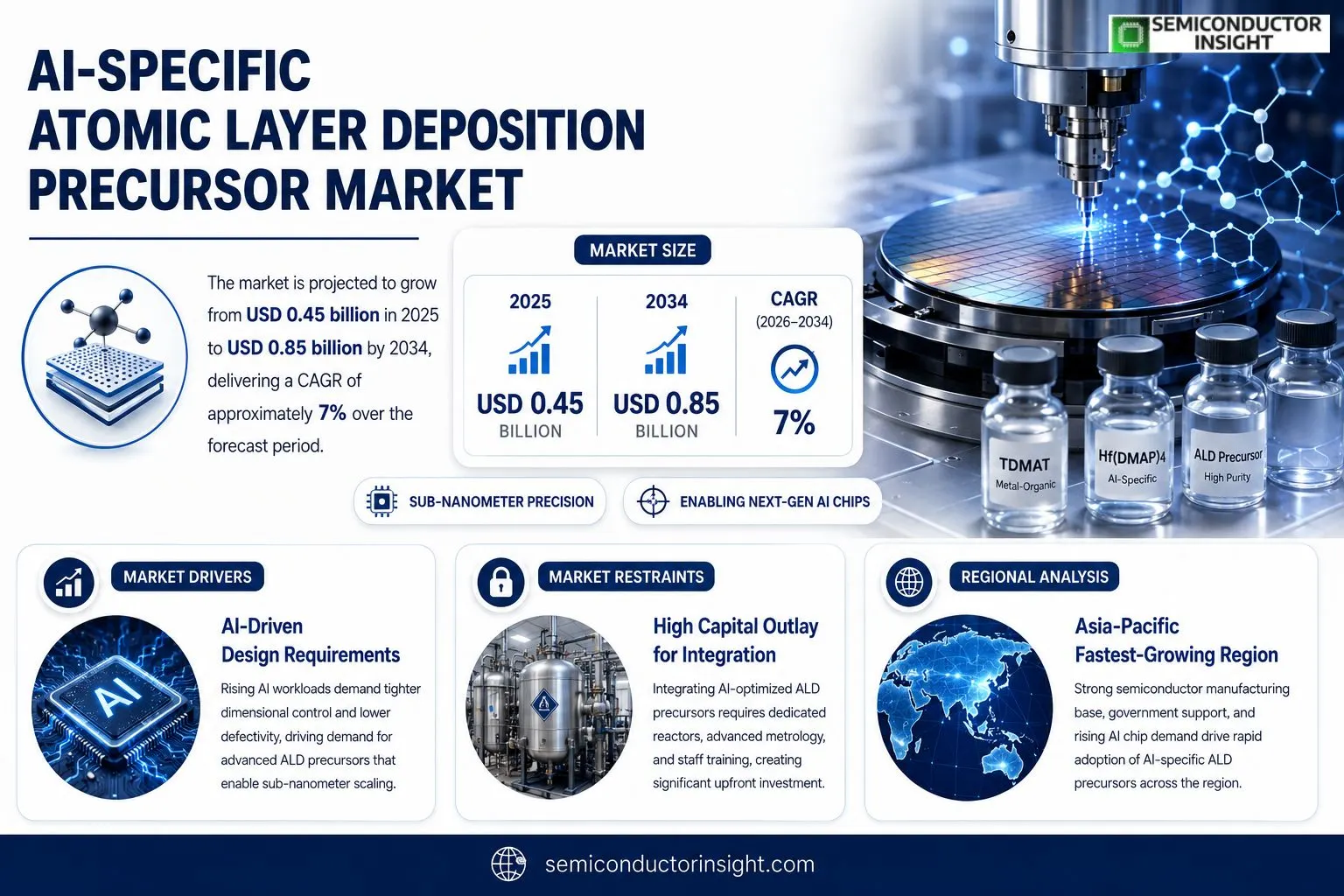
AI-Specific Atomic Layer Deposition Precursor market recorded a value of USD 0.45 billion in 2025 and will climb to USD 0.85 billion by 2034, delivering a compound annual growth rate of approximately 7 % over the forecast horizon.
Atomic layer deposition (ALD) precursors designed for artificial‑intelligence hardware are highly purified organometallic compounds that enable sub‑nanometer film control on advanced semiconductor wafers. These chemicals decompose layer‑by‑layer under controlled temperature cycles, ensuring uniform dielectric and conductive layers essential for neuromorphic chips and edge‑AI processors.The sector gains momentum because semiconductor manufacturers intensify their shift toward heterogeneous integration, while AI workloads demand ever‑thinner interconnects and low‑loss dielectrics. Moreover, government funding for next‑generation computing platforms fuels R&D spending on tailored ALD chemistries. In March 2024, Lam Research announced a strategic alliance with IBM Research to co‑develop AI‑specific precursors that reduce cycle time by up to 15 %. Other active participants such as Applied Materials, Veeco Instruments and Tokyo Electron continue expanding their portfolios through targeted acquisitions.
MARKET DRIVERS
AI‑Driven Design Requirements
The proliferation of AI workloads demands transistors with tighter dimensional control and reduced defectivity. AI‑Specific Atomic Layer Deposition Precursor Market suppliers that can deliver monolayer‑precision films are seeing heightened interest from chipmakers seeking to meet those performance thresholds. This pressure translates into faster adoption cycles for advanced precursors that enable sub‑nanometer scaling.
Shift Toward Heterogeneous Integration
Manufacturers are increasingly combining logic, memory, and sensor functions on a single die. The resulting process complexity elevates the need for chemically stable, low‑temperature ALD precursors that can be sequenced without cross‑contamination. Companies that engineer tailor‑made chemistries gain a competitive edge as they support the move away from traditional bulk‑silicon architectures.
➤ Clients value precursors that minimize cycle time while preserving film uniformity, because shorter runs directly improve fab throughput.
Beyond technical merits, the strategic partnerships forming between precursor developers and AI‑focused fab services lower the barrier to entry for niche players. Such collaborations accelerate knowledge transfer and reduce time‑to‑market for next‑generation materials, reinforcing the growth momentum of the sector.
MARKET CHALLENGES
Regulatory Scrutiny of Novel Chemistries
New organometallic compounds introduced for AI‑specific deposition often fall under stricter environmental and safety regulations. Compliance testing can extend product launch timelines, especially in regions with rigorous VOC and REACH standards. Companies must allocate resources to certification, which can erode margin potential.
Other Challenges
Supply‑Chain Volatility
shortages of high‑purity metal salts, coupled with logistics bottlenecks, have created intermittent delays in precursor availability. End‑users, wary of production interruptions, may revert to legacy chemistries despite the performance gap, dampening demand for the latest formulations.
MARKET RESTRAINTS
High Capital Outlay for Process Integration
Integrating AI‑optimized ALD precursors into existing fab lines often requires dedicated reactors, advanced metrology, and staff retraining. The upfront investment can be prohibitive for mid‑size foundries, leading them to postpone adoption until the technology reaches a more mature cost profile.
MARKET OPPORTUNITIES
Customization Platforms for Edge AI Devices
Edge‑computing devices, such as autonomous sensors and smart cameras, require ultra‑thin, low‑power layers that conventional precursors cannot reliably produce. A service model that offers on‑demand synthesis of bespoke ALD chemistries could unlock a new revenue stream, positioning providers at the forefront of the AI‑specific material ecosystem.
AI-Specific Atomic Layer Deposition Precursor Market Trends
Shift Toward AI‑Optimized Heterogeneous Integration
AI‑Specific Atomic Layer Deposition Precursor Market is responding to a palpable shift in semiconductor design philosophy. Manufacturers are increasingly layering diverse functional blockslogic, memory, and neuromorphic elementswithin a single die to meet the throughput demands of modern AI workloads. This architectural evolution forces a tighter tolerance on film thickness and dielectric loss, conditions that only highly purified organometallic ALD precursors can satisfy. By enabling sub‑nanometer control, the precursors reduce parasitic capacitance and improve signal fidelity, which directly translates into higher inference speed for edge‑AI processors. The competitive pressure to deliver such performance is prompting fabs to replace legacy chemistries with AI‑focused formulations, thereby expanding the market’s installed base.
Other Trends
Strategic Partnerships Accelerating Development
Collaboration between equipment suppliers and research institutions is a defining feature of the current landscape. In March 2024, Lam Research disclosed a joint venture with IBM Research aimed at engineering precursors that cut cycle time by roughly 15 %. The partnership illustrates how shared R&D resources lower entry barriers for next‑generation chemistries, allowing smaller vendors to benefit from IBM’s algorithmic expertise. Parallel moves by Applied Materials, Veeco Instruments, and Tokyo Electroneach bolstering their portfolios through targeted acquisitionssignal a broader industry consensus that collaboration, rather than isolated development, accelerates time‑to‑market for AI‑specific solutions.
Government‑Backed Funding Fuels Innovation
Public investment programs are shaping the supply chain by earmarking capital for advanced computing platforms. National initiatives that prioritize neuromorphic chips and high‑performance edge AI devices generate a steady stream of grant money for precursor research. This financial support reduces the risk profile for companies that might otherwise hesitate to allocate resources toward niche chemistries. Consequently, AI‑Specific Atomic Layer Deposition Precursor Market enjoys a more resilient pipeline of innovations, with manufacturers better positioned to meet the escalating material specifications dictated by AI‑centric designs.
COMPETITIVE LANDSCAPEKey Industry Players
AI‑Specific ALD Precursors: Competitive Dynamics
Lam Research continues to dominate the supply chain for AI‑oriented ALD precursors, leveraging its deep integration with wafer‑fab equipment portfolios. The recent partnership with IBM Research signals a shift toward bespoke chemistry that trims deposition cycles, giving Lam a tangible advantage in volume manufacturing of neuromorphic processors. Applied Materials and Tokyo Electron follow closely, each expanding their precursor catalog through strategic acquisitions of boutique chemical firms. Their ability to embed custom chemistries within existing deposition platforms creates a barrier for newcomers and forces the market into a duopolistic‑ish structure where scale and integration capability become decisive factors for semiconductor OEMs.Beyond the tier‑one incumbents, a cohort of specialized suppliers is carving out niches that address ultra‑thin dielectric layers and low‑loss interconnects. Veeco Instruments, ASM International, and Merck KGaA supply high‑purity organometallics that cater to research‑grade and pilot‑line production. Air Liquide and BASF focus on bulk‑scale organosilicon compounds, while Hitachi High‑Technologies and NTT Advanced Technology provide region‑specific formulations aligned with Asian fabs. Samsung Electronics and Intel are increasingly developing in‑house precursor lines to secure supply continuity for future AI hardware generations, underscoring the strategic importance of chemical sourcing in the broader compute ecosystem.
List of Key AI‑Specific Atomic Layer Deposition Precursor Companies Profiled
- Lam Research
- Applied Materials
- Tokyo Electron
- Veeco Instruments
- ASM International
- Merck KGaA
- Air Liquide
- BASF
- Hitachi High‑Technologies
- NTT Advanced Technology
- Samsung Electronics
- Intel Corporation
Segment Analysis:
| Segment Category | Sub-Segments | Key Insights |
| By Type |
|
Metal‑Organic Precursors dominate due to their superior volatility and fine‑tuned ligand design, enabling precise thickness control for AI‑centric interconnects.
|
| By Application |
|
Neuromorphic Computing demands ultra‑thin, low‑loss dielectrics that ALD precursors uniquely deliver.
|
| By End User |
|
Semiconductor Foundries are the primary adopters, integrating AI‑specific precursors into their production pipelines.
|
| By Chemistry |
|
Transition‑Metal‑Based Precursors are gaining traction for their ability to create conductive layers essential for AI accelerators.
|
| By Integration Strategy |
|
Heterogeneous Integration emerges as the pivotal growth driver for AI‑specific ALD precursors.
|
Regional Analysis: AI-Specific Atomic Layer Deposition Precursor Market
North America
Vendors in the region are redesigning logistics to mitigate cross‑border disruptions, emphasizing regional warehousing and just‑in‑time inventory models that align with the rapid iteration cycles of AI‑optimized ALD processes.
Environmental compliance frameworks are evolving, prompting precursor manufacturers to adopt greener synthesis routes that satisfy both federal standards and corporate sustainability mandates.
The region’s universities produce a steady stream of chemists and data scientists whose interdisciplinary expertise fuels the development of AI‑guided precursor libraries.
Fab operators are co‑creating formulations with suppliers, ensuring that the chemical properties align precisely with the deposition windows demanded by emerging device architectures.
Europe
European research institutions are integrating AI platforms into their material‑discovery workflows, resulting in precursor candidates that balance volatility with thermal stability. The region benefits from a dense network of specialist chemical manufacturers willing to engage in small‑batch, high‑value projects. Collaborative funding schemes between the EU and national bodies are encouraging cross‑border projects that pool expertise from chemistry, machine learning, and semiconductor engineering. This multidisciplinary synergy is prompting fabs in Germany and the Netherlands to adopt more aggressive process windows, confident that bespoke precursors can be sourced locally without compromising performance.
Asia‑Pacific
The Asia‑Pacific market is distinguished by its scale of production and aggressive investment in AI‑enhanced manufacturing. While the bulk of precursor volume originates from large chemical firms, a growing number of niche players are leveraging AI to fine‑tune molecular structures for specific device tiers. Governments in China, South Korea, and Taiwan are offering incentives that link AI research funding directly to precursor development, catalyzing a feedback loop where process demands shape chemical innovation. This dynamic encourages fab managers to experiment with higher‑aspect‑ratio patterns, knowing that supply partners can respond swiftly to bespoke requirements.
South America
South American activity remains exploratory, with several university labs piloting AI‑driven synthesis pathways for low‑cost precursors aimed at emerging markets. The region’s comparatively modest fab footprint limits immediate demand, but local manufacturers are positioning themselves as alternative suppliers for niche applications, such as flexible electronics. Partnerships with North American research consortia are gradually transferring knowledge, suggesting a future where South American firms could serve as cost‑effective extensions of the supply chain.
Middle East & Africa
In the Middle East and Africa, interest centers on leveraging AI to accelerate the commercialization of ALD technology for renewable‑energy components. Early‑stage collaborations between oil‑focused research centers and semiconductor specialists are generating precursor concepts that prioritize thermal resilience under harsh operating conditions. While the market share is still nascent, the strategic emphasis on sustainability and energy efficiency may soon attract multinational investors seeking diversified sources of high‑purity chemicals.
Report Scope
This market research report provides a comprehensive analysis of the AI-Specific Atomic Layer Deposition Precursor Market , covering the forecast period 2026–2034. It offers detailed insights into market dynamics, technological advancements, competitive landscape, and key trends shaping the industry.
Key focus areas of the report include:
- Market Overview: The report begins with an overview outlining its current market scenario, key growth indicators, and industry transformation drivers. It discusses macroeconomic factors, demand–supply balance, regulatory landscape, and the strategic role of semiconductors in powering advancements across industries such as automotive, telecommunications, consumer electronics, and industrial automation.
- Market Size & Forecast: Historical data and future projections for revenue, unit shipments, and market value across major regions and segments.
- Segmentation Analysis: Detailed breakdown by product type, technology, application, and end-user industry to identify high-growth segments and investment opportunities.
- Regional Insights: Insights into market performance across North America, Europe, Asia-Pacific, Latin America, and the Middle East & Africa, including country-level analysis where relevant.
- Competitive Landscape: Profiles of leading market participants, including their product offerings, R&D focus, manufacturing capacity, pricing strategies, and recent developments such as mergers, acquisitions, and partnerships.
- Technology Trends & Innovation: Assessment of emerging technologies, integration of AI/IoT, semiconductor design trends, fabrication techniques, and evolving industry standards.
- Market Drivers & Restraints: Evaluation of factors driving market growth along with challenges, supply chain constraints, regulatory issues, and market-entry barriers.
- Stakeholder Insights: Insights for component suppliers, OEMs, system integrators, investors, and policymakers regarding the evolving ecosystem and strategic opportunities.
Primary and secondary research methods are employed, including interviews with industry experts, data from verified sources, and real-time market intelligence to ensure the accuracy and reliability of the insights presented.
FREQUENTLY ASKED QUESTIONS:
What is the current market size of AI-Specific Atomic Layer Deposition Precursor Market?
-> AI-Specific Atomic Layer Deposition Precursor Market was valued at USD 0.45 billion in 2025 and is expected to reach USD 0.85 billion by 2034, representing a compound annual growth rate of approximately 7 %.
Which key companies operate in AI-Specific Atomic Layer Deposition Precursor Market?
-> Key players include Lam Research, IBM Research, Applied Materials, Veeco Instruments, Tokyo Electron, among others.
What are the key growth drivers?
-> Key growth drivers include intensified heterogeneous integration, demand for thinner interconnects, low‑loss dielectrics, and government funding for next‑generation computing platforms.
Which region dominates the market?
-> Asia-Pacific is the fastest‑growing region, while North America remains a dominant market.
What are the emerging trends?
-> Emerging trends include development of AI‑specific organometallic chemistries, cycle‑time reduction technologies, and strategic alliances between semiconductor equipment manufacturers and AI research institutes.
Get Sample Report PDF for Exclusive Insights
Report Sample Includes
- Table of Contents
- List of Tables & Figures
- Charts, Research Methodology, and more...
 Download Sample Report PDF






