AI Signal Processing Market Insights
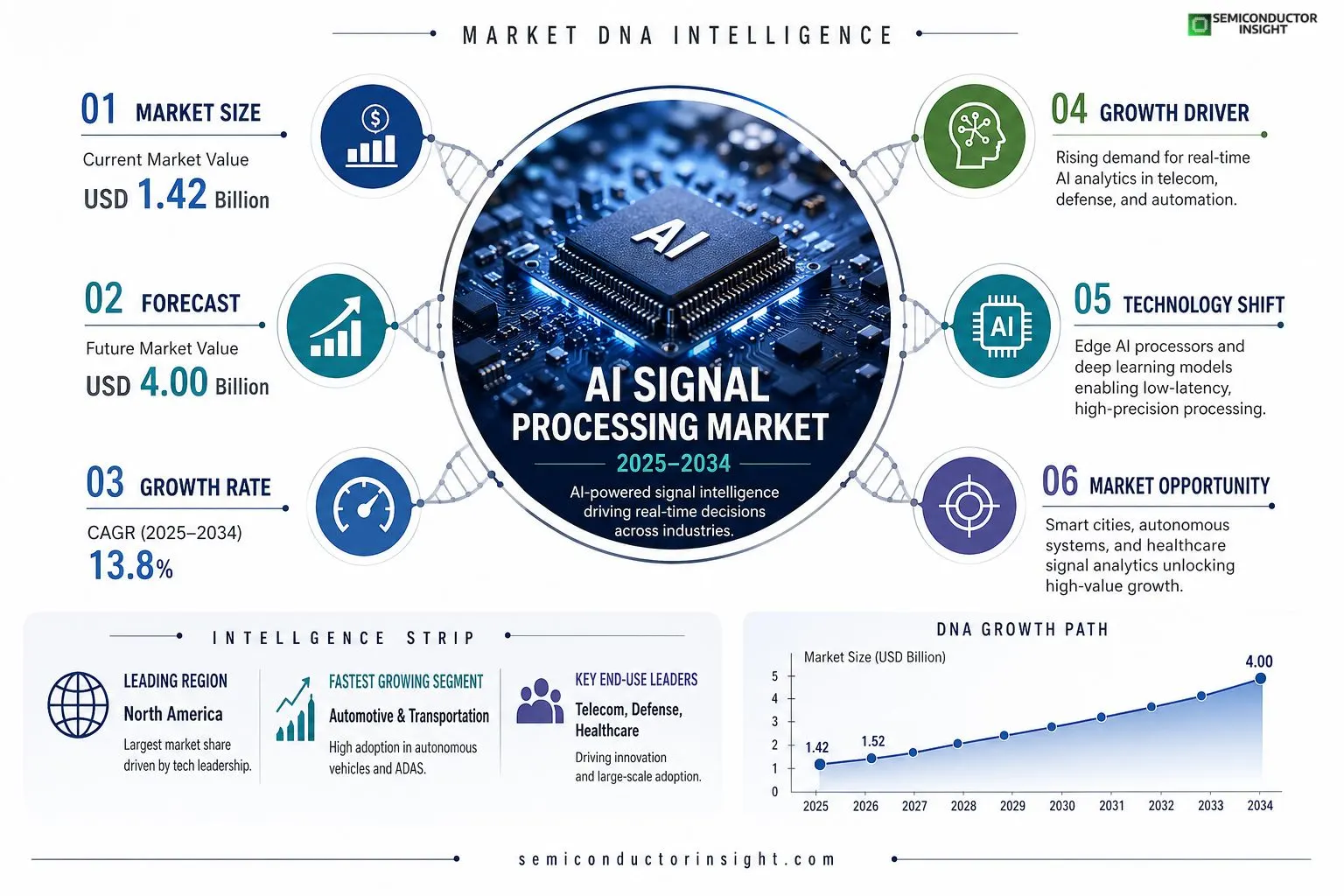
Global AI Signal Processing Market size was valued at USD 1.42 billion in 2025. The market is projected to grow from USD 1.52 billion in 2025 to USD 4 billion by 2034, exhibiting a CAGR of 13.8% during the forecast period.
AI signal processing refers to the application of artificial‑intelligence techniquessuch as deep learning, neural networks, and adaptive filteringto analyze, interpret, and transform raw signals including audio, video, radar, biomedical and sensor data.The market is experiencing rapid growth because investment in AI‑driven analytics continues to surge, demand for autonomous vehicles and smart‑city infrastructure fuels higher‑volume signal handling, and edge‑computing advances enable real‑time processing on constrained devices. Furthermore, leading innovators like NVIDIA Corporation,
Intel Corporation,
Qualcomm Technologies Inc., and MathWorks are expanding their portfolios with dedicated AI signal‑processing toolkits, which further accelerates adoption across industries.
MARKET DRIVERS
Growing Adoption of AI in Real‑Time Signal Analysis
AI Signal Processing Market is benefiting from a rapid shift toward intelligent analytics in telecommunications, defense, and industrial automation. Recent estimates place the market value near USD 6 billion in 2023, with an anticipated compound annual growth rate of roughly 12 % through 2030. Enterprises are deploying AI‑enhanced algorithms to extract actionable insights from high‑frequency data streams, driving demand for sophisticated software platforms and specialized hardware accelerators.
Advancements in Edge Computing and Sensor Fusion
Edge‑enabled AI signal processors now deliver sub‑millisecond latency, enabling real‑time decision‑making in autonomous vehicles and remote monitoring stations. The convergence of sensor fusion techniques with deep learning models is expanding the applicability of AI across domains such as acoustic surveillance, radar imaging, and biomedical signal interpretation. These technological gains are reducing the total cost of ownership and encouraging mid‑size firms to adopt AI‑based solutions.
➤ Deployments of AI‑driven signal pipelines have trimmed processing times by up to 40 % compared with conventional DSP chains, markedly improving operational efficiency.
Overall, the synergy between AI breakthroughs, proliferating edge devices, and the relentless growth of data volumes is establishing a robust foundation for the continued expansion of AI Signal Processing Market.
MARKET CHALLENGES
Technical Complexity and Model Interpretability
Designing AI models that can reliably process noisy, non‑stationary signals remains a significant hurdle. Engineers must balance model depth with explainability, as many regulated sectors require transparent decision pathways. The need for extensive hyper‑parameter tuning and domain‑specific training data inflates development cycles and elevates project risk.
Other Challenges
Data Scarcity and Quality
High‑fidelity labeled datasets for niche signal typessuch as underwater acoustics or low‑power biomedical recordingsare scarce. Organizations often resort to synthetic data generation, which can introduce bias and limit model generalization, thereby slowing market adoption.
MARKET RESTRAINTS
Regulatory Compliance and Privacy Concerns
Stringent data‑privacy regulations, including GDPR and sector‑specific mandates, restrict the collection and cross‑border movement of raw signal datasets. Companies must implement robust anonymization and encryption protocols, which add layers of complexity and cost to AI signal processing deployments.Furthermore, the high upfront investment required for specialized AI accelerators and the scarcity of skilled personnel capable of integrating these solutions act as additional restraints, particularly for small and mid‑market players seeking to enter AI Signal Processing Market.
MARKET OPPORTUNITIES
Expansion into Healthcare and Autonomous Systems
AI‑enhanced signal analysis is poised to transform diagnostic imaging, patient monitoring, and robotic surgery, where precise interpretation of electro‑physiological and acoustic signals can improve outcomes and reduce costs. Parallel growth in autonomous driving platforms creates a demand for ultra‑reliable radar and lidar signal processing pipelines that leverage deep learning for object detection and classification.Integration with emerging 5G and IoT networks also presents a sizable opportunity, as the ultra‑dense connectivity fabric will generate unprecedented volumes of real‑time sensor data. Leveraging AI to filter, aggregate, and analyze this data at the edge will be a key differentiator for vendors in AI Signal Processing Market, unlocking new revenue streams across smart cities, industrial IoT, and beyond.
AI Signal Processing Market Trends
Edge‑AI Signal Processing Expands in Autonomous and Smart‑City Systems
AI Signal Processing Market is being reshaped by an accelerating shift toward on‑device intelligence. Investment in AI‑driven analytics continues to rise as manufacturers of autonomous vehicles and smart‑city infrastructure require ever‑higher‑volume signal handling with minimal latency. Edge‑computing platforms now incorporate dedicated neural‑network accelerators, allowing real‑time audio, video, radar, and sensor streams to be processed locally. This reduces bandwidth consumption and enhances privacy, a critical factor for municipal deployments. Meanwhile, software ecosystems are converging around open standards, enabling developers to port models across heterogeneous hardware with little re‑engineering effort. The combined effect of stronger compute at the edge and streamlined software tooling is driving broader adoption across transportation, public safety, and urban management domains.
Other Trends
Hardware Innovation Accelerates Deployment
Leading innovators such as NVIDIA, Intel, Qualcomm, and MathWorks are expanding their portfolios with purpose‑built AI signal‑processing toolkits and ASICs. These solutions embed adaptive filtering, deep‑learning inference, and low‑power neural engines directly into sensor hubs and communication modules. The availability of pre‑optimized libraries shortens time‑to‑market for OEMs, while modular accelerator cards enable scalable upgrades in data‑center environments. As a result, AI Signal Processing Market benefits from a rapid feedback loop where hardware advances inspire new algorithmic approaches, and vice versa, fostering a vibrant ecosystem that supports both legacy legacy signal chains and next‑generation AI workloads.
Software Framework Standardization Boosts Cross‑Industry Integration
Software frameworks are increasingly standardized around interoperable model formats such as ONNX and TensorFlow Lite, facilitating seamless deployment of AI signal‑processing pipelines across sectors. This harmonization reduces integration overhead for industries ranging from biomedical imaging to defense radar, where precise signal interpretation is mission‑critical. Enhanced debugging and profiling tools now allow engineers to fine‑tune latency and energy consumption, aligning performance with stringent regulatory and safety requirements. Looking ahead, AI Signal Processing Market is poised to experience sustained momentum as emerging use casessuch as immersive augmented‑reality communication and predictive maintenance in manufacturingdemand ever‑more sophisticated real‑time signal analysis. The convergence of hardware capability, open software standards, and sector‑specific demand creates a resilient growth trajectory for the market.
COMPETITIVE LANDSCAPEKey Industry Players
AI Signal Processing Market Competitive Overview
AI Signal Processing Market is led by a handful of technology powerhouses that have integrated deep‑learning toolkits and hardware accelerators into their core offerings. NVIDIA Corporation dominates the high‑performance GPU segment, providing CUDA‑based AI signal‑processing libraries that are widely adopted in autonomous‑vehicle and edge‑computing deployments. Intel Corporation leverages its Xeon and Core processor families together with the oneAPI programming model to deliver scalable solutions for both data‑center and embedded environments. Qualcomm Technologies Inc. focuses on mobile and edge devices, embedding AI‑enhanced audio and vision processing within its Snapdragon platforms. MathWorks complements the hardware ecosystem with MATLAB and Simulink toolboxes that enable rapid prototyping of adaptive filters, neural‑network‑based denoising, and sensor‑fusion algorithms, cementing its role as a critical software partner across industries.Beyond the primary tier, several niche and regionally strong firms contribute specialized capabilities that broaden the market’s depth. IBM’s Watson AI services are being extended to signal analytics for healthcare and industrial IoT, while Texas Instruments offers ultra‑low‑power DSPs with built‑in neural‑network inference for wearable sensors. Xilinx (now part of AMD) provides programmable FPGA fabrics that allow custom AI pipelines for radar and video processing. Analog Devices supplies precision analog front‑ends coupled with machine‑learning‑ready signal chains for biomedical applications. Cadence Design Systems, Keysight Technologies, Siemens, Bosch, Microsoft, and Huawei complete the landscape, delivering end‑to‑end design tools, testing platforms, and AI‑infused signal‑processing modules that serve diverse verticals from smart cities to automotive safety.
List of Key AI Signal Processing Companies Profiled
- NVIDIA Corporation
- Intel Corporation
- Qualcomm Technologies Inc.
- MathWorks
- IBM
- Texas Instruments
- AMD (Xilinx)
- Analog Devices
- Cadence Design Systems
- Keysight Technologies
- Siemens AG
- Bosch Sensortec
- Microsoft Corporation
- Huawei Technologies Co., Ltd.
Segment Analysis:
| Segment Category | Sub-Segments | Key Insights |
| By Type |
|
Deep Learning Based Processing is emerging as the dominant approach because it can uncover highly complex patterns within raw audio, video and sensor streams. Practitioners appreciate its ability to evolve with additional data, delivering continuously refined performance.
|
| By Application |
|
Audio Enhancement drives consumer and enterprise experiences by making speech intelligible even in challenging acoustic conditions. This segment benefits from tight integration with voice assistants and smart‑speaker ecosystems.
|
| By End User |
|
Automotive OEMs are leveraging AI‑enhanced signal pipelines to power next‑generation driver assistance and infotainment systems. Their focus on safety‑critical perception creates a strong demand for robust radar and lidar processing.
|
| By Technology |
|
Edge AI Chips are gaining traction because they allow signal‑intensive workloads to be processed locally, minimizing latency and bandwidth reliance. This technology aligns with the broader shift toward distributed intelligence.
|
| By Deployment |
|
Embedded Systems embed AI‑driven signal algorithms directly into hardware, delivering deterministic performance for mission‑critical workloads. Their adoption is fueled by the need for reliable operation in constrained environments.
|
Regional Analysis: North America
United States
The telecommunications sector is a major consumer of AI signal processing technologies, leveraging them for network optimization, improved call quality, and the development of next-generation communication services.
The automotive industry is integrating AI signal processing for advanced driver-assistance systems (ADAS), autonomous driving capabilities, and enhancing in-vehicle infotainment systems.
AI signal processing plays a vital role in medical imaging analysis, patient monitoring, and the development of personalized healthcare solutions.
The defense and aerospace sectors utilize AI signal processing for radar systems, electronic warfare, and secure communications.
Europe
Europe represents a significant and steadily growing market for AI Signal Processing. The region’s strengths lie in its strong emphasis on data privacy regulations and its commitment to ethical AI development. Key markets like Germany, the UK, and France are leading the adoption of AI signal processing across industries, including automotive, manufacturing, and finance. While the pace of adoption might be slightly more cautious compared to the United States, Europe is witnessing substantial investments in R&D and strategic partnerships. The focus on sustainable technology and the development of low-power AI solutions are particularly prominent. Stringent data protection frameworks, such as GDPR, influence the development and deployment strategies within the European AI signal processing landscape.
Asia-Pacific
Asia-Pacific is poised for the most rapid expansion in AI Signal Processing Market. Countries like China, Japan, and South Korea are investing heavily in AI infrastructure and application development. The burgeoning 5G networks and the proliferation of IoT devices are creating a massive demand for efficient signal processing solutions. China, in particular, is emerging as a dominant player, driven by government support and a vast domestic market. The region’s focus on smart cities, industrial automation, and consumer electronics is fueling the adoption of AI signal processing technologies. However, regulatory complexities and data privacy concerns present challenges to market growth in certain areas.
South America
South America presents a developing market for AI Signal Processing, with increasing adoption driven by the growth of e-commerce, telecommunications investments, and the expansion of the industrial sector. Brazil and Argentina are the key markets within the region, showing growing interest in leveraging AI for data analytics, fraud detection, and customer service applications. While the market size is currently smaller compared to North America and Asia-Pacific, the potential for growth is significant, particularly as connectivity improves and investment in technological infrastructure increases.
Middle East & Africa
The Middle East & Africa region is an emerging market for AI Signal Processing, with growing adoption across sectors like oil and gas, healthcare, and finance. Countries like Saudi Arabia, the UAE, and South Africa are investing in smart city initiatives and digital transformation programs, creating demand for advanced AI solutions. The region’s focus on energy efficiency, infrastructure development, and healthcare advancements is driving the adoption of AI signal processing technologies. While the market is relatively nascent, the long-term growth potential is substantial, fueled by increasing internet penetration and government initiatives to promote technological innovation.
Report Scope
This market research report provides a comprehensive analysis of the AI Signal Processing Market , covering the forecast period 2026–2034. It offers detailed insights into market dynamics, technological advancements, competitive landscape, and key trends shaping the industry.
Key focus areas of the report include:
- Market Overview: The report begins with an overview outlining its current market scenario, key growth indicators, and industry transformation drivers. It discusses macroeconomic factors, demand–supply balance, regulatory landscape, and the strategic role of semiconductors in powering advancements across industries such as automotive, telecommunications, consumer electronics, and industrial automation.
- Market Size & Forecast: Historical data and future projections for revenue, unit shipments, and market value across major regions and segments.
- Segmentation Analysis: Detailed breakdown by product type, technology, application, and end-user industry to identify high-growth segments and investment opportunities.
- Regional Insights: Insights into market performance across North America, Europe, Asia-Pacific, Latin America, and the Middle East & Africa, including country-level analysis where relevant.
- Competitive Landscape: Profiles of leading market participants, including their product offerings, R&D focus, manufacturing capacity, pricing strategies, and recent developments such as mergers, acquisitions, and partnerships.
- Technology Trends & Innovation: Assessment of emerging technologies, integration of AI/IoT, semiconductor design trends, fabrication techniques, and evolving industry standards.
- Market Drivers & Restraints: Evaluation of factors driving market growth along with challenges, supply chain constraints, regulatory issues, and market-entry barriers.
- Stakeholder Insights: Insights for component suppliers, OEMs, system integrators, investors, and policymakers regarding the evolving ecosystem and strategic opportunities.
Primary and secondary research methods are employed, including interviews with industry experts, data from verified sources, and real-time market intelligence to ensure the accuracy and reliability of the insights presented.
FREQUENTLY ASKED QUESTIONS:
What is the current market size of AI Signal Processing Market?
-> AI Signal Processing Market was valued at USD 1,420 million in 2025 and is expected to reach USD 4,000 million by 2034.
Which key companies operate in AI Signal Processing Market?
-> Key players include NVIDIA Corporation, Intel Corporation, Qualcomm Technologies Inc., and MathWorks.
What are the key growth drivers?
-> Key growth drivers include increasing investment in AI‑driven analytics, rising demand for autonomous vehicles and smart‑city infrastructure, and advances in edge‑computing that enable real‑time signal processing.
Which region dominates the market?
-> North America remains the dominant market, while Asia‑Pacific is emerging as a fast‑growing region.
What are the emerging trends?
-> Emerging trends include development of dedicated AI signal‑processing toolkits, integration of AI with edge devices, and real‑time processing of multimodal sensor data.

Get Sample Report PDF for Exclusive Insights
Report Sample Includes
- Table of Contents
- List of Tables & Figures
- Charts, Research Methodology, and more...