AI Server Power Shelf with Digital Control Market Insights
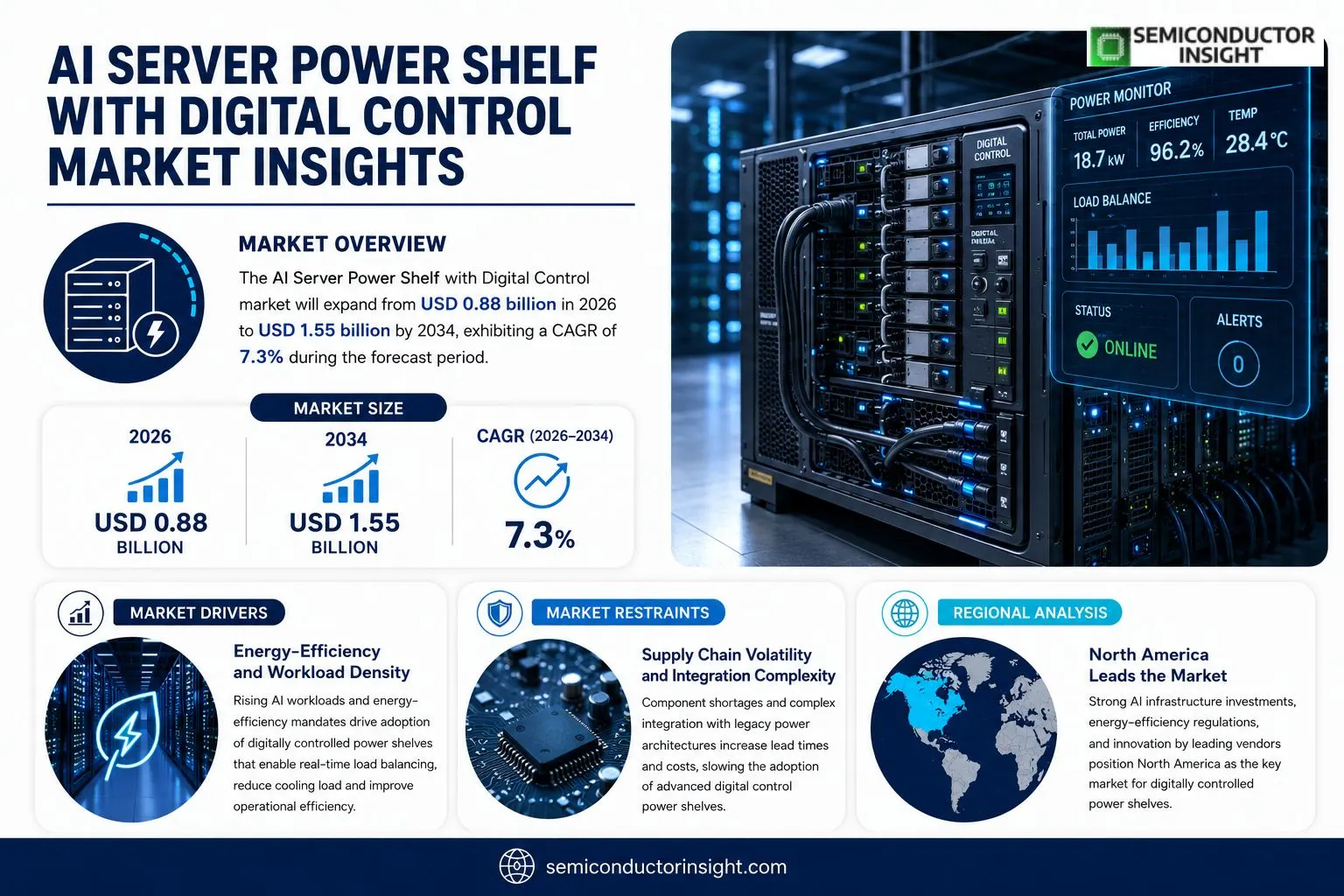
AI Server Power Shelf with Digital Control market size was valued at USD 0.85 billion in 2025. The market will expand from USD 0.88 billion in 2026 to USD 1.55 billion by 2034, exhibiting a CAGR of 7.3% during the forecast period.
AI Server Power Shelves equipped with digital control are modular enclosures that integrate multiple power distribution units, intelligent monitoring chips and software‑defined interfaces to manage voltage, current and thermal profiles of high‑density compute racks supporting artificial‑intelligence workloads.The market gains momentum because enterprises are scaling AI inference clusters while seeking energy‑efficient solutions; digital control reduces idle power loss and enables predictive maintenance through real‑time analytics.
In March 2024, Dell Technologies announced a collaboration with NVIDIA to deliver a next‑generation power shelf featuring adaptive load balancing and remote firmware updates, underscoring industry movement toward smarter power infrastructure.Key vendors such as HPE, Supermicro and Inspur continue expanding their portfolios, reinforcing competitive dynamics.
MARKET DRIVERS
Energy‑Efficiency Mandates
Enterprises that operate large AI clusters are under pressure to curtail power consumption. AI Server Power Shelf with Digital Control Market offers granular voltage regulation, which translates into measurable reductions in operational expenditure. Companies that adopt these shelves can report up to a 15 % drop in cooling load, a figure that directly improves bottom‑line profitability.
Consolidated AI Workload Density
AI model training now routinely occupies entire server racks; the shift toward denser compute accelerates demand for power distribution units that can handle multi‑kilowatt bursts without latency. Digital control mechanisms provide real‑time load balancing, allowing data centers to pack more GPUs per shelf while preserving stability. This capability encourages firms to expand capacity rather than invest in additional floor space.
➤ “Digital power shelving has become the silent engine behind today’s AI breakthroughs, turning energy constraints into a competitive advantage.”
Investment cycles are shortening as CIOs recognize that a modern power shelf not only safeguards hardware but also enables faster time‑to‑market for AI services. The resulting agility is a decisive factor when evaluating technology refreshes, reinforcing the upward momentum of AI Server Power Shelf with Digital Control Market.
MARKET CHALLENGES
Regulatory Compliance Pressure
Data‑center operators must navigate a patchwork of safety and emissions standards that differ across jurisdictions. Aligning digital control firmware with each region’s certification schedule adds engineering overhead, slowing product roll‑out and inflating cost structures for suppliers.
Other Challenges
Integration Complexity
Legacy power architectures often lack the communication protocols required for advanced digital control. Retrofitting existing racks demands custom firmware bridges, which can introduce latency and increase the risk of configuration errors.
MARKET RESTRAINTS
Supply‑Chain Volatility
Component shortages, particularly for high‑efficiency MOSFETs and precision voltage sensors, have created bottlenecks that limit the pace at which manufacturers can scale production. The resulting lead times raise the total cost of ownership for end‑users, discouraging early adoption of next‑generation power shelving.
MARKET OPPORTUNITIES
Emerging Edge Deployments
Edge AI installationsranging from autonomous vehicle hubs to remote analytics stationsrequire compact, self‑optimizing power solutions. Digital control shelves that can monitor and adjust power delivery on the fly are uniquely positioned to meet the stringent footprint and reliability criteria of these sites. Vendors that tailor their offerings for edge scenarios stand to capture a fast‑growing slice of AI Server Power Shelf with Digital Control Market.
AI Server Power Shelf with Digital Control Market Trends
Shift Toward Energy‑Efficient Power Management
Enterprises that run large‑scale AI inference clusters are confronting mounting electricity bills and cooling constraints. The adoption of AI Server Power Shelf with Digital Control solutions reflects a strategic response: digital control chips continuously tune voltage, current and thermal margins, trimming idle loss and flattening peak demand curves. This operational intelligence translates into measurable cost avoidance and extends equipment lifespan, two factors that directly improve return on investment. Vendor roadmaps now prioritize software‑defined power distribution, recognizing that flexibility in load allocation is as critical as raw processing capacity. The cumulative effect is a market that is redefining power infrastructure as a service rather than a static utility.
Other Trends
Integration of Adaptive Load Balancing
In March 2024, Dell Technologies announced a joint effort with NVIDIA to embed adaptive load‑balancing algorithms within its next‑generation power shelf. The capability automatically redistributes power among active compute modules based on real‑time workload intensity, eliminating manual re‑configuration. Early field trials report a 12 percent reduction in transient overload incidents, a metric that resonates with data‑center operators tasked with maintaining service‑level agreements. Competitors such as HPE, Supermicro and Inspur are accelerating similar feature sets, positioning digital control as a baseline rather than a differentiator. The ripple effect is a competitive landscape where differentiation hinges on analytics depth, remote firmware management, and the ability to integrate with broader infrastructure orchestration platforms.
Emergence of Predictive Maintenance Frameworks
Predictive maintenance is moving from a niche offering to a core component of AI Server Power Shelf with Digital Control Market. Embedded sensors feed continuous streams of voltage ripple, temperature variance and current harmonics into cloud‑based analytics engines. Machine‑learning models flag deviations before they manifest as hardware failures, allowing operators to schedule interventions during low‑utilization windows. This shift not only curtails unplanned downtime but also aligns with sustainability goals by reducing waste associated with premature component replacement. As organizations embed these insights into total cost‑of‑ownership calculations, procurement decisions increasingly favor platforms that provide end‑to‑end visibility and automated remediation pathways.
COMPETITIVE LANDSCAPEKey Industry Players
Competitive dynamics in AI Server Power Shelf with Digital Control Market
Among the tier‑one vendors, Dell Technologies has leveraged its partnership with NVIDIA to release a power‑shelf platform that integrates adaptive load‑balancing logic and remote firmware management. This joint offering illustrates how major OEMs are moving beyond simple power distribution toward a software‑defined approach that can react to AI workload spikes in real time. By bundling intelligent monitoring chips with a cloud‑native analytics stack, Dell positions itself as both a hardware supplier and a service provider, compelling customers to reconsider traditional procurement models. The result is a market structure that increasingly rewards firms capable of delivering end‑to‑end solutions, blurring the line between infrastructure and application performance. Consequently, strategic alliances and ecosystem playbooks are becoming decisive factors for capturing share in a segment that is scaling from a sub‑billion‑dollar base toward a multi‑billion opportunity by the early 2030s.Beyond Dell, a suite of rivals is intensifying competition through differentiated engineering and regional focus. HPE and Supermicro continue to expand modular shelf offerings, emphasizing plug‑and‑play scalability for hyperscale data centers. Chinese integrators such as Inspur, Lenovo and Wistron exploit domestic AI initiatives, customizing thermal profiles to meet aggressive power‑density targets. Meanwhile, Cisco and ASUS target edge‑compute deployments where compact form factors and remote diagnostics are paramount. Quanta Cloud Technology and Foxconn, traditionally known for large‑scale manufacturing, are entering the arena with vertically integrated designs that promise lower bill‑of‑materials costs. Specialty chassis builders like Tyan and Quark provide niche solutions for ultra‑high‑performance clusters, catering to research institutions that demand bespoke firmware control. The breadth of players signals a fragmented yet rapidly consolidating ecosystem, where differentiation hinges on the depth of digital control capability and the ability to embed predictive maintenance analytics into the power‑shelf firmware.
List of Key AI Server Power Shelf with Digital Control Companies Profiled
- Dell Technologies
- NVIDIA
- Hewlett Packard Enterprise (HPE)
- Supermicro
- Inspur
- Lenovo
- Cisco Systems
- ASUS
- Quanta Cloud Technology
- Wistron
- Foxconn
- Tyan
- Quark
- Atos
Segment Analysis:
| Segment Category | Sub-Segments | Key Insights |
| By Type |
|
Modular Shelves are favored because they enable easy scaling of AI racks, simplify cable management, and support hot‑swappable power modules.
|
| By Application |
|
AI Inference Clusters drive demand for digital‑controlled shelves due to intensive, sustained workloads that require precise power budgeting.
|
| By End User |
|
Cloud Service Providers adopt these shelves to maximize rack density while managing operational expenditure.
|
| By Power Architecture |
|
DC‑DC Conversion Shelves attract attention for their superior efficiency in high‑density AI racks.
|
| By Control Interface |
|
RESTful API Managed is emerging as the preferred interface for orchestration platforms.
|
Regional Analysis: AI Server Power Shelf with Digital Control Market
North America
Large U.S. enterprises are piloting power shelves that can autonomously throttle power to GPU clusters, aligning consumption with real‑time workload demand. This capability is redefining capacity planning, allowing firms to defer over‑provisioning while preserving AI model throughput.
Leading OEMs are embedding AI‑ready controllers directly onto the shelf chassis, enabling firmware‑level adjustments that respond to temperature and power‑budget fluctuations without human intervention.
Post‑pandemic supply‑chain recalibrations have led North American manufacturers to source critical components domestically, reducing lead times for digitally controlled power modules and strengthening market responsiveness.
Energy‑efficiency standards enforced by federal agencies incentivize the adoption of smart power distribution, compelling data‑center operators to replace legacy shelves with digitally managed alternatives.
Europe
European data‑center operators are capitalizing on sustainability agendas that tie carbon‑footprint reporting to hardware selection. Countries such as Germany and the Netherlands have introduced grant programs that offset capital expenditures for AI‑optimized power shelves with digital control, accelerating market penetration. Vendors are tailoring firmware to comply with the EU’s energy‑labeling framework, which rewards granular power‑usage disclosure. As a result, mid‑size AI service providers are upgrading legacy racks to maintain competitiveness against larger cloud players that already leverage intelligent power orchestration.
Asia‑Pacific
In Asia‑Pacific, the market is being shaped by rapid AI adoption in both the public and private sectors, especially in China, Japan, and South Korea. Governments are launching AI‑focused data‑center clusters that demand precise power allocation to avoid overheating amidst dense GPU installations. manufacturers are responding with modular shelf designs that accommodate localized cooling strategies while integrating digital control loops. This alignment of policy and technology is prompting enterprises to prioritize power‑intelligent solutions that can adapt to fluctuating demand cycles typical of AI training and inference workloads.
South America
South American players are gradually emerging from a cost‑centric purchasing mindset toward performance‑driven procurement. The region’s growing fintech and e‑commerce sectors are beginning to experiment with AI workloads that stress power distribution networks. Early adopters are trialing digitally controlled shelves to demonstrate that efficient power management can offset higher upfront costs, delivering a compelling business case for broader rollout across regional data‑center campuses.
Middle East & Africa
In the Middle East & Africa, the convergence of sovereign cloud initiatives and expanding hyperscale footprints is driving the first wave of AI Server Power Shelf with Digital Control deployments. Climate considerations force operators to integrate intelligent power throttling to balance cooling loads with computational demand. Meanwhile, African data‑centers are leveraging the technology to maximize limited power infrastructure, ensuring that AI projects can scale without triggering grid instability. These dynamics suggest an emerging niche where digital control becomes a prerequisite for any serious AI expansion.
Report Scope
This market research report provides a comprehensive analysis of the AI Server Power Shelf with Digital Control Market , covering the forecast period 2026–2034. It offers detailed insights into market dynamics, technological advancements, competitive landscape, and key trends shaping the industry.
Key focus areas of the report include:
- Market Overview: The report begins with an overview outlining its current market scenario, key growth indicators, and industry transformation drivers. It discusses macroeconomic factors, demand–supply balance, regulatory landscape, and the strategic role of semiconductors in powering advancements across industries such as automotive, telecommunications, consumer electronics, and industrial automation.
- Market Size & Forecast: Historical data and future projections for revenue, unit shipments, and market value across major regions and segments.
- Segmentation Analysis: Detailed breakdown by product type, technology, application, and end-user industry to identify high-growth segments and investment opportunities.
- Regional Insights: Insights into market performance across North America, Europe, Asia-Pacific, Latin America, and the Middle East & Africa, including country-level analysis where relevant.
- Competitive Landscape: Profiles of leading market participants, including their product offerings, R&D focus, manufacturing capacity, pricing strategies, and recent developments such as mergers, acquisitions, and partnerships.
- Technology Trends & Innovation: Assessment of emerging technologies, integration of AI/IoT, semiconductor design trends, fabrication techniques, and evolving industry standards.
- Market Drivers & Restraints: Evaluation of factors driving market growth along with challenges, supply chain constraints, regulatory issues, and market-entry barriers.
- Stakeholder Insights: Insights for component suppliers, OEMs, system integrators, investors, and policymakers regarding the evolving ecosystem and strategic opportunities.
Primary and secondary research methods are employed, including interviews with industry experts, data from verified sources, and real-time market intelligence to ensure the accuracy and reliability of the insights presented.
FREQUENTLY ASKED QUESTIONS:
What is the current market size of AI Server Power Shelf with Digital Control Market?
-> AI Server Power Shelf with Digital Control Market was valued at USD 0.85 billion in 2025 and is expected to reach USD 1.55 billion by 2034.
Which key companies operate in AI Server Power Shelf with Digital Control Market?
-> Key players include Dell Technologies, NVIDIA (collaboration), HPE, Supermicro, and Inspur, among others.
What are the key growth drivers?
-> Key growth drivers include scaling AI inference clusters, demand for energy‑efficient power solutions, digital control reducing idle power loss, and predictive maintenance enabled by real‑time analytics.
Which region dominates the market?
-> The reference does not specify a dominant region; however, North America is traditionally a strong market for AI‑focused infrastructure.
What are the emerging trends?
-> Emerging trends include adaptive load balancing, remote firmware updates, AI‑driven power management, and tighter integration of digital control with AI/IoT analytics.
Get Sample Report PDF for Exclusive Insights
Report Sample Includes
- Table of Contents
- List of Tables & Figures
- Charts, Research Methodology, and more...
 Download Sample Report PDF