AI Server Liquid Cooling Electronics Market Insights
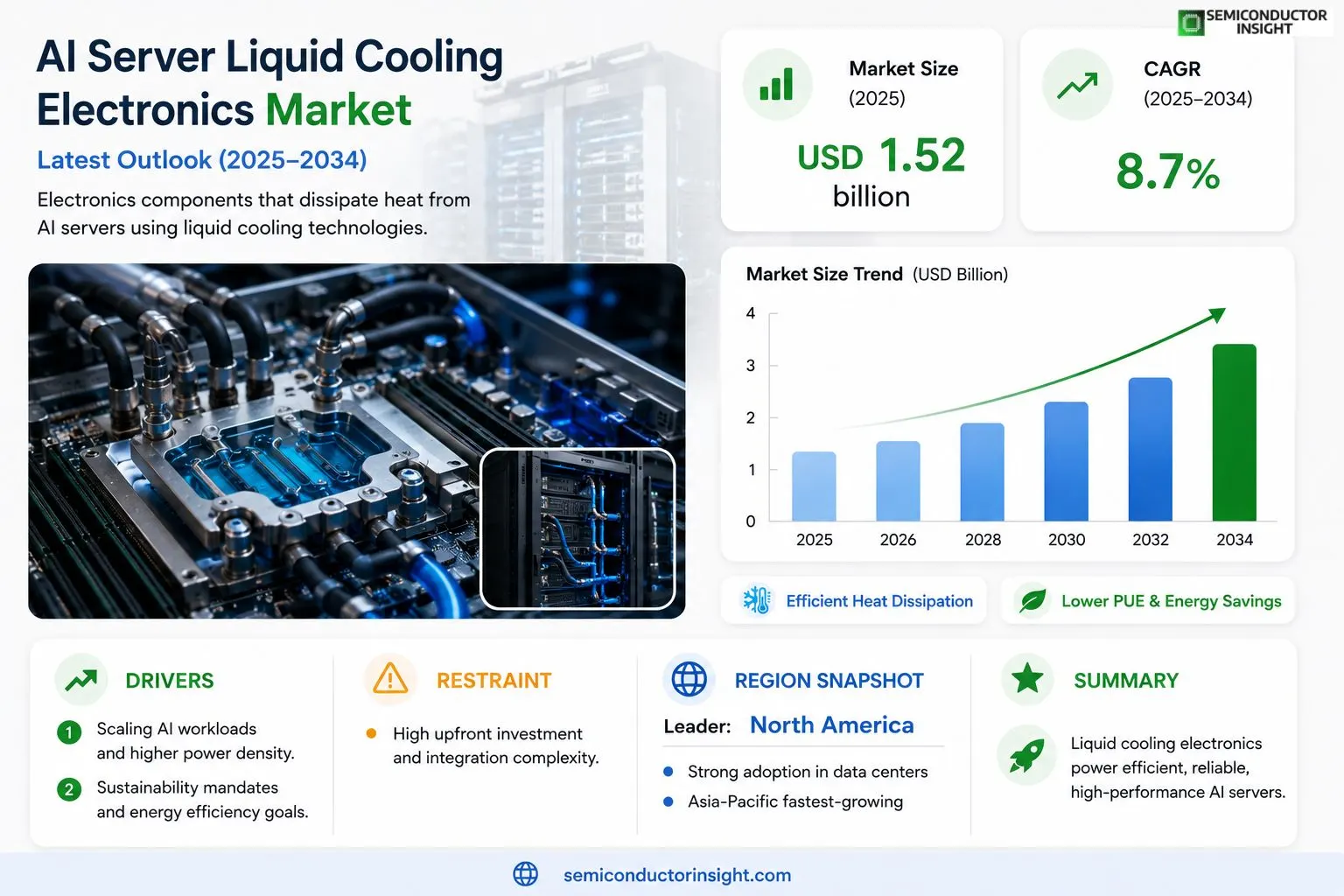
Global AI server liquid cooling electronics market size was valued at USD 1.52 billion in 2025. The market is projected to grow from USD 1.58 billion in 2025 to USD 3.24 billion by 2034, exhibiting a CAGR of 8.7% during the forecast period.
AI server liquid cooling electronics comprise specialized componentssuch as cold plates, high‑efficiency pumps, dielectric fluids, and integrated heat exchangersdesigned to dissipate the intense thermal loads generated by AI accelerators and GPUs within data‑center servers.The market is experiencing rapid growth because enterprises are scaling AI workloads that demand higher power densities while seeking energy‑efficient solutions; however, traditional air‑cooling faces limitations in heat removal capacity. Furthermore, rising sustainability mandates drive adoption of liquid‑cooling technologies that reduce overall PUE (Power Usage Effectiveness). Key players such as CoolIT Systems, Asetek, Dell Technologies, and Nvidia are expanding their portfolios; for instance, in March 2024 Nvidia announced a strategic partnership with CoolIT Systems to co‑develop next‑generation immersion cooling modules for hyperscale AI clusters.
MARKET DRIVERS
Rising AI Workload Demands
The exponential growth of generative AI models has pushed data centers to seek higher compute density, making traditional air‑cooling insufficient. Companies are therefore investing heavily in liquid‑cooled platforms to sustain performance while preventing thermal throttling. This shift directly fuels the expansion of AI Server Liquid Cooling Electronics Market.
Energy‑Efficiency Regulations
Governments worldwide are tightening power‑usage standards for large‑scale computing facilities. Liquid‑cooling solutions can reduce overall PUE (Power Usage Effectiveness) by up to 15 %, helping operators meet compliance while lowering operating costs. The regulatory push acts as a strong catalyst for market adoption.
➤ “Adopting direct‑to‑chip cooling can cut server inlet temperature by 30 °C, extending hardware lifespan and reducing total cost of ownership.”
In addition, major cloud providers have publicly announced multi‑year roadmaps that prioritize liquid‑cooled AI racks, signaling long‑term demand and encouraging ecosystem partners to develop compatible electronics.
MARKET CHALLENGES
High Capital Expenditure
Deploying liquid‑cooling infrastructure requires significant upfront investment in sealed loops, pumps, and specialty coolant, which can deter smaller data‑center operators. The payback period often exceeds three years, creating budgetary constraints for rapid rollout.
Other Challenges
Integration Complexity
Designing server boards that accommodate cold plates and coolant channels demands close collaboration between silicon, PCB, and mechanical engineers. Misalignment can lead to leaks or reduced thermal performance, increasing warranty risk.
MARKET RESTRAINTS
Supply‑Chain Vulnerabilities
Globally, the production of high‑precision pumps and specialty polymers is concentrated in a limited number of manufacturers. Disruptions in these supply chains can delay server deployments and raise component costs.
Limited Skilled Workforce
Effective installation and maintenance of liquid‑cooled systems require technicians with niche training. The current talent pool is insufficient to meet the accelerating deployment schedules, slowing market penetration.Furthermore, legacy data‑center designs that rely on raised‑floor airflow are not easily retrofitted, imposing additional retrofitting costs that restrain broader adoption.
MARKET OPPORTUNITIES
Modular Liquid‑Cooling Platforms
Emerging modular cooling kits allow operators to upgrade existing racks without major overhauls. These plug‑and‑play solutions lower entry barriers and create a fast‑growing segment within AI Server Liquid Cooling Electronics Market.
AI‑Optimized Thermal Management Software
Advanced AI algorithms that dynamically balance coolant flow based on real‑time workload patterns are gaining traction. Such software enhances efficiency, offering a differentiated value proposition for hardware vendors.Finally, sustainability initiatives driven by ESG goals are encouraging data‑center owners to adopt greener cooling technologies, opening new revenue streams for manufacturers of low‑global‑warming‑potential fluids and compliant components.
AI Server Liquid Cooling Electronics Market Trends
Rising Adoption of Immersion Cooling
AI Server Liquid Cooling Electronics Market is witnessing accelerated deployment of immersion cooling solutions as data‑center operators seek to manage the thermal envelope of high‑performance AI accelerators. Immersion eliminates air‑to‑liquid heat transfer steps, allowing power densities beyond 500 W per rack unit while maintaining component reliability. Operators report measurable reductions in cooling‑related energy consumption, with several hyperscale facilities achieving sub‑1.2 PUE values after retrofitting existing servers with dielectric fluid‑based systems. This shift is driven by the need to sustain AI model training workloads that increasingly exceed the limits of conventional air‑cooled designs.
Other Trends
Energy Efficiency and PUE Optimization
Energy efficiency remains a core focus within AI Server Liquid Cooling Electronics Market. By directly contacting heat‑generating components, liquid cooling reduces the temperature differential required for heat rejection, which in turn lowers fan speeds and compressor loads. Real‑world deployments indicate that overall facility energy demand can drop by 15‑25 % compared with legacy air‑cooling configurations. In addition, the use of low‑global‑warming‑potential dielectric fluids supports corporate sustainability targets, aligning cooling strategy with broader ESG commitments.
Strategic Alliances Driving Innovation
Collaboration between hardware vendors and cooling specialists is shaping the competitive landscape. Recent announcements highlight joint development programs that integrate custom cold‑plate designs with next‑generation GPU architectures, enabling tighter thermal coupling and higher sustained clock rates. These partnerships also streamline supply chains, offering pre‑validated cooling modules that reduce time‑to‑market for AI‑focused servers. As a result, customers benefit from reduced integration risk and clearer ROI calculations for large‑scale AI deployments.
COMPETITIVE LANDSCAPEKey Industry Players
AI Server Liquid Cooling Electronics – Competitive Overview
AI server liquid‑cooling electronics market is anchored by a handful of large‑scale innovators that command the majority of revenue in 2025. CoolIT Systems and Asetek continue to lead the cold‑plate and immersion‑cooling segments, leveraging deep R&D investments and strategic OEM partnerships. Nvidia’s recent alliance with CoolIT Systems to co‑develop immersion modules for hyperscale AI clusters underscores the convergence of GPU manufacturers and specialized cooling firms, reinforcing a market structure where vertical integration is becoming a key differentiator. Dell Technologies and Hewlett‑Packard Enterprise (HPE) integrate these cooling solutions into their server portfolios, offering turnkey AI‑optimized data‑center racks that accelerate adoption across cloud providers. The combined influence of these players shapes a competitive environment characterized by high entry barriers, extensive IP portfolios, and a focus on energy‑efficiency metrics such as Power Usage Effectiveness (PUE).Beyond the dominant tier, a diverse set of niche and regionally focused companies enriches the ecosystem. Companies such as IBM, Huawei, and Siemens are expanding their liquid‑cooling offerings to support AI workloads in enterprise and telecom environments. Emerging specialists like LiquidStack, Submer, and Corsair provide modular immersion‑cooling platforms tailored for start‑ups and mid‑size data centers. Additional contributors, including Amphenol, Delta Electronics, Fujikura, and Thermacore, supply critical componentshigh‑efficiency pumps, dielectric fluids, and heat exchangersthat enable system‑level integration. These players differentiate through bespoke engineering, cost‑effective designs, and strategic alliances with server manufacturers, driving incremental innovation that complements the broader market trajectory.
List of Key AI Server Liquid Cooling Electronics Companies Profiled
- CoolIT Systems
- Asetek
- Nvidia
- Dell Technologies
- Hewlett‑Packard Enterprise
- IBM
- Huawei
- Siemens
- LiquidStack
- Submer
- Corsair
- Amphenol
- Delta Electronics
- Fujikura
- Thermacore
Segment Analysis:
| Segment Category | Sub-Segments | Key Insights |
| By Type |
|
Cold plates dominate the type‑based landscape because they align closely with existing server architectures while delivering superior heat removal.
|
| By Application |
|
Cloud AI services emerge as the primary application driver, propelled by massive model training workloads and the need for continuous uptime.
|
| By End User |
|
Data‑center operators lead the end‑user segment, driven by the imperative to host ever larger AI workloads while maintaining operational efficiency.
|
| By Cooling Technology |
|
Direct‑to‑chip liquid cooling is the most influential technology, offering the highest thermal transfer efficiency for AI accelerators.
|
| By Deployment Scale |
|
Hyperscale data centers dominate the deployment‑scale segment owing to their massive AI compute footprints and the need for energy‑efficient cooling at scale.
|
Regional Analysis: North America
United States
The primary driver for AI server liquid cooling in the US is the rapid expansion of AI applications in various sectors, including machine learning, deep learning, and data analytics. The need for sustained high performance under demanding workloads necessitates efficient cooling solutions.
Continuous advancements in liquid cooling technologies, such as direct-to-chip cooling and immersion cooling, are gaining traction in the US market. These innovations offer superior heat dissipation capabilities compared to traditional air cooling.
Government funding and initiatives supporting AI research and development in the US are further contributing to the growth of the AI server liquid cooling market.
The ongoing expansion of data center infrastructure across the US, driven by cloud adoption and digital transformation, is creating a substantial demand for advanced cooling solutions for AI servers.
North America
The North American region encompasses the United States and Canada, presenting a significant market for AI server liquid cooling electronics. The concentration of major technology hubs and the high adoption rate of advanced computing technologies contribute to this region’s dominance. The substantial investments in artificial intelligence research and development across North America fuel the demand for efficient cooling solutions capable of handling the heat generated by high-performance AI processors. Business strategies in this region often involve partnerships with leading hardware manufacturers and cloud service providers to offer comprehensive AI infrastructure solutions. The emphasis on energy efficiency and sustainability is also shaping the market, with a growing preference for liquid cooling technologies that minimize power consumption. The Canadian market, while smaller than the US, also exhibits considerable growth potential, particularly within the rapidly expanding AI sector in cities like Toronto and Vancouver.
Europe
Europe represents the second-largest market for AI server liquid cooling electronics, characterized by a strong emphasis on data privacy and security. The region’s robust industrial base and increasing adoption of cloud computing are driving demand for advanced cooling solutions. Business strategies in Europe often focus on providing customized cooling solutions tailored to the specific needs of European data centers and research institutions. The regulatory environment, particularly GDPR, influences data center design and cooling strategies, emphasizing energy efficiency and data protection. The increasing focus on sustainable data center operations is also a key driver, with liquid cooling playing a vital role in reducing energy consumption and environmental impact. Key markets within Europe include the United Kingdom, Germany, and France, each with its unique set of technological and industrial strengths.
Asia-Pacific
The Asia-Pacific region is experiencing rapid growth in AI Server Liquid Cooling Electronics Market, driven by the burgeoning AI industry in countries like China, Japan, and South Korea. The region’s massive data center expansion and increasing adoption of cloud services are creating substantial demand for efficient cooling solutions. Business strategies in Asia-Pacific often involve localized manufacturing and partnerships with regional technology providers. The government support for AI development and the growing investments in high-performance computing are further boosting the market. The energy efficiency concerns and the need for reliable cooling in densely populated areas are also driving the adoption of advanced liquid cooling technologies. India and Southeast Asian nations present significant future growth opportunities within this dynamic market.
South America
South America presents a relatively nascent market for AI server liquid cooling electronics, but with promising growth potential. The increasing adoption of cloud services and the expansion of data centers in countries like Brazil and Argentina are creating a foundation for market development. Business strategies in the region often focus on providing cost-effective cooling solutions tailored to the specific needs of emerging AI applications. The energy infrastructure challenges and the need for reliable power supply in some parts of the continent pose certain hurdles, but the long-term outlook remains positive. The growing interest in AI and data analytics across various industries is expected to drive further demand for advanced cooling technologies in the coming years.
Middle East & Africa
The Middle East and Africa represent a developing market for AI server liquid cooling electronics, with significant potential for future growth. The increasing investments in data centers and the growing adoption of AI technologies in countries like Saudi Arabia, UAE, and South Africa are creating demand for advanced cooling solutions. Business strategies in the region often involve partnerships with global technology providers and a focus on providing customized solutions for the hyper-cooling needs of AI infrastructure. The hot and arid climate of many countries in the region necessitates highly efficient cooling systems, making liquid cooling a particularly attractive option. Government initiatives promoting technological advancement and digital transformation are also expected to fuel market expansion in the coming years.
Report Scope
This market research report provides a comprehensive analysis of the AI Server Liquid Cooling Electronics Market , covering the forecast period 2026–2034. It offers detailed insights into market dynamics, technological advancements, competitive landscape, and key trends shaping the industry.
Key focus areas of the report include:
- Market Overview: The report begins with an overview outlining its current market scenario, key growth indicators, and industry transformation drivers. It discusses macroeconomic factors, demand–supply balance, regulatory landscape, and the strategic role of semiconductors in powering advancements across industries such as automotive, telecommunications, consumer electronics, and industrial automation.
- Market Size & Forecast: Historical data and future projections for revenue, unit shipments, and market value across major regions and segments.
- Segmentation Analysis: Detailed breakdown by product type, technology, application, and end-user industry to identify high-growth segments and investment opportunities.
- Regional Insights: Insights into market performance across North America, Europe, Asia-Pacific, Latin America, and the Middle East & Africa, including country-level analysis where relevant.
- Competitive Landscape: Profiles of leading market participants, including their product offerings, R&D focus, manufacturing capacity, pricing strategies, and recent developments such as mergers, acquisitions, and partnerships.
- Technology Trends & Innovation: Assessment of emerging technologies, integration of AI/IoT, semiconductor design trends, fabrication techniques, and evolving industry standards.
- Market Drivers & Restraints: Evaluation of factors driving market growth along with challenges, supply chain constraints, regulatory issues, and market-entry barriers.
- Stakeholder Insights: Insights for component suppliers, OEMs, system integrators, investors, and policymakers regarding the evolving ecosystem and strategic opportunities.
Primary and secondary research methods are employed, including interviews with industry experts, data from verified sources, and real-time market intelligence to ensure the accuracy and reliability of the insights presented.
FREQUENTLY ASKED QUESTIONS:
What is the current market size of AI Server Liquid Cooling Electronics Market?
-> AI Server Liquid Cooling Electronics Market was valued at USD 1.52 billion in 2025 and is expected to reach USD 3.24 billion by 2034 with a CAGR of 8.7%.
Which key companies operate in AI Server Liquid Cooling Electronics Market?
-> Key players include CoolIT Systems, Asetek, Dell Technologies, and Nvidia, among others.
What are the key growth drivers?
-> Key growth drivers include scaling AI workloads, higher power density demands, and sustainability mandates driving energy‑efficient liquid‑cooling adoption.
Which region dominates the market?
-> North America shows strong adoption, while Asia-Pacific is emerging as a fast‑growing region.
What are the emerging trends?
-> Emerging trends include immersion cooling solutions, advanced dielectric fluids, and integrated heat‑exchanger modules for hyperscale AI clusters.
Get Sample Report PDF for Exclusive Insights
Report Sample Includes
- Table of Contents
- List of Tables & Figures
- Charts, Research Methodology, and more...
 Download Sample Report PDF