
AI Sensors Market Insights
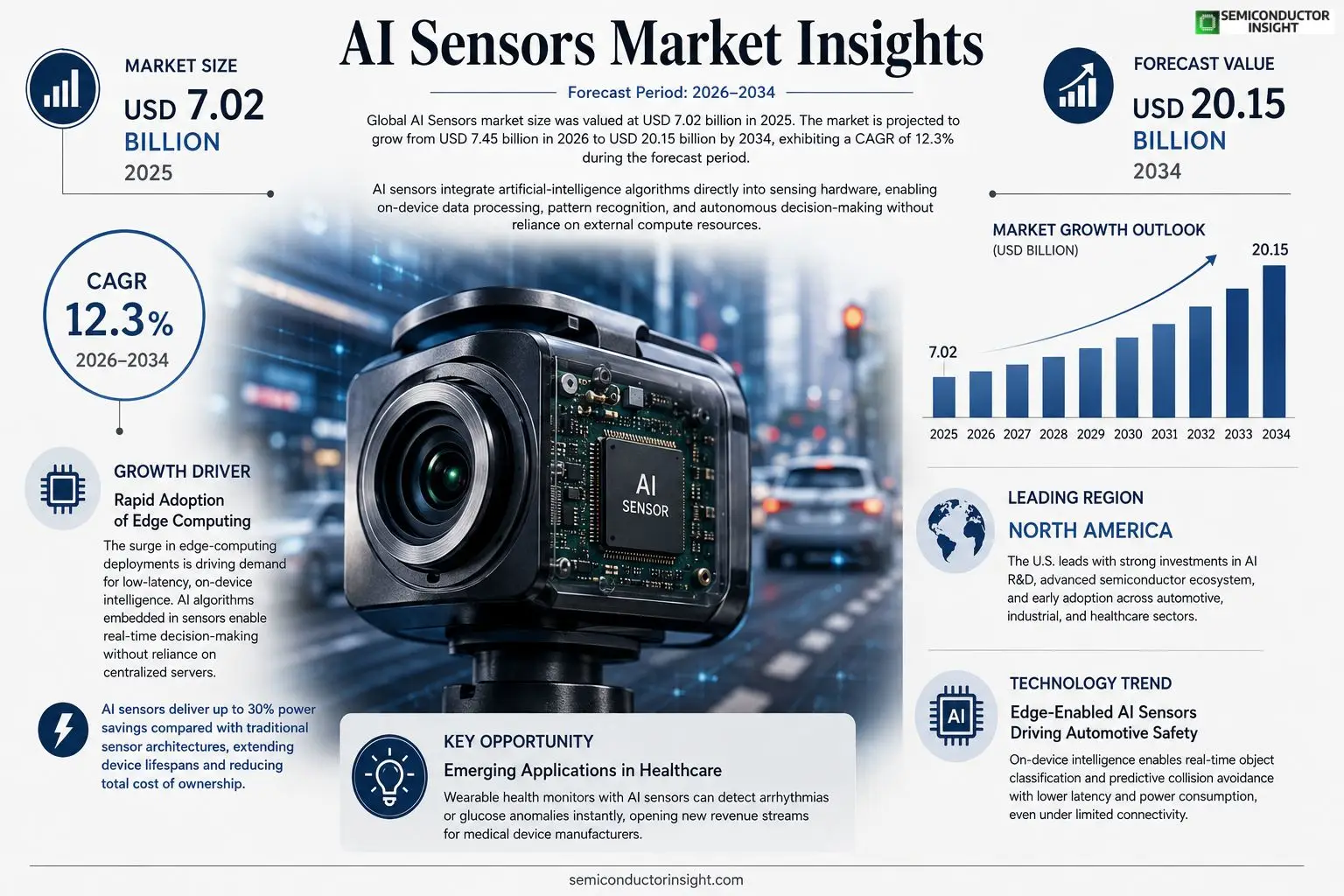
Global AI Sensors market size was valued at USD 7.02 billion in 2025. The market is projected to grow from USD 7.45 billion in 2026 to USD 20.15 billion by 2034, exhibiting a CAGR of 12.3% during the forecast period.
AI sensors integrate artificial‑intelligence algorithms directly into sensing hardware, enabling on‑device data processing, pattern recognition, and autonomous decision‑making without reliance on external compute resources.The market is experiencing rapid expansion because demand for edge‑computing solutions in automotive safety, industrial automation, and smart‑city infrastructure is surging. Furthermore, advances in low‑power neural‑network chips and increased investment from semiconductor leaders such as Bosch, Texas Instruments, and STMicroelectronics are accelerating adoption. For example, in March 2024 Bosch announced a strategic partnership with NVIDIA to co‑develop next‑generation AI‑enabled perception sensors for autonomous vehicles.
MARKET DRIVERS
Rapid Adoption of Edge Computing
AI Sensors Market is being propelled by the surge in edge‑computing deployments, which require low‑latency, on‑device intelligence. Manufacturers are embedding AI algorithms directly into sensors, enabling real‑time decision‑making without reliance on centralized servers.
Growth of Autonomous Systems
Industries such as automotive, robotics, and logistics are integrating AI‑enabled sensors to improve safety and efficiency. For example, AI cameras in autonomous vehicles can detect pedestrians and hazards with accuracy rates exceeding 95%, fostering greater consumer confidence.
➤ AI sensors deliver up to 30% power savings compared with traditional sensor architectures, extending device lifespans and reducing total cost of ownership.
Additionally, the convergence of 5G connectivity and AI processing is expanding use cases in smart cities, where sensor networks can analyze environmental data instantly, supporting proactive infrastructure management.
MARKET CHALLENGES
Data Privacy and Security Concerns
As AI sensors collect granular data, protecting that information becomes a critical hurdle. Companies must implement robust encryption and comply with emerging regulations, which can increase development costs and slow time‑to‑market.
Other Challenges
Integration Complexity
Integrating AI models into heterogeneous hardware platforms often requires specialized expertise, leading to longer engineering cycles and higher budgets.
MARKET RESTRAINTS
High Up‑Front Investment
Developing AI‑enabled sensor chips involves substantial R&D expenditure, including costs for silicon design, training datasets, and validation labs. Smaller players may find these barriers prohibitive, limiting market diversification.Furthermore, the need for continuous firmware updates to maintain model accuracy adds operational overhead, which some end‑users view as a long‑term restraint.Supply‑chain volatility for semiconductors also affects the ability to scale production, especially during periods of heightened demand for advanced components.
MARKET OPPORTUNITIES
Emerging Applications in Healthcare
AI Sensors Market stands to gain from wearable health monitors that analyze physiological signals in real time. AI algorithms can detect arrhythmias or glucose anomalies instantly, opening new revenue streams for medical device manufacturers.
Industrial IoT Expansion
Smart factories are increasingly relying on AI sensors for predictive maintenance, reducing unplanned downtime by up to 40%. This creates a sizable opportunity for sensor vendors that can deliver rugged, low‑power AI solutions tailored to harsh environments.
AI Sensors Market Trends
Edge‑Enabled AI Sensors Driving Automotive Safety
AI Sensors Market is witnessing a decisive shift toward on‑device intelligence that eliminates the latency associated with cloud‑based processing. In the automotive sector, manufacturers are embedding AI algorithms directly into perception sensors to enable real‑time object classification, lane‑keeping assistance, and predictive collision avoidance. This edge‑centric approach aligns with regulatory pressures for higher safety standards and supports the growing demand for autonomous driving functions that must operate reliably even under limited connectivity. By processing sensor data locally, vehicle platforms achieve lower power consumption and faster decision loops, which are critical for safety‑critical scenarios.
Other Trends
Industrial Automation Integration
Industrial equipment makers are adopting AI‑enabled vibration, temperature, and visual sensors to improve predictive maintenance and process optimization. AI Sensors Market benefits from the convergence of low‑power neural‑network chips with rugged sensor housings, allowing factories to run analytics at the edge of the production line. Consequently, downtime is reduced, and quality control becomes more adaptive, as machinery can autonomously adjust parameters based on real‑time condition monitoring. Investment from semiconductor leaders accelerates the availability of customized AI sensor modules for specific manufacturing use cases.
Smart‑City Infrastructure Expansion
Urban planners are incorporating AI sensors into traffic management, public safety, and environmental monitoring systems. These sensors provide instant pattern recognition for traffic flow, enabling dynamic signal timing that reduces congestion and emissions. In addition, AI‑driven video analytics improve incident detection in public spaces, while low‑power air‑quality sensors feed continuous data to city dashboards for rapid response. A notable development is the March 2024 partnership between Bosch and NVIDIA, which aims to co‑develop next‑generation perception sensors for autonomous vehicles and, by extension, for connected city logistics. This collaboration exemplifies how cross‑industry alliances are fueling AI Sensors Market, delivering scalable solutions that combine hardware efficiency with advanced algorithmic capabilities.
COMPETITIVE LANDSCAPEKey Industry Players
AI Sensors Market Competitive Overview
AI Sensors Market is dominated by a handful of semiconductor powerhouses that combine advanced analog front‑ends with on‑chip neural‑network accelerators. Bosch leads the automotive side, leveraging its long‑standing expertise in perception hardware and a strategic 2024 partnership with NVIDIA to co‑develop next‑generation AI‑enabled perception modules for autonomous vehicles. Texas Instruments and STMicroelectronics follow closely, offering low‑power AI edge ASICs that embed inference capabilities directly in sensor silicon, thereby reducing latency and bandwidth requirements for industrial automation and smart‑city deployments. Infineon Technologies rounds out the core group, focusing on robust, automotive‑grade AI radar and lidar sensors that meet stringent safety standards. This concentration of capital and R&D results in a market structure where a few large firms capture the majority of revenue while setting de facto standards for power consumption and data security.Beyond the dominant tier, a vibrant ecosystem of niche innovators expands functional diversity and accelerates vertical adoption. Sony and Samsung Electronics apply their imaging expertise to embed AI vision directly into camera sensors for consumer electronics and robotics. Qualcomm and MediaTek are integrating AI sensor IP into mobile SoCs, enabling on‑device gesture and environmental awareness. Himax, ON Semiconductor, and Analog Devices supply specialized AI‑enabled proximity and pressure sensors for wearable health devices, while Renesas and Apple focus on ultra‑low‑power designs for IoT edge nodes. These smaller players differentiate through application‑specific algorithms, form‑factor innovations, and strategic alliances with OEMs, ensuring healthy competition and rapid technology diffusion across multiple end‑markets.
List of Key AI Sensors Companies Profiled
- Bosch
- NVIDIA
- Texas Instruments
- STMicroelectronics
- Infineon Technologies
- Sony
- Samsung Electronics
- Qualcomm
- MediaTek
- Himax
- ON Semiconductor
- Analog Devices
- Renesas
- Apple
Segment Analysis:
| Segment Category | Sub-Segments | Key Insights |
| By Type |
|
Vision Sensors
|
| By Application |
|
Autonomous Vehicles
|
| By End User |
|
Automotive OEMs
|
| By Technology |
|
Edge AI Chips
|
| By Deployment |
|
On‑Device Processing
|
Regional Analysis: North America
United States
The automotive sector is a major driver of AI Sensors Market in the United States. AI sensors play a crucial role in developing advanced driver-assistance systems (ADAS) and autonomous driving capabilities. These sensors provide critical data for functionalities like object detection, lane keeping, and adaptive cruise control, enhancing safety and convenience for drivers.
In the healthcare industry, AI sensors are being utilized for remote patient monitoring, wearable health devices, and diagnostic tools. These sensors enable continuous data collection, facilitating early detection of health issues and personalized treatment plans. The increasing demand for connected healthcare solutions is boosting the adoption of AI sensor technology in the US.
The industrial sector in the US is leveraging AI sensors for predictive maintenance, quality control, and process optimization. Integrating these sensors into the Internet of Things (IoT) infrastructure enables real-time monitoring of equipment and manufacturing processes, leading to improved efficiency and reduced downtime.
The retail industry is exploring AI sensors for applications like foot traffic analysis, inventory management, and personalized customer experiences. These sensors provide valuable insights into consumer behavior, enabling businesses to optimize store layouts and marketing strategies.
Europe
Europe represents another significant market for AI Sensors Market, with a strong emphasis on innovation and data privacy. Countries like Germany, the UK, and France are leading the way in adopting these technologies across various industries. The stringent data protection regulations, such as GDPR, are influencing the development and deployment of AI sensors, emphasizing ethical considerations and user privacy. The focus on sustainable development and smart city initiatives further drives the demand for AI sensor solutions in Europe. Regions like Scandinavia are particularly advanced in adopting these technologies for environmental monitoring and urban planning. AI Sensors Market in Europe is experiencing considerable growth, fueled by advancements in edge computing and the increasing availability of high-quality sensor data.
Asia-Pacific
Asia-Pacific is emerging as the fastest-growing market for AI Sensors Market, driven by rapid industrialization, increasing urbanization, and growing investments in technology. China, Japan, and South Korea are key contributors to this growth, with significant adoption across manufacturing, transportation, and consumer electronics. The region’s focus on smart manufacturing and the development of intelligent infrastructure are major drivers for the demand for AI sensors. The availability of a large pool of skilled labor and a supportive government ecosystem further contributes to the market’s expansion. The increasing adoption of 5G technology is also expected to accelerate the growth of AI Sensors Market in Asia-Pacific.
South America
AI Sensors Market in South America is still in its nascent stages but holds significant potential for growth. Brazil and Mexico are the leading markets in the region, with increasing adoption in sectors like agriculture, mining, and logistics. The demand for AI sensors is driven by the need for improved operational efficiency, enhanced safety measures, and optimized resource management. Government initiatives aimed at promoting technological advancements and infrastructure development are expected to further stimulate the growth of the market in South America. The agricultural sector, in particular, is witnessing increased adoption of AI sensors for precision farming and crop monitoring.
Middle East & Africa
The Middle East & Africa presents a promising growth opportunity for AI Sensors Market. Countries like Saudi Arabia, the UAE, and South Africa are investing heavily in smart city initiatives, infrastructure development, and technological advancements. The demand for AI sensors is driven by the need for improved safety and security, optimized resource management, and enhanced operational efficiency across various sectors. The oil and gas, construction, and transportation industries are key drivers of growth in this region. The increasing adoption of IoT and the availability of funding for technology projects are expected to fuel the expansion of the market in the coming years.
Report Scope
This market research report provides a comprehensive analysis of the AI Sensors Market , covering the forecast period 2026–2034. It offers detailed insights into market dynamics, technological advancements, competitive landscape, and key trends shaping the industry.
Key focus areas of the report include:
- Market Overview: The report begins with an overview outlining its current market scenario, key growth indicators, and industry transformation drivers. It discusses macroeconomic factors, demand–supply balance, regulatory landscape, and the strategic role of semiconductors in powering advancements across industries such as automotive, telecommunications, consumer electronics, and industrial automation.
- Market Size & Forecast: Historical data and future projections for revenue, unit shipments, and market value across major regions and segments.
- Segmentation Analysis: Detailed breakdown by product type, technology, application, and end-user industry to identify high-growth segments and investment opportunities.
- Regional Insights: Insights into market performance across North America, Europe, Asia-Pacific, Latin America, and the Middle East & Africa, including country-level analysis where relevant.
- Competitive Landscape: Profiles of leading market participants, including their product offerings, R&D focus, manufacturing capacity, pricing strategies, and recent developments such as mergers, acquisitions, and partnerships.
- Technology Trends & Innovation: Assessment of emerging technologies, integration of AI/IoT, semiconductor design trends, fabrication techniques, and evolving industry standards.
- Market Drivers & Restraints: Evaluation of factors driving market growth along with challenges, supply chain constraints, regulatory issues, and market-entry barriers.
- Stakeholder Insights: Insights for component suppliers, OEMs, system integrators, investors, and policymakers regarding the evolving ecosystem and strategic opportunities.
Primary and secondary research methods are employed, including interviews with industry experts, data from verified sources, and real-time market intelligence to ensure the accuracy and reliability of the insights presented.
FREQUENTLY ASKED QUESTIONS:
What is the current market size of AI Sensors Market?
-> AI Sensors Market was valued at USD 7.02 billion in 2025 and is expected to reach USD 20.15 billion by 2034, growing at a CAGR of 12.3% during the forecast period.
Which key companies operate in AI Sensors Market?
-> Key players include Bosch, Texas Instruments, STMicroelectronics, and NVIDIA.
What are the key growth drivers?
-> Key growth drivers include rising demand for edge‑computing solutions in automotive safety, industrial automation, and smart‑city infrastructure, as well as advances in low‑power neural‑network chips.
Which region dominates the market?
-> The reference highlights worldwide adoption, with no single region identified as dominant.
What are the emerging trends?
-> Emerging trends include on‑device AI processing, co‑development of AI‑enabled perception sensors (e.g., Bosch‑NVIDIA partnership), and the rollout of low‑power neural‑network chips.
Get Sample Report PDF for Exclusive Insights
Report Sample Includes
- Table of Contents
- List of Tables & Figures
- Charts, Research Methodology, and more...





