AI Robotics Semiconductor Market Insights
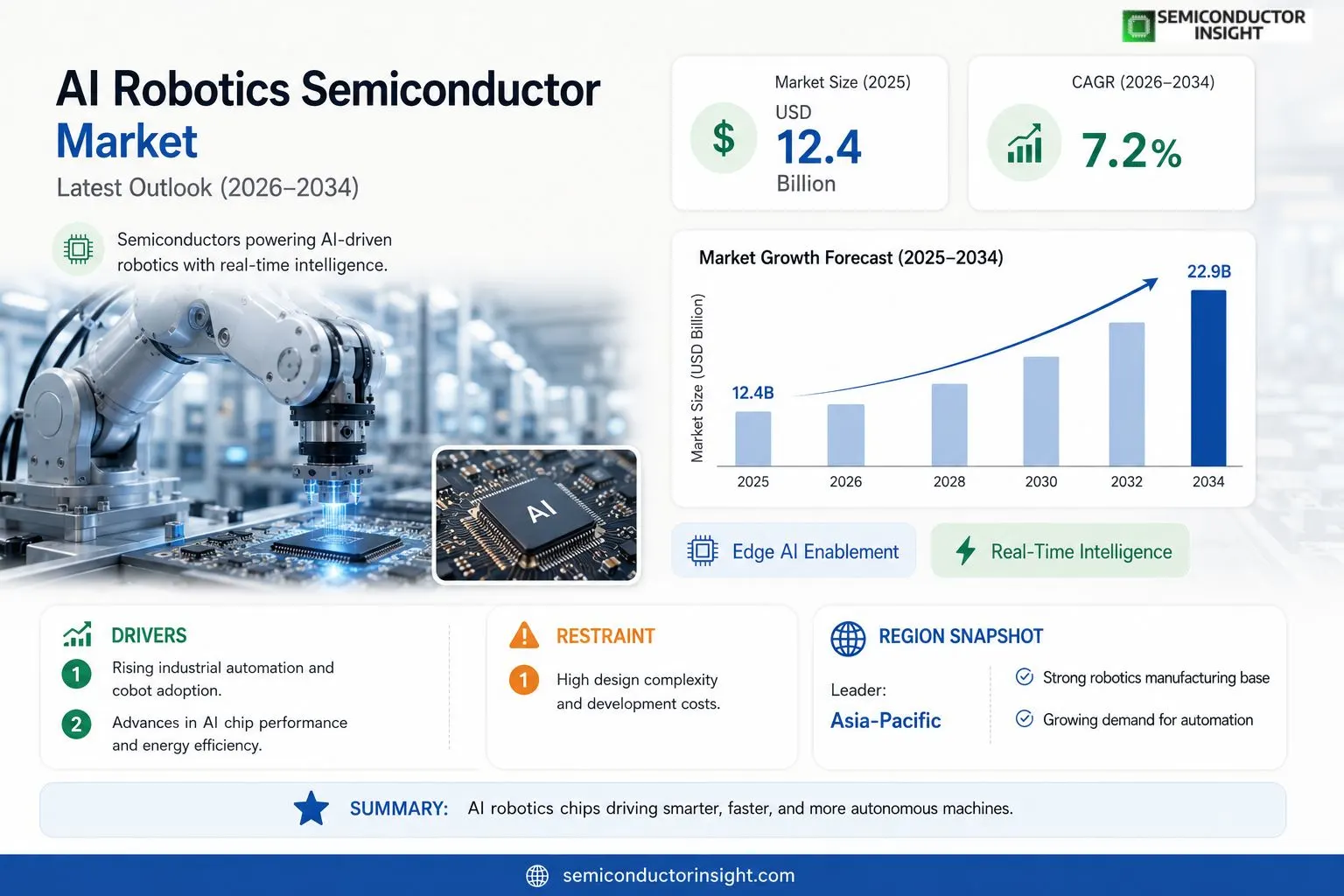
Global AI Robotics Semiconductor Market size was valued at USD 12.4 billion in 2025. The market is projected to grow from USD 13.6 billion in 2026 to USD 22.9 billion by 2034, exhibiting a CAGR of 7.2% during the forecast period.
AI Robotics Semiconductors are specialized integrated circuits designed to enable autonomous decision‑making, sensor fusion, and real‑time control in robotic systems powered by artificial intelligence. These chips combine high‑performance compute cores, low‑latency memory interfaces, and dedicated accelerators for neural‑network inference, allowing robots to perceive environments, plan actions, and execute tasks with precision.\The market is experiencing rapid growth because investments in industrial automation, collaborative robots (cobots), and edge AI are accelerating demand for purpose‑built silicon. Furthermore, advancements in heterogeneous integration and power‑efficient designs are lowering barriers for deployment across manufacturing, logistics, and service sectors. Key players such as NVIDIA Corporation, Intel Corporation (Mobileye), Qualcomm Technologies, and Samsung Electronics are expanding their portfolios through strategic partnerships and acquisitions, further fueling market expansion.
MARKET DRIVERS
Growing Demand for Edge AI
AI Robotics Semiconductor Market is being propelled by an unprecedented demand for edge‑AI capabilities in autonomous machines. Manufacturers are integrating low‑latency processors to enable real‑time decision‑making, which reduces reliance on cloud connectivity and improves energy efficiency. This shift is especially evident in logistics robots that now operate with 12‑15 % higher throughput.
Advances in Process Technology
Recent 5‑nm and 3‑nm node rollouts have unlocked higher transistor density, allowing AI‑optimized chips to deliver double the performance per watt compared with previous generations. These technological gains are encouraging OEMs to adopt more sophisticated vision and motion‑control algorithms, directly fueling market expansion.
➤ “The convergence of edge‑AI demand and next‑gen silicon is the single most powerful catalyst for AI Robotics Semiconductor Market in the next five years.”
Additionally, strategic collaborations between semiconductor foundries and robotics firms are shortening time‑to‑market for specialized AI chips, further accelerating adoption across industrial and consumer segments.
MARKET CHALLENGES
Complex Design Integration
Designing semiconductor solutions that meet both AI workloads and stringent robotics reliability standards remains a major hurdle. Engineers must balance high compute density with thermal constraints, which often leads to longer development cycles and higher R&D expenditures.
Other Challenges
Supply Chain Constraints
Global component shortages, particularly for advanced packaging materials, have created bottlenecks that can delay production runs. Companies are therefore investing in diversified sourcing strategies to mitigate risk.
MARKET RESTRAINTS
Regulatory and Safety Standards
Stringent safety certifications required for robotic systems in sectors such as healthcare and automotive add compliance costs and extend time‑to‑market. These regulatory hurdles can deter smaller players from entering AI Robotics Semiconductor Market.Moreover, data‑privacy regulations in key regions impose limits on on‑device AI processing, compelling manufacturers to adopt more complex encryption solutions that increase chip complexity.Finally, the high capital intensity of advanced node fabs limits the number of suppliers capable of delivering the specialized AI silicon required for robotics, constraining competitive dynamics.
MARKET OPPORTUNITIES
Emerging Applications in Service Robotics
Service robots in hospitality, retail, and healthcare are projected to grow at a double‑digit rate, creating a sizable demand for power‑efficient AI processors. This segment offers a lucrative avenue for chip vendors to differentiate through customized neural‑network accelerators.In parallel, the rise of AI‑enabled collaborative robots (cobots) in small‑ and medium‑sized enterprises opens new volume opportunities, as these customers seek cost‑effective solutions that do not compromise on performance.Investments in heterogenous integration,combining logic, memory, and analog sensors on a single die,are unlocking novel form‑factors for robotics, positioning early adopters to capture premium market share within AI Robotics Semiconductor Market.
AI Robotics Semiconductor Market Trends
Growth of Edge AI Integration
Robotic platforms are increasingly relying on on‑device processing to meet latency and privacy requirements. By embedding AI‑ready silicon at the edge, manufacturers can execute neural‑network inference locally, eliminating the need for constant cloud connectivity. This shift is driving a surge in demand for processors that combine high‑throughput compute cores with low‑power memory interfaces. The result is a noticeable acceleration in the deployment of collaborative robots on factory floors, where real‑time perception and decision‑making are critical. Vendors are therefore prioritising designs that support sensor‑fusion workloads while maintaining a small thermal envelope, enabling continuous operation in constrained environments. Furthermore, the convergence of low‑latency Ethernet and PCIe 5.0 interfaces provides the bandwidth required for multi‑sensor data streams, allowing robots to execute complex visual‑servoing tasks with millisecond response times. This technical synergy is prompting OEMs to redesign chassis to accommodate higher power budgets while still adhering to stringent safety certifications.
Other Trends
Heterogeneous Integration Advances
Heterogeneous integration is redefining chip architecture by stacking compute, memory, and sensor interfaces within a single package. This approach reduces interconnect length, improves bandwidth, and cuts power consumption,attributes essential for autonomous robotic applications. Recent silicon‑on‑silicon bonding techniques allow manufacturers to combine high‑performance AI cores with specialized analog front‑ends, delivering precise control loops for motion and force feedback. As a consequence, system‑level designers can achieve higher payload capacities without increasing board size, facilitating the adoption of robots in logistics and warehousing where space is at a premium. The momentum behind this technology is evident in the rapid qualification of 3D‑stacked modules across multiple fab lines, positioning AI Robotics Semiconductor Market for scalable growth. The yield improvements observed in recent pilot lines also reduce cost per die, making complex AI chips more accessible for mid‑size manufacturers.
Strategic Partnerships Among Chip Leaders
Leading semiconductor firms are forging alliances to accelerate time‑to‑market for AI‑enabled robotics solutions. Collaborative arrangements between GPU manufacturers and vision‑system specialists enable joint development of reference designs that integrate neural‑network accelerators with high‑resolution imaging pipelines. In parallel, memory providers are partnering with edge‑AI chipmakers to co‑optimize bandwidth and latency characteristics, ensuring that data from lidar, radar, and tactile sensors can be processed within a single silicon footprint. These strategic moves not only broaden the ecosystem but also lower the entry barrier for system integrators seeking turnkey solutions. As a result, the adoption curve for intelligent robotic equipment is steepening, reinforcing the overall momentum of AI Robotics Semiconductor Market across industrial, logistics, and service sectors. These ecosystems are further reinforced by joint standards initiatives.
COMPETITIVE LANDSCAPEKey Industry Players
Strategic Rivalries and Innovation Dynamics Shaping Global AI Robotics Semiconductor Market
Global AI Robotics Semiconductor Market is characterized by intense competition among a mix of established semiconductor giants and specialized chipmakers, each vying to capture a growing share of a market valued at USD 12.4 billion in 2025 and projected to reach USD 22.9 billion by 2034. NVIDIA Corporation maintains a commanding presence in this space, leveraging its GPU architecture and Jetson edge AI platform to deliver high-performance neural-network inference capabilities for robotic applications across industrial automation, logistics, and collaborative robot (cobot) deployments. Intel Corporation, through its Mobileye division and broader AI accelerator portfolio, continues to advance heterogeneous integration strategies that enable low-latency sensor fusion and real-time control essential for autonomous robotic systems. Qualcomm Technologies has similarly strengthened its foothold by extending its Snapdragon compute platforms toward edge AI robotics, while Samsung Electronics is expanding its semiconductor design capabilities to address the power-efficient processing demands of next-generation robotic systems. These leading players are actively pursuing strategic partnerships, mergers, and acquisitions to consolidate their competitive positioning and accelerate time-to-market for purpose-built silicon solutions.Beyond the dominant players, several specialized and emerging semiconductor companies are carving out significant niches within AI Robotics Semiconductor Market. Texas Instruments continues to be a trusted supplier of embedded processors and motor-control semiconductors widely used in industrial robotic platforms. Renesas Electronics and NXP Semiconductors are advancing microcontroller and system-on-chip (SoC) designs tailored for real-time robotic control and functional safety compliance. AMD is increasingly competing in the AI inference accelerator segment, while Arm Holdings provides foundational processor IP that underpins a broad ecosystem of robotics chipsets from multiple vendors. Horizon Robotics and Ambarella are notable for their energy-efficient AI inference SoCs optimized for edge robotics and vision-based navigation. Meanwhile, MediaTek and Rockchip are expanding their AI processing capabilities into the collaborative and service robotics segments, particularly across Asia-Pacific markets. Collectively, these players are driving innovation in heterogeneous integration and power-efficient architectures, lowering deployment barriers across manufacturing, logistics, healthcare, and service-oriented robotic applications.
List of Key AI Robotics Semiconductor Companies Profiled
- NVIDIA Corporation
- Intel Corporation (Mobileye)
- Qualcomm Technologies
- Samsung Electronics
- Texas Instruments
- Renesas Electronics
- NXP Semiconductors
- AMD (Advanced Micro Devices)
- Arm Holdings
- Horizon Robotics
- Ambarella
- MediaTek
- Rockchip
- STMicroelectronics
- Broadcom
Segment Analysis:
| Segment Category | Sub-Segments | Key Insights |
| By Type |
|
ASIC‑Driven Precision
|
| By Application |
|
Industrial Automation Focus
|
| By End User |
|
Manufacturing Leadership
|
| By Integration Architecture |
|
Chiplet Strategy Gains Traction
|
| By Functional Capability |
|
Secure Edge AI Becomes Differentiator
|
Regional Analysis: North America
United States
The demand for semiconductors in industrial robots is steadily increasing, fueled by the need for enhanced precision, efficiency, and adaptability in manufacturing processes. This segment is witnessing the adoption of specialized chips for tasks like vision processing and motion control.
The development of autonomous vehicles relies heavily on sophisticated semiconductor technology for perception, decision-making, and control systems. The US is a major hub for automotive innovation, driving significant demand for high-performance AI-powered chips.
Robotics in healthcare is gaining traction, with applications ranging from surgical assistance to patient care. This segment requires semiconductors capable of handling complex algorithms and real-time processing for enhanced precision and safety.
The logistics sector is increasingly adopting robots for tasks like warehouse automation and last-mile delivery. This trend is driving demand for semiconductors optimized for navigation, object recognition, and efficient operation in dynamic environments.
Europe
Europe’s AI Robotics Semiconductor Market presents a diverse landscape, with key markets like Germany, the UK, and France leading the way. The region is characterized by a strong emphasis on industrial automation and a growing focus on sustainable technologies. While investment in AI robotics semiconductors is robust, it often follows a more cautious and strategic approach compared to the US, with a greater emphasis on established players and collaborative research initiatives. The European Union’s initiatives to promote digital sovereignty and technological independence are also influencing the development of the semiconductor ecosystem. The integration of AI and robotics into manufacturing, particularly in automotive and aerospace, is shaping the demand for specialized chips.
Asia-Pacific
Asia-Pacific represents a dynamic and rapidly expanding market for AI Robotics Semiconductors. Countries like China, Japan, and South Korea are witnessing substantial growth driven by increasing industrialization, advancements in automotive manufacturing, and a burgeoning robotics industry. China, in particular, is emerging as a major player in AI robotics, with significant government support and substantial domestic demand. The region is experiencing a surge in demand for semiconductors used in collaborative robots (cobots) and automated guided vehicles (AGVs). The competitive landscape is intense, with both established global players and local manufacturers vying for market share.
South America
South America’s AI Robotics Semiconductor Market is still in its nascent stages, but it holds significant potential for future growth. Brazil and Argentina are the primary markets, driven by increasing adoption of automation in industries like agriculture, mining, and logistics. While the investment in sophisticated semiconductor technology is relatively lower compared to other regions, there is a growing awareness of the benefits of AI and robotics for improving efficiency and productivity. The market is expected to witness increased adoption of cost-effective robotic solutions in the coming years.
Middle East & Africa
The Middle East & Africa region presents a promising, albeit relatively smaller, market for AI Robotics Semiconductors. Countries like Saudi Arabia and the UAE are investing heavily in smart city initiatives and industrial diversification, creating opportunities for robotic adoption. The demand for semiconductors in sectors like oil & gas, construction, and defense is expected to drive market growth. The region’s focus on technological advancement and infrastructure development is also contributing to the expansion of AI Robotics Semiconductor Market.
Report Scope
This market research report provides a comprehensive analysis of the AI Robotics Semiconductor Market , covering the forecast period 2026–2034. It offers detailed insights into market dynamics, technological advancements, competitive landscape, and key trends shaping the industry.
Key focus areas of the report include:
- Market Overview: The report begins with an overview outlining its current market scenario, key growth indicators, and industry transformation drivers. It discusses macroeconomic factors, demand–supply balance, regulatory landscape, and the strategic role of semiconductors in powering advancements across industries such as automotive, telecommunications, consumer electronics, and industrial automation.
- Market Size & Forecast: Historical data and future projections for revenue, unit shipments, and market value across major regions and segments.
- Segmentation Analysis: Detailed breakdown by product type, technology, application, and end-user industry to identify high-growth segments and investment opportunities.
- Regional Insights: Insights into market performance across North America, Europe, Asia-Pacific, Latin America, and the Middle East & Africa, including country-level analysis where relevant.
- Competitive Landscape: Profiles of leading market participants, including their product offerings, R&D focus, manufacturing capacity, pricing strategies, and recent developments such as mergers, acquisitions, and partnerships.
- Technology Trends & Innovation: Assessment of emerging technologies, integration of AI/IoT, semiconductor design trends, fabrication techniques, and evolving industry standards.
- Market Drivers & Restraints: Evaluation of factors driving market growth along with challenges, supply chain constraints, regulatory issues, and market-entry barriers.
- Stakeholder Insights: Insights for component suppliers, OEMs, system integrators, investors, and policymakers regarding the evolving ecosystem and strategic opportunities.
Primary and secondary research methods are employed, including interviews with industry experts, data from verified sources, and real-time market intelligence to ensure the accuracy and reliability of the insights presented.
FREQUENTLY ASKED QUESTIONS:
What is the current market size of AI Robotics Semiconductor Market?
-> AI Robotics Semiconductor Market was valued at USD 12.4 billion in 2025 and is expected to reach USD 22.9 billion by 2034, exhibiting a CAGR of 7.2% during the forecast period.
Which key companies operate in AI Robotics Semiconductor Market?
-> Key players include NVIDIA Corporation, Intel Corporation (Mobileye), Qualcomm Technologies, and Samsung Electronics, among others.
What are the key growth drivers?
-> Key growth drivers include industrial automation investments, collaborative robots (cobots), edge AI adoption, heterogeneous integration, and power‑efficient silicon designs.
Which region dominates the market?
-> Asia-Pacific is the fastest‑growing region, while Europe remains a dominant market.
What are the emerging trends?
-> Emerging trends include purpose‑built AI semiconductor architectures, edge AI deployment, and advanced heterogeneous integration techniques.

Get Sample Report PDF for Exclusive Insights
Report Sample Includes
- Table of Contents
- List of Tables & Figures
- Charts, Research Methodology, and more...
 Download Sample Report PDF