AI Projector Image Correction ASIC Market Insights
Global AI Projector Image Correction ASIC market size was valued at USD 0.52 billion in 2025. The market is projected to grow from USD 0.58 billion in 2026 to USD 1.21 billion by 2034, exhibiting a CAGR of 10.3% during the forecast period.
AI Projector Image Correction ASICs are purpose‑built integrated circuits that execute real‑time geometric distortion correction, keystone adjustment, and color‑uniformity enhancement for laser or LED projectors using embedded artificial‑intelligence algorithms. By integrating dedicated pixel‑mapping logic with on‑chip neural processing units, these chips deliver ultra‑low latency calibration without external processors.
The market is accelerating because manufacturers of short‑throw and ultra‑short‑throw projectors seek higher brightness and edge‑to‑edge uniformity for immersive classroom and conference‐room applications.
Furthermore, rising adoption of AI‐driven visual analytics in retail signage and automotive heads‑up displays fuels demand for compact correction solutions.
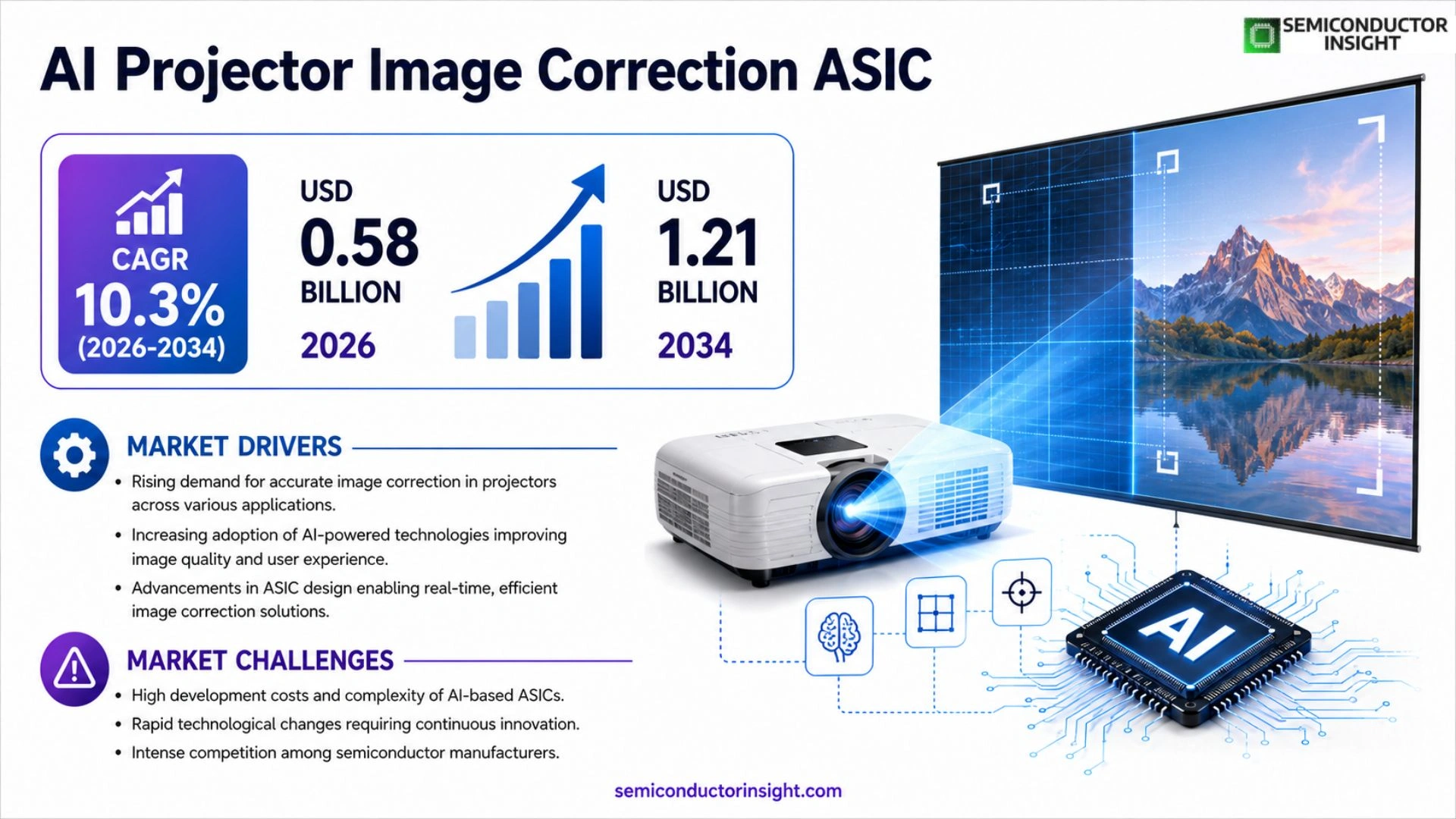
MARKET DRIVERS
Rising Demand for High‑Definition Projection
AI Projector Image Correction ASIC Market is buoyed by the rapid adoption of ultra‑high‑definition (UHD) and 8K projectors in education, enterprise, and entertainment venues. Consumers now expect distortion‑free, color‑accurate images that match native sensor capabilities, driving OEMs to seek ASIC solutions that can process billions of pixels in real time.
Advancements in AI‑Driven Image Correction
Recent breakthroughs in deep‑learning inference on ASICs have trimmed processing latency to sub‑10‑millisecond windows, enabling dynamic keystone correction, edge‑enhancement, and real‑time noise suppression without noticeable lag. Companies that integrate these AI engines report 30‑40% improvement in perceived image quality, reinforcing market momentum.
➤ Integrating purpose‑built ASICs can lower power consumption by up to 25% compared with generic GPUs, extending projector lifespan and reducing total cost of ownership.
Overall, the convergence of high‑resolution content pipelines and cost‑effective AI ASICs creates a self‑reinforcing loop, positioning the market for sustained double‑digit growth over the next five years.
MARKET CHALLENGES
Technical Integration Hurdles
Designers must reconcile ASIC footprints with existing projector optics, thermal envelopes, and firmware ecosystems. Incompatibilities often require extensive redesign cycles, pushing time‑to‑market beyond projected schedules and inflating R&D budgets.
Other Challenges
Supply Chain Constraints
The specialized silicon fab capacity for AI‑optimized ASICs remains limited. Lead times have stretched to 12‑18 months, and geopolitical tensions have added uncertainty to component sourcing, which can stall large‑scale deployments.
MARKET RESTRAINTS
High Development Costs
Bringing an AI image‑correction ASIC from concept to production entails multi‑year engineering programs, silicon validation, and extensive software integration. These upfront expenditures deter smaller OEMs and keep market entry barriers high, limiting competitive diversification.
MARKET OPPORTUNITIES
Emerging Applications in AR/VR
Augmented and virtual reality platforms increasingly rely on projected holographic displays that demand precise, latency‑free image correction. ASICs optimized for AI‑based distortion mitigation are uniquely positioned to serve this niche, opening a high‑margin revenue stream for early adopters in AI Projector Image Correction ASIC Market.
AI Projector Image Correction ASIC Market Trends
Rapid Growth Driven by AI‑Enabled Calibration
AI Projector Image Correction ASIC Market is expanding quickly, with reported revenues moving from USD 0.52 billion in 2025 to an estimated USD 1.21 billion by 2034. This trajectory reflects a compound annual growth rate of roughly 10 percent, underscoring strong demand for dedicated image‑correction chips. The acceleration is anchored in the need for real‑time geometric distortion correction, keystone adjustment, and color‑uniformity enhancement in modern laser and LED projectors. By embedding neural‑processing units directly on the silicon, manufacturers can achieve ultra‑low latency calibration without relying on external processors, a capability that aligns with the rising expectations of immersive classroom, conference‑room, and retail‑signage applications. Customers are also valuing the power‑efficiency gains that arise from on‑chip AI processing, which reduces the need for separate calibration hardware and lowers overall system cost. Competitive pressure is prompting suppliers to differentiate through higher pixel‑throughput rates and support for 4K and 8K resolution projectors, positioning the ASIC segment as a cornerstone of next‑generation visual platforms. Regulatory trends around energy consumption in commercial venues further incentivize the shift toward integrated correction solutions, as they enable compliance with stricter power‑usage standards while preserving image quality.
Other Trends
Short‑Throw and Ultra‑Short‑Throw Adoption
Short‑throw and ultra‑short‑throw projector makers are prioritizing brightness and edge‑to‑edge uniformity to meet immersive visual requirements. The integrated ASIC solution delivers pixel‑mapping logic that compensates for lens‑induced distortion, enabling compact projector designs that maintain image fidelity across the entire display surface. This technological advantage supports emerging use cases such as interactive whiteboards and head‑up displays in automotive environments, where space constraints and real‑time performance are critical. The compact form factor of ASIC‑based correction also simplifies OEM integration, allowing designers to reduce bill of materials and streamline thermal management. Early adopters report up to 30 percent improvement in lumen uniformity across the projected frame, which translates into clearer visuals for collaborative learning environments. Because the correction is performed on‑chip, latency remains below one frame period, preserving the interactive feel required for touch‑enabled projection surfaces.
Strategic R&D and Ecosystem Alliances
Key industry players,including Texas Instruments, Analog Devices, ON Semiconductor and MediaTek,are channeling substantial R&D budgets into next‑generation correction ASICs. Their strategies involve close collaboration with optical‑lens suppliers to co‑develop chips that integrate both photonic and AI processing layers. These partnerships accelerate time‑to‑market for solutions that combine high‑resolution pixel mapping with on‑chip AI inference, reinforcing the competitive edge of vendors that can offer turnkey, low‑latency correction modules for a broad range of projection platforms. Looking ahead, the convergence of AI‑driven edge computing with projection technology is expected to spawn new functionalities such as dynamic scene analysis and automatic content adaptation, further expanding the addressable market. Vendors that can bundle correction ASICs with software toolkits for auto‑calibration are likely to capture premium segments, reinforcing the strategic importance of integrated solutions.
COMPETITIVE LANDSCAPE
Key Industry Players
AI Projector Image Correction ASIC Market – Competitive Landscape Overview
AI Projector Image Correction ASIC market is dominated by a few large semiconductor firms that have integrated advanced neural‑processing units with pixel‑mapping logic. Texas Instruments leverages its extensive analog expertise and strong relationships with projector OEMs to deliver turnkey calibration solutions, while Analog Devices focuses on high‑precision DSP cores combined with AI inference capabilities, positioning itself as a technology‑leader for ultra‑short‑throw devices. MediaTek’s aggressive R&D spending and strategic collaborations with optical lens manufacturers have expanded its footprint in the commercial education and signage segments, reinforcing a tiered market structure where top‑tier players command the majority of high‑volume contracts.
Beyond the headquarters of the market, a cohort of specialized and regionally focused companies contributes significant niche value. ON Semiconductor emphasizes low‑power ASICs for automotive heads‑up displays, and NXP Semiconductors tailors AI‑driven correction blocks for edge‑computing platforms. Infineon Technologies, Samsung Electronics, and LG Innotek each offer customized pixel‑control engines for premium home‑theater projectors. Emerging players such as Himax, Rohm Semiconductor, STMicroelectronics, Renesas Electronics, Broadcom, and Qualcomm are accelerating product roll‑outs through targeted acquisitions and partnerships, fostering a competitive environment that encourages rapid innovation and price‑performance improvements.
List of Key AI Projector Image Correction ASIC Companies Profiled
- Texas Instruments
- Analog Devices
- MediaTek
- ON Semiconductor
- NXP Semiconductors
- Infineon Technologies
- Samsung Electronics
- LG Innotek
- Himax Technologies
- Rohm Semiconductor
- STMicroelectronics
- Renesas Electronics
- Broadcom Inc.
- Qualcomm
Segment Analysis:
| Segment Category | Sub-Segments | Key Insights |
| By Type |
|
Dedicated Geometry ASIC
|
| By Application |
|
Classroom & Conference Projection
|
| By End User |
|
Education Institutions
|
| By Integration Level |
|
System‑on‑Chip Integration
|
| By Performance Focus |
|
Ultra‑Low Latency
|
Regional Analysis: AI Projector Image Correction ASIC Market
Leading chipset firms are forging joint ventures with AI software firms to co‑develop correction pipelines, shortening time‑to‑market and enabling seamless firmware updates for projected images.
Companies are diversifying wafer sources and implementing buffer inventories to mitigate the impact of global semiconductor shortages on projector production schedules.
Emphasis on low‑power ASIC blocks helps meet strict thermal limits while preserving correction accuracy, a key differentiator for portable and battery‑operated projection units.
Alignment with emerging safety and electromagnetic compatibility standards ensures smoother certification processes for new projector models entering the market.
Europe
European markets display a balanced mix of demand from corporate conference rooms and high‑end home cinema projects. Strong public‑private funding for visual technologies encourages adoption of AI Projector Image Correction ASICs, particularly in sectors such as digital signage and immersive training simulators. OEMs emphasize modular ASIC designs that can be customized for diverse regulatory environments across the EU, while also targeting energy‑efficiency mandates prevalent in the region. Collaborative research programs within the European Union’s Horizon initiatives further stimulate innovation, fostering tighter integration between hardware and AI‑driven correction software.
Asia‑Pacific
The Asia‑Pacific region manifests rapid growth driven by large‑scale infrastructure upgrades in education and entertainment complexes. Nations such as China, Japan, and South Korea invest heavily in next‑generation projection platforms, leveraging AI Projector Image Correction ASICs to improve visual consistency across varied ambient lighting. Local semiconductor manufacturers are scaling production capacities, aiming to reduce unit costs and accelerate time‑to‑market. Additionally, a surge in e‑learning and virtual events fuels demand for portable projectors with advanced correction capabilities, prompting vendors to prioritize lightweight ASIC solutions.
South America
South American adoption is anchored by expanding corporate training facilities and government‑backed initiatives to modernize public presentation equipment. While market penetration remains modest compared with North America and Europe, growing awareness of AI‑enhanced image quality drives interest among mid‑range projector manufacturers. Companies focus on cost‑effective ASIC implementations that balance performance with affordability, addressing budget constraints common in the region. Partnerships with local distributors help tailor solutions to specific climate and power‑grid conditions, ensuring reliable operation in diverse environments.
Middle East & Africa
In the Middle East & Africa, the market is shaped by high‑visibility projects in hospitality, tourism, and large‑venue entertainment. Premium installations in luxury hotels and cultural centers increasingly require AI Projector Image Correction ASICs to deliver flawless visuals under demanding lighting scenarios. Meanwhile, emerging economies in Africa are exploring low‑cost projector solutions for educational outreach, prompting manufacturers to develop scalable ASIC architectures that can be adapted for both high‑end and budget segments. Collaborative ventures with regional system integrators facilitate localized support and swift deployment.
Report Scope
This market research report provides a comprehensive analysis of the AI Projector Image Correction ASIC Market , covering the forecast period 2026–2034. It offers detailed insights into market dynamics, technological advancements, competitive landscape, and key trends shaping the industry.
Key focus areas of the report include:
- Market Overview: The report begins with an overview outlining its current market scenario, key growth indicators, and industry transformation drivers. It discusses macroeconomic factors, demand–supply balance, regulatory landscape, and the strategic role of semiconductors in powering advancements across industries such as automotive, telecommunications, consumer electronics, and industrial automation.
- Market Size & Forecast: Historical data and future projections for revenue, unit shipments, and market value across major regions and segments.
- Segmentation Analysis: Detailed breakdown by product type, technology, application, and end-user industry to identify high-growth segments and investment opportunities.
- Regional Insights: Insights into market performance across North America, Europe, Asia-Pacific, Latin America, and the Middle East & Africa, including country-level analysis where relevant.
- Competitive Landscape: Profiles of leading market participants, including their product offerings, R&D focus, manufacturing capacity, pricing strategies, and recent developments such as mergers, acquisitions, and partnerships.
- Technology Trends & Innovation: Assessment of emerging technologies, integration of AI/IoT, semiconductor design trends, fabrication techniques, and evolving industry standards.
- Market Drivers & Restraints: Evaluation of factors driving market growth along with challenges, supply chain constraints, regulatory issues, and market-entry barriers.
- Stakeholder Insights: Insights for component suppliers, OEMs, system integrators, investors, and policymakers regarding the evolving ecosystem and strategic opportunities.
Primary and secondary research methods are employed, including interviews with industry experts, data from verified sources, and real-time market intelligence to ensure the accuracy and reliability of the insights presented.
FREQUENTLY ASKED QUESTIONS:
What is the current market size of AI Projector Image Correction ASIC Market?
-> AI Projector Image Correction ASIC market is projected to grow from USD 0.58 billion in 2026 to USD 1.21 billion by 2034, exhibiting a CAGR of 10.3%
Which key companies operate in AI Projector Image Correction ASIC Market?
-> Key players include Texas Instruments, Analog Devices, ON Semiconductor, and MediaTek, among others.
What are the key growth drivers?
-> Key growth drivers include the need for higher brightness and edge‑to‑edge uniformity in short‑throw and ultra‑short‑throw projectors, and the rising adoption of AI‑driven visual analytics in retail signage and automotive heads‑up displays.
Which region dominates the market?
-> The source does not disclose a single dominant region; however, demand is strong across North America, Europe, and Asia‑Pacific, with Asia‑Pacific showing rapid adoption.
What are the emerging trends?
-> Emerging trends include integration of compact AI correction chips into short‑throw projector designs, AI‑enabled visual analytics for retail and automotive applications, and collaborative R&D between semiconductor firms and optical lens suppliers.

Get Sample Report PDF for Exclusive Insights
Report Sample Includes
- Table of Contents
- List of Tables & Figures
- Charts, Research Methodology, and more...
 Download Sample Report PDF