
AI Processor 3DIC Memory-on-Logic EDA Tool Suite Market Insights
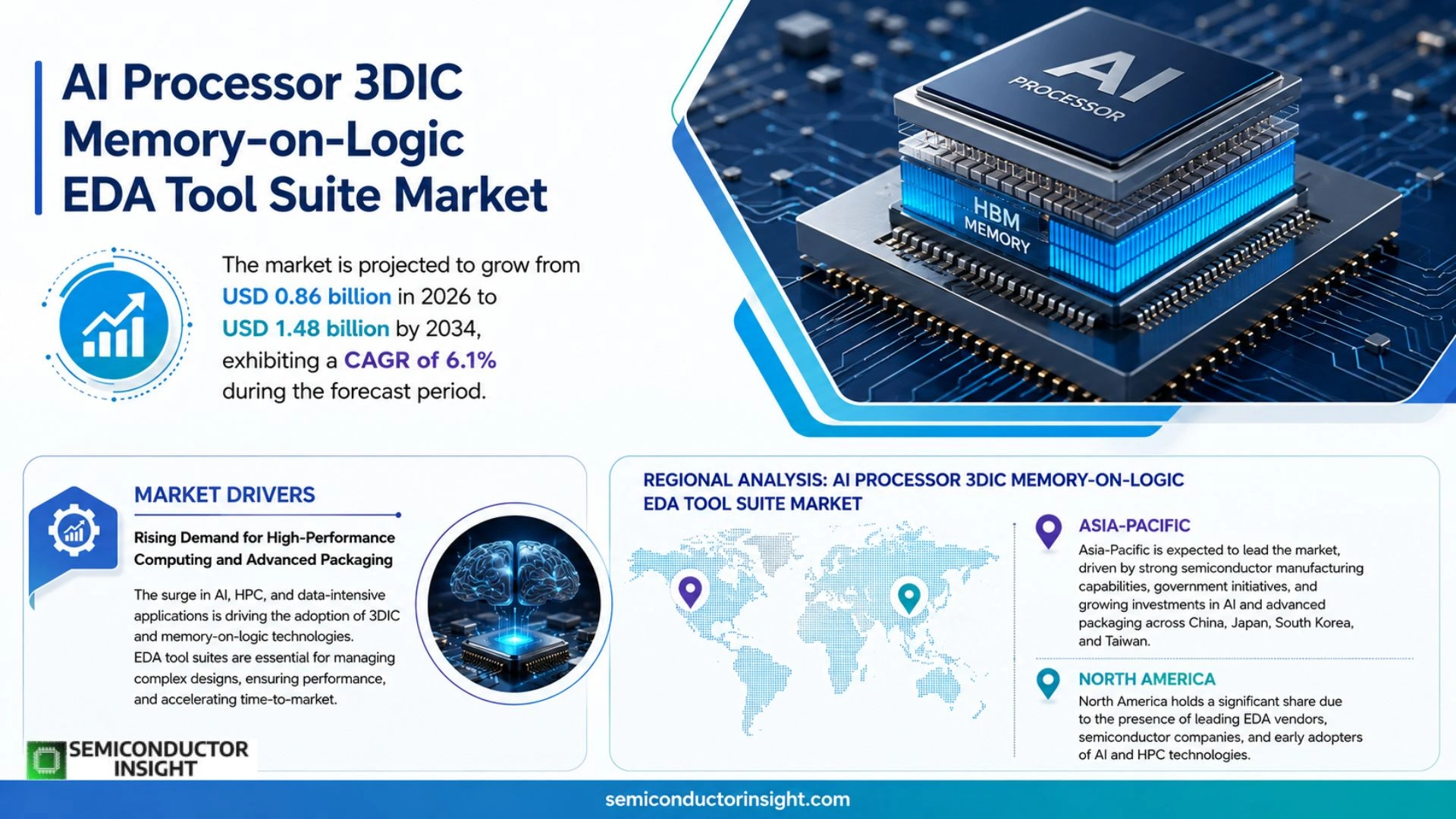
Global AI Processor 3DIC Memory-on-Logic EDA Tool Suite market size was valued at USD 0.86 billion in 2025. The market is projected to grow from USD 0.86 billion in 2025 to USD 1.48 billion by 2034, exhibiting a CAGR of 6.1% during the forecast period.
AI Processor 3DIC (Three‑Dimensional Integrated Circuit) Memory‑on‑Logic refers to the co‑integration of high‑performance AI compute cores with stacked memory layers directly on the logic die. The associated EDA (Electronic Design Automation) tool suite encompasses design capture, physical synthesis, thermal analysis, and verification solutions specifically optimized for heterogeneous stacking and advanced packaging workflows.
The market is experiencing rapid growth because semiconductor manufacturers are accelerating AI chip deployments while seeking higher bandwidth and lower latency than traditional package‑on‑package solutions can provide. Furthermore, rising investment in advanced packaging technologies such as TSV (Through‑Silicon Vias) and fan‑out wafer‑level packaging fuels demand for specialized EDA tools that can handle complex thermal and signal integrity challenges.
MARKET DRIVERS
Growing Demand for AI‑Optimized Compute
The surge in generative AI services and large‑scale neural networks is compelling data‑center operators to adopt AI processors that deliver higher throughput per watt. This macro trend directly fuels AI Processor 3DIC Memory‑on‑Logic EDA Tool Suite Market, as silicon designers seek integrated solutions that minimize latency and power consumption.
Advancements in 3DIC Integration
Three‑dimensional integration techniques now enable memory and logic tiers to be stacked with sub‑micron alignment, reducing interconnect parasitics dramatically. These technical gains translate into higher compute density, making 3DIC a strategic choice for next‑generation AI accelerators.
➤ “The convergence of AI workloads and 3DIC packaging is redefining performance baselines for edge and cloud processors.”
Advanced EDA tool suites that automate co‑optimization of logic, memory, and thermal budgets are becoming indispensable. Vendors that embed AI‑driven layout heuristics are delivering up to 30% faster design cycles, reinforcing market expansion.
MARKET CHALLENGES
Design Complexity and Verification Bottlenecks
Integrating heterogeneous dies within a single stack introduces multi‑physics interactions that conventional verification flows struggle to capture. The lack of mature simulation models prolongs design validation, elevating time‑to‑market risk.
Other Challenges
Talent Shortage
Skilled engineers proficient in both AI processor architecture and 3DIC packaging are scarce, driving up labor costs and limiting the pace of innovation.
Moreover, fragmented standards for inter‑die communication hinder seamless IP reuse, compelling companies to invest in custom adapter logic, which further strains budgets.
MARKET RESTRAINTS
High Cost of Advanced Packaging
The capital expenditures associated with wafer‑level bonding, through‑silicon vias, and precision alignment equipment remain prohibitive for many mid‑size fabs, restricting broader adoption of 3DIC solutions.
In addition, the recurring expense of licensing premium IP blocks for memory‑on‑logic configurations adds a financial layer that can deter cost‑sensitive customers.
MARKET OPPORTUNITIES
Emerging Edge AI Applications
Edge devices such as autonomous drones, AR/VR headsets, and smart cameras demand compact AI processors with on‑chip memory to meet real‑time inference requirements while maintaining low power envelopes. This creates a fertile niche for 3DIC‑enabled products.
Customization services that offer turn‑key co‑design of AI cores and memory stacks are gaining traction, allowing OEMs to differentiate without building in‑house expertise.
Regional growth, particularly in APAC’s semiconductor hubs, is accelerating investment in advanced packaging infrastructure, positioning AI Processor 3DIC Memory‑on‑Logic EDA Tool Suite Market for sustained expansion over the next five years.
AI Processor 3DIC Memory-on-Logic EDA Tool Suite Market Trends
Accelerating Adoption of 3DIC Memory‑on‑Logic Solutions
AI Processor 3DIC Memory‑on‑Logic EDA Tool Suite Market is on a clear upward trajectory as leading semiconductor firms intensify development of AI‑centric chips that require stacked memory directly on the compute die. Valued at USD 0.86 billion in 2025, the market is projected to reach approximately USD 1.48 billion by 2034, translating to a compound annual growth rate of about 6 %. This expansion is driven by the demand for higher bandwidth and lower latency that traditional package‑on‑package architectures cannot satisfy. Designers are increasingly turning to specialized EDA solutions that support heterogeneous integration, enabling faster verification of thermal profiles and signal‑integrity constraints inherent in memory‑on‑logic stacks.
Other Trends
Advanced Packaging Integration Drives Tool Complexity
Investment in through‑silicon‑via (TSV) and fan‑out wafer‑level packaging has reshaped the design landscape for AI processors. The resulting complexity requires EDA suites to embed sophisticated thermal‑analysis engines and automated layout optimizations that address the tight power envelopes of 3DIC configurations. As manufacturers scale stack heights and adopt finer pitch interconnects, verification cycles shorten, and tool vendors respond by integrating machine‑learning‑assisted rule checks that speed defect detection while preserving design intent. The convergence of packaging and design automation is therefore a critical catalyst for broader market adoption.
Consolidation Among Leading EDA Vendors
Key industry players,including Synopsys, Cadence Design Systems, Siemens EDA (formerly Mentor Graphics) and Ansys,are deepening their portfolios through strategic acquisitions and partnership programs. This consolidation delivers end‑to‑end workflows that combine design capture, physical synthesis, and multi‑physics verification within a unified environment, reducing data transfer overhead and accelerating time‑to‑market for AI‑optimized 3DIC products. As AI Processor 3DIC Memory‑on‑Logic EDA Tool Suite Market matures, the emphasis shifts toward integrated solutions that can handle the full stack from algorithmic modeling to final tape‑out, reinforcing the competitive advantage of vendors that offer comprehensive, validated toolchains.
COMPETITIVE LANDSCAPE
Key Industry Players
AI Processor 3DIC Memory-on-Logic EDA Tool Suite Competitive Landscape
Synopsys dominates AI Processor 3DIC Memory‑on‑Logic EDA Tool Suite market, leveraging its comprehensive suite that spans front‑end capture, physical synthesis, and advanced thermal‑analysis modules. The company’s recent acquisition of a specialist stacking‑verification vendor has fortified its ability to support heterogeneous integration workflows, positioning it as the de‑facto reference platform for large‑scale AI chip projects. Market structure reflects a clear tiered hierarchy: a handful of integrated‑tool providers command the majority of revenue, while a growing cohort of niche vendors address specific packaging or verification challenges.
Beyond the market leader, Cadence Design Systems and Siemens EDA (formerly Mentor Graphics) provide strong complementary portfolios, with Cadence’s custom‑IC platform and Siemens’ robust TSV and fan‑out design tools attracting mid‑size fab customers. Ansys contributes high‑fidelity simulation capabilities that are increasingly required for thermal and signal‑integrity validation in stacked memory architectures. Smaller but strategically important players such as ARM, Qualcomm, Samsung Electronics, TSMC, Intel, AMD, Marvell Technology, and NXP Semiconductors focus on in‑house tool development or co‑development agreements to streamline AI processor‑on‑logic designs, thereby enriching the overall ecosystem and expanding the addressable market.
List of Key AI Processor 3DIC Memory-on-Logic EDA Tool Suite Companies Profiled
- Synopsys
- Synopsys
- Cadence Design Systems
- Cadence Design Systems
- Siemens EDA (formerly Mentor Graphics)
- Ansys
- Ansys
- ARM
- Qualcomm
- Samsung Electronics
- Samsung Electronics
- TSMC
- Intel
- Intel
- AMD
- Marvell Technology
- NXP Semiconductors
Segment Analysis:
| Segment Category | Sub-Segments | Key Insights |
| By Type |
|
Domain‑specific AI Accelerators are driving tool‑suite differentiation:
|
| By Application |
|
Data‑center AI workloads shape the EDA ecosystem:
|
| By End User |
|
Semiconductor foundries influence tool selection:
|
| By Technology Stack |
|
TSV‑based 3DIC garners the most tool investment:
|
| By Design Phase |
|
Thermal & reliability analysis emerges as a decisive factor:
|
Regional Analysis: AI Processor 3DIC Memory-on-Logic EDA Tool Suite Market
North America
The convergence of AI workloads with 3D IC architectures fuels demand for sophisticated EDA suites capable of handling complex thermal and signal‑integrity challenges. Investment in AI‑centric design methodologies and memory‑on‑logic integration further accelerates adoption across high‑performance compute platforms.
Edge AI devices and next‑generation automotive applications open new avenues for compact, power‑efficient 3DIC solutions. EDA vendors that embed AI‑assisted verification and layout optimization are poised to capture early market share in these fast‑growing segments.
A handful of established EDA providers dominate the market, yet niche players focusing on AI‑driven analytics are gaining traction. Strategic partnerships between tool vendors and foundries enhance co‑optimization, reinforcing the competitive edge of integrated solution offerings.
Export controls on advanced semiconductor technology shape design strategies, encouraging domestic tool development. Meanwhile, sustainability mandates are prompting EDA firms to incorporate energy‑aware design checks, aligning with broader environmental objectives.
Europe
European semiconductor consortia are emphasizing collaborative research on heterogeneous integration, which supports AI Processor 3DIC Memory-on-Logic EDA Tool Suite Market through shared design frameworks. Governments are allocating funds to strengthen chip design capabilities, especially in autonomous mobility and industrial IoT. The region’s regulatory focus on data security is influencing EDA tool features that enable secure AI inference on embedded hardware. Overall, Europe is building a balanced ecosystem that blends innovation with stringent compliance, positioning itself as a strong secondary hub for advanced EDA adoption.
Asia‑Pacific
Asia‑Pacific showcases rapid scaling of AI‑centric chip production, driven by high‑volume demand in consumer electronics and cloud services. Major foundries are aligning with EDA vendors to co‑develop memory‑on‑logic workflows that address cost‑sensitive high‑density designs. While the market benefits from abundant manufacturing capacity, talent gaps in high‑level AI algorithm integration present challenges. Nonetheless, the region’s aggressive roadmap for AI accelerators and strong government incentives sustain a robust growth trajectory for AI Processor 3DIC Memory-on-Logic EDA Tool Suite Market.
South America
South America’s semiconductor activity remains modest, yet emerging AI applications in agriculture technology and fintech are driving interest in advanced design tools. Local universities are partnering with multinational EDA firms to build expertise in 3D integration, creating a niche talent pool. Although funding constraints limit large‑scale deployment, targeted initiatives to attract foreign investment are gradually expanding the market’s footprint, laying the groundwork for future participation in AI Processor 3DIC Memory-on-Logic ecosystem.
Middle East & Africa
The Middle East & Africa region is focusing on building a knowledge‑based economy, with several national programs emphasizing AI and semiconductor research. Pilot projects in smart cities and renewable‑energy management are exploring AI processor designs that could benefit from 3DIC memory‑on‑logic solutions. While the current market size is limited, increasing collaborations with global EDA providers and the establishment of regional innovation hubs suggest a slow but steady progression toward greater involvement in AI Processor 3DIC Memory-on-Logic EDA Tool Suite Market.
Report Scope
This market research report provides a comprehensive analysis of the AI Processor 3DIC Memory-on-Logic EDA Tool Suite Market , covering the forecast period 2026–2034. It offers detailed insights into market dynamics, technological advancements, competitive landscape, and key trends shaping the industry.
Key focus areas of the report include:
- Market Overview: The report begins with an overview outlining its current market scenario, key growth indicators, and industry transformation drivers. It discusses macroeconomic factors, demand–supply balance, regulatory landscape, and the strategic role of semiconductors in powering advancements across industries such as automotive, telecommunications, consumer electronics, and industrial automation.
- Market Size & Forecast: Historical data and future projections for revenue, unit shipments, and market value across major regions and segments.
- Segmentation Analysis: Detailed breakdown by product type, technology, application, and end-user industry to identify high-growth segments and investment opportunities.
- Regional Insights: Insights into market performance across North America, Europe, Asia-Pacific, Latin America, and the Middle East & Africa, including country-level analysis where relevant.
- Competitive Landscape: Profiles of leading market participants, including their product offerings, R&D focus, manufacturing capacity, pricing strategies, and recent developments such as mergers, acquisitions, and partnerships.
- Technology Trends & Innovation: Assessment of emerging technologies, integration of AI/IoT, semiconductor design trends, fabrication techniques, and evolving industry standards.
- Market Drivers & Restraints: Evaluation of factors driving market growth along with challenges, supply chain constraints, regulatory issues, and market-entry barriers.
- Stakeholder Insights: Insights for component suppliers, OEMs, system integrators, investors, and policymakers regarding the evolving ecosystem and strategic opportunities.
Primary and secondary research methods are employed, including interviews with industry experts, data from verified sources, and real-time market intelligence to ensure the accuracy and reliability of the insights presented.
FREQUENTLY ASKED QUESTIONS:
What is the current market size of AI Processor 3DIC Memory-on-Logic EDA Tool Suite Market?
-> AI Processor 3DIC Memory-on-Logic EDA Tool Suite Market was valued at USD 0.86 billion in 2025 and is expected to reach USD 1.48 billion by 2034.
Which key companies operate in AI Processor 3DIC Memory-on-Logic EDA Tool Suite Market?
-> Key players include Synopsys, Cadence Design Systems, Siemens EDA (formerly Mentor Graphics), and Ansys, among others.
What are the key growth drivers?
-> Key growth drivers include accelerated AI chip deployments, demand for higher bandwidth and lower latency, and rising investment in advanced packaging technologies such as TSV and fan‑out wafer‑level packaging.
Which region dominates the market?
-> Regional dominance details were not specified in the provided data.
What are the emerging trends?
-> Emerging trends include co‑integration of AI compute cores with stacked memory layers, specialized thermal analysis and signal‑integrity solutions, and the expansion of heterogeneous stacking workflows within EDA tool suites.

Get Sample Report PDF for Exclusive Insights
Report Sample Includes
- Table of Contents
- List of Tables & Figures
- Charts, Research Methodology, and more...
 Download Sample Report PDF




