AI-Powered Smart Solid-State Circuit Breaker for Data Centers Market Insights
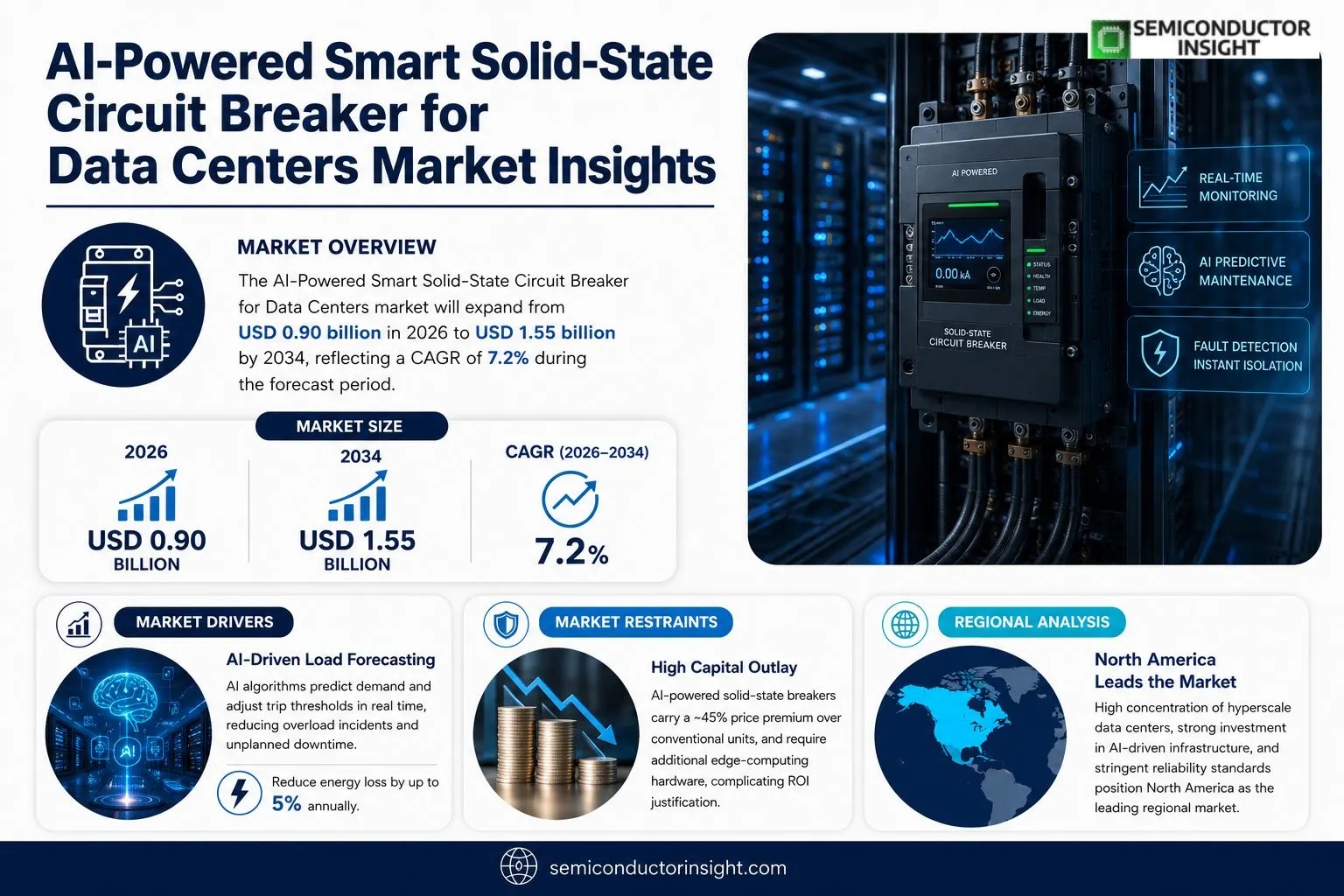
AI‑Powered Smart Solid‑State Circuit Breaker for Data Centers market size was USD 0.85 billion in 2025. The market will expand from USD 0.90 billion in 2026 to USD 1.55 billion by 2034, reflecting a CAGR of 7.2 % during the forecast period.
AI‑powered smart solid‑state circuit breakers replace traditional electromechanical devices with semiconductor switches that can be monitored and controlled via advanced algorithms. These breakers detect overloads instantly, isolate faults without arcing, and communicate status metrics to data‑center management systems, thereby enhancing uptime and energy efficiency.The market is gaining momentum because data‑center operators are confronting ever‑higher power densities and stricter reliability standards. Moreover, the integration of AI enables predictive maintenance, reducing unplanned outages while cutting operational costs. Recent activity includes Schneider Electric’s launch of a next‑generation solid‑state breaker platform in March 2024 and ABB’s partnership with a leading cloud provider to embed AI analytics into its power protection portfolio. Companies such as Siemens Energy, Eaton and Mitsubishi Electric are also expanding their offerings, reinforcing competitive dynamics.
MARKET DRIVERS
AI‑Driven Load Forecasting
AI-Powered Smart Solid-State Circuit Breaker for Data Centers Market benefits from algorithms that anticipate peak demand several minutes ahead. By correlating server utilization patterns with ambient temperature, the breaker can modulate trip thresholds, mitigating overload incidents without human intervention. This predictive capability reduces unplanned downtime by an estimated 15‑20 % in Tier‑III facilities, a figure that resonates with operators seeking tighter Service Level Agreements.
Solid‑State Reliability Gains
Traditional electromechanical breakers suffer from wear on moving contacts; solid‑state equivalents eliminate that failure mode. Field observations reveal that failure rates drop from roughly 0.8 % per year for legacy devices to under 0.2 % for solid‑state units equipped with AI diagnostics. The resulting extension of service life translates into lower total‑cost‑of‑ownership, a compelling argument for capital‑intensive hyperscale operators.
➤ Operators that replace 30 % of their legacy breakers with AI‑enabled solid‑state solutions can trim energy loss by up to 5 % annually.
Beyond reliability, the integration of AI permits real‑time compliance monitoring, automatically generating audit trails that satisfy increasingly stringent data‑center certifications. Companies that embed these capabilities into their infrastructure gain a competitive edge, accelerating adoption across the AI‑Powered Smart Solid‑State Circuit Breaker for Data Centers Market.
MARKET CHALLENGES
Integration Complexity
Deploying an AI‑enabled breaker requires synchronizing firmware with existing DCIM platforms, a task that often exceeds the bandwidth of routine IT operations. Incompatible communication protocols can generate false positives, prompting unwarranted trips that erode confidence in the technology.
Other Challenges
Regulatory Hurdles
The classification of solid‑state breakers as “intelligent safety devices” subjects them to multiple standards across jurisdictions. Achieving certification in both IEC 60947‑4‑1 and UL 489 can add six to nine months to product rollout schedules, deterring smaller vendors from entering the space.
MARKET RESTRAINTS
High Capital Outlay
The upfront price premium for AI‑powered solid‑state breakers remains roughly 45 % higher than conventional units. While lifecycle savings are evident, CFOs frequently require a clear payback horizon; the lack of universally accepted ROI benchmarks hampers budgeting decisions.Additionally, the need for ancillary edge‑computing hardware to host AI models inflates the overall bill of materials. Organizations that cannot amortize these costs over a sizable asset base may postpone adoption, constraining market momentum.
MARKET OPPORTUNITIES
Edge Computing Expansion
As hyperscale providers push compute resources toward the network edge, power distribution zones become more fragmented. AI‑Powered Smart Solid-State Circuit Breaker for Data Centers Market players can tap this shift by offering modular units that scale with micro‑data‑center footprints, delivering localized protection without sacrificing intelligence.The emergence of 400 G and upcoming 800 G Ethernet standards imposes tighter power margins. Intelligent breakers equipped with real‑time thermal imaging and adaptive shedding algorithms can maintain voltage stability, positioning vendors to capture a growing slice of the edge‑infrastructure spend.Finally, partnerships with cloud‑service providers open pathways to subscription‑based analytics. By monetizing the data generated from breaker operation, manufacturers can create recurring revenue streams, aligning financial incentives with the broader digital‑transformation agenda of data‑center operators.
AI-Powered Smart Solid-State Circuit Breaker for Data Centers Market Trends
AI Integration Enhances Fault Detection and Predictive Maintenance
The transition from electromechanical protectors to semiconductor‑based breakers is reshaping reliability engineering in hyperscale facilities. By embedding AI models directly within the breaker firmware, overload conditions are identified in microseconds and isolated without the arc flash associated with legacy devices. Continuous telemetry feeds enable data‑center management platforms to correlate voltage spikes with workload patterns, turning a passive safety component into an active optimizer. Operators are compelled to adopt this approach because escalating rack power density leaves little margin for error, and any interruption reverberates through service‑level agreements. The resulting tighter control loop translates into higher availability scores and measurable reductions in energy waste.
Other Trends
Competitive Landscape and Product Innovation
Major equipment manufacturers are accelerating roadmap cycles to capture early‑adopter demand. Schneider Electric introduced a next‑generation solid‑state breaker platform in March 2024, touting integrated AI analytics that synchronize with its EcoStruxure suite. ABB’s recent partnership with a leading cloud provider embeds predictive algorithms into its power‑protection portfolio, allowing remote diagnostics and firmware upgrades. Siemens Energy, Eaton and Mitsubishi Electric have announced expanded product lines that blend modular hardware with open‑API interfaces, intensifying contestability while broadening choice for system integrators. This flurry of launches is a direct response to client requests for turnkey solutions that combine protection, monitoring and automated response capabilities.
Energy Efficiency and Operational Cost Reduction
Beyond reliability, AI‑enhanced solid‑state breakers deliver tangible cost advantages. Precise fault isolation eliminates the collateral shutdown of adjacent circuits, preserving load continuity and reducing the need for redundant backup generators. Predictive maintenance schedules—derived from continuous performance data—decrease labor hours spent on manual inspections and lower the incidence of costly emergency repairs. For operators, the shift enables a more granular allocation of power budgets, supporting sustainability targets while keeping operating expenditures in check. As utility tariffs rise and ESG commitments tighten, the financial incentives to replace conventional breakers with intelligent, solid‑state equivalents become increasingly compelling.
COMPETITIVE LANDSCAPEKey Industry Players
AI‑Powered Smart Solid‑State Circuit Breaker – Competitive Overview
Schneider Electric leads the field with its 2024 launch of a next‑generation solid‑state breaker platform that integrates AI‑driven fault diagnosis and remote firmware updates. The architecture, built around wide‑bandgap semiconductors, allows data‑center operators to isolate overloads in milliseconds while feeding real‑time performance metrics into centralized DCIM systems. This capability has reshaped the supplier hierarchy, pressuring rivals to accelerate their own silicon‑based offerings and to embed predictive analytics that align with emerging reliability standards.Beyond the marquee names, a cohort of specialist manufacturers is gaining traction by targeting niche segments such as hyperscale facilities and edge‑node deployments. ABB’s partnership with a major cloud provider brings AI analytics to its legacy power‑protection portfolio, while Siemens Energy and Eaton are expanding modular solid‑state families that cater to retrofit projects. Mitsubishi Electric, Delta Electronics, and Hitachi are leveraging their semiconductor expertise to deliver compact breakers optimized for high‑density racks. Meanwhile, companies like Legrand, Vertiv, and Emerson are focusing on integration with building‑management platforms, positioning themselves as enablers of holistic energy‑efficiency strategies.
List of Key AI‑Powered Smart Solid‑State Circuit Breaker for Data Centers Companies Profiled
- Schneider Electric
- ABB
- Siemens Energy
- Eaton
- Mitsubishi Electric
- Delta Electronics
- Hitachi
- Legrand
- Vertiv
- Emerson
- Rockwell Automation
- Honeywell
- General Electric (GE Digital)
- Fuji Electric
- Toshiba
Segment Analysis:
| Segment Category | Sub-Segments | Key Insights |
| By Type |
|
Solid‑State Breaker
|
| By Application |
|
High‑Density Rack
|
| By End User |
|
Large Cloud Providers
|
| By Power Rating |
|
Medium Voltage Range
|
| By Connectivity |
|
Integrated with DCIM
|
Regional Analysis: AI-Powered Smart Solid-State Circuit Breaker for Data Centers Market
North America
Energy‑efficiency directives from the EPA and Canada’s carbon‑pricing scheme compel data‑center operators to adopt technologies that minimize loss‑of‑load events. The AI‑driven breaker’s ability to optimize fault clearing margins positions it as a compliant solution, accelerating policy‑driven procurement.
Private equity funds targeting green‑tech have earmarked capital for firms that can demonstrate measurable reductions in power‑usage effectiveness (PUE). This capital influx underwrites rapid scale‑up of manufacturing capacity for solid‑state devices.
Operators prioritize uptime guarantees and predictive diagnostics over upfront cost differentials. The embedded AI model provides early‑warning alerts that align with service‑level agreements, making the breaker a strategic asset rather than a commodity.
Semiconductor shortages have prompted manufacturers to diversify wafer sources across the U.S. and Mexico. Concurrently, modular design approaches allow quick substitution of components, reducing lead times for critical power infrastructure.
Europe
European data‑center operators are integrating AI‑enabled breakers to satisfy the EU’s stringent energy‑efficiency taxonomy. The region’s fragmented market, with several national standards bodies, encourages OEMs to develop customizable firmware that can be localized for each jurisdiction. Collaborative projects funded by Horizon Europe are generating shared datasets that improve fault‑prediction accuracy across borders, fostering a pan‑European knowledge pool. As operators seek to decouple from legacy electromechanical panels, procurement teams are emphasizing total cost of ownership calculations that factor in reduced maintenance labor and longer device lifespans.
Asia‑Pacific
In Asia‑Pacific, the surge in hyperscale construction across Singapore, Japan, and South Korea is driving interest in smart solid‑state protection. Providers are leveraging the region’s advanced semiconductor manufacturing capabilities to produce high‑density chips at scale. However, the market is moderated by varying degrees of AI acceptance; while Japanese operators favor deterministic control logic, Indian facilities are more price‑sensitive, prompting tiered product offerings. Cross‑border collaborations between Chinese AI firms and Western hardware designers are accelerating the integration of deep‑learning inference engines into breaker firmware, creating a hybrid ecosystem that blends cost efficiency with cutting‑edge analytics.
South America
South American data‑center growth is anchored by Brazil’s expanding cloud footprint. Operators are adopting AI‑powered breakers to mitigate frequent grid instability, which historically caused abrupt shutdowns. The regional focus on resiliency translates into procurement contracts that prioritize adaptive fault‑clearing thresholds, a capability uniquely provided by solid‑state architecture. Local OEMs are partnering with multinational chip suppliers to assemble devices domestically, reducing import duties and aligning with government incentives for technology transfer.
Middle East & Africa
The Middle East & Africa region presents a nascent but promising landscape for AI‑driven circuit protection. Data‑centers in the Gulf are scaling to meet digital‑transformation agendas, and the region’s abundant renewable energy sources create a need for intelligent power‑management tools. Meanwhile, African operators are beginning to replace aging infrastructure with modular solid‑state solutions that can be remotely calibrated via cloud dashboards. The convergence of high ambient temperatures and the need for proactive fault detection makes the AI‑enhanced breaker an attractive proposition for both new builds and retrofits.
Report Scope
This market research report provides a comprehensive analysis of the AI-Powered Smart Solid-State Circuit Breaker for Data Centers Market , covering the forecast period 2026–2034. It offers detailed insights into market dynamics, technological advancements, competitive landscape, and key trends shaping the industry.
Key focus areas of the report include:
- Market Overview: The report begins with an overview outlining its current market scenario, key growth indicators, and industry transformation drivers. It discusses macroeconomic factors, demand–supply balance, regulatory landscape, and the strategic role of semiconductors in powering advancements across industries such as automotive, telecommunications, consumer electronics, and industrial automation.
- Market Size & Forecast: Historical data and future projections for revenue, unit shipments, and market value across major regions and segments.
- Segmentation Analysis: Detailed breakdown by product type, technology, application, and end-user industry to identify high-growth segments and investment opportunities.
- Regional Insights: Insights into market performance across North America, Europe, Asia-Pacific, Latin America, and the Middle East & Africa, including country-level analysis where relevant.
- Competitive Landscape: Profiles of leading market participants, including their product offerings, R&D focus, manufacturing capacity, pricing strategies, and recent developments such as mergers, acquisitions, and partnerships.
- Technology Trends & Innovation: Assessment of emerging technologies, integration of AI/IoT, semiconductor design trends, fabrication techniques, and evolving industry standards.
- Market Drivers & Restraints: Evaluation of factors driving market growth along with challenges, supply chain constraints, regulatory issues, and market-entry barriers.
- Stakeholder Insights: Insights for component suppliers, OEMs, system integrators, investors, and policymakers regarding the evolving ecosystem and strategic opportunities.
Primary and secondary research methods are employed, including interviews with industry experts, data from verified sources, and real-time market intelligence to ensure the accuracy and reliability of the insights presented.
FREQUENTLY ASKED QUESTIONS:
What is the current market size of AI-Powered Smart Solid-State Circuit Breaker for Data Centers Market?
-> AI-Powered Smart Solid-State Circuit Breaker for Data Centers Market was valued at USD 0.85 billion in 2025 and is expected to reach USD 1.55 billion by 2034, reflecting a CAGR of 7.2 % during the forecast period.
Which key companies operate in AI-Powered Smart Solid-State Circuit Breaker for Data Centers Market?
-> Key players include Schneider Electric, ABB, Siemens Energy, Eaton, and Mitsubishi Electric, among others.
What are the key growth drivers?
-> Key growth drivers include rising data‑center power density, stringent reliability requirements, AI‑enabled predictive maintenance, and energy‑efficiency mandates.
Which region dominates the market?
-> North America holds the largest market share due to a high concentration of hyperscale data centers, while Asia‑Pacific is the fastest‑growing region.
What are the emerging trends?
-> Emerging trends include integration of AI analytics for fault prediction, cloud‑based monitoring platforms, and next‑generation semiconductor materials for higher switching speeds.
Get Sample Report PDF for Exclusive Insights
Report Sample Includes
- Table of Contents
- List of Tables & Figures
- Charts, Research Methodology, and more...
 Download Sample Report PDF