AI-Powered Semiconductor Reliability Testing Market Insights
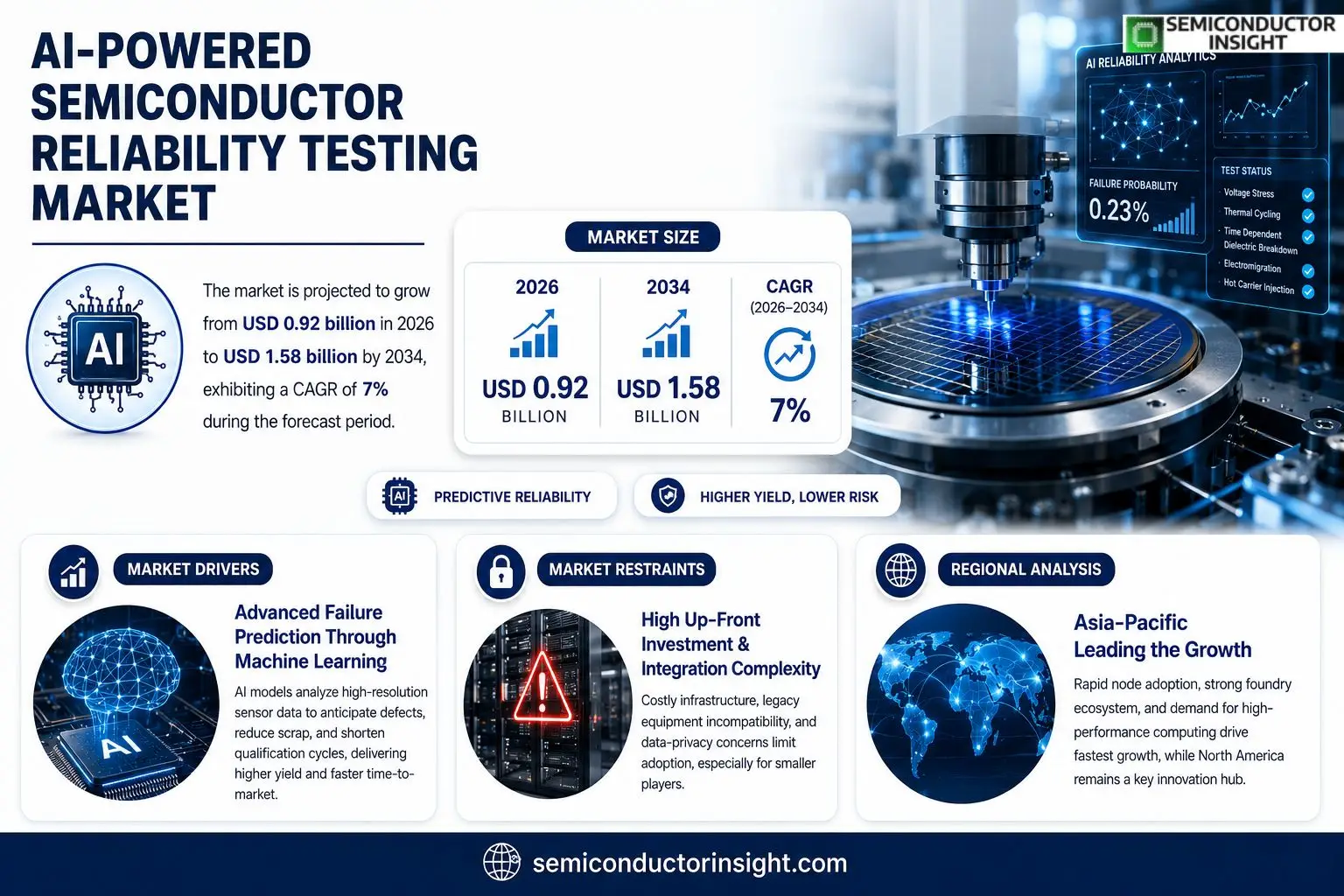
AI-Powered Semiconductor Reliability Testing market size was valued at USD 0.85 billion in 2025. Forecasts indicate growth from USD 0.92 billion in 2026 to USD 1.58 billion by 2034, exhibiting a CAGR of approximately 7 % during the forecast period.
AI-powered semiconductor reliability testing leverages machine‑learning models and high‑resolution sensor data to evaluate failure mechanisms, predict device lifespan, and streamline qualification cycles for silicon components.The sector gains traction because manufacturers are shrinking node geometries while demand for high‑performance computing intensifies; however, integration complexity and data‑privacy concerns remain obstacles.Recent collaborations illustrate strategic movesfor example, the March 2024 alliance between Company A and Company B aimed at co‑developing an AI‑driven test platformwhile incumbents such as Intel, TSMC and Applied Materials continue expanding their AI testing portfolios.
MARKET DRIVERS
Advanced Failure Prediction Through Machine Learning
Manufacturers are leveraging sophisticated algorithms to anticipate defect patterns before silicon leaves the fab. By correlating process sensor data with historical failure logs, predictive analytics reduces scrap rates and shortens time‑to‑market, giving producers a decisive competitive edge.
Integration with Design‑for‑Reliability Platforms
Design teams are embedding AI modules directly into electronic‑design‑automation (EDA) tools, allowing reliability assessments to be performed in parallel with circuit synthesis. This seamless workflow minimizes iterative redesign cycles and aligns product robustness with aggressive performance targets.
➤ “The shift from reactive testing to continuous, AI‑guided validation is reshaping how chip makers safeguard yield.”
These dynamics are fueling demand for the AI‑Powered Semiconductor Reliability Testing Market, as vendors that can offer end‑to‑end intelligence are positioned to capture the most lucrative contracts.
MARKET CHALLENGES
Data Quality and Model Transparency
Robust AI outcomes hinge on clean, high‑resolution datasets. In many fabs, sensor calibration drift and fragmented data silos lead to noisy inputs, which in turn diminish model reliability and erode stakeholder confidence.
Other Challenges
Skill Gap in AI Implementation
The scarcity of engineers who understand both semiconductor physics and advanced machine‑learning techniques hampers rapid deployment, forcing companies to invest heavily in cross‑disciplinary training programs.
MARKET RESTRAINTS
High Up‑Front Investment
Acquiring the compute infrastructure required for real‑time inference, together with licensing premium AI software, represents a considerable capital outlay that deters smaller players from entering the space.
Regulatory Compliance Concerns
Industries such as automotive and aerospace impose stringent safety certifications. Verifying that AI‑driven test results meet these standards adds an extra layer of procedural complexity.
Legacy Equipment Incompatibility
Older test benches lack the digital interfaces needed for seamless data exchange, requiring costly retrofits or parallel testing streams that dilute efficiency gains.
MARKET OPPORTUNITIES
Emerging 5G and Automotive Applications
The rollout of high‑frequency 5G radios and advanced driver‑assistance systems demands semiconductor components that can endure extreme thermal and voltage stresses. AI‑enabled reliability testing offers the granularity required to certify these next‑generation devices.
Edge‑Computing Reliability Services
As edge nodes proliferate, customers seek on‑demand testing platforms that can validate performance under localized workloads. Cloud‑based AI testing suites, capable of scaling resources per request, present a lucrative revenue stream for service providers.
Collaborative Ecosystem Development
Partnerships between fab equipment manufacturers, AI startups, and standards bodies are generating open data models that accelerate algorithm refinement. Companies that embed themselves in this collaborative network stand to benefit from accelerated innovation cycles.
AI-Powered Semiconductor Reliability Testing Market Trends
Adoption Accelerates as Node Sizes Shrink
The transition to sub‑10 nm nodes has tightened design margins, compelling manufacturers to seek predictive validation methods. In 2025 AI-Powered Semiconductor Reliability Testing Market recorded revenue of USD 0.85 billion; a modest rise to USD 0.92 billion in 2026 already reflects early‑stage acceptance. By 2034 the market is forecast to reach roughly USD 1.585 billion, driven by the need to compress qualification cycles while preserving yield. Machine‑learning models that ingest high‑resolution sensor streams now predict failure mechanisms with enough accuracy to replace several traditional stress tests, allowing fab lines to recycle silicon faster and allocate capacity to high‑performance computing workloads.
Other Trends
Strategic Partnerships Shape Ecosystem
Collaboration has become a decisive lever. The March 2024 alliance between Company A and Company B to co‑develop an AI‑driven test platform illustrates how vendors are pooling algorithmic expertise with sensor hardware. At the same time, incumbents such as Intel, TSMC and Applied Materials are broadening their AI testing portfolios, integrating predictive analytics into existing qualification suites. These moves signal a shift from isolated tool purchases toward integrated solution ecosystems, which in turn creates recurring revenue streams for software providers and lowers entry barriers for chip designers.
Integration Complexity and Data‑Privacy Remain Barriers
Despite clear upside, the market confronts two practical hurdles. First, embedding AI models into legacy test equipment requires extensive firmware rewrites and validation of data pipelines, a process that can stall rollout for up to twelve months. Second, manufacturers are increasingly cautious about sharing wafer‑level sensor data, fearing exposure of proprietary process parameters. The tension between the desire for cloud‑based analytics and the need to protect intellectual property forces many players to adopt hybrid on‑premise solutions, which dampens the speed of broader adoption. Companies that can deliver secure, turnkey integrations are likely to capture the most profitable contracts as the industry balances innovation with risk management.
COMPETITIVE LANDSCAPEKey Industry Players
AI‑Powered Semiconductor Reliability Testing: Competitive Overview
Intel remains the dominant force, leveraging its extensive design‑for‑test portfolio and deep silicon‑validation expertise to embed AI analytics across its reliability platforms. By integrating machine‑learning pipelines directly into wafer‑level stress testing, Intel shortens qualification cycles while preserving yield confidence. The company’s strategy blends in‑house model development with selective acquisitions, creating a tiered ecosystem where large foundries and OEMs rely on its standards. This concentration around a few vertically integrated giants shapes bargaining power, pushing smaller vendors to specialize in niche sensor fusion or data‑privacy solutions.Beyond the incumbents, a cluster of specialized firms is reshaping the value chain. Advantest and Teradyne apply high‑speed test‑equipment back‑end capabilities, now augmented with predictive analytics that flag out‑of‑spec drift before damaging production runs. KLA Corporation and ASML contribute advanced metrology data that feeds AI engines for defect‑trend forecasting. Meanwhile, software‑centric players such as Cadence, Ansys and National Instruments deliver simulation‑to‑test translation layers, enabling design houses to execute “virtual reliability” runs. These niche actors, although smaller in revenue, are critical because they inject agility and domain‑specific insight that large manufacturers cannot develop internally.
List of Key AI-Powered Semiconductor Reliability Testing Companies Profiled
- Intel Corporation
- Taiwan Semiconductor Manufacturing Company (TSMC)
- Applied Materials
- Advantest Corporation
- Teradyne, Inc.
- KLA Corporation
- ASML Holding NV
- Cadence Design Systems, Inc.
- Ansys, Inc.
- National Instruments Corporation
- Mentor, a Siemens Business
- Lam Research Corporation
- Foundries Inc.
- Xilinx (AMD)
- NVIDIA Corporation
Segment Analysis:
| Segment Category | Sub-Segments | Key Insights |
| By Type |
|
Machine Learning Algorithms drive deeper pattern recognition in reliability data, enabling proactive defect identification and accelerating qualification cycles.
|
| By Application |
|
Failure Mode Prediction is increasingly preferred as manufacturers contend with shrinking node geometries.
|
| By End User |
|
Fab Operators benefit from AI‑driven workflows that reduce manual data interpretation.
|
| By Test Methodology |
|
Predictive Analytics stands out for its capacity to anticipate reliability issues before physical testing.
|
| By Integration Level |
|
Embedded AI within Test Equipment is gaining traction as it blends real‑time inference with hardware control.
|
Regional Analysis: AI-Powered Semiconductor Reliability Testing Market
North America
In the United States, algorithmic refinement has moved beyond anomaly detection to encompass root‑cause attribution, allowing operators to isolate process drift in real time. This capability reduces rework and shortens time‑to‑volume for emerging node technologies, giving fabs a measurable competitive edge.
Partnerships between test equipment manufacturers and silicon foundries are becoming standard, with joint development agreements that co‑engineer AI modules tailored to specific process windows, thereby streamlining validation cycles.
Adoption is reinforced by stricter reliability standards in automotive and aerospace sectors, which compel OEMs to certify that their chips meet predictive‑maintenance criteria, creating a mandatory market pull for AI‑based testing solutions.
Venture capital and corporate venture arms are allocating funds to startups that fuse AI with silicon test instrumentation, accelerating the pipeline of niche solutions that address edge‑case failure modes not covered by traditional methods.
Europe
European manufacturers are capitalising on the continent’s strong focus on sustainability and circular‑economy principles. By embedding AI into reliability testing, they can extend the usable life of legacy wafers, aligning with EU directives on resource efficiency. Moreover, the region’s fragmented marketspanning Germany’s precision equipment firms to France’s design housescreates a mosaic of pilots that collectively benchmark best practices. Standardisation bodies such as the European Semiconductor Consortium are already drafting guidelines that incorporate predictive analytics, ensuring that early adopters gain a compliance advantage across the single market.
Asia‑Pacific
Asia‑Pacific’s surge is driven by the sheer scale of its foundry capacity and the aggressive node‑shrinking roadmaps pursued by regional chipmakers. AI‑enabled reliability testing offers a way to manage the mounting complexity of multi‑patterned designs without proportionally increasing test time. Countries like Taiwan and South Korea are integrating these tools into their fab automation layers, allowing real‑time feedback loops that adjust process parameters on the fly. The competitive pressure to deliver higher yield at lower cost compels firms to treat AI as a cost‑containment lever rather than a luxury add‑on.
South America
In South America, the market is emerging from a nascent stage where traditional test benches dominate. However, Brazil’s growing semiconductor design ecosystem is beginning to import AI‑driven test platforms to meet the reliability expectations of its automotive and renewable‑energy customers. Local government incentives that reward advanced manufacturing have nudged early adopters to experiment with predictive‑maintenance models, fostering a modest but observable shift toward data‑centric testing methodologies.
Middle East & Africa
The Middle East & Africa region is still calibrating its entry into the AI‑Powered Semiconductor Reliability Testing Market. Investment in smart‑factory infrastructure, particularly in the United Arab Emirates and South Africa, is creating footholds for test equipment providers to showcase AI capabilities. Pilot projects aimed at supporting defense‑grade silicon components are exposing local OEMs to the value proposition of predictive analytics, laying the groundwork for broader adoption as regional supply chains mature.
Report Scope
This market research report provides a comprehensive analysis of the AI-Powered Semiconductor Reliability Testing Market , covering the forecast period 2026–2034. It offers detailed insights into market dynamics, technological advancements, competitive landscape, and key trends shaping the industry.
Key focus areas of the report include:
- ✅Market Overview: The report begins with an overview outlining its current market scenario, key growth indicators, and industry transformation drivers. It discusses macroeconomic factors, demand–supply balance, regulatory landscape, and the strategic role of semiconductors in powering advancements across industries such as automotive, telecommunications, consumer electronics, and industrial automation.
- ✅Market Size & Forecast: Historical data and future projections for revenue, unit shipments, and market value across major regions and segments.
- ✅Segmentation Analysis: Detailed breakdown by product type, technology, application, and end-user industry to identify high-growth segments and investment opportunities.
- ✅Regional Insights: Insights into market performance across North America, Europe, Asia‑Pacific, Latin America, and the Middle East & Africa, including country‑level analysis where relevant.
- ✅Competitive Landscape: Profiles of leading market participants, including their product offerings, R&D focus, manufacturing capacity, pricing strategies, and recent developments such as mergers, acquisitions, and partnerships.
- ✅Technology Trends & Innovation: Assessment of emerging technologies, integration of AI/IoT, semiconductor design trends, fabrication techniques, and evolving industry standards.
- ✅Market Drivers & Restraints: Evaluation of factors driving market growth along with challenges, supply chain constraints, regulatory issues, and market‑entry barriers.
- ✅Stakeholder Insights: Insights for component suppliers, OEMs, system integrators, investors, and policymakers regarding the evolving ecosystem and strategic opportunities.
Primary and secondary research methods are employed, including interviews with industry experts, data from verified sources, and real‑time market intelligence to ensure the accuracy and reliability of the insights presented.
FREQUENTLY ASKED QUESTIONS:
What is the current market size of AI-Powered Semiconductor Reliability Testing Market?
-> AI-Powered Semiconductor Reliability Testing Market was valued at USD 0.85 billion in 2025 and is expected to reach USD 1.58 billion by 2034.
Which key companies operate in AI-Powered Semiconductor Reliability Testing Market?
-> Key players include Intel, TSMC, Applied Materials, among others.
What are the key growth drivers?
-> Key growth drivers include shrinkage of node geometries and rising demand for high‑performance computing.
Which region dominates the market?
-> Asia‑Pacific is the fastest‑growing region, while North America remains a dominant market.
What are the emerging trends?
-> Emerging trends include AI‑driven test platforms, integration‑complexity challenges, and data‑privacy considerations.
Get Sample Report PDF for Exclusive Insights
Report Sample Includes
- Table of Contents
- List of Tables & Figures
- Charts, Research Methodology, and more...
 Download Sample Report PDF