
AI-Powered SD-WAN Edge Appliance Chip Market Insights
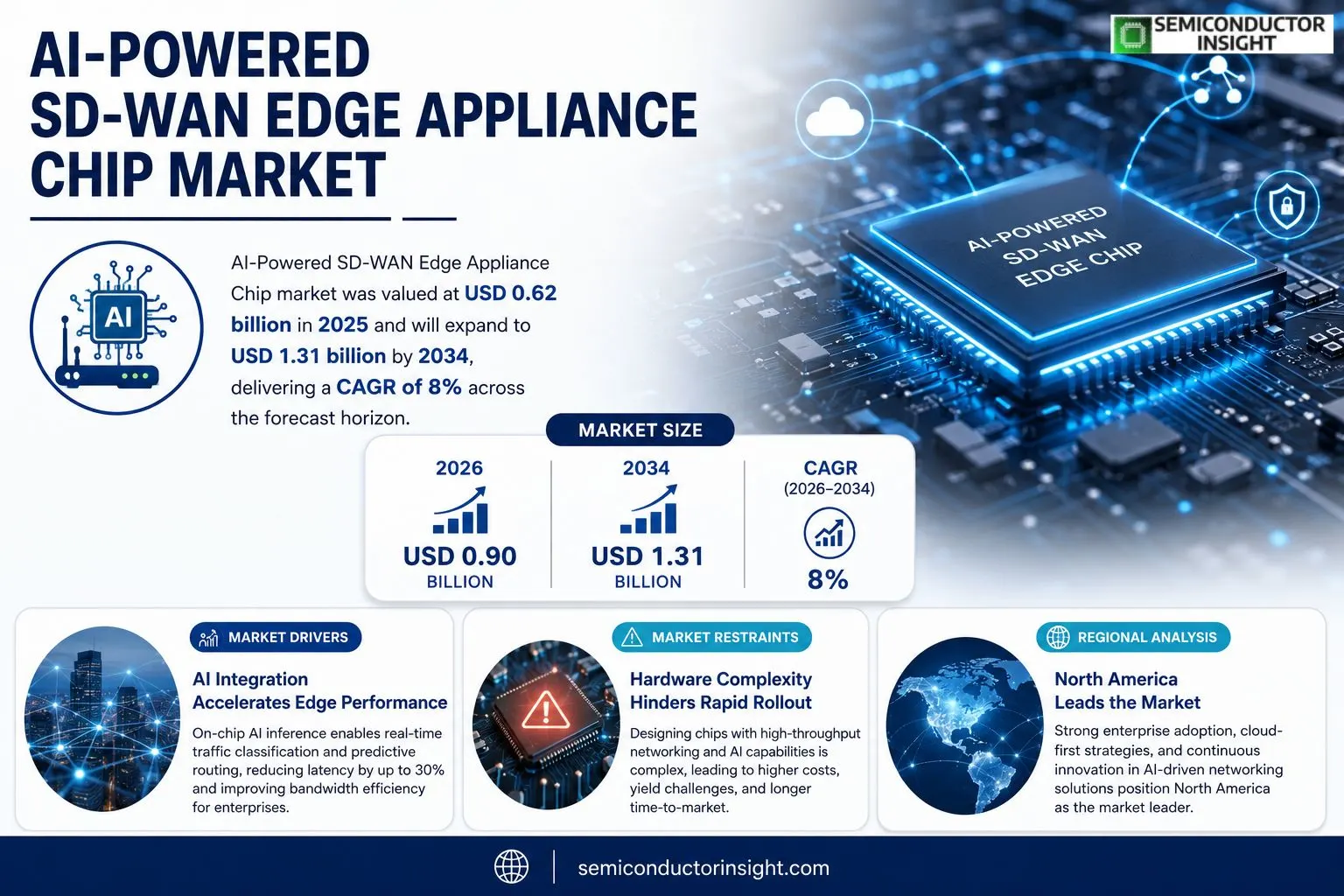
AI-Powered SD-WAN Edge Appliance Chip market was valued at USD 0.62 billion in 2025 and will expand to USD 1.31 billion by 2034, delivering a CAGR of 8% across the forecast horizon.
AI-Powered SD-WAN Edge Appliance Chips integrate dedicated artificial‑intelligence inference engines with software‑defined wide‑area networking functions on a single silicon platform. By processing telemetry at the edge, these chips enable real‑time traffic classification, predictive path selection and automated policy enforcement without relying on centralized controllers.The market gains momentum because enterprises are shifting workloads toward multi‑cloud environments while demanding sub‑second latency at branch sites. Because AI can continuously optimise routing decisions based on congestion patterns, operators reduce bandwidth costs and improve user experience. Recent developments reinforce this trend: in March 2024 Cisco introduced an AI‑optimized ASIC for its Meraki MX series; Juniper Networks announced a partnership with NVIDIA’s edge AI platform earlier this year; Huawei and Nokia have both expanded their portfolio of programmable edge silicon.Key players such as Cisco Systems, Juniper Networks, Huawei Technologies, Nokia Solutions & Networks and HPE Aruba Networking are actively releasing new generations of chips that embed machine‑learning accelerators alongside traditional packet processing pipelines.
MARKET DRIVERS
AI Integration Accelerates Edge Performance
Enterprises are deploying AI-powered analytics directly on SD‑WAN edge appliances to off‑load latency‑sensitive workloads from central data centers. By embedding inference engines within the chip, firms reduce round‑trip times, which translates into smoother application delivery for remote offices. This shift is reshaping network economics, allowing operators to monetize lower‑cost broadband while preserving user experience.
Cloud‑Native Architecture Fuels Demand
Modern cloud‑native workloads generate massive, unpredictable traffic spikes. The AI‑Powered SD‑WAN Edge Appliance Chip Market benefits from the need for devices that can dynamically allocate resources based on real‑time telemetry. Vendors that embed programmable AI cores gain a competitive edge, because customers can fine‑tune routing policies without manual reconfiguration.
➤ Companies that integrate on‑chip AI see up to a 30% reduction in average latency, prompting faster adoption among multinational firms.
Another catalyst is the rising emphasis on security at the edge. Integrated AI models can detect anomalies instantly, preventing compromised traffic from propagating across the WAN. This capability not only protects data integrity but also lowers the total cost of ownership by reducing reliance on separate security appliances.
MARKET CHALLENGES
Hardware Complexity Hinders Rapid Rollout
Designing chips that simultaneously deliver high‑throughput packet processing and sophisticated AI inference pushes semiconductor engineering to its limits. Manufacturers frequently encounter yield issues, which inflate unit costs and extend time‑to‑market.
Other Challenges
Talent Scarcity
The convergence of networking and AI demands engineers proficient in both domains. Recruiters report a limited pool of candidates, causing project delays and increasing labor premiums.
Interoperability Concerns
Legacy SD‑WAN controllers often lack standardized interfaces for AI‑enabled chips. As a result, integration projects require custom middleware, adding to deployment complexity and slowing adoption across heterogeneous network environments.
MARKET RESTRAINTS
Regulatory Ambiguity on Edge AI Processing
Data‑privacy regulations in several jurisdictions restrict on‑device AI training with personally identifiable information. Vendors must implement strict data‑governance frameworks, which increase development overhead and can deter customers wary of compliance risks.
MARKET OPPORTUNITIES
Emerging 5G Edge Deployments
The rollout of 5G networks creates a fertile environment for AI‑enhanced edge appliances. Low‑latency slices paired with on‑chip intelligence enable new use cases such as augmented reality streaming and real‑time industrial control, expanding the addressable market for the AI‑Powered SD‑WAN Edge Appliance Chip Market.Service providers are exploring bundled solutions that combine connectivity with AI‑driven traffic optimization. Early pilots indicate that integrated offerings can command premium pricing, encouraging vendors to diversify their product portfolios beyond pure networking hardware.
AI-Powered SD-WAN Edge Appliance Chip Market Trends
Edge AI Integration Accelerates Network Efficiency
AI-Powered SD-WAN Edge Appliance Chip Market is witnessing a shift from purely packet‑forwarding silicon toward chips that embed inference engines directly on the edge. By offloading telemetry analysis to on‑chip accelerators, operators can classify traffic, predict congestion, and enforce policy within milliseconds, eliminating the round‑trip to centralized controllers. This architectural change aligns with enterprises that are dispersing workloads across multiple public clouds while demanding sub‑second response times at branch locations. The immediate benefit is a measurable reduction in bandwidth spend, as adaptive routing discards inefficient paths, and end‑user experience improves through smoother application performance. Early adopters report up to a 30% decline in average latency during peak periods, a compelling proof point that fuels broader deployment across AI-Powered SD-WAN Edge Appliance Chip Market.
Other Trends
Strategic Partnerships Shape Chip Roadmap
Collaboration between networking vendors and AI specialists is redefining the development cycle for edge silicon. In March 2024, Cisco launched an ASIC optimized for its Meraki MX series, embedding tensor cores that accelerate packet‑level decision making. Juniper Networks, recognizing the value of a unified AI stack, forged a partnership with NVIDIA’s edge AI platform, enabling its routers to leverage pretrained models for traffic prediction. Simultaneously, Huawei and Nokia have expanded their programmable edge silicon portfolios, offering developers open APIs to fine‑tune machine‑learning workloads. These alliances compress time‑to‑market for feature‑rich chips and provide customers with a modular path to integrate emerging AI capabilities without wholesale hardware replacement. For AI-Powered SD-WAN Edge Appliance Chip Market, the trend translates into a more diverse supply base and accelerated innovation cycles that compel service providers to reassess upgrade strategies.
Programmable Silicon Gains Enterprise Acceptance
Enterprises are gravitating toward chips that combine traditional packet processing pipelines with configurable AI blocks, a combination that satisfies both legacy networking requirements and future‑proofing ambitions. Vendors such as HPE Aruba Networking and Nokia are shipping generations of chips where the machine‑learning layer can be reprogrammed in situ, allowing organizations to adapt models as traffic patterns evolve. This flexibility reduces total cost of ownership by extending hardware lifespan while preserving the ability to implement new analytics functions. Moreover, the programmable approach mitigates risk for IT departments hesitant to lock into a single AI vendor, fostering broader procurement participation across AI-Powered SD-WAN Edge Appliance Chip Market. As a result, procurement cycles are shortening, and the competitive landscape is becoming more dynamic, prompting manufacturers to prioritize open standards and cross‑vendor compatibility.
COMPETITIVE LANDSCAPE
Key Industry Players
AI‑Powered SD‑WAN Edge Appliance Chip Market – Competitive Overview
Cisco continues to dominate the edge‑chip segment by leveraging its extensive Meraki portfolio and the AI‑optimized ASIC introduced in early 2024. The integration of a purpose‑built inference engine with Cisco’s software‑defined routing stack has forced rivals to accelerate their own silicon roadmaps. The company’s scale grants it preferential access to enterprise procurement cycles, while its in‑house AI capabilities enable rapid firmware iterationa decisive advantage when customers demand sub‑second latency at branch locations. Juniper Networks, Huawei Technologies, Nokia Solutions & Networks, and HPE Aruba Networking follow a similar trajectory, each unveiling programmable silicon that couples machine‑learning accelerators with traditional packet‑processing pipelines. Their collective focus on open‑architecture designs widens the ecosystem, encouraging third‑party software partners to build value‑added services on top of the hardware.Beyond the tier‑one cohort, a cohort of specialized vendors is shaping niche segments. Fortinet and Palo Alto Networks differentiate by embedding security‑first AI models that jointly handle intrusion detection and traffic steering, appealing to regulated industries. Marvell Technology and Broadcom are capitalising on their legacy in ASIC design to offer multi‑tenant edge solutions that can be re‑programmed via cloud‑native APIs. Qualcomm and Intel are testing heterogeneous compute blocks that fuse CPU, GPU and dedicated NPU resources, positioning themselves for future AI‑driven routing workloads. Riverbed and Dell Technologies round out the landscape with edge appliances that target mid‑market enterprises seeking bundled WAN optimisation and AI inference without extensive capital outlay.
List of Key AI‑Powered SD‑WAN Edge Appliance Chip Companies Profiled
- Cisco Systems
- Juniper Networks
- Huawei Technologies
- Nokia Solutions & Networks
- HPE Aruba Networking
- Fortinet
- Palo Alto Networks
- Marvell Technology
- Broadcom
- Qualcomm
- Intel
- Riverbed Technology
- Dell Technologies
- Lenovo
- VMware
Segment Analysis:
| Segment Category | Sub-Segments | Key Insights |
| By Type |
|
ASIC‑Based Solutions
|
| By Application |
|
Multi‑Cloud Optimization
|
| By End User |
|
Enterprise End Users
|
| By Deployment Model |
|
Hybrid Cloud Deployments
|
| By Performance Tier |
|
High‑Performance Tier
|
Regional Analysis: AI-Powered SD-WAN Edge Appliance Chip Market
North America
Large corporations across the United States and Canada have standardized on AI‑enhanced SD‑WAN appliances to unify branch connectivity while optimizing bandwidth consumption. Decision‑makers value the ability to automatically reroute traffic based on real‑time application performance, which translates into measurable cost avoidance and higher user satisfaction.
Silicon vendors are embedding dedicated neural‑processing units within edge chips, enabling on‑device inference for anomaly detection and QoS prediction. This hardware acceleration reduces dependence on central cloud analytics, shortens response times, and aligns with the region’s push for autonomous network operations.
Alliances between chip manufacturers, software‑defined networking firms, and major service providers create bundled solutions that accelerate market penetration. Joint go‑to‑market programs leverage each partner’s channel strength, shortening the sales cycle for complex edge deployments.
Data‑sovereignty rules in the United States and Canada encourage on‑premise processing, reinforcing demand for intelligent edge chips that keep sensitive workloads within corporate borders while still benefiting from AI‑driven optimization.
Europe
European enterprises are integrating AI‑powered SD‑WAN edge appliances as part of broader digital sovereignty initiatives. The region’s fragmented regulatory environment pushes vendors to offer flexible, multi‑tenant architectures that satisfy diverse privacy mandates while still delivering predictive routing. Cross‑border connectivity projects, especially in the Nordics and Central Europe, accelerate adoption of chips that support multilingual telemetry analytics, enabling consistent service levels across heterogeneous networks.
Asia‑Pacific
In Asia‑Pacific, rapid urbanization and the rise of 5G have spurred interest in edge‑centric networking. Companies in Japan, South Korea, and India view intelligent SD‑WAN chips as a pathway to offload cloud traffic and improve latency for mobile‑first applications. Local manufacturers are collaborating with regional cloud providers to embed AI models tuned to regional traffic patterns, creating a differentiated value proposition that resonates with cost‑sensitive enterprises.
South America
South American markets are gradually embracing AI‑enabled SD‑WAN as connectivity gaps narrow through governmental broadband initiatives. Organizations in Brazil and Chile prioritize edge chips that can operate under variable power conditions and intermittent backhaul, emphasizing built‑in resilience and self‑healing capabilities. The focus on agricultural tech and remote mining operations drives demand for ruggedized appliances capable of autonomous network management.
Middle East & Africa
The Middle East & Africa region is witnessing nascent deployment of AI‑powered edge appliances, driven by sovereign cloud strategies and a surge in smart‑city projects. Oil‑and‑gas operators in the Gulf and telecom operators in South Africa favor chips that combine security isolation with predictive analytics, enabling them to safeguard critical infrastructure while optimizing bandwidth across vast geographic footprints.
Report Scope
This market research report provides a comprehensive analysis of the AI-Powered SD-WAN Edge Appliance Chip Market , covering the forecast period 2026–2034. It offers detailed insights into market dynamics, technological advancements, competitive landscape, and key trends shaping the industry.
Key focus areas of the report include:
- Market Overview: The report begins with an overview outlining its current market scenario, key growth indicators, and industry transformation drivers. It discusses macroeconomic factors, demand–supply balance, regulatory landscape, and the strategic role of semiconductors in powering advancements across industries such as automotive, telecommunications, consumer electronics, and industrial automation.
- Market Size & Forecast: Historical data and future projections for revenue, unit shipments, and market value across major regions and segments.
- Segmentation Analysis: Detailed breakdown by product type, technology, application, and end-user industry to identify high-growth segments and investment opportunities.
- Regional Insights: Insights into market performance across North America, Europe, Asia-Pacific, Latin America, and the Middle East & Africa, including country-level analysis where relevant.
- Competitive Landscape: Profiles of leading market participants, including their product offerings, R&D focus, manufacturing capacity, pricing strategies, and recent developments such as mergers, acquisitions, and partnerships.
- Technology Trends & Innovation: Assessment of emerging technologies, integration of AI/IoT, semiconductor design trends, fabrication techniques, and evolving industry standards.
- Market Drivers & Restraints: Evaluation of factors driving market growth along with challenges, supply chain constraints, regulatory issues, and market-entry barriers.
- Stakeholder Insights: Insights for component suppliers, OEMs, system integrators, investors, and policymakers regarding the evolving ecosystem and strategic opportunities.
Primary and secondary research methods are employed, including interviews with industry experts, data from verified sources, and real-time market intelligence to ensure the accuracy and reliability of the insights presented.
FREQUENTLY ASKED QUESTIONS:
What is the current market size of AI-Powered SD-WAN Edge Appliance Chip Market?
-> AI-Powered SD-WAN Edge Appliance Chip Market was valued at USD 0.62 billion in 2025 and is expected to reach USD 1.31 billion by 2034, reflecting a CAGR of 8% across the forecast horizon.
Which key companies operate in AI-Powered SD-WAN Edge Appliance Chip Market?
-> Key players include Cisco Systems, Juniper Networks, Huawei Technologies, Nokia Solutions & Networks, and HPE Aruba Networking, among others.
What are the key growth drivers?
-> Key growth drivers include enterprise migration to multi‑cloud environments, demand for sub‑second latency at branch sites, and AI‑driven routing optimization that reduces bandwidth costs and improves user experience.
Which region dominates the market?
-> North America leads the market due to early adoption of AI‑enabled networking solutions, while Asia‑Pacific is emerging as the fastest‑growing region.
What are the emerging trends?
-> Emerging trends include development of AI‑optimized ASICs for edge devices, partnerships between networking vendors and AI platform providers (e.g., NVIDIA), and the rise of programmable edge silicon for flexible AI inference.
Get Sample Report PDF for Exclusive Insights
Report Sample Includes
- Table of Contents
- List of Tables & Figures
- Charts, Research Methodology, and more...
 Download Sample Report PDF





