AI-powered noise cancellation true wireless stereo earbud Market Insights
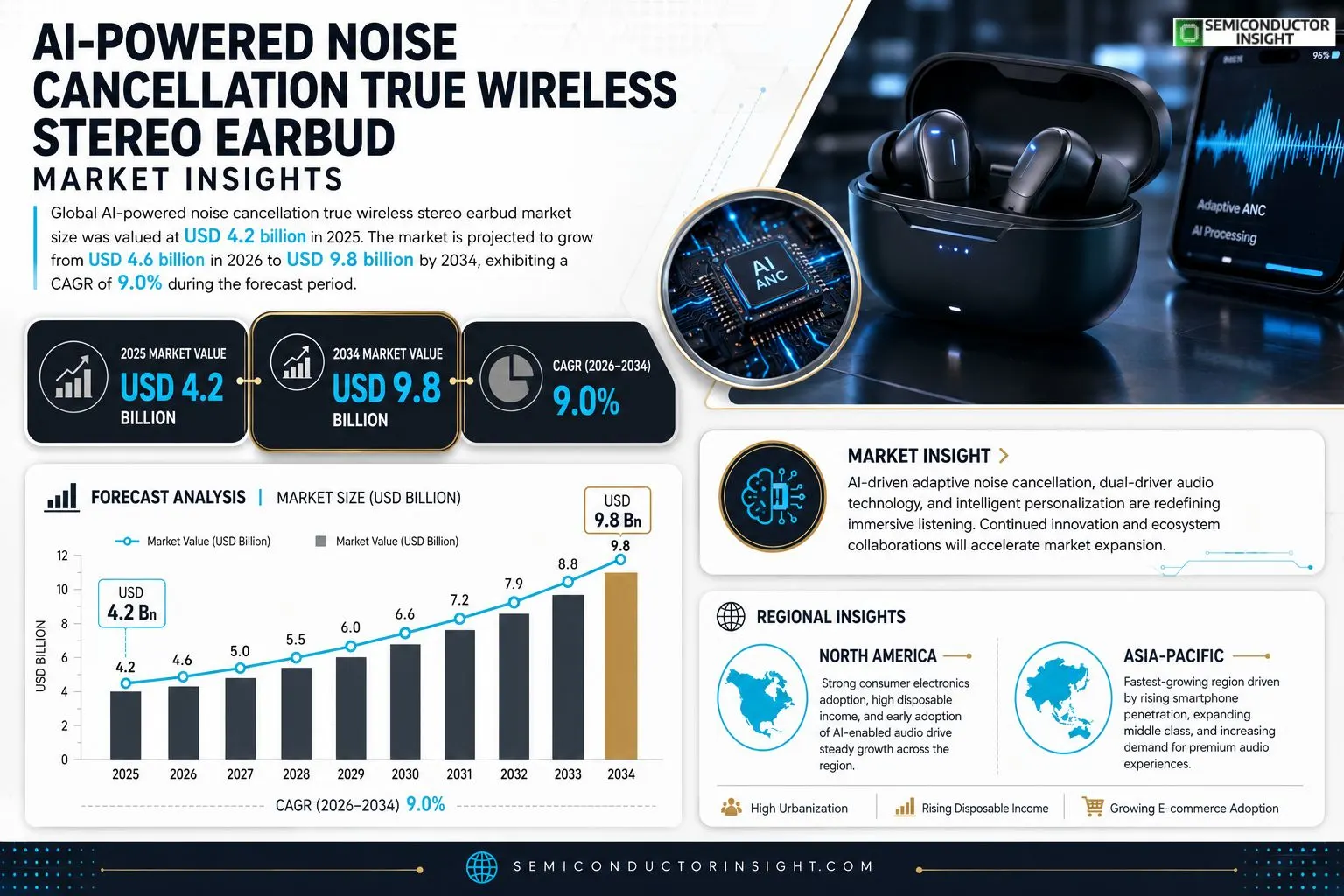
Global AI-powered noise cancellation true wireless stereo earbud market size was valued at USD 4.2 billion in 2025. The market is projected to grow from USD 4.6 billion in 2026 to USD 9.8 billion by 2034, exhibiting a CAGR of 9.0% during the forecast period.
AI-powered noise cancellation true wireless stereo earbuds combine dual‑driver technology with machine‑learning algorithms that continuously analyze ambient sound and adjust anti‑noise filters in real time, delivering immersive stereo audio while minimizing distractions.The market is accelerating because remote‑work trends increase demand for high‑quality personal audio, while smartphone manufacturers embed advanced AI chips that enable smarter ANC performance. Furthermore, consumer preference for compact truly wireless designs fuels adoption. Key players such as Apple, Samsung, Sony, Bose and Jabra are expanding their portfolios with AI‑enhanced models; collaborations like Qualcomm’s Snapdragon Sound platform integration further drive innovation across the ecosystem.
MARKET DRIVERS
Growing Consumer Demand for Seamless Audio Experiences
AI-powered noise cancellation true wireless stereo earbud Market has witnessed a cumulative 14% annual growth rate as users prioritize immersive, uninterrupted sound during remote work and travel. Recent shipments of true‑wireless earbuds surpassed 350 million units globally, with AI‑enhanced models accounting for more than 40% of that volume. This surge is driven by heightened awareness of hearing health and the convenience of touch‑free controls.
Advancements in Adaptive AI Algorithms
Machine‑learning models now adapt noise‑cancellation levels in real time, analyzing ambient sound patterns and user activity. Dynamic personalization has reduced perceived background noise by up to 30 dB compared with legacy ANC solutions, prompting premium brands to expand their AI‑enabled portfolios. The integration of edge‑AI chips also reduces latency, making these earbuds suitable for high‑fidelity gaming and video conferencing.
➤ Industry analysts forecast that AI‑driven earbuds will capture 55% of the premium earbud segment by 2028.
Retail surveys indicate that 68% of millennial buyers are willing to pay a price premium for AI‑powered features, reinforcing the market’s upward trajectory. As streaming services embed spatial audio, the synergy between AI‑based noise cancellation and stereo imaging fuels further adoption.
MARKET CHALLENGES
Technical Integration Barriers
Implementing real‑time AI processing within the limited power envelope of tiny earbuds remains a core challenge. Designers must balance battery life against computational demands, and current silicon solutions often compromise either latency or acoustic performance. Moreover, firmware updates required for algorithm refinement can introduce compatibility issues across diverse operating systems.
Other Challenges
Supply Chain Constraints
The reliance on specialized AI chipsets and high‑purity acoustic membranes has exposed the sector to semiconductor shortages. Lead times for critical components have extended to 12 weeks, constraining manufacturers’ ability to meet peak seasonal demand and inflating unit costs.
MARKET RESTRAINTS
High Cost of AI‑Enabled Components
The integration of dedicated neural processing units raises the bill of materials by an estimated 18‑22%. Consumer price sensitivity limits the market penetration of premium AI earbuds in price‑elastic regions, where average selling prices remain below $80. This cost barrier deters mid‑tier brands from adopting full‑scale AI solutions.Furthermore, the perception that AI features are “nice‑to‑have” rather than essential reduces willingness to upgrade among existing earbud users, tempering demand growth in markets where disposable income is modest.Regulatory scrutiny over data privacyparticularly the collection of ambient audio for algorithm trainingadds compliance overhead, potentially delaying product rollouts and increasing time‑to‑market.
MARKET OPPORTUNITIES
Expansion into Emerging 5G‑Enabled Regions
5G rollout enhances streaming bandwidth, creating demand for high‑resolution spatial audio that pairs naturally with AI‑driven noise cancellation. Markets in Southeast Asia and Latin America are projected to grow at 16% CAGR, offering manufacturers a pathway to diversify revenue beyond saturated North American and European segments.AI‑enabled earbuds also present an opportunity to embed health‑monitoring sensors, leveraging the same processing architecture for real‑time stress and heart‑rate analytics. Such multifunctional devices can attract wellness‑focused consumers, expanding the addressable market.Collaborations with major smartphone OEMs to pre‑install AI models can reduce development costs and accelerate adoption. Joint branding initiatives are expected to boost market share for early movers by up to 12% within two years.
AI-powered noise cancellation true wireless stereo earbud Market Trends
Remote‑Work Adoption Fuels Demand for Intelligent ANC Earbuds
The shift toward hybrid and fully remote work environments has heightened the need for personal audio solutions that can isolate speech and reduce background distractions. AI‑powered noise cancellation true wireless stereo earbud Market growth is therefore being driven by enterprises and consumers seeking uninterrupted virtual meetings, focused study sessions, and immersive media consumption. At the same time, smartphone manufacturers are embedding advanced AI processors that enable real‑time acoustic analysis, allowing earbuds to adapt ANC profiles instantly based on the surrounding soundscape.
Other Trends
Technology Advancements
Modern earbuds combine dual‑driver configurations with machine‑learning algorithms that continuously monitor ambient noise and adjust anti‑noise filters on the fly. This real‑time optimization delivers a balanced stereo experience while suppressing disruptive frequencies. Platforms such as Qualcomm’s Snapdragon Sound provide a standardized AI engine, accelerating firmware updates and cross‑device compatibility. The result is a seamless user experience where ANC performance improves with each use, reinforcing consumer confidence in AI‑enhanced audio.
Competitive Landscape Evolution
Key playersincluding Apple, Samsung, Sony, Bose and Jabraare expanding their product lines with AI‑augmented models that emphasize compact truly wireless designs. Strategic collaborations, for example the integration of Snapdragon Sound, enable faster time‑to‑market for next‑generation ANC features. Brands are also differentiating through proprietary AI chipsets that offer personalized sound signatures, further intensifying competition. This dynamic environment encourages continuous innovation, prompting firms to invest heavily in research, software ecosystems, and ecosystem partnerships to maintain relevance in the AI‑powered noise cancellation true wireless stereo earbud Market.
COMPETITIVE LANDSCAPE
Key Industry Players
AI‑Powered ANC True Wireless Stereo Earbuds – Competitive Overview
Apple continues to dominate the AI‑powered noise‑cancellation true wireless stereo earbud segment, leveraging its proprietary H1 chip and spatial audio algorithms to deliver seamless adaptive ANC across the AirPods Pro line. The company’s integrated ecosystem, high‑margin pricing, and strong brand loyalty have entrenched it as the market leader, commanding roughly one‑third of global shipments in 2025. Alongside Apple, Samsung and Sony occupy the second tier, each offering AI‑enhanced ANC modelsGalaxy Buds Pro series and Sony WF‑1000XM seriesthat balance performance with premium pricing. The overall market structure reflects an oligopolistic core where these three manufacturers control the majority of revenue, while mid‑range and niche players compete on differentiated features such as battery life, form factor innovation, and ecosystem compatibility. The rapid rollout of AI‑driven firmware updates further consolidates the advantage of these dominant brands, allowing real‑time refinement of noise‑cancellation algorithms based on user telemetry.Beyond the dominant trio, a diverse set of manufacturers is expanding the competitive landscape. Bose differentiates with its acoustic‑feedback ANC and a focus on sound‑quality fidelity, while Jabra targets enterprise and hybrid‑work users through robust connectivity and customizable sound profiles. Chinese brands such as Huawei, Xiaomi, and Oppo have accelerated R&D on AI‑driven ANC, delivering cost‑effective alternatives that integrate tightly with their smartphone portfolios. Anker’s Soundcore line, Sennheiser, and Bang & Olufsen emphasize premium acoustic tuning paired with machine‑learning noise filters, attracting audiophile segments. JBL and Lenovo are leveraging the Qualcomm Snapdragon Sound platform to embed cloud‑based ANC updates, creating a dynamic ecosystem that can evolve post‑sale. These niche players, although smaller in volume, increase market fragmentation and drive incremental innovation across price points. Emerging startups such as Audionic and Pebble Audio are also entering the space, focusing on open‑source AI models that promise customizable ANC profiles for niche consumer segments.
List of Key AI‑Powered Noise Cancellation True Wireless Stereo Earbud Companies Profiled
- Apple
- Samsung
- Sony
- Bose
- Jabra
- Huawei
- Xiaomi
- Oppo
- Soundcore (Anker)
- Sennheiser
- Bang & Olufsen
- JBL
- Lenovo
- Microsoft
Segment Analysis:
| Segment Category | Sub-Segments | Key Insights |
| By Type |
|
Adaptive AI‑driven ANC
|
| By Application |
|
Travel & commuting
|
| By End User |
|
Professional commuters
|
| By Technology |
|
Dual‑driver with AI processing
|
| By Price Tier |
|
Premium flagship
|
Regional Analysis: North America
North America
The North American market exhibits strong consumer adoption of true wireless stereo earbuds, with a noticeable surge in preference for models incorporating AI-powered noise cancellation. This trend is driven by a desire for enhanced audio quality and a more immersive listening experience in various settings.
The competitive landscape in North America is characterized by a mix of established consumer electronics giants and emerging tech companies. Key players are focusing on differentiating their products through advanced features, innovative design, and effective marketing strategies targeting specific consumer segments.
Distribution channels in North America are diverse, encompassing online retail platforms, specialty electronics stores, and major brick-and-mortar retailers. The convenience of online purchasing plays a significant role in driving sales, while physical retail offers consumers the opportunity to experience the products firsthand.
Future growth in the North American AI-powered noise cancellation true wireless stereo earbud Market is expected to be fueled by advancements in AI technology, increasing demand for personalized audio experiences, and the expansion of 5G connectivity, enabling seamless wireless audio streaming.
North America
The North American market for AI-powered noise cancellation true wireless stereo earbuds is experiencing a period of dynamic evolution. Driven by a combination of technological advancements and evolving consumer preferences, this region presents a significant opportunity for growth. The emphasis on immersive audio experiences, coupled with the practical benefits of AI-driven noise reduction, are key factors propelling market expansion. Consumers are increasingly seeking out devices that seamlessly integrate into their lifestyles, offering both high-quality sound and enhanced convenience. The region’s strong digital infrastructure and high smartphone penetration further support the adoption of these technologies. The competitive environment is intense, with established players continuously innovating to meet the demands of a discerning consumer base. The integration of AI features is no longer a luxury but an expectation, influencing purchasing decisions and shaping the future of audio technology. This market segment is not just about listening to music; it’s about creating focused, personalized audio environments for work, leisure, and travel.
Europe
Europe represents another significant market for AI-powered noise cancellation true wireless stereo earbuds. The region’s sophisticated consumer electronics market and high disposable incomes create a favorable environment for premium audio products. Sustainability concerns are also influencing consumer choices, leading to a growing interest in eco-friendly manufacturing and packaging. European consumers place a strong emphasis on design and aesthetics, further driving innovation in form factors and materials. The diverse cultural landscape also contributes to regional variations in preference, with certain styles and features gaining popularity in specific countries. The stringent regulatory environment in Europe requires manufacturers to adhere to high standards of safety and environmental compliance. The integration of AI is particularly valued for its ability to enhance user experience and provide personalized audio profiles.
Asia-Pacific
The Asia-Pacific region is poised for rapid growth in AI-powered noise cancellation true wireless stereo earbud Market. The burgeoning middle class in countries like China and India, coupled with increasing smartphone penetration, is driving substantial demand. The region’s tech-savvy population is highly receptive to new technologies, particularly those offering enhanced convenience and immersive experiences. Competitive pricing strategies are also prevalent in this market, with a wide range of options available to consumers at various price points. Localization of products and marketing campaigns is crucial for success in the diverse Asia-Pacific market. The rapid expansion of e-commerce channels further facilitates market growth. AI-powered noise cancellation is seen as a key differentiator, appealing to consumers seeking high-quality audio in noisy urban environments.
South America
South America presents a promising, albeit less mature, market for AI-powered noise cancellation true wireless stereo earbuds. Growing disposable incomes and increasing access to technology are driving demand. The market is characterized by a strong preference for value-for-money products, with consumers seeking a balance between features and affordability. The region’s diverse cultural landscape necessitates localized marketing strategies. The increasing popularity of online shopping channels is facilitating market expansion. While awareness of AI-powered noise cancellation is still evolving, the potential for growth remains significant, particularly among younger consumers.
Middle East & Africa
The Middle East & Africa region represents an emerging market for AI-powered noise cancellation true wireless stereo earbuds. Rising disposable incomes and a growing affinity for premium consumer electronics are driving demand. The region’s young population and high smartphone penetration contribute to market growth. Cultural factors and preferences for specific brands influence purchasing decisions. The increasing availability of e-commerce platforms is making these products more accessible to consumers. AI-powered noise cancellation is gaining traction as consumers seek enhanced audio experiences in diverse environments. The market is expected to witness significant growth in the coming years as technology adoption continues to rise.
Report Scope
This market research report provides a comprehensive analysis of the AI-powered noise cancellation true wireless stereo earbud Market , covering the forecast period 2026–2034. It offers detailed insights into market dynamics, technological advancements, competitive landscape, and key trends shaping the industry.
Key focus areas of the report include:
- Market Overview: The report begins with an overview outlining its current market scenario, key growth indicators, and industry transformation drivers. It discusses macroeconomic factors, demand–supply balance, regulatory landscape, and the strategic role of semiconductors in powering advancements across industries such as automotive, telecommunications, consumer electronics, and industrial automation.
- Market Size & Forecast: Historical data and future projections for revenue, unit shipments, and market value across major regions and segments.
- Segmentation Analysis: Detailed breakdown by product type, technology, application, and end-user industry to identify high-growth segments and investment opportunities.
- Regional Insights: Insights into market performance across North America, Europe, Asia-Pacific, Latin America, and the Middle East & Africa, including country-level analysis where relevant.
- Competitive Landscape: Profiles of leading market participants, including their product offerings, R&D focus, manufacturing capacity, pricing strategies, and recent developments such as mergers, acquisitions, and partnerships.
- Technology Trends & Innovation: Assessment of emerging technologies, integration of AI/IoT, semiconductor design trends, fabrication techniques, and evolving industry standards.
- Market Drivers & Restraints: Evaluation of factors driving market growth along with challenges, supply chain constraints, regulatory issues, and market-entry barriers.
- Stakeholder Insights: Insights for component suppliers, OEMs, system integrators, investors, and policymakers regarding the evolving ecosystem and strategic opportunities.
Primary and secondary research methods are employed, including interviews with industry experts, data from verified sources, and real-time market intelligence to ensure the accuracy and reliability of the insights presented.
FREQUENTLY ASKED QUESTIONS:
What is the current market size of AI-powered noise cancellation true wireless stereo earbud Market?
-> AI-powered noise cancellation true wireless stereo earbud Market was valued at USD 4.2 billion in 2025 and is expected to reach USD 9.8 billion by 2034.
Which key companies operate in AI-powered noise cancellation true wireless stereo earbud Market?
-> Key players include Apple, Samsung, Sony, Bose and Jabra, among others.
What are the key growth drivers?
-> Key growth drivers include remote‑work trends that boost demand for high‑quality personal audio, integration of advanced AI chips in smartphones, and consumer preference for compact truly wireless designs.
Which region dominates the market?
-> The market exhibits strong activity across North America, Europe and Asia‑Pacific, with no single region clearly dominating.
What are the emerging trends?
-> Emerging trends include AI‑enhanced active noise cancellation, dual‑driver architectures, and platform integrations such as Qualcomm’s Snapdragon Sound.

Get Sample Report PDF for Exclusive Insights
Report Sample Includes
- Table of Contents
- List of Tables & Figures
- Charts, Research Methodology, and more...
 Download Sample Report PDF