AI-Powered Multi-Corner Multi-Mode Timing Closure Market Insights
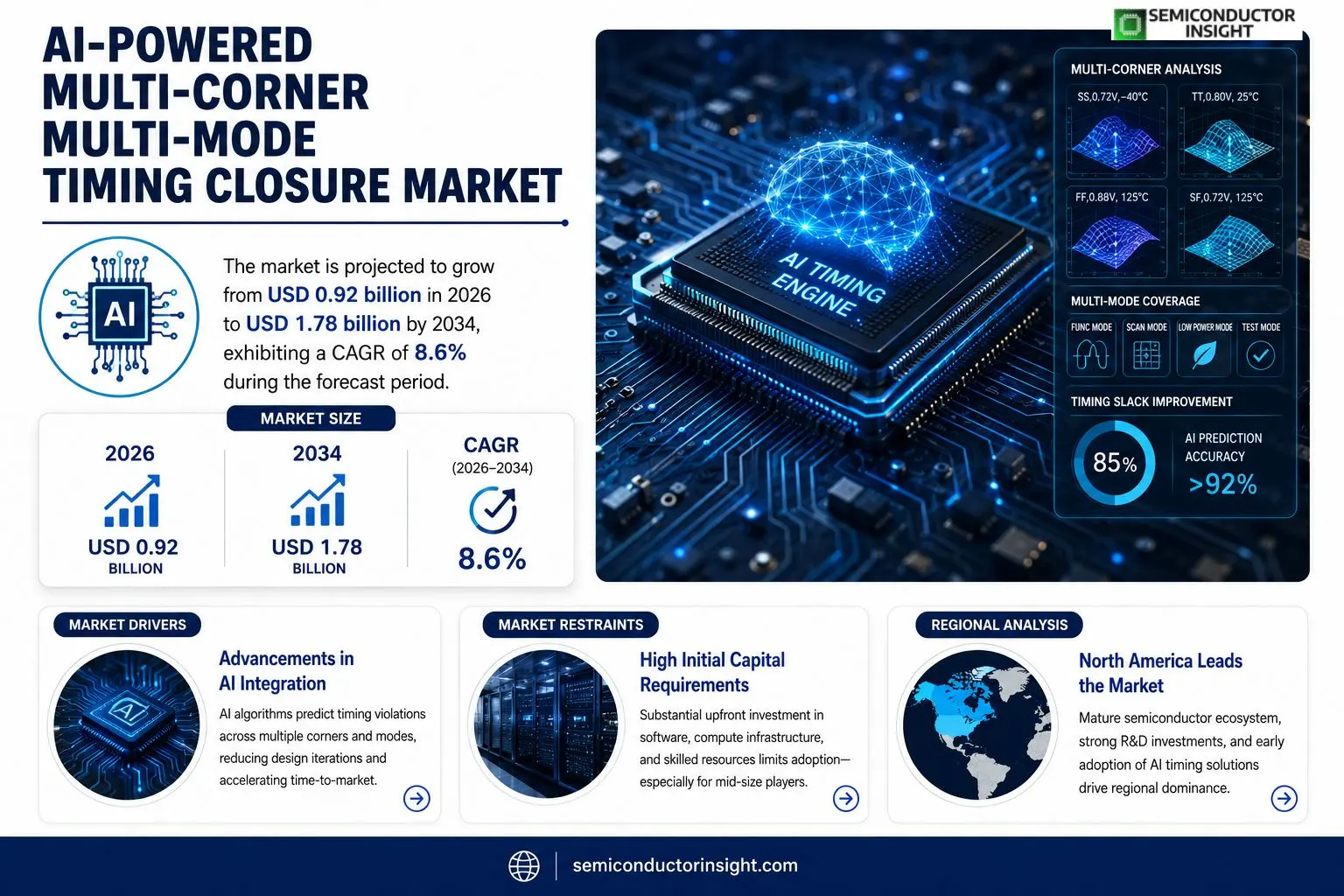
AI-Powered Multi-Corner Multi-Mode Timing Closure market size was valued at USD 0.85 billion in 2025. The market is projected to grow from USD 0.92 billion in 2026 to USD 1.78 billion by 2034, exhibiting a CAGR of 8.6% during the forecast period.
AI‑Powered Multi‑Corner Multi‑Mode Timing Closure refers to advanced electronic‑design‑automation (EDA) solutions that leverage artificial intelligence to simultaneously resolve timing constraints across multiple process corners, voltage levels, and operating modes during chip synthesis and place‑and‑route stages.The market is experiencing rapid expansion because semiconductor manufacturers are confronting ever‑increasing design complexity and tighter time‑to‑market pressures. Moreover, the rise of heterogeneous integration and advanced nodes drives demand for smarter timing engines that can cut iteration cycles while preserving yield.Key vendors such as Synopsys, Cadence Design Systems, and Siemens EDA are accelerating development through strategic acquisitions and partnerships that embed deep‑learning models into their timing analysis suites.
MARKET DRIVERS
Advancements in AI Integration
AI-Powered Multi-Corner Multi-Mode Timing Closure Market is being propelled by rapid improvements in machine‑learning algorithms that can predict timing violations before silicon fabrication. These intelligent engines enable designers to close timing loops across multiple process corners and operating modes within a single optimized flow, dramatically reducing manual iteration. Design productivity gains are evident as teams report up to a 25 % reduction in time‑to‑market.
Rising Demand for Multi‑Mode Timing Solutions
As semiconductor nodes reach 5 nm and below, chips must operate reliably under diverse voltage, temperature, and frequency scenarios. The market responds to this pressure by adopting AI‑driven timing closure tools that simultaneously address all mode combinations, ensuring robust performance across the product lifecycle. OEMs increasingly benchmark AI‑enabled solutions against traditional methods, citing faster convergence and lower silicon respin rates.
➤ AI‑driven timing closure reduces design cycles by up to 30 % while maintaining sign‑off quality.
Overall, the convergence of AI expertise, complex design requirements, and cost pressures creates a compelling value proposition, positioning AI-Powered Multi-Corner Multi-Mode Timing Closure Market for sustained growth through 2030.
MARKET CHALLENGES
Complex Design Verification
Despite algorithmic advances, verifying AI‑generated timing solutions across all corners remains labor‑intensive. Verification engineers must reconcile AI predictions with physical silicon data, which can extend validation timelines. Resource constraints in specialized verification teams therefore pose a notable hurdle.
Other Challenges
Regulatory and Compliance Issues
The industry faces growing scrutiny over AI model transparency and data integrity. Companies must document AI decision pathways to satisfy audits, adding process overhead that can slow adoption in highly regulated markets such as automotive and aerospace.
MARKET RESTRAINTS
High Initial Capital Requirements
Implementing AI‑based timing closure platforms demands substantial upfront investment in software licenses, high‑performance compute infrastructure, and skilled personnel. For many mid‑size design houses, the cost barrier limits immediate deployment, slowing overall market penetration.
MARKET OPPORTUNITIES
Emerging 7nm and Beyond Nodes
The transition to sub‑7 nm processes intensifies the need for precise, multi‑corner timing closure. AI‑enabled solutions can model process variations with higher fidelity, offering designers a strategic advantage in meeting aggressive performance targets. Early adopters are already seeing yield improvements, signaling a clear growth pathway for AI-Powered Multi-Corner Multi-Mode Timing Closure Market as next‑generation nodes mature.
AI-Powered Multi-Corner Multi-Mode Timing Closure Market Trends
Accelerated Growth Driven by Design Complexity
AI-Powered Multi-Corner Multi-Mode Timing Closure Market is witnessing a notable expansion as semiconductor designers grapple with escalating circuit intricacy and shrinking product windows. valuation reached USD 0.85 billion in 2025 and is expected to climb to USD 0.92 billion in 2026, ultimately achieving USD 1.78 billion by 2034. This trajectory reflects an underlying demand for timing solutions that can simultaneously address multiple process corners, voltage domains, and operational modes without sacrificing yield. The adoption of deep‑learning techniques within electronic‑design‑automation (EDA) tools enables faster convergence on optimal timing paths, thereby shortening iteration cycles and supporting the shift toward heterogeneous integration and advanced‑node technologies.
Other Trends
Vendor Consolidation and Technology Integration
Key players such as Synopsys, Cadence Design Systems, and Siemens EDA are intensifying their portfolios through strategic acquisitions and collaborative partnerships. By embedding proprietary AI models into existing timing analysis suites, these vendors are delivering unified platforms that reduce tool fragmentation. The consolidation trend also fosters standardization of data formats and APIs, making it easier for design houses to migrate between solutions while preserving investment in legacy work‑flows. Consequently, the market is seeing a gradual shift from niche, point‑solution offerings toward comprehensive, end‑to‑end timing closure ecosystems.
AI‑Enhanced Timing Engines Reduce Time‑to‑Market
Beyond vendor dynamics, the core advantage of AI‑powered timing closure lies in its ability to trim design turnaround times. By leveraging predictive models trained on historic silicon results, the engines can pre‑emptively identify timing violations and propose corrective actions during place‑and‑route. This proactive capability translates into measurable reductions in sign‑off cyclesoften by 15 % to 25 % in mature projectsallowing manufacturers to meet aggressive product launch schedules. The operational efficiencies gained are especially pronounced in advanced nodes where process variation and power budgeting are critical constraints. As the industry continues to push performance envelopes, AI-Powered Multi-Corner Multi-Mode Timing Closure Market is poised to become an indispensable component of the semiconductor design toolbox.
COMPETITIVE LANDSCAPE
Key Industry Players
AI-Powered Multi-Corner Multi-Mode Timing Closure Market Competitive Overview
The market is heavily anchored by the three traditional EDA powerhousesSynopsys, Cadence Design Systems, and Siemens EDA. Each has integrated deep‑learning models into their timing engines, allowing simultaneous closure across corner, voltage, and mode dimensions. Synopsys leverages its PrimeTime X platform, while Cadence extends its Tempus suite with AI‑driven heuristics, and Siemens embeds neural‑net inference within its Quest platform. Strategic acquisitions, such as Cadence’s purchase of Tensilica’s AI IP and Siemens’ absorption of Mentor Graphics, have accelerated roadmap execution and broadened the addressable silicon pool. The combined revenue and R&D spend of these leaders create a barrier to entry that sustains a tiered market structure: a dominant tier of ly‑scaled vendors, a secondary tier of specialized solution providers, and an emerging tier of AI‑focused startups.Beyond the dominant tier, a cohort of niche players is gaining traction by targeting specific segments of the timing closure workflow. ANSYS’s RedHawk‑AI offers power‑aware timing analysis for advanced nodes, while ASTC (Advanced Semiconductor Technologies) supplies AI‑enhanced signoff tools for automotive and aerospace ASICs. Start‑ups such as DeepSilicon, SiLico, and AITiming Labs are delivering cloud‑native, reinforcement‑learning based solvers that reduce iteration cycles for small‑to‑mid‑size fabless firms. Regional champions like Taiwan’s TSMC Design Services and Korea’s Samsung Foundry Design Solutions also embed proprietary AI timing kernels within their in‑house design kits, creating a competitive pressure that forces the larger EDA vendors to continuously innovate.
List of Key AI-Powered Multi-Corner Multi-Mode Timing Closure Companies Profiled
- Synopsys
- Cadence Design Systems
- Siemens EDA
- ANSYS (RedHawk‑AI)
- ASTC (Advanced Semiconductor Technologies)
- DeepSilicon
- SiLico
- AITiming Labs
- TSMC Design Services
- Samsung Foundry Design Solutions
- Mentor Graphics (Siemens)
- Foundries Design Solutions
- Mentor (Siemens)
- Imagination Technologies
- Arm Limited (Design Tools)
Segment Analysis:
| Segment Category | Sub-Segments | Key Insights |
| By Type |
|
Hybrid AI‑enabled timing engines are emerging as the dominant type because they combine algorithmic speed with deep‑learning prediction capabilities. Key observations include:
|
| By Application |
|
High‑performance computing (HPC) chips represent the leading application focus. Industry experts note:
|
| By End User |
|
Semiconductor fab design teams are the primary end users because they must ensure yield across process variations. Notable insights include:
|
| By Design Phase |
|
Place‑and‑route stage emerges as the most critical phase for AI‑powered timing closure. Observations include:
|
| By Integration Strategy |
|
Chiplet‑based heterogeneous integration is gaining traction as the leading integration strategy for timing closure solutions. Key points:
|
Regional Analysis: AI-Powered Multi-Corner Multi-Mode Timing Closure Market
North America
The convergence of AI with timing analysis is propelled by the need for faster time‑to‑market and higher design accuracy. Silicon manufacturers in North America are leveraging machine‑learning models to predict worst‑case path delays, reducing iterative loops. This strategic push is further supported by sizable capital allocations toward advanced EDA platforms.
A handful of established EDA vendors dominate the regional market, yet startups are gaining traction by offering niche AI‑enabled timing closure modules. Partnerships between major IP providers and AI specialists are reshaping competitive dynamics, encouraging co‑development of integrated solutions that address both multi‑corner and multi‑mode challenges.
Adoption rates are accelerated by cloud‑based AI services that allow smaller design teams to access high‑performance computation without heavy upfront investment. Enterprises are embedding AI pipelines directly into their verification environments, enabling real‑time adjustments to timing budgets across diverse operating conditions.
While no specific regulations target AI timing tools, broader semiconductor standards emphasize reliability and security. North American standards bodies are incorporating AI validation criteria into design guidelines, ensuring that timing closure solutions meet stringent functional safety requirements.
Europe
Europe remains a strong contender in the market, particularly through its collaborative research networks and emphasis on sustainable semiconductor production. Leading design houses across Germany, France, and the United Kingdom are integrating AI‑driven timing analysis to manage the escalating complexity of EUV‑enabled nodes. The European Union’s strategic initiatives, such as the Chips Act, provide funding that encourages development of indigenous AI timing tools, reducing reliance on external vendors. Moreover, the region’s focus on energy‑efficient design aligns with AI optimization techniques that minimize computational overhead while preserving accuracy, fostering a balanced growth trajectory.
Asia‑Pacific
The Asia‑Pacific region is witnessing rapid expansion in AI‑enabled timing closure capabilities, underpinned by the massive scale of its semiconductor manufacturing base. Taiwan, South Korea, and Japan host leading foundries that are increasingly adopting AI algorithms to streamline multi‑corner validation across diverse process variants. Government incentives aimed at advancing AI research, combined with a surge in talent pipelines, support the integration of sophisticated timing suites within design houses. While cost considerations drive a preference for adaptable solutions, the region’s emphasis on high‑volume production accelerates the refinement of AI models tailored to mass‑market chips.
South America
South America’s presence in the market is emerging, propelled by growing demand for advanced consumer and automotive electronics. Brazil and Argentina have begun investing in AI‑centric EDA capabilities to bridge the technology gap with more mature markets. Local firms are forming alliances with AI vendors to access cutting‑edge timing analysis platforms, while academic programs in machine learning contribute to a nascent talent pool. Though market penetration remains modest, the focus on cost‑effective AI solutions reflects a pragmatic approach to enhancing design efficiency.
Middle East & Africa
The Middle East & Africa region is at an early stage of adoption for AI‑driven timing closure, yet strategic investments signal a forward‑looking outlook. Gulf Cooperation Council (GCC) countries are channeling resources into semiconductor design hubs, attracted by favorable tax regimes and technology parks. Collaborative projects with European AI specialists are introducing advanced timing analysis techniques to local design teams. While the ecosystem is still developing, the emphasis on knowledge transfer and capacity building positions the region to gradually integrate AI timing tools as its electronics manufacturing footprint expands.
Report Scope
This market research report provides a comprehensive analysis of the AI-Powered Multi-Corner Multi-Mode Timing Closure Market , covering the forecast period 2026–2034. It offers detailed insights into market dynamics, technological advancements, competitive landscape, and key trends shaping the industry.
Key focus areas of the report include:
- Market Overview: The report begins with an overview outlining its current market scenario, key growth indicators, and industry transformation drivers. It discusses macroeconomic factors, demand–supply balance, regulatory landscape, and the strategic role of semiconductors in powering advancements across industries such as automotive, telecommunications, consumer electronics, and industrial automation.
- Market Size & Forecast: Historical data and future projections for revenue, unit shipments, and market value across major regions and segments.
- Segmentation Analysis: Detailed breakdown by product type, technology, application, and end-user industry to identify high-growth segments and investment opportunities.
- Regional Insights: Insights into market performance across North America, Europe, Asia-Pacific, Latin America, and the Middle East & Africa, including country-level analysis where relevant.
- Competitive Landscape: Profiles of leading market participants, including their product offerings, R&D focus, manufacturing capacity, pricing strategies, and recent developments such as mergers, acquisitions, and partnerships.
- Technology Trends & Innovation: Assessment of emerging technologies, integration of AI/IoT, semiconductor design trends, fabrication techniques, and evolving industry standards.
- Market Drivers & Restraints: Evaluation of factors driving market growth along with challenges, supply chain constraints, regulatory issues, and market-entry barriers.
- Stakeholder Insights: Insights for component suppliers, OEMs, system integrators, investors, and policymakers regarding the evolving ecosystem and strategic opportunities.
Primary and secondary research methods are employed, including interviews with industry experts, data from verified sources, and real-time market intelligence to ensure the accuracy and reliability of the insights presented.
FREQUENTLY ASKED QUESTIONS:
What is the current market size of AI-Powered Multi-Corner Multi-Mode Timing Closure Market?
-> AI-Powered Multi-Corner Multi-Mode Timing Closure Market was valued at USD 0.85 billion in 2025 and is expected to reach USD 1.78 billion by 2034.
Which key companies operate in AI-Powered Multi-Corner Multi-Mode Timing Closure Market?
-> Key players include Axalta Coating Systems, AkzoNobel, BASF SE, PPG, Sherwin-Williams, and 3M, among others.
What are the key growth drivers?
-> Key growth drivers include railway infrastructure investments, urbanization, and demand for durable coatings.
Which region dominates the market?
-> Asia-Pacific is the fastest-growing region, while Europe remains a dominant market.
What are the emerging trends?
-> Emerging trends include bio-based coatings, smart coatings, and sustainable rail solutions.
Get Sample Report PDF for Exclusive Insights
Report Sample Includes
- Table of Contents
- List of Tables & Figures
- Charts, Research Methodology, and more...
 Download Sample Report PDF