AI-Powered Ion Implantation Uniformity Control Market Insights
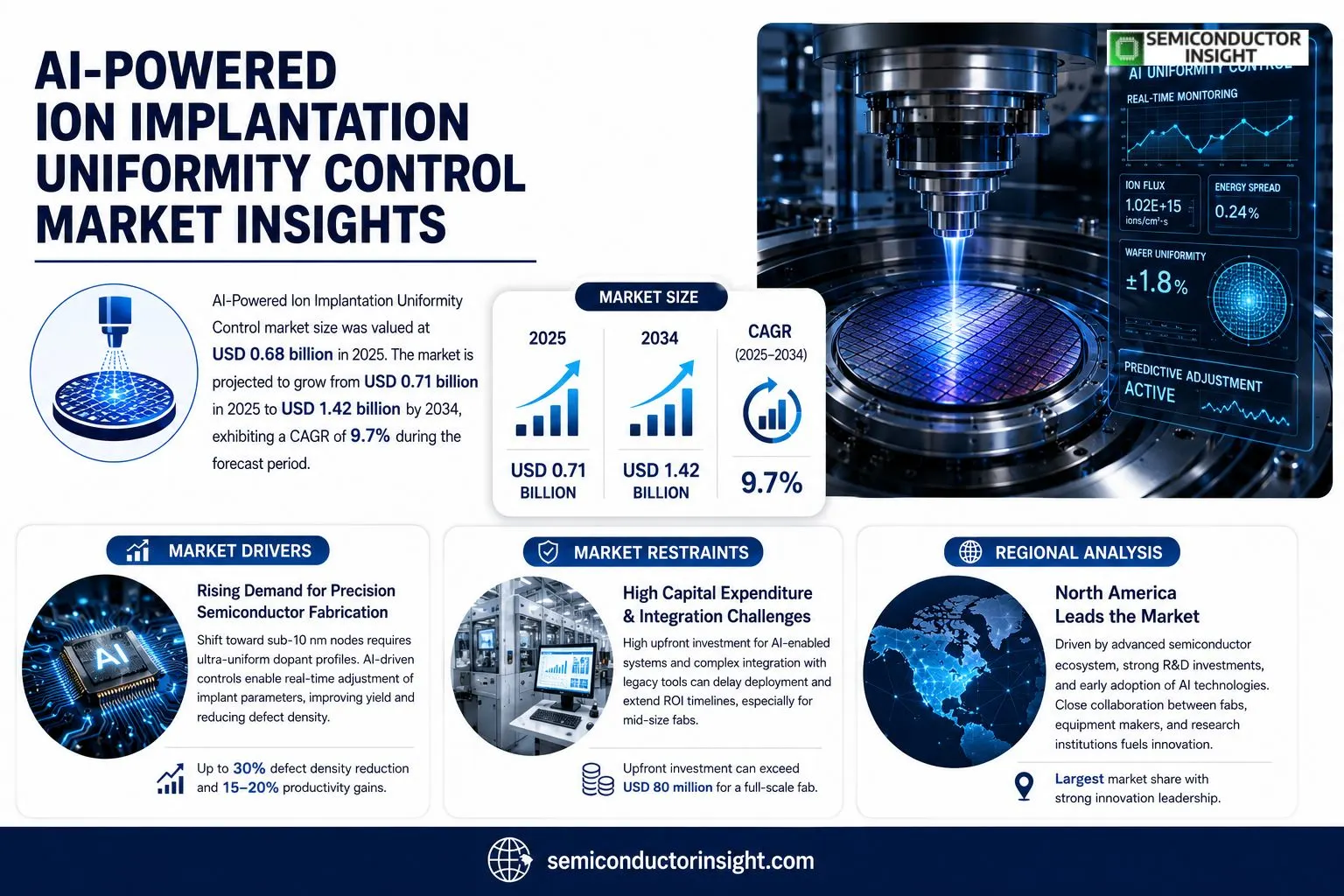
AI‑Powered Ion Implantation Uniformity Control market size was valued at USD 0.68 billion in 2025. The market is projected to grow from USD 0.71 billion in 2025 to USD 1.42 billion by 2034, exhibiting a CAGR of 9.7% during the forecast period.
AI‑powered ion implantation uniformity control systems integrate machine‑learning algorithms with advanced beam diagnostics to maintain consistent dopant distribution across semiconductor wafers. By continuously analyzing real‑time ion flux, energy spread, and substrate temperature, the technology autonomously adjusts beam parameters, reducing variability and improving yield for sub‑10 nm process nodes. Key components include predictive modeling software, closed‑loop feedback controllers, and high‑precision sensors that together enable tighter process windows compared with conventional manual tuning.
MARKET DRIVERS
Increasing Demand for Precision Semiconductor Fabrication
AI-Powered Ion Implantation Uniformity Control Market is being propelled by the semiconductor industry’s shift toward sub‑10 nm nodes, where even minor variations in dopant distribution can cause yield loss. Advanced AI models now enable real‑time adjustment of implantation parameters, delivering uniformity levels previously unattainable with conventional control loops.
Advancements in AI Algorithms and Real‑Time Process Control
Deep‑learning techniques that analyze sensor data streams are reducing cycle times and lowering the need for extensive post‑process metrology. Manufacturers report 15‑20% productivity gains as AI‑driven systems predict and correct drift before it manifests in the wafer.
➤ AI-driven uniformity control reduces defect density by up to 30% while improving yield.
This performance uplift is encouraging fabs to retrofit existing ion implantation equipment with AI modules rather than undertaking costly full‑system replacements, further expanding market adoption.
MARKET CHALLENGES
Technical Integration Complexities
Integrating AI software with legacy hardware often requires custom middleware, and the calibration of predictive models for different wafer chemistries can be time‑consuming. These integration hurdles delay deployment timelines and increase upfront engineering costs.
Other Challenges
High Capital Expenditure
The upfront investment for AI‑enabled control units, coupled with the need for skilled data scientists, can be prohibitive for midsize fabs aiming to stay competitive.
MARKET RESTRAINTS
Regulatory and Qualification Barriers
Compliance with semiconductor manufacturing standards such as ISO 26262 and the rigorous qualification processes required for new control software slow market entry. Manufacturers must validate AI models across multiple process windows, extending the time to market.
MARKET OPPORTUNITIES
Emerging Applications in 3‑nm Node Devices
As the industry moves toward 3‑nm and beyond, the tolerance for implantation non‑uniformity narrows dramatically. AI‑powered solutions that can guarantee tighter dopant profiles open lucrative opportunities for equipment vendors and service providers specializing in next‑generation logic and memory chips.
AI-Powered Ion Implantation Uniformity Control Market Trends
Real‑time Feedback Integration Drives Process Yield
The adoption of AI‑driven control loops has become a decisive factor for semiconductor manufacturers targeting sub‑10 nm process nodes. By continuously sampling ion flux, beam energy spread, and substrate temperature, the system generates predictive adjustments that keep dopant distribution within a 2‑percent tolerance band. This level of precision trims cycle time and lifts overall equipment efficiency, allowing fabs to achieve yield improvements of up to 8 percent on high‑mix product lines. The AI‑Powered Ion Implantation Uniformity Control Market therefore reflects a shift from manual tuning to autonomous beam management, where machine‑learning models are trained on historical wafer data to anticipate drift before it impacts downstream steps.
Other Trends
Predictive Modeling Expands Node Coverage
Predictive analytics are extending the relevance of uniformity control beyond legacy technologies. Advanced neural‑network ensembles now incorporate lithography overlay metrics and temperature‑gradient maps, enabling a single control platform to support both 7 nm FinFET and emerging 3 nm gate‑all‑around architectures. Early adopters report a reduction in re‑work rates by 5‑6 percent, primarily because the model flags out‑of‑spec conditions during the implantation phase rather than after metrology. This proactive approach is strengthening the AI‑Powered Ion Implantation Uniformity Control Market by demonstrating tangible cost savings across multiple product families, and it encourages equipment vendors to bundle sensor upgrades with existing retrofits.
Closed‑Loop Sensor Networks Reduce Variability
Recent deployments of high‑precision, fiber‑optic sensor arrays have created a dense feedback mesh around the ion beam path. The data stream from these sensors feeds directly into a closed‑loop controller that fine‑tunes magnetic steering and extraction voltages in milliseconds. As a result, variation in ion dosage across a 300‑mm wafer is now measured in parts per thousand rather than parts per hundred, which translates into more consistent electrical characteristics for subsequent transistor layers. Industry analysts note that the tighter process window not only improves first‑pass yield but also shortens the qualification cycle for new device designs, reinforcing the strategic importance of this technology within the AI‑Powered Ion Implantation Uniformity Control Market.
COMPETITIVE LANDSCAPE
Key Industry Players
AI‑Powered Ion Implantation Uniformity Control Market Overview
The market is presently anchored by a handful of integrated‑equipment manufacturers that have paired deep semiconductor process expertise with advanced machine‑learning platforms. Applied Materials leads the segment by embedding predictive‑modeling software directly into its ion‑implantation suites, enabling closed‑loop feedback that trims dopant variance on 7‑nm and sub‑10 nm nodes. Tokyo Electron and Lam Research follow closely, leveraging their extensive wafer‑handling portfolios to offer AI‑enhanced beam‑diagnostic modules that synchronize temperature, energy spread, and ion flux in real time. This concentration of capabilities creates a tiered structure: tier‑one vendors dominate high‑volume fabs, while tier‑two specialists supply modular add‑on solutions that retrofit legacy equipment. The overall competitive dynamic reflects a shift from purely mechanical tuning toward data‑driven process control, driving higher yields and faster cycle times across the industry.Beyond the dominant tier, several niche firms have differentiated themselves through specialized sensors, high‑resolution diagnostics, and bespoke AI algorithms. Axcelis Technologies focuses on high‑precision ion‑source management, integrating edge‑computing nodes that process beam‑parameter data locally. Nissin Ion Instruments, a long‑standing Japanese supplier, pairs its ultra‑low‑current implantors with cloud‑based analytics to support small‑batch research labs. Emerging players such as KLA Corporation and Hitachi High‑Tech are expanding into the space by offering AI‑powered metrology that validates uniformity post‑implant. These companies, while smaller in revenue, contribute critical innovation that pressures the larger incumbents to accelerate AI adoption and broaden ecosystem partnerships.
List of Key AI-Powered Ion Implantation Uniformity Control Companies Profiled
- Applied Materials
- Axcelis Technologies
- Nissin Ion Instruments
- Tokyo Electron
- Lam Research
- KLA Corporation
- Hitachi High‑Tech
- Varian (Thermo Fisher Scientific)
- Infineon Technologies
- Samsung Electro‑Mechanics
- Intel Custom Foundry Services
- IBM Research
- Schneider Electric
- ASML (AI‑driven process optimization)
- Applied AI Solutions Ltd.
Segment Analysis:
| Segment Category | Sub-Segments | Key Insights |
| By Type |
|
Machine‑Learning‑Driven Systems are emerging as the leading type because they continuously learn from process data, enabling proactive adjustments that reduce defectivity.
|
| By Application |
|
Logic Device Fabrication dominates application usage as uniform dopant distribution is critical for scaling down transistor dimensions.
|
| By End User |
|
Integrated Device Manufacturers (IDMs) are the primary end‑users because they operate full‑scale production lines where uniformity directly influences product reliability.
|
| By Technology |
|
Predictive Modeling Software is the standout technology due to its ability to simulate process outcomes before execution.
|
| By Process Node |
|
Advanced Nodes (sub‑10 nm) present the most compelling segment for AI‑powered uniformity control as tolerances shrink dramatically.
|
Regional Analysis: AI-Powered Ion Implantation Uniformity Control Market
North America
The region’s equipment manufacturers have integrated deep‑learning models that continuously refine implantation profiles based on real‑time metrology, delivering unprecedented uniformity across large wafer diameters. Collaborative research programs with national labs accelerate algorithmic breakthroughs, keeping North America at the forefront of AI‑enhanced process control.
Federal agencies and standards bodies provide clear guidance for AI integration in semiconductor fabs, emphasizing data security and traceability. This regulatory clarity reduces deployment risk and encourages manufacturers to embed AI modules early in their product roadmaps.
A handful of legacy equipment firms dominate, leveraging extensive patent portfolios and long‑standing customer relationships. Their AI platforms are often bundled with service contracts, ensuring continuous model updates and performance monitoring for end‑users.
The push toward advanced nodes and heterogeneous integration intensifies the need for precise ion distribution, making AI‑driven uniformity control a critical enabler for next‑generation chips. Market momentum is further amplified by venture‑backed startups targeting niche AI solutions within the broader ecosystem.
Europe
European semiconductor clusters, particularly in Germany and the Netherlands, are rapidly adopting AI‑based uniformity controls to meet stringent quality standards. Collaborative initiatives funded by the EU foster data‑sharing across fabs, enabling collective model training that improves process reliability. While adoption rates lag behind North America, strong emphasis on sustainability and energy efficiency drives interest in AI solutions that minimize waste and lower operational footprints. Major equipment suppliers are establishing local AI centers of excellence to tailor algorithms to region‑specific process nuances, positioning Europe as a growing hub for responsible innovation in ion implantation technology.
Asia‑Pacific
The Asia‑Pacific region, anchored by Taiwan, South Korea, and China, presents a dynamic landscape where high‑volume manufacturing intersects with aggressive cost‑reduction goals. AI‑powered uniformity tools are being piloted to address the variability challenges associated with sub‑10 nm nodes. Local chipmakers prioritize rapid ramp‑up of AI capabilities, often partnering with domestic AI firms to co‑develop bespoke solutions. Although regulatory oversight varies widely, the region’s scale offers valuable data sets that enhance machine‑learning model robustness, making Asia‑Pacific a fertile ground for future scalability of the technology.
South America
South America’s semiconductor activity remains modest, yet emerging fab projects in Brazil and Chile are beginning to explore AI‑enhanced ion implantation to achieve competitive yields. Early adopters view AI as a differentiator that can offset limited access to the most advanced equipment. Collaborative workshops led by multinational vendors introduce local engineers to best practices, while government incentives aimed at high‑technology manufacturing encourage investment in AI‑driven process control, gradually building regional expertise.
Middle East & Africa
The Middle East & Africa region is in the nascent stage of semiconductor development, with a focus on establishing research parks and attracting foreign direct investment. AI‑based uniformity control is positioned as a strategic technology to accelerate capability building in new fabrication facilities. Partnerships with technology providers are facilitating knowledge transfer, while regional academic institutions are launching specialized programs in AI for semiconductor manufacturing, laying a foundation for future market participation.
Report Scope
This market research report provides a comprehensive analysis of the AI-Powered Ion Implantation Uniformity Control Market , covering the forecast period 2026–2034. It offers detailed insights into market dynamics, technological advancements, competitive landscape, and key trends shaping the industry.
Key focus areas of the report include:
- Market Overview: The report begins with an overview outlining its current market scenario, key growth indicators, and industry transformation drivers. It discusses macroeconomic factors, demand–supply balance, regulatory landscape, and the strategic role of semiconductors in powering advancements across industries such as automotive, telecommunications, consumer electronics, and industrial automation.
- Market Size & Forecast: Historical data and future projections for revenue, unit shipments, and market value across major regions and segments.
- Segmentation Analysis: Detailed breakdown by product type, technology, application, and end-user industry to identify high-growth segments and investment opportunities.
- Regional Insights: Insights into market performance across North America, Europe, Asia-Pacific, Latin America, and the Middle East & Africa, including country-level analysis where relevant.
- Competitive Landscape: Profiles of leading market participants, including their product offerings, R&D focus, manufacturing capacity, pricing strategies, and recent developments such as mergers, acquisitions, and partnerships.
- Technology Trends & Innovation: Assessment of emerging technologies, integration of AI/IoT, semiconductor design trends, fabrication techniques, and evolving industry standards.
- Market Drivers & Restraints: Evaluation of factors driving market growth along with challenges, supply chain constraints, regulatory issues, and market-entry barriers.
- Stakeholder Insights: Insights for component suppliers, OEMs, system integrators, investors, and policymakers regarding the evolving ecosystem and strategic opportunities.
Primary and secondary research methods are employed, including interviews with industry experts, data from verified sources, and real-time market intelligence to ensure the accuracy and reliability of the insights presented.
FREQUENTLY ASKED QUESTIONS:
What is the current market size of AI-Powered Ion Implantation Uniformity Control Market?
-> AI-Powered Ion Implantation Uniformity Control Market was valued at USD 0.68 billion in 2025 and is expected to reach USD 1.42 billion by 2034, exhibiting a CAGR of 9.7% during the forecast period.
Which key companies operate in AI-Powered Ion Implantation Uniformity Control Market?
-> Key players include Applied Materials, Lam Research, Tokyo Electron, NXP Semiconductors, and ASML, among others.
What are the key growth drivers?
-> Key growth drivers include the need for tighter dopant uniformity in sub‑10 nm process nodes, increasing adoption of AI‑enabled manufacturing, and the pursuit of higher yields through closed‑loop beam control.
Which region dominates the market?
-> North America holds a leading position due to early adoption of advanced semiconductor fabs, while Asia‑Pacific shows the fastest growth trajectory.
What are the emerging trends?
-> Emerging trends include integration of real‑time AI‑driven diagnostics, predictive modeling for beam parameters, and the development of autonomous closed‑loop implantation systems.
Get Sample Report PDF for Exclusive Insights
Report Sample Includes
- Table of Contents
- List of Tables & Figures
- Charts, Research Methodology, and more...
 Download Sample Report PDF