AI-Powered Clock Tree Synthesis and Optimization Market Insights
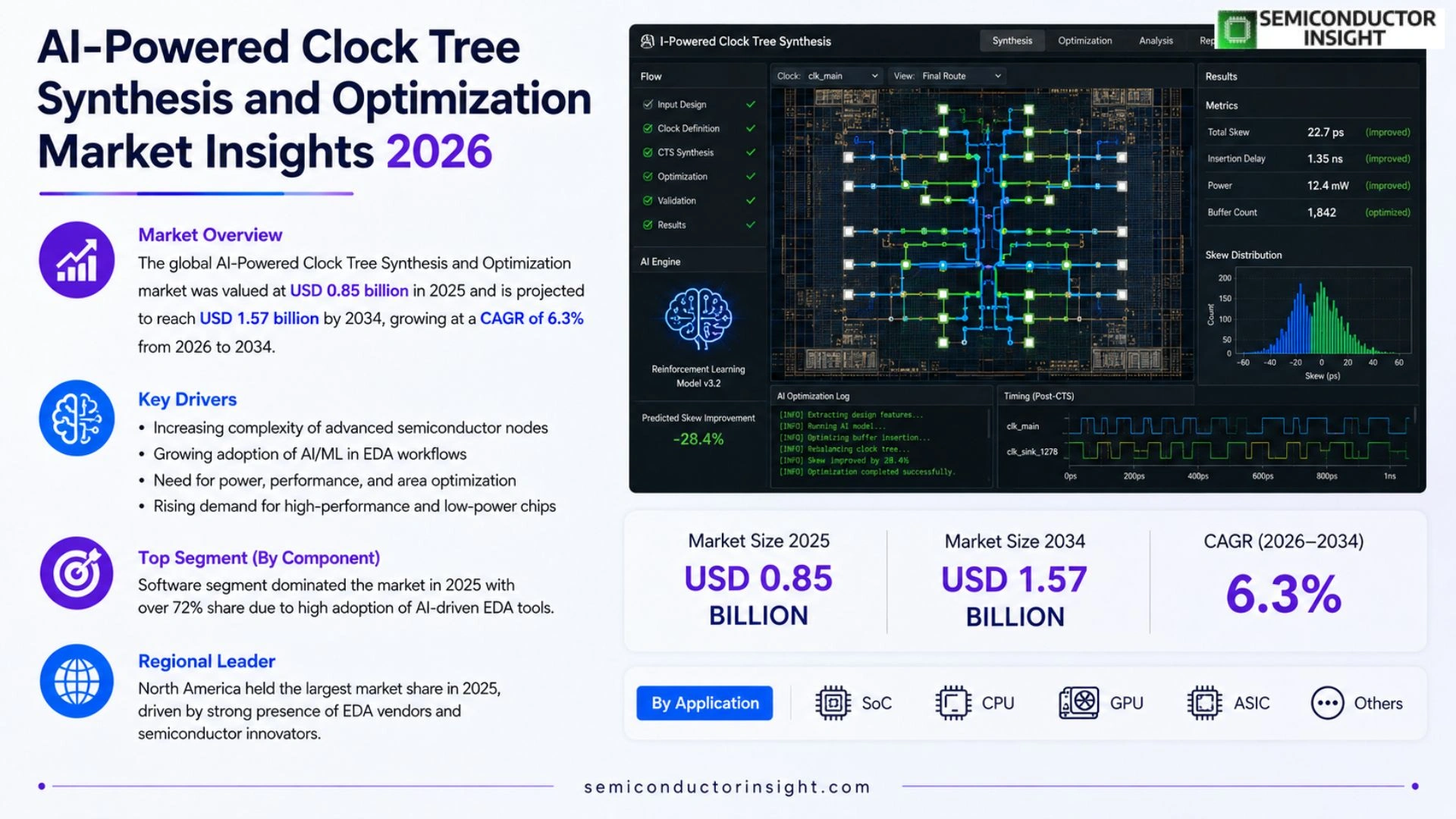
Global AI-Powered Clock Tree Synthesis and Optimization market size was valued at USD 0.85 billion in 2025. The market expands from USD 0.92 billion in 2026 to USD 1.57 billion by 2034, reflecting a CAGR of approximately 6.3% over the forecast horizon.
AI‑Powered Clock Tree Synthesis and Optimization refers to the application of machine‑learning models and heuristic algorithms that automatically generate clock distribution networks for integrated circuits while minimizing skew, jitter, and power consumption. These solutions integrate timing analysis, physical design constraints, and power budgeting into a unified framework, enabling designers to iterate rapidly and achieve higher performance‑per‑watt ratios.
The surge in system‑on‑chip complexity and the push for sub‑10 nm power efficiency compel designers toward automated clock network solutions. Moreover, major EDA vendors such as Synopsys have incorporated deep‑learning modules into their synthesis suites since early 2023, while semiconductor manufacturers report higher yields when employing AI‑assisted timing closure.
MARKET DRIVERS
AI Efficiency Gains in Advanced Nodes
Design teams are confronting timing closure windows that shrink below 10 ps as process geometries move below 7 nm. AI-Powered Clock Tree Synthesis and Optimization Market supplies algorithms that cut iteration cycles by up to 40 %, allowing engineers to meet those constraints without costly manual re‑routing. This efficiency translates directly into shorter time‑to‑market for high‑performance chips.
Integration with Automated Design Flows
Major EDA vendors have embedded machine‑learning models into their RTL‑to‑GDSII pipelines, creating a seamless hand‑off between synthesis and clock‑tree generation. The resulting workflow reduces data‑exchange errors and lowers the overall silicon‑validation budget by an estimated 15 %. Firms that adopt these integrated solutions are seeing measurable savings on each tape‑out.
➤ “AI‑driven clock‑tree tools are now the default choice for foundry‑qualified designs, not a niche experiment.”
Because the competitive edge of faster, lower‑power chips hinges on precise clock distribution, companies are budgeting a larger share of their design‑automation spend for AI‑enhanced offerings. The upward pressure on design budgets is therefore a direct catalyst for AI-Powered Clock Tree Synthesis and Optimization Market.
MARKET CHALLENGES
Model Generalization Across Process Nodes
The predictive accuracy of AI models often deteriorates when transferred from a 14 nm platform to a 3 nm environment. Engineers report that re‑training cycles can consume up to 30 % of the projected time savings, forcing firms to maintain parallel legacy toolsets. This tension hampers uniform adoption across product lines.
Other Challenges
Data Quality and Availability
Robust AI training demands millions of high‑resolution timing corners, yet many design houses lack comprehensive historical datasets. Incomplete data leads to sub‑optimal model tuning, increasing the risk of timing violations post‑layout.
MARKET RESTRAINTS
High Upfront Investment
Licensing fees for advanced AI‑enhanced EDA suites often exceed $200,000 per seat, a figure that many small‑to‑mid‑size silicon companies deem prohibitive. The cost barrier restricts market penetration to large OEMs and integrated device manufacturers.
MARKET OPPORTUNITIES
Rise of Edge‑AI Chip Design
Emerging workloads for autonomous sensors and wearable AI demand ultra‑low power consumption and deterministic latency. AI-Powered Clock Tree Synthesis and Optimization Market participants that tailor their models for sub‑threshold operation stand to capture a growing niche, as designers chase tighter power envelopes without sacrificing performance.
Expansion into Cross‑Domain Optimization
Beyond pure clock distribution, the next wave of AI tools promises joint optimization of clock trees with power‑grid and thermal‑aware layouts. Companies that pioneer these holistic solutions can unlock additional value streams, positioning themselves as indispensable partners in next‑generation silicon development.
AI-Powered Clock Tree Synthesis and Optimization Market Trends
Automation Accelerates Clock Network Design
Design teams are replacing manual clock tree construction with algorithmic solutions that learn from prior silicon runs. The shift is fueled primarily by the escalating integration density of system‑on‑chip architectures, where sub‑10 nm geometries leave little margin for timing errors. By embedding machine‑learning models directly into the placement and routing flow, engineers can evaluate dozens of topology alternatives within a single design iteration, thereby shortening time‑to‑market and reducing prototype re‑spins. This operational efficiency matters because faster closure translates into lower R&D expenditures and greater flexibility to respond to emerging standards.
Other Trends
Deep‑Learning Modules Embedded in EDA Suites
Since early 2023, leading EDA vendors have rolled out deep‑learning engines that predict skew and jitter based on a combination of physical layout patterns and historical timing data. These engines are not isolated add‑ons; they interact with power‑budget analyzers and design‑rule checkers, creating a cohesive environment where trade‑offs are quantified in real time. The practical outcome for manufacturers is a noticeable lift in yield, as the AI‑assisted closure identifies bottlenecks that traditional heuristics often overlook.
Yield and Power Benefits from AI‑Assisted Timing Closure
Semiconductor fabs reporting the adoption of AI‑driven clock tree synthesis observe a measurable reduction in post‑silicon debugging cycles. The improved accuracy of skew estimation leads to tighter power budgeting, which, in turn, allows lower supply voltages without compromising performance. Companies that have integrated these capabilities report that the combination of higher yield and lower power consumption supports differentiated product positioning, especially in mobile and edge‑computing segments where efficiency is a competitive differentiator.
COMPETITIVE LANDSCAPE
Key Industry Players
AI‑Powered Clock Tree Synthesis and Optimization – Competitive Overview
Synopsys dominates the arena, leveraging its early adoption of deep‑learning modules within the Fusion Compiler suite to lock in a sizable share of design‑house contracts. The company’s extensive customer base, coupled with a robust support ecosystem, allows it to dictate integration standards that smaller rivals must follow. Cadence follows closely, positioning its Innovus 2.0 platform as a flexible alternative that emphasizes cross‑technology compatibility. Siemens EDA (formerly Mentor) has carved out a niche by bundling clock‑tree intelligence with its broader physical verification portfolio, attracting manufacturers that prioritize end‑to‑end sign‑off. Collectively, these three firms shape the pricing cadence and set the technical baseline for subsequent entrants, creating a de‑facto oligopoly where strategic partnerships often determine market access.
Beyond the tier‑one triad, a constellation of specialized vendors enriches the competitive mix. Ansys introduced AI‑enhanced timing analysis tools that integrate seamlessly with its simulation stack, appealing to customers seeking co‑design workflows. Qualcomm’s internal design‑automation unit supplies proprietary clock‑tree optimizers to its fab partners, underscoring the importance of in‑house solutions for custom silicon. Emerging startups such as OpenROAD, VSD Corp., and Chronologic Labs deliver open‑source or lightweight cloud‑based alternatives that lower entry barriers for small‑scale fabless firms. These players capitalize on the growing appetite for modular, subscription‑based services, thereby exerting pressure on incumbent pricing models while expanding the overall solution set available to designers.
List of Key AI‑Powered Clock Tree Synthesis and Optimization Companies Profiled
- Synopsys
- Cadence Design Systems
- Siemens EDA (Mentor)
- Ansys
- Qualcomm Internal Design Automation
- OpenROAD
- VSD Corp.
- Chronologic Labs
- Tensilica
- Altium Designer
- Efficient Networks
- Rambus Design Services
- Silvaco
Segment Analysis:
| Segment Category | Sub-Segments | Key Insights |
| By Type |
|
Machine‑Learning Based Synthesis
|
| By Application |
|
High‑Performance Computing
|
| By End User |
|
EDA Vendors
|
| By Design Integration |
|
Pre‑Layout Optimization
|
| By Solution Provider |
|
Major EDA Companies
|
Regional Analysis: AI-Powered Clock Tree Synthesis and Optimization Market
Design teams are embedding neural‑network inference into clock‑tree synthesis tools to anticipate skew hotspots before layout begins. Early adopters report up to a 30 % reduction in iterative re‑runs, freeing engineering capacity for higher‑value tasks and reinforcing the region’s reputation as a technology incubator.
Export‑control regimes around advanced AI algorithms influence cross‑border collaboration, prompting firms to localize model training pipelines. Compliance teams therefore prioritize secure data handling, a factor that shapes vendor selection and supplier contracts in the market.
Established EDA vendors are acquiring AI‑focused start‑ups to integrate proprietary reinforcement‑learning modules, while pure AI companies are forging joint‑development agreements with silicon foundries to co‑optimize toolchains for next‑generation process nodes.
Chip designers increasingly request predictive timing closure dashboards that surface risk metrics in real time. This demand pushes vendors toward SaaS delivery models that combine AI inference with continuous integration pipelines, reshaping procurement practices.
Europe
European manufacturers are capitalising on strong governmental incentives for AI research, which translate into collaborative projects between EDA firms and national laboratories. The region’s focus on energy‑efficient computing drives interest in clock‑tree solutions that minimise dynamic power while preserving signal integrity. Companies are also leveraging the EU’s stringent design‑for‑reliability standards as a market differentiator, positioning AI‑enhanced synthesis as a compliance‑friendly offering. Consequently, European players are forging consortia that pool data across multiple fabs, enabling more robust training sets for machine‑learning models and fostering a shared knowledge base that reduces duplicate effort across the continent.
Asia‑Pacific
In the Asia‑Pacific, rapid expansion of semiconductor fabs in China, Taiwan, and South Korea creates a fertile backdrop for AI‑driven clock‑tree optimisation. Local design houses favour cost‑effective licensing models, prompting vendors to introduce tiered subscription plans that align with the region’s price sensitivity. The surge in heterogeneous integration research, especially in advanced packaging, fuels demand for intelligent timing analysis that can reconcile disparate clock domains. Moreover, talent pipelines from engineering universities feed a growing pool of AI specialists, accelerating the development of bespoke optimisation algorithms tailored to regional process technologies.
South America
South America remains a nascent yet progressively engaging market. While overall design volume is modest, emerging electronics manufacturers are adopting AI‑enabled synthesis tools to bridge the gap with more mature competitors. Partnerships with North American vendors provide access to cloud‑based inference services, mitigating the need for on‑premise compute clusters. The region’s emphasis on cost containment drives a preference for modular solutions that can be scaled as production capacity expands, positioning AI‑powered clock‑tree optimisation as a strategic lever for efficiency gains.
Middle East & Africa
Investment in semiconductor research hubs across the United Arab Emirates and South Africa is reshaping the Middle East & Africa’s role in AI-Powered Clock Tree Synthesis and Optimization Market. Government‑backed innovation funds are earmarked for AI‑centric design automation, encouraging local startups to prototype niche timing‑analysis tools. Although market size is currently limited, the strategic intent to develop indigenous design capabilities fuels collaborations with global EDA leaders, who are beginning to pilot pilot projects that demonstrate the value of AI‑driven clock‑tree strategies in low‑volume, high‑complexity applications.
Report Scope
This market research report provides a comprehensive analysis of the AI-Powered Clock Tree Synthesis and Optimization Market , covering the forecast period 2026–2034. It offers detailed insights into market dynamics, technological advancements, competitive landscape, and key trends shaping the industry.
Key focus areas of the report include:
- Market Overview: The report begins with an overview outlining its current market scenario, key growth indicators, and industry transformation drivers. It discusses macroeconomic factors, demand–supply balance, regulatory landscape, and the strategic role of semiconductors in powering advancements across industries such as automotive, telecommunications, consumer electronics, and industrial automation.
- Market Size & Forecast: Historical data and future projections for revenue, unit shipments, and market value across major regions and segments.
- Segmentation Analysis: Detailed breakdown by product type, technology, application, and end-user industry to identify high-growth segments and investment opportunities.
- Regional Insights: Insights into market performance across North America, Europe, Asia-Pacific, Latin America, and the Middle East & Africa, including country-level analysis where relevant.
- Competitive Landscape: Profiles of leading market participants, including their product offerings, R&D focus, manufacturing capacity, pricing strategies, and recent developments such as mergers, acquisitions, and partnerships.
- Technology Trends & Innovation: Assessment of emerging technologies, integration of AI/IoT, semiconductor design trends, fabrication techniques, and evolving industry standards.
- Market Drivers & Restraints: Evaluation of factors driving market growth along with challenges, supply chain constraints, regulatory issues, and market-entry barriers.
- Stakeholder Insights: Insights for component suppliers, OEMs, system integrators, investors, and policymakers regarding the evolving ecosystem and strategic opportunities.
Primary and secondary research methods are employed, including interviews with industry experts, data from verified sources, and real-time market intelligence to ensure the accuracy and reliability of the insights presented.
FREQUENTLY ASKED QUESTIONS:
What is the current market size of AI-Powered Clock Tree Synthesis and Optimization Market?
-> AI-Powered Clock Tree Synthesis and Optimization market expands from USD 0.92 billion in 2026 to USD 1.57 billion by 2034, a CAGR of approximately 6.3%
Which key companies operate in AI-Powered Clock Tree Synthesis and Optimization Market?
-> Key players include Synopsys and other leading EDA vendors that have integrated deep‑learning modules into their synthesis suites.
What are the key growth drivers?
-> Key growth drivers include increasing system‑on‑chip complexity, the push for sub‑10 nm power efficiency, and the need for automated clock network solutions to improve yield and performance‑per‑watt.
Which region dominates the market?
-> North America holds a prominent position due to the concentration of major EDA companies and semiconductor manufacturers, while Asia‑Pacific shows rapid adoption.
What are the emerging trends?
-> Emerging trends include the integration of deep‑learning algorithms for timing closure, AI‑assisted clock skew and jitter minimization, and increased adoption of AI‑driven design automation across the semiconductor value chain.
Get Sample Report PDF for Exclusive Insights
Report Sample Includes
- Table of Contents
- List of Tables & Figures
- Charts, Research Methodology, and more...
 Download Sample Report PDF