AI-Powered Barcode and QR Code Scanning ASIC Market Insights
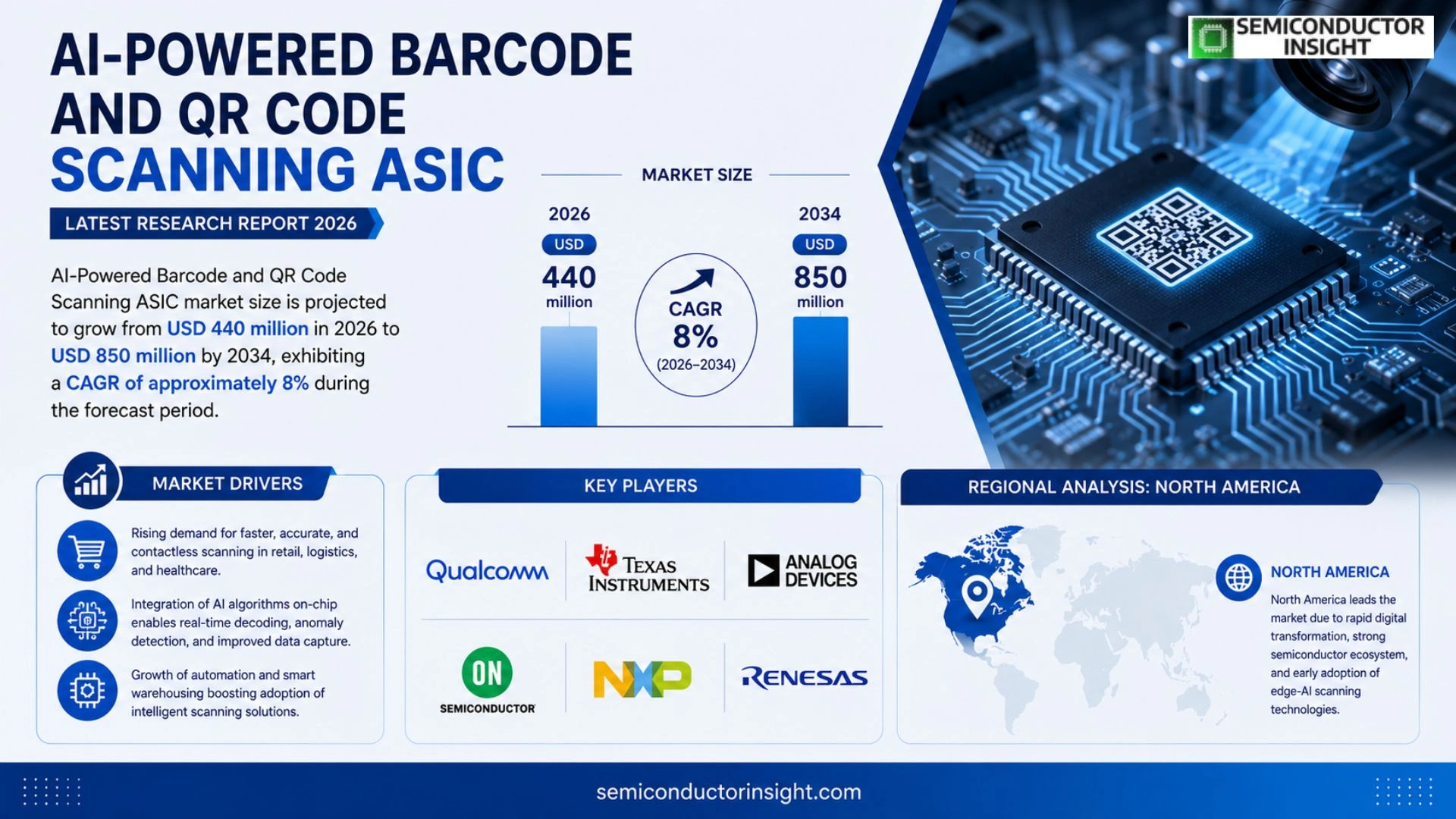
Global AI-Powered Barcode and QR Code Scanning ASIC market size was valued at USD 420 million in 2025. The market is projected to grow from USD 440 million in 2026 to USD 850 million by 2034, exhibiting a CAGR of approximately 8% during the forecast period.
AI‑powered barcode and QR‑code scanning ASICs are custom‑designed integrated circuits that embed high‑speed image capture modules together with on‑chip neural inference engines and optimized decoding logic. By handling vision processing on silicon rather than a host CPU, these chips achieve sub‑10 ms latency while consuming markedly less power,key for point‑of‑sale terminals, industrial scanners and mobile devices.
The market is accelerating because retailers are expanding contactless checkout systems, logistics firms demand real‑time inventory verification, and manufacturers seek cost‑effective edge intelligence for smart factories. Moreover advances in deep learning models improve read accuracy on damaged or low‑contrast codes , driving adoption across retail, healthcare, and transportation sectors. Leading suppliers such as Texas Instruments, STMicroelectronics, NXP Semiconductors, Ambarella Inc., and ON Semiconductor are intensifying R&D investments and forging firmware ecosystems to capture this growth.
MARKET DRIVERS
Rising Demand for Real‑Time Inventory Management
AI‑Powered Barcode and QR Code Scanning ASIC Market is being propelled by the need for instantaneous inventory visibility across warehouses and retail floors. AI‑enabled image processing on ASICs reduces scan latency to milliseconds, allowing businesses to automate replenishment decisions without human intervention. This acceleration translates into lower stock‑out rates and higher service levels, driving widespread adoption.
Advancements in Edge AI and Power Efficiency
Recent breakthroughs in edge‑AI algorithms coupled with sub‑10 mW ASIC designs have made it feasible to embed high‑performance scanning engines into battery‑operated devices. The resulting power savings enable longer device life cycles and lower total cost of ownership, encouraging OEMs to replace legacy CMOS scanners with AI‑centric solutions.
➤ AI‑driven ASICs reduce scan latency by up to 40 % while cutting energy consumption by roughly 30 %.
These technical gains, combined with stricter supply‑chain digitisation mandates, create a virtuous cycle that continues to expand the addressable market for AI‑powered scanning chips.
MARKET CHALLENGES
Integration Complexity Across Legacy Systems
Many retailers and manufacturers still rely on decades‑old data‑capture infrastructures. Retrofitting AI‑Powered Barcode and QR Code Scanning ASICs often requires extensive firmware rewrites and middleware adaptation, leading to longer deployment cycles and higher integration costs.
Other Challenges
Regulatory and Data Security Concerns
Stringent data‑privacy regulations in Europe and North America impose strict controls on image data processing at the edge. Companies must implement secure encryption and on‑device anonymisation, which adds design overhead and can delay time‑to‑market.
MARKET RESTRAINTS
High Initial Capital Expenditure
Deploying AI‑enhanced ASICs requires sizable upfront investment in design qualification, tooling, and pilot production runs. Small‑to‑mid‑size enterprises often lack the financial bandwidth to absorb these costs, limiting early market penetration.
Limited Availability of Skilled AI Engineers
The specialized expertise needed to fine‑tune neural‑network models for barcode and QR decoding on silicon is scarce. Talent shortages drive up labor rates and extend development timelines, further restraining market growth.
MARKET OPPORTUNITIES
Expansion into Smart Retail and Autonomous Checkout
The rise of frictionless checkout experiences creates a fertile environment for AI‑Powered Barcode and QR Code Scanning ASIC Market. Embedding low‑power ASICs in shelf‑edge devices and mobile POS terminals enables seamless product identification without line queues, opening new revenue streams for technology providers.
Growth in Augmented Reality Applications
AR‑enabled shopping apps increasingly rely on rapid QR code detection to overlay product information. ASIC‑based AI accelerators can deliver the required performance on handheld devices, positioning the market to capture a share of the emerging AR retail ecosystem.
AI-Powered Barcode and QR Code Scanning ASIC Market Trends
Rise of Edge AI in Retail Scanning
The shift toward contactless checkout has compelled retailers to embed vision intelligence directly into scanning hardware. By moving neural inference onto a dedicated ASIC, latency drops below ten milliseconds, enabling real‑time decoding of low‑contrast or partially damaged codes. This performance advantage reduces the reliance on external processors, shortens transaction times, and improves throughput in high‑traffic environments. As a result, equipment manufacturers are prioritizing edge‑focused designs that can operate within the confined power envelopes of point‑of‑sale terminals while delivering consistent read accuracy across a broad range of lighting conditions.
Other Trends
Integration with Mobile POS Platforms
Mobile point‑of‑sale solutions are adopting compact ASICs to augment smartphone cameras with on‑chip neural accelerators. The approach allows merchants to launch portable checkout stations without sacrificing speed or battery life. Early deployments show a notable reduction in power consumption,up to 30 % compared with software‑only implementations,while maintaining decoding success rates above 98 % for standard barcode symbologies. This integration supports flexible store layouts and pop‑up retail concepts, reinforcing the broader trend of decentralizing the checkout experience.
Power Efficiency Gains Driving Adoption
Power efficiency has emerged as a decisive factor for large‑scale adoption in logistics hubs and manufacturing floors. Modern ASICs combine low‑power image sensors with quantized neural networks, achieving sub‑50 mW operation per scan cycle. Such figures enable continuous operation of high‑volume scanners without intensive cooling infrastructure, translating into lower total cost of ownership. Vendors are also standardizing firmware update mechanisms, allowing field upgrades that improve decoding algorithms without hardware changes, further extending device lifespans.
COMPETITIVE LANDSCAPE
Key Industry Players
AI‑Powered Barcode and QR Code Scanning ASIC Market: Competitive Overview
AI‑powered barcode and QR‑code scanning ASIC segment is anchored by a handful of vertically integrated semiconductor firms that couple mature analog front‑ends with on‑chip neural inference engines. Texas Instruments, STMicroelectronics, NXP Semiconductors, Ambarella Inc., and ON Semiconductor collectively control a large share of design wins in point‑of‑sale terminals, industrial scanners, and edge devices. Their advantage stems from deep R&D budgets, established customer ecosystems, and the ability to provide turnkey reference designs that integrate high‑speed image capture, low‑latency deep‑learning inference, and power‑efficient decoding logic. These leaders have announced roadmap extensions targeting sub‑10 ms latency and sub‑500 mW power envelopes, positioning them to capture the projected growth from USD 420 million in 2025 to USD 850 million by 2034. The market structure reflects a classic “oligopoly with specialist niches,” where large players dominate volume tiers while partnering with system integrators to address specific industry verticals such as retail, logistics, and healthcare.
Beyond the core group, a broader cohort of semiconductor specialists is expanding the competitive field. MediaTek and Qualcomm are leveraging their mobile‑processor expertise to embed AI‑vision ASICs directly into smartphones and wearables, creating new low‑cost entry points. Sony Semiconductor Solutions and Infineon Technologies contribute advanced image‑sensor interfaces and automotive‑grade reliability, appealing to transportation and smart‑factory deployments. Broadcom’s expertise in connectivity complements scanning ASICs for IoT gateways, while Renesas Electronics, Microchip Technology, and Silicon Labs focus on niche applications requiring extreme power efficiency or robust safety certifications. These companies enrich the ecosystem with differentiated IP, customized firmware stacks, and regional market reach, fostering a dynamic environment where innovation can emerge from both established titans and agile newcomers.
List of Key AI‑Powered Barcode and QR Code Scanning ASIC Companies Profiled
- Texas Instruments
- STMicroelectronics
- NXP Semiconductors
- Ambarella Inc.
- ON Semiconductor
- MediaTek
- Sony Semiconductor Solutions
- Qualcomm
- Broadcom
- Infineon Technologies
- Renesas Electronics
- Microchip Technology
- Silicon Labs
Segment Analysis:
| Segment Category | Sub-Segments | Key Insights |
| By Type |
|
Edge AI ASICs
|
| By Application |
|
Retail Checkout
|
| By End User |
|
Retailers
|
| By Integration Level |
|
System‑on‑Chip (SoC) Integrations
|
| By Deployment Scenario |
|
Embedded IoT Edge Nodes
|
Regional Analysis: AI-Powered Barcode and QR Code Scanning ASIC Market
The region showcases aggressive rollout of edge‑AI scanning chips, with retailers piloting camera‑based ASICs that execute barcode decoding locally, eliminating latency and reducing dependence on cloud services. Early integration with 5G networks further amplifies real‑time data capture capabilities.
Leading semiconductor firms such as Qualcomm, Texas Instruments, and Analog Devices dominate the landscape, while niche innovators partner with software platforms to deliver turnkey AI scanning solutions tailored for point‑of‑sale and warehouse automation.
Domestic fab capacity has expanded, supported by government incentives, which shortens lead times for ASICs. However, component shortages in adjacent markets occasionally ripple into scanning chip production, prompting inventory buffering strategies.
Compliance with the FDA’s device traceability guidance and emerging data‑privacy rules drives adoption of secure, on‑device decoding, positioning AI‑enhanced ASICs as a preferred choice for regulated industries.
Europe
European markets exhibit a measured but steady uptake of AI‑Powered Barcode and QR Code Scanning ASICs, driven largely by mature retail chains seeking to harmonize omnichannel experiences. The region benefits from a dense network of standards bodies that promote interoperability, encouraging manufacturers to embed advanced image‑processing algorithms within low‑power chips. Sustainability agendas also influence procurement, with firms favoring energy‑efficient ASICs that lower the carbon footprint of point‑of‑sale devices. Collaborative research programs across the EU are fostering innovation in edge‑AI, positioning Europe as a hub for secure, privacy‑by‑design scanning solutions.
Asia‑Pacific
Asia‑Pacific presents the fastest growth trajectory for intelligent scanning technology, underpinned by expansive e‑commerce platforms and a surge in automated warehousing. Countries such as China, Japan, and South Korea invest heavily in semiconductor R&D, accelerating the development of high‑density ASICs capable of processing complex QR codes in challenging lighting conditions. While cost sensitivity remains high, the region’s scale economies enable aggressive pricing, making AI‑enhanced scanners accessible to small and medium enterprises. Cross‑border logistics hubs are also adopting these chips to streamline customs verification and improve supply‑chain visibility.
South America
In South America, adoption is emerging as retailers modernize legacy point‑of‑sale infrastructure. Market participants emphasize ruggedized ASIC designs that can withstand variable environmental conditions typical of the region’s distribution networks. Brazil and Mexico lead pilot programs that integrate on‑device AI decoding to reduce reliance on intermittent internet connectivity. The focus is on achieving operational efficiency and reducing shrinkage, with a growing awareness of the strategic advantage offered by real‑time data capture at the point of interaction.
Middle East & Africa
The Middle East & Africa region is gradually embracing AI‑Powered Barcode and QR Code Scanning ASICs, primarily within high‑value retail outlets and smart‑city initiatives. Investment in digital infrastructure, especially in the Gulf Cooperation Council countries, facilitates the deployment of edge‑AI scanners that support contactless payments and enhanced security screening. African markets are exploring low‑cost, low‑power ASIC solutions to extend scanning capabilities to remote retail environments, aiming to boost supply‑chain transparency and support the growth of mobile commerce.
Report Scope
This market research report provides a comprehensive analysis of the AI-Powered Barcode and QR Code Scanning ASIC Market , covering the forecast period 2026–2034. It offers detailed insights into market dynamics, technological advancements, competitive landscape, and key trends shaping the industry.
Key focus areas of the report include:
- Market Overview: The report begins with an overview outlining its current market scenario, key growth indicators, and industry transformation drivers. It discusses macroeconomic factors, demand–supply balance, regulatory landscape, and the strategic role of semiconductors in powering advancements across industries such as automotive, telecommunications, consumer electronics, and industrial automation.
- Market Size & Forecast: Historical data and future projections for revenue, unit shipments, and market value across major regions and segments.
- Segmentation Analysis: Detailed breakdown by product type, technology, application, and end-user industry to identify high-growth segments and investment opportunities.
- Regional Insights: Insights into market performance across North America, Europe, Asia-Pacific, Latin America, and the Middle East & Africa, including country-level analysis where relevant.
- Competitive Landscape: Profiles of leading market participants, including their product offerings, R&D focus, manufacturing capacity, pricing strategies, and recent developments such as mergers, acquisitions, and partnerships.
- Technology Trends & Innovation: Assessment of emerging technologies, integration of AI/IoT, semiconductor design trends, fabrication techniques, and evolving industry standards.
- Market Drivers & Restraints: Evaluation of factors driving market growth along with challenges, supply chain constraints, regulatory issues, and market-entry barriers.
- Stakeholder Insights: Insights for component suppliers, OEMs, system integrators, investors, and policymakers regarding the evolving ecosystem and strategic opportunities.
Primary and secondary research methods are employed, including interviews with industry experts, data from verified sources, and real-time market intelligence to ensure the accuracy and reliability of the insights presented.
FREQUENTLY ASKED QUESTIONS:
What is the current market size of AI-Powered Barcode and QR Code Scanning ASIC Market?
-> AI-Powered Barcode and QR Code Scanning ASIC market is projected to grow from USD 440 million in 2026 to USD 850 million by 2034.
Which key companies operate in AI-Powered Barcode and QR Code Scanning ASIC Market?
-> Key players include Texas Instruments, STMicroelectronics, NXP Semiconductors, Ambarella Inc., and ON Semiconductor, among others.
What are the key growth drivers?
-> Key growth drivers include expansion of contactless checkout systems by retailers, logistics firms demanding real‑time inventory verification, and manufacturers seeking edge‑intelligence for smart factories.
Which region dominates the market?
-> The market is globally competitive, with strong activity across North America, Europe, and Asia‑Pacific, and no single region can be said to dominate exclusively.
What are the emerging trends?
-> Emerging trends include on‑silicon AI inference engines, low‑power deep‑learning models for improved read accuracy on damaged or low‑contrast codes, and tighter integration of AI/IoT for edge‑based vision processing.
Get Sample Report PDF for Exclusive Insights
Report Sample Includes
- Table of Contents
- List of Tables & Figures
- Charts, Research Methodology, and more...
 Download Sample Report PDF