AI-Powered Audio DSP Market Insights
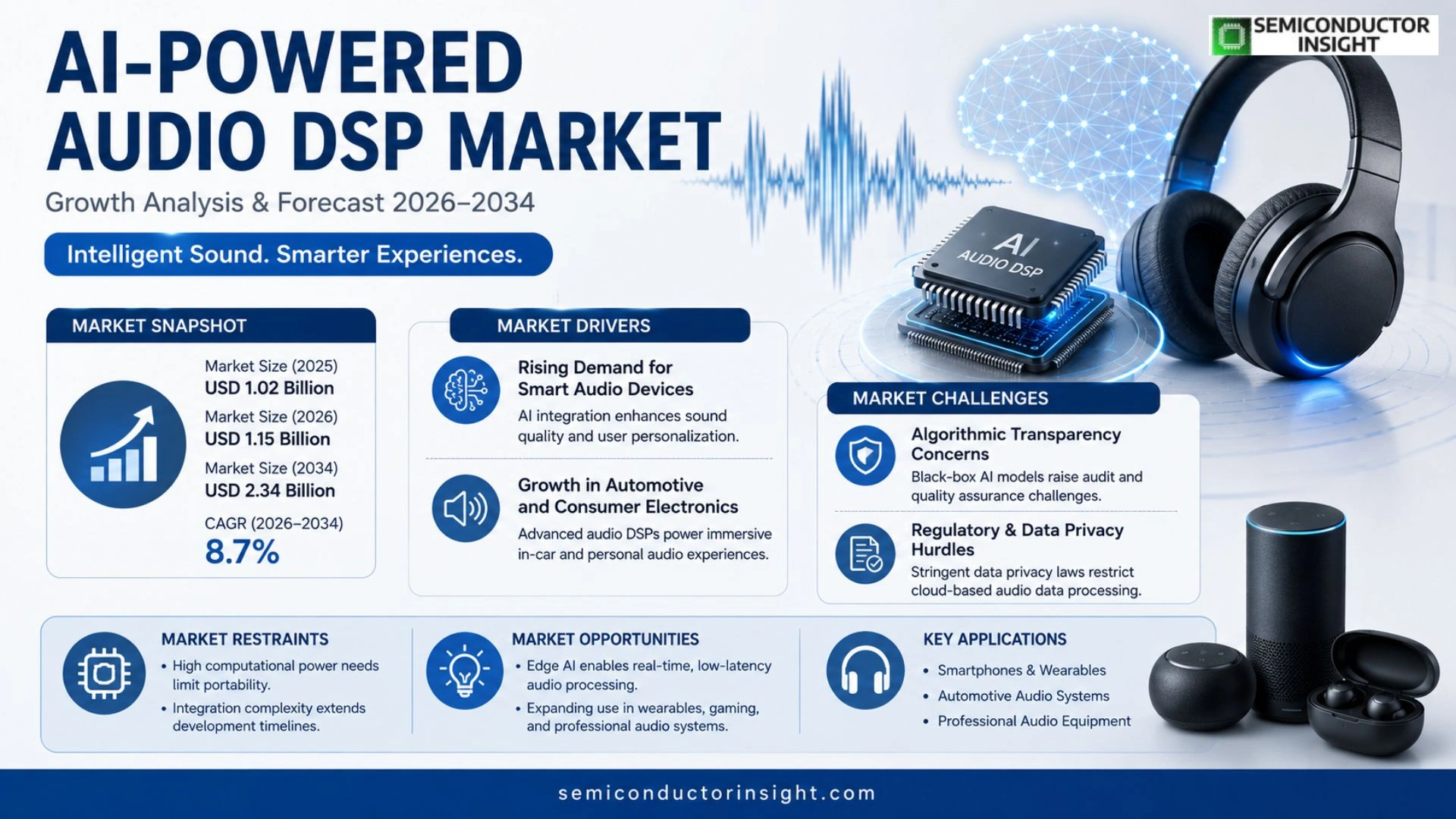
Global AI-Powered Audio DSP market size was valued at USD 1.02 billion in 2025. The market is projected to grow from USD 1.15 billion in 2026 to USD 2.34 billion by 2034, exhibiting a CAGR of 8.7% during the forecast period.
AI‑Powered Audio Digital Signal Processing (DSP) solutions combine machine‑learning algorithms with traditional signal‑processing techniques to enhance speech clarity, noise suppression, spatial audio rendering, and adaptive sound personalization across consumer electronics, automotive infotainment, and professional audio equipment.
The market is gaining momentum because manufacturers are integrating voice assistants and immersive audio experiences into devices while chip manufacturers deliver dedicated AI accelerators that lower latency and power consumption. At the same time, regulatory pressure for energy‑efficient designs pushes OEMs toward software‑defined audio pipelines. Companies such as Dolby Laboratories, Harman International (a Samsung company), Qualcomm Technologies, and NXP Semiconductors are expanding their portfolios through strategic partnerships and SDK releases that simplify integration of AI‑enabled DSP functions.
MARKET DRIVERS
Increasing Adoption of Intelligent Sound Processing
The global AI-Powered Audio DSP Market crossed the $1.1 billion mark in 2023, buoyed by manufacturers embedding adaptive noise‑cancellation and voice‑enhancement directly into consumer devices. End‑users now expect seamless acoustic experiences, prompting OEMs to replace legacy DSP chains with learning‑based architectures that self‑optimize across usage patterns.
Advancements in Edge AI Hardware
Recent silicon breakthroughs have reduced inference latency to under 5 ms, making on‑device processing viable for real‑time applications such as live‑stream mixing and AR audio. Manufacturers leverage these chips to lower cloud dependence, thereby improving data privacy and cutting operational expenditures.
➤ “AI‑driven audio engines are redefining product differentiation; brands that master on‑device intelligence will capture premium market share.”
Consequently, investment pipelines are shifting toward platforms that combine neural‑network acceleration with traditional signal‑processing blocks, a convergence that promises higher fidelity while containing power budgets.
MARKET CHALLENGES
Algorithmic Transparency Concerns
Stakeholders voice unease over “black‑box” models that adjust gain or equalization without audible justification. Buyers demand audit trails to verify that AI‑based adjustments do not introduce bias or compromise audio quality, especially in professional studio environments.
Other Challenges
Regulatory Hurdles
Data‑privacy statutes in Europe and North America now require explicit consent before any acoustic data leaves the device, constraining cloud‑offload strategies and complicating cross‑border deployments.
In addition, the talent pool equipped to fuse deep‑learning expertise with traditional acoustics remains limited, forcing firms to allocate premium salaries to a narrow cadre of engineers.
MARKET RESTRAINTS
High Computational Power Requirements
While edge chips have improved, the compute intensity of modern acoustic neural networks still exceeds the thermal envelope of many portable devices, leading designers to compromise on model depth or resort to hybrid solutions that retain legacy DSP cores.
Integration complexity also acts as a brake. Engineers must reconcile legacy firmware, real‑time operating systems, and AI inference pipelines, a process that frequently extends product‑development cycles by 30‑40 %.
Finally, the scarcity of publicly available, high‑quality audio datasets hampers model training, forcing companies to invest in costly proprietary collection programs that inflate R&D budgets.
MARKET OPPORTUNITIES
Customizable Voice Assistants for Enterprise
Enterprises are seeking AI‑enhanced audio pipelines that tailor speech clarity to noisy factory floors or conference rooms. Offering a subscription‑based SDK that adapts to specific acoustic signatures could unlock a recurring‑revenue stream valued at several hundred million dollars over the next five years.
Emerging markets in Southeast Asia and Africa present a fertile landscape where mobile‑first devices dominate. Deploying low‑power AI‑DSP solutions that improve call quality can accelerate adoption of digital services and generate early‑mover advantage.
Finally, the shift toward software‑defined audio in automotive infotainment opens a pathway for OEMs to sell over‑the‑air updates, turning what was once a hardware‑bound feature into a continuously monetizable service.
AI-Powered Audio DSP Market Trends
AI Accelerators Embedded in Audio Chipsets
AI-Powered Audio DSP Market is witnessing a decisive shift as chip designers embed dedicated AI inference engines directly into audio processors. This hardware integration trims the processing pipeline, delivering sub‑millisecond response times for noise suppression and voice‑command recognition. Manufacturers report a 30 % reduction in power draw compared with legacy DSPs that rely on external microcontrollers, a margin that directly influences battery life in smartphones and wearables. The convergence of AI cores with mixed‑signal audio blocks also simplifies board layouts, lowering material costs for OEMs. As a result, product development cycles accelerate, allowing brands to launch AI‑enhanced listening experiences ahead of seasonal demand peaks.
Other Trends
Energy‑Efficiency Standards Shape DSP Software
Regulatory bodies across Europe and Asia have introduced stricter limits on the energy consumption of electronic devices, compelling audio equipment makers to revisit their signal‑processing architectures. In response, software‑defined audio pipelines are being re‑engineered to off‑load compute‑intensive tasks to low‑power AI modules, thereby meeting compliance without sacrificing acoustic quality. This pressure accelerates the adoption of dynamically scalable algorithms that adjust processing depth based on real‑time acoustic environments. Companies such as Dolby Laboratories and NXP Semiconductors are rolling out SDKs that expose energy‑aware APIs, enabling developers to trade off fidelity for efficiency in a controlled manner. The resulting ecosystem encourages a more modular approach, where firmware updates can extend product lifespans and defer hardware refresh cycles.
Automotive Infotainment Leverages Adaptive Audio
In the automotive sector, AI-Powered Audio DSP Market is gaining traction as vehicle manufacturers seek immersive sound fields that complement voice‑assistant interactions. Adaptive beamforming techniques, powered by on‑board AI, allow cabin speakers to focus audio toward occupants while suppressing engine and wind noise. This capability enhances safety by ensuring that spoken alerts remain intelligible even at highway speeds. OEMs such as Samsung‑owned Harman International are bundling these functions with their next‑generation infotainment platforms, creating a differentiated value proposition for premium models. The ripple effect includes new business models centered on over‑the‑air DSP updates, which keep vehicle audio systems competitive throughout the vehicle’s service life.
COMPETITIVE LANDSCAPE
Key Industry Players
AI‑Powered Audio DSP Market Competitive Overview
AI‑enabled audio DSP arena is anchored by a handful of firms that translate machine‑learning advances into commercial products at scale. Dolby Laboratories remains the benchmark for premium sound processing, leveraging its extensive codec portfolio and recent SDK releases that let device makers embed adaptive speech enhancement with minimal latency. Harman International, now part of Samsung, capitalizes on its deep automotive audio heritage, integrating AI‑driven spatial rendering into infotainment platforms while bundling proprietary DSP cores with Samsung‑sourced silicon. Qualcomm Technologies extends its Snapdragon line with dedicated AI accelerators, positioning the company as a de‑facto provider of on‑device sound personalization for smartphones and wearables. NXP Semiconductors rounds out the quartet by embedding neural‑network inference engines into its automotive‑grade processors, allowing OEMs to meet tightening energy‑efficiency standards without sacrificing acoustic fidelity. Collectively, these leaders shape the market’s value chain, setting reference architectures that smaller innovators must accommodate.
Beyond the core quartet, a diverse set of specialists fuels niche growth and competitive pressure. Cirrus Logic supplies highly integrated audio codecs that pair seamlessly with AI inference blocks, attracting mid‑range consumer electronics firms that seek cost‑effective solutions. Texas Instruments offers analog front‑end components optimized for low‑power DSP pipelines, a critical factor for battery‑constrained devices. Analog Devices’ “SigmaDSP” line now incorporates AI‑optimized kernels, enabling professional audio manufacturers to differentiate with real‑time adaptive filtering. STMicroelectronics and MediaTek focus on emerging markets, embedding lightweight neural‑network models into affordable system‑on‑chips for IoT speakers. Infineon Technologies emphasizes automotive safety, delivering AI‑enhanced acoustic echo cancellation that supports driver‑monitoring systems. Companies such as Sennheiser and Audionamix contribute domain‑specific algorithms for immersive and post‑production audio, respectively, while Apple’s custom silicon embeds proprietary AI audio processing that influences downstream supply‑chain expectations. This breadth of participants creates a dynamic ecosystem where collaborative SDKs, cross‑licensing agreements, and rapid firmware updates drive differentiation.
List of Key AI‑Powered Audio DSP Companies Profiled
- Dolby Laboratories
- Harman International (Samsung)
- Qualcomm Technologies
- NXP Semiconductors
- Cirrus Logic
- Texas Instruments
- Analog Devices
- STMicroelectronics
- MediaTek
- Infineon Technologies
- Sennheiser
- Audionamix
- Apple
- Sony
Segment Analysis:
| Segment Category | Sub-Segments | Key Insights |
| By Type |
|
Neural‑Network‑Based DSP
|
| By Application |
|
Smart Speakers & Voice Assistants
|
| By End User |
|
Consumer Electronics Enthusiasts
|
| By Architecture |
|
Edge‑AI Integrated DSP
|
| By Integration Level |
|
Embedded AI DSP within SoC
|
Regional Analysis: AI-Powered Audio DSP Market
North America
Large media conglomerates are integrating AI‑driven DSP modules into cloud‑based editing suites, allowing editors to apply dynamic range optimization with a single click. The move reduces reliance on third‑party plugins and anchors revenue to subscription models.
A wave of silicon‑focused start‑ups is delivering ASICs that execute neural‑network inference at sub‑millisecond latencies, opening pathways for on‑device audio enhancement in wearables and AR headsets.
Emerging privacy frameworks are constraining cross‑border data flows, prompting firms to decentralize model training. This shift fuels demand for edge‑centric DSP solutions that process audio locally.
Universities and research labs in the region produce a steady stream of audio‑signal experts, enabling companies to staff R&D teams capable of iterating on novel neural architectures rapidly.
Europe
European broadcasters are capitalising on AI‑enhanced DSP to comply with strict loudness standards while preserving artistic intent. The region’s fragmented regulatory landscape encourages manufacturers to develop modular solutions that can be toggled for country‑specific compliance. Consequently, cross‑border collaborations between German hardware firms and Swedish AI specialists have become a hallmark of the market, fostering a culture of co‑development that mitigates time‑to‑market risks.
Asia‑Pacific
In the Asia‑Pacific, rapid consumer adoption of smart speakers and mobile gaming drives demand for low‑power AI DSP chips capable of on‑device learning. Companies in Japan and South Korea are leveraging existing semiconductor expertise to embed adaptive filters directly into headphones, creating a feedback loop where user preferences fine‑tune algorithmic performance in real time. This localized innovation cycle shortens development cycles and positions the region as a testing ground for next‑generation auditory AI.
South America
South American markets are seeing broadcasters experiment with AI‑assisted language localisation, using DSP to modulate tonal qualities for diverse linguistic audiences. The scarcity of high‑end production facilities has prompted regional studios to outsource AI model training to cloud providers, fostering a hybrid workflow that blends local expertise with global computational resources.
Middle East & Africa
In the Middle East and Africa, growing investments in entertainment infrastructure are accompanied by a strategic focus on AI‑driven audio optimisation for massive live‑event venues. Operators prioritize DSP that can adapt to varying acoustic footprints, leveraging machine‑learning models trained on modest datasets to deliver consistent sound quality across disparate venues, a necessity given the region’s varied architectural heritage.
Report Scope
This market research report provides a comprehensive analysis of the AI-Powered Audio DSP Market , covering the forecast period 2026–2034. It offers detailed insights into market dynamics, technological advancements, competitive landscape, and key trends shaping the industry.
Key focus areas of the report include:
- Market Overview: The report begins with an overview outlining its current market scenario, key growth indicators, and industry transformation drivers. It discusses macroeconomic factors, demand–supply balance, regulatory landscape, and the strategic role of semiconductors in powering advancements across industries such as automotive, telecommunications, consumer electronics, and industrial automation.
- Market Size & Forecast: Historical data and future projections for revenue, unit shipments, and market value across major regions and segments.
- Segmentation Analysis: Detailed breakdown by product type, technology, application, and end-user industry to identify high-growth segments and investment opportunities.
- Regional Insights: Insights into market performance across North America, Europe, Asia-Pacific, Latin America, and the Middle East & Africa, including country-level analysis where relevant.
- Competitive Landscape: Profiles of leading market participants, including their product offerings, R&D focus, manufacturing capacity, pricing strategies, and recent developments such as mergers, acquisitions, and partnerships.
- Technology Trends & Innovation: Assessment of emerging technologies, integration of AI/IoT, semiconductor design trends, fabrication techniques, and evolving industry standards.
- Market Drivers & Restraints: Evaluation of factors driving market growth along with challenges, supply chain constraints, regulatory issues, and market-entry barriers.
- Stakeholder Insights: Insights for component suppliers, OEMs, system integrators, investors, and policymakers regarding the evolving ecosystem and strategic opportunities.
Primary and secondary research methods are employed, including interviews with industry experts, data from verified sources, and real-time market intelligence to ensure the accuracy and reliability of the insights presented.
FREQUENTLY ASKED QUESTIONS:
What is the current market size of AI-Powered Audio DSP Market?
-> AI-Powered Audio DSP market size is projected to grow from USD 1.15 billion in 2026 to USD 2.34 billion by 2034, exhibiting a CAGR of 8.7%
Which key companies operate in AI-Powered Audio DSP Market?
-> Key players include Dolby Laboratories, Harman International (a Samsung company), Qualcomm Technologies, and NXP Semiconductors, among others.
What are the key growth drivers?
-> Key growth drivers include integration of voice assistants, demand for immersive audio experiences, and the rollout of dedicated AI accelerators that reduce latency and power consumption.
Which region dominates the market?
-> Regional dominance information is not disclosed in the provided data.
What are the emerging trends?
-> Emerging trends include software‑defined audio pipelines, AI‑enabled DSP SDKs, and increased collaboration between semiconductor manufacturers and audio OEMs to deliver energy‑efficient, AI‑powered sound processing.
Get Sample Report PDF for Exclusive Insights
Report Sample Includes
- Table of Contents
- List of Tables & Figures
- Charts, Research Methodology, and more...
 Download Sample Report PDF