AI PCs Market Insights
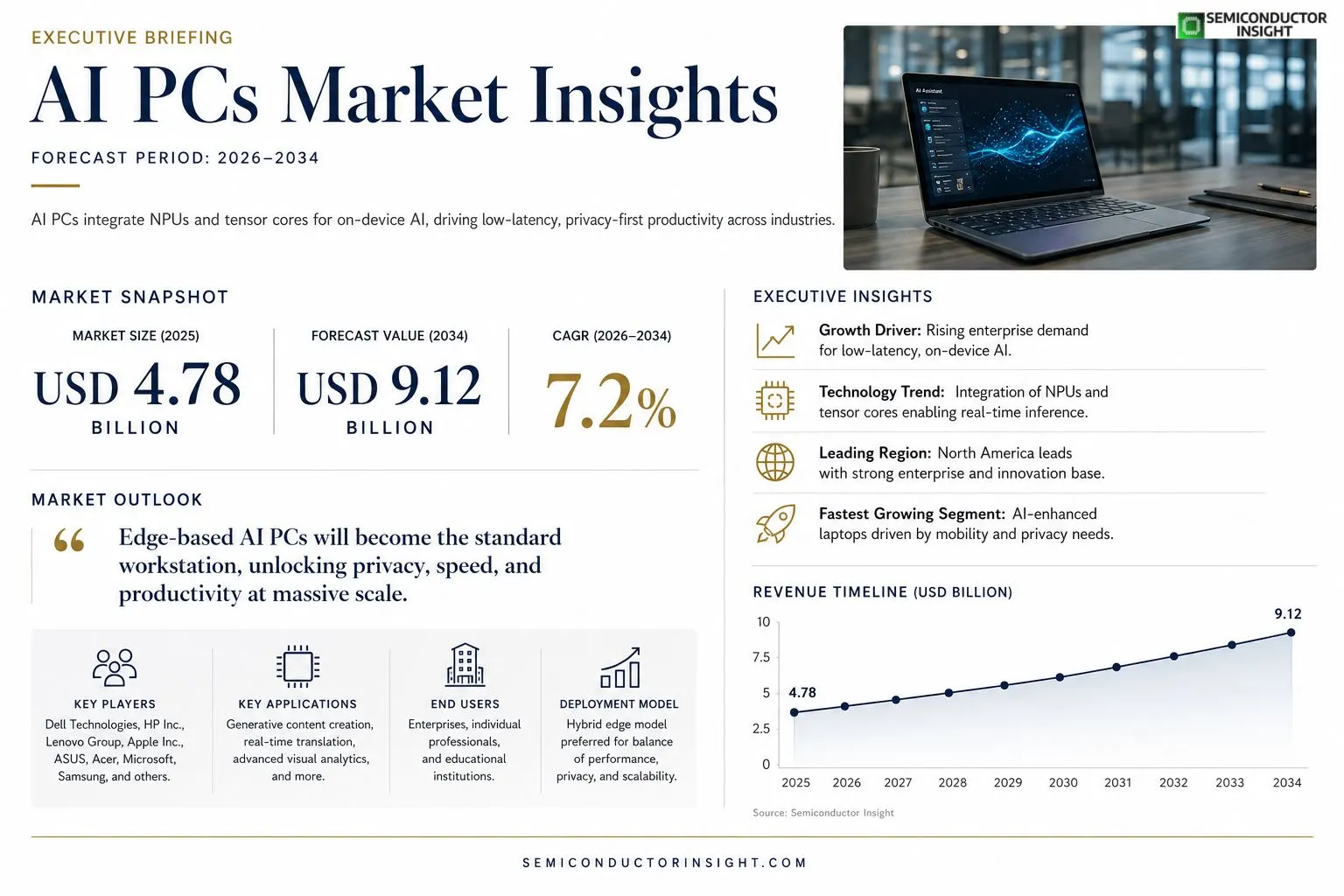
AI PCs market size was valued at USD 4.78 billion in 2025. The market is projected to grow from USD 4.95 billion in 2026 to USD 9.12 billion by 2034, exhibiting a CAGR of 7.2% during the forecast period.
AI‑enhanced personal computers integrate traditional CPUs/G PUs with dedicated artificial‑intelligence accelerators,such as neural‑processing units (NPUs) or tensor cores,to provide on‑device inference for generative‑AI tools, real‑time translation, and advanced visual analytics while preserving user privacy.The market is accelerating because enterprises and creators increasingly demand low‑latency AI capabilities without relying on cloud bandwidth.Furthermore, falling costs of silicon‑photonic interconnects and strategic OEM collaborations with chipset leaders like Nvidia and AMD are expanding adoption.Key players,including Dell Technologies, HP Inc., Lenovo Group, Apple Inc., and ASUS,are launching AI‑first laptops and desktops that embed these accelerators, driving robust growth.
MARKET DRIVERS
Growing Adoption of Generative AI
The rapid integration of generative AI models into daily workflows is prompting enterprises to upgrade to hardware that can process large neural networks locally. Performance‑centric users are increasingly favoring devices that combine traditional PC capabilities with dedicated AI accelerators, driving higher demand for AI PCs Market.
Edge Computing and Data Privacy
Regulatory pressures around data residency are encouraging organizations to shift AI inference from cloud to the edge. By deploying AI‑enabled PCs, companies can keep sensitive data on‑premise while still benefitting from real‑time analytics, a key catalyst for market growth.
➤ “Local AI processing reduces latency by up to 70 % compared with cloud‑only solutions, unlocking new use‑cases in design, health, and finance.”
These drivers collectively create a stable pipeline of demand, positioning AI PCs Market for sustained expansion over the next five years.
MARKET CHALLENGES
High Development Costs
Designing chips that balance general‑purpose computing with AI acceleration requires substantial R&D investment. Smaller OEMs often lack the capital to develop proprietary solutions, limiting their participation in AI PCs Market.
Other Challenges
Software Ecosystem Fragmentation
The diversity of AI frameworks and operating‑system integrations creates compatibility issues, forcing developers to spend extra effort on optimization, which can slow adoption rates.
MARKET RESTRAINTS
Power Consumption Constraints
AI accelerators increase the power envelope of a typical workstation. In environments where energy efficiency is critical,such as remote offices or mobile scenarios,elevated electricity usage can deter purchase decisions, acting as a restraint on AI PCs Market.
MARKET OPPORTUNITIES
Customization for Industry Verticals
Tailoring AI‑enabled PCs for specific sectors,such as content creation, scientific research, and autonomous robotics,offers a differentiated value proposition. By bundling specialized software stacks with hardware, vendors can capture premium pricing and expand AI PCs Market footprint.
AI PCs Market Trends
AI‑Enhanced Compute Integration
Enterprises and creative professionals are increasingly prioritizing low‑latency AI capabilities that run directly on the workstation. By embedding neural‑processing units and tensor cores alongside traditional CPUs, AI PCs Market delivers on‑device inference for generative‑AI tools, real‑time translation, and advanced visual analysis while preserving data privacy. The convergence of silicon‑photonic interconnects and diminishing accelerator costs accelerates adoption across midsize firms and large corporations alike. Edge‑centric designs also reduce reliance on cloud bandwidth, enabling smoother collaboration in distributed teams and tighter compliance with regional data‑handling regulations.
Other Trends
On‑Device Inference
On‑device inference eliminates the round‑trip to cloud services, reducing bandwidth consumption and response time. Modern AI‑first laptops incorporate dedicated NPUs that handle image classification, language modeling, and video enhancement locally. This capability is especially valuable in regulated sectors where data residency rules restrict external processing, reinforcing the strategic relevance of AI‑powered personal computers. Developers are increasingly leveraging unified software stacks that abstract hardware differences, allowing applications to scale from a notebook to a workstation without code rewrites.
Strategic OEM Partnerships
Key manufacturers such as Dell, HP, Lenovo, Apple, and ASUS have deepened collaborations with chipset leaders including Nvidia and AMD. These alliances streamline the integration of AI accelerators into consumer and business product lines, enabling faster time‑to‑market for devices that reference AI PCs Market’s emerging standards. Joint development programs also focus on power‑efficient designs, ensuring that AI workloads can run continuously on battery‑powered devices without compromising performance. Looking ahead, the ecosystem is expected to expand with modular AI cards and cloud‑edge hybrid workflows that further blur the line between desktop and server capabilities.
COMPETITIVE LANDSCAPEKey Industry Players
AI PCs Market – Competitive Overview
The AI‑enhanced personal computer segment is now dominated by a handful of original equipment manufacturers (OEMs) that have integrated neural‑processing units (NPUs) or tensor‑core GPUs directly into flagship laptops and desktops. Dell Technologies leads the market with its “Alienware X‑Series AI” line, leveraging Nvidia’s latest tensor cores to deliver on‑device generative‑AI inference for enterprise creators. HP Inc. follows closely, embedding AMD‑based AI accelerators in its Envy and ZBook portfolios, while Lenovo Group has institutionalized AI‑first designs across its ThinkPad X1 series, partnering with both Nvidia and Qualcomm’s AI chipsets. Apple Inc. differentiates through its in‑house M‑series silicon, which combines a high‑performance CPU, GPU, and a dedicated NPU, positioning the MacBook Pro as a privacy‑centric AI workstation. ASUS amplifies the competitive pressure with its ROG Zephyrus AI laptops, targeting gaming and content‑creation workloads that demand low‑latency model inference. Collectively, these leaders shape a market that grew from USD 4.78 billion in 2025 to an expected USD 9.12 billion by 2034, reflecting a CAGR of roughly 7 % driven by enterprise demand for edge‑based AI capabilities and the declining cost of silicon‑photonic interconnects.Beyond the core OEMs, a diverse set of niche and regionally strong players contributes to the depth of the AI PCs ecosystem. Acer has introduced AI‑optimized Aspire models that integrate low‑power NPUs for student and remote‑work use cases, while Microsoft’s Surface lineup incorporates Azure‑linked AI features without sacrificing offline inference speed. Samsung Electronics brings its Galaxy Book series, embedding proprietary AI accelerators that enhance real‑time translation and image processing. MSI focuses on the esports segment, offering AI‑enhanced graphics pipelines for competitive gamers. Razer Inc. leverages its brand cachet to market high‑refresh‑rate laptops with built‑in AI rendering engines. Huawei Technologies supplies AI‑centric notebooks in the APAC market, emphasizing on‑device privacy. Gigabyte Technology and Fujitsu round out the list, delivering specialized AI workstations for scientific computing and financial modeling, respectively. These players collectively broaden the competitive landscape, ensuring continuous innovation and price‑performance improvements across the AI PC value chain.
List of Key AI PCs Companies Profiled
- Dell Technologies
- HP Inc.
- Lenovo Group
- Apple Inc.
- ASUS
- Acer
- Microsoft
- Samsung Electronics
- MSI (Micro‑Star International)
- Razer Inc.
- Huawei Technologies
- Gigabyte Technology
- Fujitsu
Segment Analysis:
| Segment Category | Sub-Segments | Key Insights |
| By Type |
|
AI‑Enhanced Laptops
|
| By Application |
|
Generative Content Creation
|
| By End User |
|
Enterprises
|
| By Industry |
|
Media & Entertainment
|
| By Deployment Model |
|
Hybrid Edge
|
Regional Analysis: North America
North America
Government initiatives promoting AI research and development, coupled with substantial funding allocations, are significantly boosting AI PCs Market in North America. These efforts are fostering innovation and encouraging the development of advanced AI-powered hardware and software solutions.
Large enterprises across various sectors are increasingly adopting AI PCs to enhance productivity, streamline operations, and gain a competitive edge. The demand for AI-powered workstations for design, engineering, and financial modeling is particularly strong, driving market growth in the business segment.
Consumers are showing a growing interest in AI PCs for gaming, content creation, and other demanding applications. The demand for devices with powerful processors and dedicated AI accelerators is rising, creating opportunities for manufacturers to offer high-performance AI-enabled PCs.
The expanding ecosystem of AI software and tools is a key driver for the North American AI PCs market. The availability of sophisticated AI frameworks and libraries is enabling developers to create innovative applications that leverage the power of AI PCs.
North America
The North American AI PCs market is characterized by a strong emphasis on innovation and high-performance computing. This region’s established technological infrastructure, combined with significant investment in research and development, positions it as a leader in the AI PC space. The demand for these powerful machines is driven by various sectors, including enterprise, consumer, and government, all seeking to leverage the capabilities of AI for enhanced productivity and advanced applications.
Europe
Europe’s AI PCs market is gaining momentum, with a focus on sustainable and energy-efficient solutions. Government initiatives are supporting the development of AI technologies while emphasizing environmental responsibility. The region is seeing increased adoption in research institutions and specialized industries.
Asia-Pacific
Asia-Pacific represents a significant growth opportunity for AI PCs Market. Rapid industrialization, a burgeoning tech sector, and increasing disposable incomes are fueling demand. The region is witnessing a rise in AI PC adoption across various applications, from manufacturing to education.
South America
AI PCs Market in South America is in its early stages but shows promising potential. Growing digital infrastructure and increasing investment in technology are expected to drive adoption in the coming years, particularly in sectors like finance and healthcare.
Middle East & Africa
The Middle East & Africa’s AI PCs market is nascent but poised for significant expansion. Increasing government focus on technological advancement and a growing awareness of AI’s potential are key drivers. Adoption is expected to be concentrated in sectors such as energy, government, and technology.
Report Scope
This market research report provides a comprehensive analysis of the AI PCs Market , covering the forecast period 2026–2034. It offers detailed insights into market dynamics, technological advancements, competitive landscape, and key trends shaping the industry.
Key focus areas of the report include:
- Market Overview: The report begins with an overview outlining its current market scenario, key growth indicators, and industry transformation drivers. It discusses macroeconomic factors, demand–supply balance, regulatory landscape, and the strategic role of semiconductors in powering advancements across industries such as automotive, telecommunications, consumer electronics, and industrial automation.
- Market Size & Forecast: Historical data and future projections for revenue, unit shipments, and market value across major regions and segments.
- Segmentation Analysis: Detailed breakdown by product type, technology, application, and end-user industry to identify high-growth segments and investment opportunities.
- Regional Insights: Insights into market performance across North America, Europe, Asia-Pacific, Latin America, and the Middle East & Africa, including country-level analysis where relevant.
- Competitive Landscape: Profiles of leading market participants, including their product offerings, R&D focus, manufacturing capacity, pricing strategies, and recent developments such as mergers, acquisitions, and partnerships.
- Technology Trends & Innovation: Assessment of emerging technologies, integration of AI/IoT, semiconductor design trends, fabrication techniques, and evolving industry standards.
- Market Drivers & Restraints: Evaluation of factors driving market growth along with challenges, supply chain constraints, regulatory issues, and market-entry barriers.
- Stakeholder Insights: Insights for component suppliers, OEMs, system integrators, investors, and policymakers regarding the evolving ecosystem and strategic opportunities.
Primary and secondary research methods are employed, including interviews with industry experts, data from verified sources, and real-time market intelligence to ensure the accuracy and reliability of the insights presented.
FREQUENTLY ASKED QUESTIONS:
What is the current market size of AI PCs Market?
-> AI PCs Market was valued at USD 4.78 billion in 2025 and is expected to reach USD 9.12 billion by 2034.
Which key companies operate in AI PCs Market?
-> Key players include Dell Technologies, HP Inc., Lenovo Group, Apple Inc., and ASUS, among others.
What are the key growth drivers?
-> Key growth drivers include enterprises and creators demanding low‑latency AI capabilities, falling silicon‑photonic interconnect costs, and strategic OEM collaborations with chipset leaders.
Which region dominates the market?
-> The reference does not specify a dominant region.
What are the emerging trends?
-> Emerging trends include on‑device inference for generative AI, real‑time translation, advanced visual analytics, and the integration of neural‑processing units and tensor cores in laptops and desktops.

Get Sample Report PDF for Exclusive Insights
Report Sample Includes
- Table of Contents
- List of Tables & Figures
- Charts, Research Methodology, and more...