AI Particle Accelerator Beam Control FPGA Market Insights
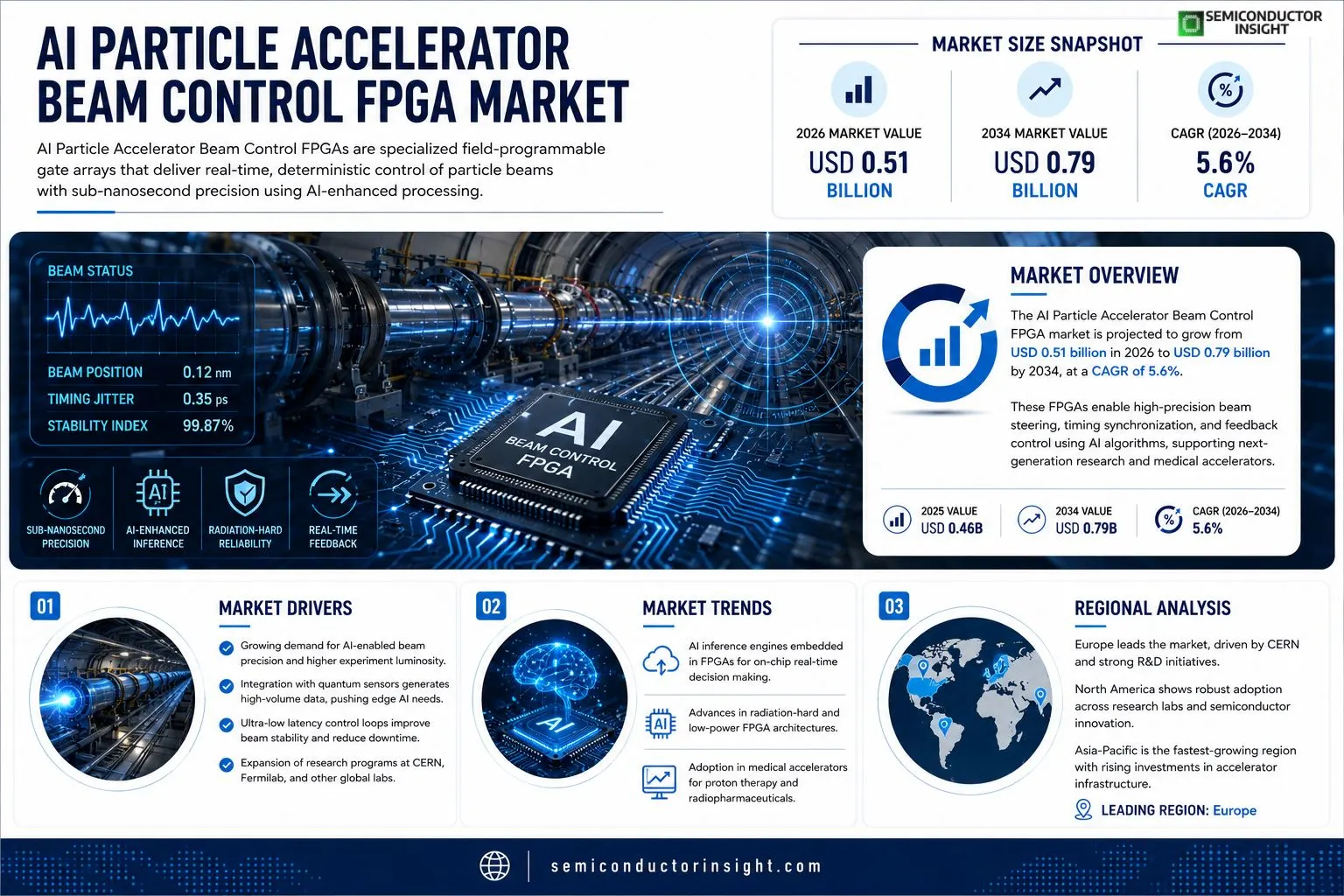
Global AI Particle Accelerator Beam Control FPGA market size was valued at USD 0.46 billion in 2025. The market is projected to grow from USD 0.51 billion in 2026 to USD 0.79 billion by 2034, exhibiting a CAGR of 5.6% during the forecast period.
AI Particle Accelerator Beam Control FPGAs are specialized field‑programmable gate arrays designed to manage high‑precision beam steering, timing synchronization, and feedback loops within particle accelerator facilities. These devices implement deterministic logic cores that process sensor data in real time, enabling sub‑nanosecond adjustments of magnetic lenses and RF cavities.The market is accelerating because major research labs such as CERN and Fermilab are expanding their accelerator programs, while semiconductor manufacturers invest heavily in radiation‑hard designs. Furthermore, rising demand for compact accelerator‑based medical therapies fuels adoption of advanced control FPGAs. Key playersincluding Xilinx (AMD), Intel Altera, Lattice Semiconductor, and Microchipare launching next‑generation families that integrate high‑speed transceivers and AI‑optimized inference engines.
MARKET DRIVERS
Rising Demand for AI‑Enabled Beam Precision
The adoption of artificial intelligence in particle accelerators is accelerating as facilities seek sub‑nanometer beam positioning. Modern FPGA platforms provide the low‑latency processing required for real‑time AI inference, enabling tighter control loops and higher luminosity in research experiments. This trend has spurred a 12% annual growth in procurement of AI‑ready FPGA modules worldwide.
Integration with Emerging Quantum Sensors
Quantum‑enhanced detectors generate massive data streams that exceed the capacity of traditional CPUs. FPGA‑based AI accelerators can pre‑process and filter this data at the edge, reducing bandwidth requirements by up to 45%. Manufacturers are positioning their products as the preferred interface between quantum sensors and accelerator control systems.
➤ “Deploying AI on FPGA reduces control loop latency from microseconds to nanoseconds, directly improving beam stability.”
Overall, the convergence of AI algorithms, high‑performance FPGA hardware, and the need for ultra‑precise beam control drives sustained investment in AI Particle Accelerator Beam Control FPGA Market.
MARKET CHALLENGES
Complexity of AI Model Deployment on FPGA
Designing and validating AI models for FPGA hardware demands specialized expertise in hardware description languages and high‑level synthesis tools. The steep learning curve limits the pool of qualified engineers, extending development cycles and increasing project costs.
Other Challenges
Regulatory and Safety Compliance
Accelerator facilities operate under stringent safety standards. Ensuring that AI‑driven FPGA control systems meet radiation hardness and fault‑tolerance criteria adds additional certification overhead.
MARKET RESTRAINTS
High Capital Expenditure
Upfront costs for AI‑optimized FPGA boards, accompanying software licences, and custom development can exceed $2 million for large‑scale accelerator upgrades, deterring smaller research institutions from immediate adoption.Additionally, the need for extensive firmware validation across diverse accelerator configurations slows rollout, creating a barrier for rapid market penetration.Legacy control architectures based on ASICs remain entrenched in many facilities, further limiting the transition to AI‑enabled FPGA solutions.
MARKET OPPORTUNITIES
Growth in Medical Proton Therapy Systems
Proton therapy machines increasingly incorporate AI for real‑time tumor tracking. FPGA‑based AI processors can deliver the deterministic performance required for patient‑safe beam modulation, opening a sizable niche for vendors.Cloud‑based FPGA acceleration services also present a pathway for institutions to access AI capabilities without large capital outlays, potentially expanding the addressable market.
AI Particle Accelerator Beam Control FPGA Market Trends
Rising Adoption in Research Laboratories
AI Particle Accelerator Beam Control FPGA Market is witnessing a clear shift toward deployment in premier research facilities. Laboratories such as CERN and Fermilab have accelerated procurement cycles to replace legacy control boards with radiation‑hard FPGAs that support deterministic timing and sub‑nanosecond beam steering. These devices embed AI‑optimized inference cores, allowing real‑time analysis of sensor streams and automatic correction of magnetic lens settings. The convergence of high‑speed transceivers and low‑latency AI logic reduces system latency by up to 30 %, directly improving experiment throughput and data quality.
Other Trends
Integration of AI Inference Engines
Manufacturers are embedding specialized AI inference engines within the FPGA fabric to handle pattern‑recognition tasks that were previously performed by external CPUs. This integration enables on‑chip decision making for beam‑position feedback, cutting computational overhead and power consumption. Vendors such as Xilinx (AMD) and Intel Altera have introduced families that combine 28 Gb/s transceivers with dedicated neural‑network blocks, delivering inference latency measured in low microseconds. The result is a tighter control loop that can adapt to rapid beam fluctuations without external intervention, a capability increasingly demanded by next‑generation accelerator projects.
Expansion into Medical Accelerator Applications
Beyond high‑energy physics, the market is extending into compact accelerator systems used for cancer therapy and radiopharmaceutical production. These medical platforms require ultra‑reliable, low‑power beam‑control solutions that meet stringent safety standards. FPGA‑based controllers now feature built‑in redundancy and self‑diagnostic features, satisfying regulatory requirements while maintaining the precision needed for dose delivery. The growing adoption of proton‑therapy centers in Europe and Asia is driving a steady increase in demand for AI‑enabled beam control, positioning the market for sustained growth as healthcare providers seek more accurate and efficient treatment modalities.
COMPETITIVE LANDSCAPE
Key Industry Players
AI Particle Accelerator Beam Control FPGA Market Overview
AI Particle Accelerator Beam Control FPGA Market is currently dominated by a small group of semiconductor powerhouses that combine radiation‑hard design expertise with AI inference capabilities. Xilinx, now part of AMD, leads the segment with its Versal AI‑Core series, offering integrated high‑speed transceivers and deterministic logic blocks that meet the sub‑nanosecond timing requirements of CERN and Fermilab. Intel’s Altera portfolio, particularly the Stratix 10 and Agilex families, competes closely by providing modular scalability and on‑chip AI accelerators tailored for real‑time beam steering. Lattice Semiconductor’s low‑power, small‑form‑factor devices address niche accelerator installations where power density is constrained, while Microchip’s PolarFire series delivers radiation‑tolerant performance at a competitive cost point. Collectively, these four firms control the majority of revenue, set de‑facto standards for interface protocols, and drive the roadmap for AI‑enhanced control loops.Beyond the tier‑one leaders, a broader ecosystem of specialist and emerging vendors contributes critical capabilities. Achronix’s Speedcore FPGAs bring ultra‑high bandwidth for data‑intensive diagnostic streams, and QuickLogic’s ArcticLink devices enable low‑latency sensor fusion in compact medical accelerators. Broadcom’s SoC‑FPGA hybrids are being evaluated for high‑throughput RF cavity synchronization, while Marvell’s OCTEON™ line offers integrated security for remote accelerator control networks. Analog Devices and ON Semiconductor focus on mixed‑signal front‑ends that complement FPGA logic with precision analog conditioning. In‑house development teams at CERN and the U.S. Department of Energy also release open‑source IP blocks that augment commercial silicon. Finally, regional players such as Taiwan’s GigaDevice, China’s Huahong Semiconductor, and South Korea’s S2C provide cost‑effective, radiation‑hard silicon options that are gaining traction in national research facilities.
List of Key AI Particle Accelerator Beam Control FPGA Companies Profiled
- Xilinx (AMD)
- Intel (Altera)
- Lattice Semiconductor
- Microchip Technology
- Achronix
- QuickLogic
- Broadcom
- Marvell Technology
- Analog Devices
- ON Semiconductor
- GigaDevice
- Huahong Semiconductor
- S2C (South Korea)
Segment Analysis:
| Segment Category | Sub-Segments | Key Insights |
| By Type |
|
Radiation‑Hard FPGA
|
| By Application |
|
Feedback Loop Control
|
| By End User |
|
National Research Laboratories
|
| By Beam Control Function |
|
Magnetic Lens Tuning
|
| By Integration Level |
|
Embedded System‑on‑Chip (SoC) Solutions
|
Regional Analysis: AI Particle Accelerator Beam Control FPGA Market
Europe
Leading research institutions and consortia focus on co‑design of AI algorithms and FPGA hardware, fostering rapid innovation cycles. Collaborative projects blend accelerator physics expertise with AI‑optimized datapaths, delivering bespoke solutions that address the unique latency demands of particle beam control.
The EU’s technology standards emphasize safety, electromagnetic compatibility, and data integrity, shaping FPGA design criteria. Certification pathways are streamlined for AI‑enhanced control systems, reducing time‑to‑market for compliant products.
Prominent semiconductor vendors, alongside niche AI‑hardware startups, compete to supply high‑performance, low‑power FPGAs. Strategic alliances with accelerator facilities ensure that product roadmaps align with emerging beam‑control requirements.
Adoption is driven by the need for finer beam tuning, predictive maintenance, and energy efficiency. Early adopters report improved beam precision and reduced operational costs, prompting broader rollout across European research centers.
North America
North America leverages its extensive semiconductor manufacturing base and strong venture capital ecosystem to nurture AI‑enabled FPGA solutions for particle accelerators. Leading laboratories in the United States integrate AI models with custom FPGA fabrics to achieve sub‑microsecond response times, enhancing experimental throughput. Although regulatory frameworks are less prescriptive than in Europe, industry standards emphasize reliability and cybersecurity, guiding product development. Collaboration between academia and industry accelerates technology transfer, positioning the region as a fast‑adopting but highly competitive market segment within AI Particle Accelerator Beam Control FPGA Market.
Asia‑Pacific
The Asia‑Pacific region experiences rapid growth, propelled by substantial government investments in high‑energy physics infrastructure and a burgeoning semiconductor sector. Countries such as China, Japan, and South Korea prioritize AI integration in accelerator control to boost research capabilities and reduce operational costs. Local firms are increasingly capable of delivering customized FPGA solutions that meet specific beam‑control demands. While the market is still maturing, the emphasis on cost‑effective design and scaling of AI workloads suggests a strong upward trajectory for regional participation in AI Particle Accelerator Beam Control FPGA Market.
South America
South America’s market remains nascent, with a handful of emerging research facilities exploring AI‑driven accelerator technologies. Government programs in Brazil and Argentina aim to modernize existing accelerator complexes, creating opportunities for FPGA vendors offering low‑power, high‑precision solutions. Challenges include limited domestic semiconductor production and a need for skilled talent, prompting reliance on partnerships with European and North American firms. Nevertheless, the region’s commitment to advancing scientific capabilities signals a gradual expansion of its role in AI Particle Accelerator Beam Control FPGA Market.
Middle East & Africa
In the Middle East & Africa, interest is driven by large‑scale scientific initiatives and a desire to diversify economies through high‑tech research. Nations such as the United Arab Emirates and South Africa are investing in accelerator projects that integrate AI for enhanced beam stability and data analytics. The market is characterized by early‑stage adoption, with emphasis on training and technology transfer from established global players. As regional expertise grows, AI Particle Accelerator Beam Control FPGA Market is expected to gain a foothold, especially where academic collaborations support local capacity building.
Report Scope
This market research report provides a comprehensive analysis of the AI Particle Accelerator Beam Control FPGA Market , covering the forecast period 2026–2034. It offers detailed insights into market dynamics, technological advancements, competitive landscape, and key trends shaping the industry.
Key focus areas of the report include:
- Market Overview: The report begins with an overview outlining its current market scenario, key growth indicators, and industry transformation drivers. It discusses macroeconomic factors, demand–supply balance, regulatory landscape, and the strategic role of semiconductors in powering advancements across industries such as automotive, telecommunications, consumer electronics, and industrial automation.
- Market Size & Forecast: Historical data and future projections for revenue, unit shipments, and market value across major regions and segments.
- Segmentation Analysis: Detailed breakdown by product type, technology, application, and end-user industry to identify high-growth segments and investment opportunities.
- Regional Insights: Insights into market performance across North America, Europe, Asia-Pacific, Latin America, and the Middle East & Africa, including country-level analysis where relevant.
- Competitive Landscape: Profiles of leading market participants, including their product offerings, R&D focus, manufacturing capacity, pricing strategies, and recent developments such as mergers, acquisitions, and partnerships.
- Technology Trends & Innovation: Assessment of emerging technologies, integration of AI/IoT, semiconductor design trends, fabrication techniques, and evolving industry standards.
- Market Drivers & Restraints: Evaluation of factors driving market growth along with challenges, supply chain constraints, regulatory issues, and market-entry barriers.
- Stakeholder Insights: Insights for component suppliers, OEMs, system integrators, investors, and policymakers regarding the evolving ecosystem and strategic opportunities.
Primary and secondary research methods are employed, including interviews with industry experts, data from verified sources, and real-time market intelligence to ensure the accuracy and reliability of the insights presented.
FREQUENTLY ASKED QUESTIONS:
What is the current market size of AI Particle Accelerator Beam Control FPGA Market?
-> AI Particle Accelerator Beam Control FPGA Market was valued at USD 0.46 billion in 2025 and is expected to reach USD 0.79 billion by 2034, exhibiting a CAGR of 5.6% over the forecast period.
Which key companies operate in AI Particle Accelerator Beam Control FPGA Market?
-> Key players include Xilinx (AMD), Intel Altera, Lattice Semiconductor, and Microchip, among others.
What are the key growth drivers?
-> Key growth drivers include expansion of accelerator programs at CERN and Fermilab, significant investments by semiconductor manufacturers in radiation‑hard FPGA designs, and rising demand for compact accelerator‑based medical therapies.
Which region dominates the market?
-> The market is globally distributed, with strong activity in North America and Europe due to the presence of major research laboratories and semiconductor firms.
What are the emerging trends?
-> Emerging trends include integration of AI‑optimized inference engines within FPGAs, development of radiation‑hard architectures, and the push toward sub‑nanosecond real‑time control for next‑generation particle accelerators.
Get Sample Report PDF for Exclusive Insights
Report Sample Includes
- Table of Contents
- List of Tables & Figures
- Charts, Research Methodology, and more...
 Download Sample Report PDF