AI-Optimized Coherent DSP for Optical Transport Market Insights
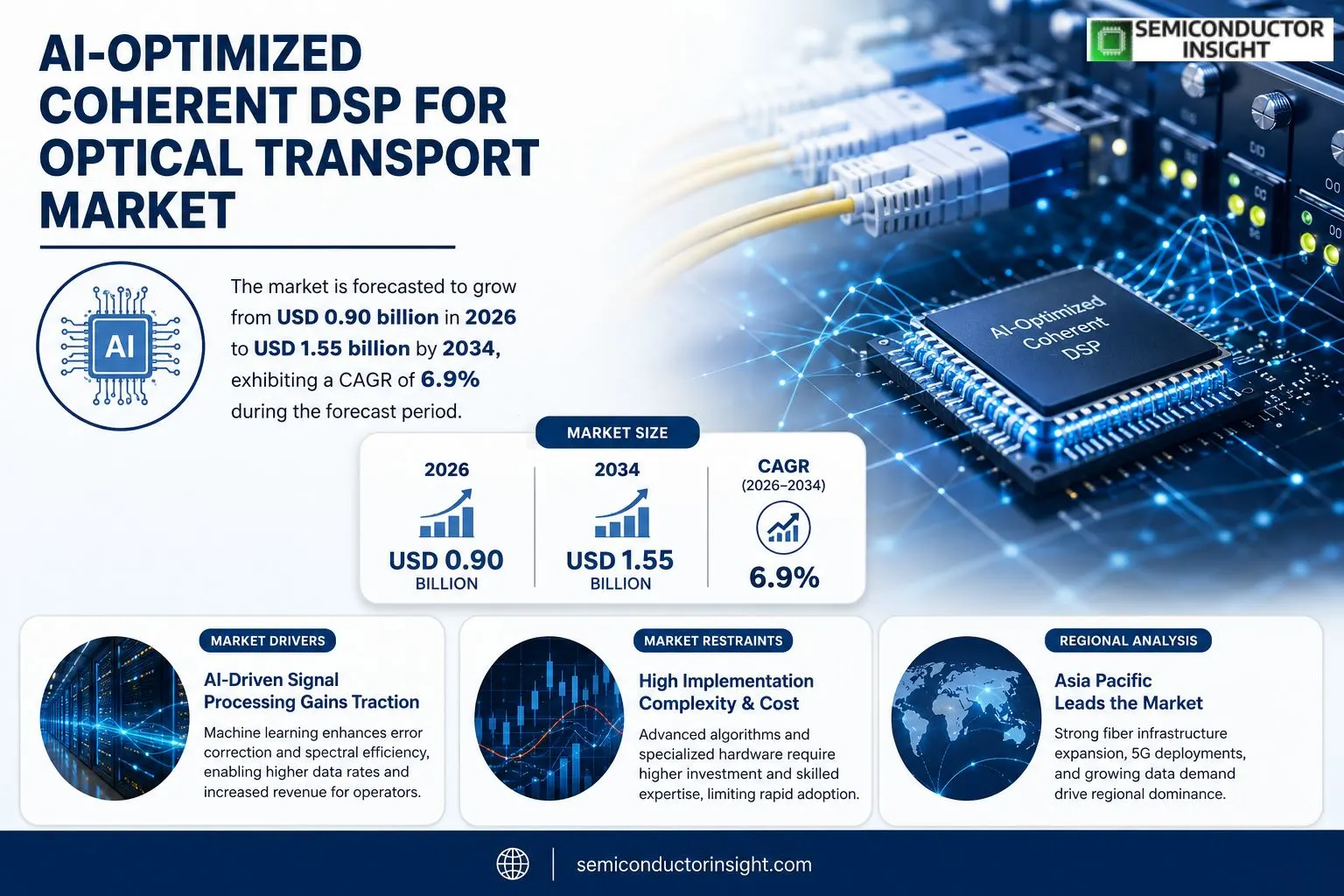
AI-Optimized Coherent DSP for Optical Transport market size was valued at USD 0.85 billion in 2025. The market is forecasted to increase from USD 0.90 billion in 2026 to USD 1.55 billion by 2034, exhibiting a CAGR of 6.9% during the forecast period.
AI‑optimized coherent digital signal processing (DSP) blends machine‑learning algorithms with conventional coherent detection to raise signal fidelity, cut latency, and boost spectral efficiency across long‑haul and metro optical networks. By continuously tuning equalization settings and forward error correction schemes, the solution supports data rates exceeding 400 Gb/s per wavelength while keeping power draw modest.The market is gaining momentum because telecom operators are expanding fiber capacity after a sustained rise in cloud workloads and video traffic since 2020. Deployments of open‑RAN fronthaul over DWDM and the rollout of 5G backhaul have heightened demand for software‑centric DSP that can be upgraded without hardware replacement. Major players such as Intel, Ciena and Nokia are releasing AI‑driven firmware upgrades, further accelerating adoption.
MARKET DRIVERS
AI‑Driven Signal Processing Gains Traction
The infusion of machine‑learning algorithms into coherent digital signal processors has begun to deliver measurable error‑correction improvements, allowing carriers to push modulation formats beyond traditional limits. Higher spectral efficiency translates directly into revenue uplift for service providers, especially in congested metro corridors where new fiber deployment is cost‑prohibitive.
Network Capacity Pressures Fuel Adoption
Rising demand for bandwidth‑intensive applicationscloud gaming, immersive media, and real‑time analyticshas forced operators to revisit legacy transport solutions. The AI‑Optimized Coherent DSP for Optical Transport Market offers a pathway to double existing link capacity without parallel fiber expansion, a compelling proposition for capital‑constrained operators.
➤ The convergence of AI and coherent DSP reshapes cost structures, delivering up to 30 % reduction in power consumption per bit.
Beyond performance, the technology’s ability to self‑tune in response to evolving network conditions reduces operational expenditures. Service teams can rely on automated calibration cycles, freeing engineering resources for higher‑value initiatives such as service innovation and market expansion.
MARKET CHALLENGES
Skill Gaps in AI Integration
Deploying AI‑enhanced coherent DSPs demands expertise that sits at the intersection of photonics, signal processing, and data science. Many incumbent operators lack in‑house talent capable of designing, validating, and maintaining these hybrid solutions, leading to prolonged rollout timelines.
Other Challenges
Integration Complexity
The coexistence of legacy ROADM architectures with next‑generation AI‑driven modules creates interoperability hurdles. Vendors must certify backward compatibility while ensuring that firmware updates do not disrupt existing traffic engineering policies.Regulatory scrutiny over algorithmic decision‑making in critical infrastructure also adds a layer of compliance risk, prompting organizations to invest in governance frameworks before full‑scale deployment.
MARKET RESTRAINTS
Capital Intensity of Up‑Front Deployments
Initial outlays for AI‑optimized coherent DSP hardware, coupled with necessary upgrades to cooling and power distribution, remain a deterrent for smaller carriers. Although total cost of ownership improves over a multi‑year horizon, the upfront financial commitment can stall procurement cycles.
Uncertainty Around Long‑Term ROI
Quantifying the precise economic benefit of AI‑driven error mitigation is still an evolving practice. Operators often rely on pilot projects that may not capture the full variability of traffic patterns, making it difficult to forecast payback periods with confidence.
MARKET OPPORTUNITIES
Edge‑Centric Service Expansion
The rise of edge computing clusters creates a demand for high‑throughput, low‑latency links that can be met by AI‑optimized coherent DSPs. Providers that position these solutions as enablers of real‑time processing at the edge stand to capture a sizeable share of forthcoming 5G and industrial IoT traffic.Partnerships between silicon photonics manufacturers and AI software firms are accelerating the development of turnkey kits, lowering the barrier to entry for regional operators. Such collaborations also open avenues for software‑defined pricing models, where customers pay based on performance metrics rather than equipment purchase.Finally, the ongoing standardization efforts around AI‑enhanced coherent interfaces promise a more predictable ecosystem, encouraging broader adoption across both private and public network operators seeking to future‑proof their transport layers.
AI-Optimized Coherent DSP for Optical Transport Market Trends
AI‑Enhanced Signal Fidelity and Spectral Efficiency
The integration of machine‑learning routines within coherent digital signal processing is reshaping how carriers manage long‑haul and metro links. By allowing the equalizer to adapt in real time to fiber non‑linearities, the solution sustains data rates above 400 Gb/s per wavelength while keeping power consumption modest. This technical edge matters because each incremental gain in per‑channel capacity translates directly into deferred fiber deployment costs for operators facing relentless growth in cloud workloads and high‑definition video streams.
Other Trends
Operational Efficiency Gains
Software‑centric DSP architectures eliminate the need for frequent hardware swaps. When a firmware update embeds a new learning model, the same chassis can accommodate evolving forward error correction algorithms, shortening upgrade cycles from months to weeks. Telecom engineers therefore experience reduced field‑service expenditures and a clearer path to meet service‑level agreements. The shift also supports a more predictable OPEX profile, encouraging capital allocation toward expanding fiber routes rather than maintaining legacy DSP inventories.
Alignment with Open‑RAN and 5G Backhaul Strategies
Open‑RAN fronthaul deployments over dense‑wavelength‑division‑multiplexing and the rollout of 5G backhaul have amplified demand for DSP that can be reprogrammed through open APIs. Vendors such as Intel, Ciena and Nokia are already shipping AI‑driven firmware that interoperates with disaggregated network functions, allowing operators to scale bandwidth on demand without redesigning the optical layer. This convergence reduces time‑to‑market for new services, creates a competitive advantage for carriers that can flexibly adjust capacity, and signals a broader industry move toward software‑defined optical transport.
COMPETITIVE LANDSCAPE
Key Industry Players
AI‑Optimized Coherent DSP Landscape in Optical Transport
The sector is anchored by a handful of integrated‑circuit powerhouses that have leveraged deep‑learning accelerators to embed adaptive equalization directly into silicon photonics platforms. Intel’s recent silicon‑photonic DSP line illustrates how a processor‑centric approach can reduce latency while sustaining 400 Gb/s per λ, positioning the firm as a reference point for carrier‑grade deployments. Ciena, with its WaveLogic AI‑enabled modules, emphasizes software‑upgradable firmware that permits operators to refine forward error correction without swapping hardware, a tactic that underlines the shift toward modular network assets. Nokia’s bundle of AI‑trained coherence engines illustrates an ecosystem model where the company supplies both the optical line system and the analytics layer, thereby shaping procurement decisions toward single‑vendor solutions. This triad not only captures a sizable portion of revenue but also dictates the technical roadmap that junior entrants must follow.Beyond the dominant trio, a constellation of niche innovators is expanding the competitive perimeter. Huawei continues to push AI‑enhanced DSP chips within its optical portfolio, targeting emerging markets where cost efficiency is paramount. Lumenum’s integration of AI‑based gain‑flattening algorithms enables tighter spectral packing for metro operators. Marvell (formerly Inphi) couples its high‑speed serdes with machine‑learning‑tuned equalizers, appealing to data‑center interconnects. ADVA’s optical networking suite now ships with AI‑driven modulation‑format adaptation, while Acacia Communicationsnow part of Ciscooffers a software‑defined DSP that can be licensed across multiple chassis. Samsung and Qualcomm are experimenting with AI‑accelerated photonic ASICs for 5G fronthaul, and Fujitsu’s research arm is piloting AI‑guided error‑correction for long‑haul routes. These players, though smaller in market share, provide specialized capabilities that force the larger incumbents to refine feature sets and pricing models.
List of Key AI-Optimized Coherent DSP for Optical Transport Companies Profiled
Segment Analysis:
| Segment Category | Sub-Segments | Key Insights |
| By Type |
|
Long‑haul DSP
|
| By Application |
|
5G Backhaul
|
| By End User |
|
Telecom Operators
|
| By Architecture |
|
Software‑defined DSP
|
| By Deployment Scenario |
|
Network Upgrade
|
Regional Analysis: AI-Optimized Coherent DSP for Optical Transport Market
Europe
The European Union’s emphasis on green networking has translated into guidelines that favor AI‑driven energy management in optical links. Spectrum allocation reforms also encourage higher‑order modulation formats, which dovetail with coherent DSP algorithms. National regulators, particularly in Germany and the UK, are issuing pilot‑scale approvals that let carriers experiment with AI‑assisted tuning without extensive certification delays.
Tier‑1 service providers have embedded AI‑Optimized DSP modules into their newest metro and long‑haul upgrades, citing measurable gains in reach and channel utilization. The rollout pace accelerates in regions where data‑center interconnect demand is coupled with legacy legacy system refresh cycles, prompting a shift from legacy DSP to smarter, software‑defined alternatives.
Leading equipment manufacturers are co‑locating AI research teams with European testbeds, allowing rapid validation of new algorithms against live traffic. Joint ventures with local chip designers amplify customization options for carriers, while strategic acquisitions of niche AI startups broaden the portfolio of predictive maintenance utilities embedded in the DSP stack.
Universities in the Netherlands and France are feeding the market with PhD‑level expertise in photonic AI, often collaborating on EU‑funded projects. The talent pipeline nurtures a culture of open‑source algorithm sharing, which reduces time‑to‑market for new coherent DSP features and creates a virtuous loop of innovation across the supply chain.
North America
In the United States and Canada, carrier investment cycles are driven by the need to support hyperscale cloud providers expanding on the West Coast and the Midwest. The AI‑Optimized Coherent DSP for Optical Transport Market attracts attention here because operators are seeking to squeeze additional capacity from existing fiber plants while meeting stringent latency goals. Software‑centric deployment models, backed by strong venture capital inflows into AI‑enabled photonics startups, are reshaping procurement strategies. Moreover, the competitive pressure among multiple Tier‑1 operators fuels a rapid iteration of field trials, prompting early‑adopter advantages for firms that can integrate machine‑learning‑based impairment mitigation into their network management platforms.
Asia‑Pacific
The Asia‑Pacific region balances explosive data growth with heterogeneous infrastructure maturity. Metropolitan hubs such as Singapore, Tokyo, and Sydney are leveraging AI‑Optimized DSP to modernize aging transport layers without extensive civil works. Meanwhile, emerging markets like Vietnam and Indonesia view intelligent DSP as a shortcut to leapfrog traditional capacity constraints, aligning with governmental digital transformation agendas. Cross‑border projects, especially under the Belt and Road Initiative, embed AI‑centric optical solutions to ensure interoperability and future‑proofing, creating a fertile environment for both OEMs and regional players.
South America
South American carriers confront a mix of legacy network assets and a rising appetite for high‑definition streaming and mobile broadband. Deployments of AI‑Optimized Coherent DSP are seen as a pragmatic approach to extend the life of existing fiber while addressing bandwidth bottlenecks in Brazil’s southeast corridor and Argentina’s central corridor. The regional focus on cost‑effective upgrades, combined with governmental incentives for digital inclusion, encourages collaborative pilots between local integrators and multinational vendors, smoothing the path for broader market penetration.
Middle East & Africa
In the Middle East, sovereign wealth funds are channeling capital into next‑generation transport infrastructure, with AI‑Optimized DSP featured prominently in flagship projects across the Gulf Cooperation Council states. The technology’s ability to maximize spectral efficiency aligns with the region’s limited spectrum availability and its ambition to position itself as a data hub linking Europe, Asia, and Africa. African markets, still building out core fiber backbones, are beginning to experiment with AI‑enhanced coherent modules as part of pilot programs aimed at connecting regional data centers and supporting burgeoning mobile broadband usage, setting the stage for incremental adoption over the next decade.
Report Scope
This market research report provides a comprehensive analysis of the AI-Optimized Coherent DSP for Optical Transport Market , covering the forecast period 2026–2034. It offers detailed insights into market dynamics, technological advancements, competitive landscape, and key trends shaping the industry.
Key focus areas of the report include:
- ✅ Market Overview: The report begins with an overview outlining its current market scenario, key growth indicators, and industry transformation drivers. It discusses macroeconomic factors, demand–supply balance, regulatory landscape, and the strategic role of semiconductors in powering advancements across industries such as automotive, telecommunications, consumer electronics, and industrial automation.
- ✅ Market Size & Forecast: Historical data and future projections for revenue, unit shipments, and market value across major regions and segments.
- ✅ Segmentation Analysis: Detailed breakdown by product type, technology, application, and end-user industry to identify high-growth segments and investment opportunities.
- ✅ Regional Insights: Insights into market performance across North America, Europe, Asia-Pacific, Latin America, and the Middle East & Africa, including country-level analysis where relevant.
- ✅ Competitive Landscape: Profiles of leading market participants, including their product offerings, R&D focus, manufacturing capacity, pricing strategies, and recent developments such as mergers, acquisitions, and partnerships.
- ✅ Technology Trends & Innovation: Assessment of emerging technologies, integration of AI/IoT, semiconductor design trends, fabrication techniques, and evolving industry standards.
- ✅ Market Drivers & Restraints: Evaluation of factors driving market growth along with challenges, supply chain constraints, regulatory issues, and market-entry barriers.
- ✅ Stakeholder Insights: Insights for component suppliers, OEMs, system integrators, investors, and policymakers regarding the evolving ecosystem and strategic opportunities.
Primary and secondary research methods are employed, including interviews with industry experts, data from verified sources, and real-time market intelligence to ensure the accuracy and reliability of the insights presented.
FREQUENTLY ASKED QUESTIONS:
What is the current market size of AI-Optimized Coherent DSP for Optical Transport Market?
-> AI-Optimized Coherent DSP for Optical Transport Market was valued at USD 0.85 billion in 2025 and is expected to reach USD 1.55 billion by 2034, reflecting a CAGR of 6.9% during the forecast period.
Which key companies operate in AI-Optimized Coherent DSP for Optical Transport Market?
-> Key players include Intel, Ciena and Nokia, which are actively releasing AI‑driven firmware upgrades and advanced coherent DSP solutions.
What are the key growth drivers?
-> Key growth drivers include expansion of fiber capacity by telecom operators, rising cloud workloads and video traffic since 2020, deployment of open‑RAN fronthaul over DWDM, and increasing 5G back‑haul demand.
Which region dominates the market?
-> Asia‑Pacific is projected to be a fast‑growing region due to extensive telecom infrastructure rollouts, while Europe and North America also show strong adoption.
What are the emerging trends?
-> Emerging trends include AI‑driven firmware upgrades, software‑centric DSP architectures, and adaptive machine‑learning equalization that enhance spectral efficiency and reduce latency.

Get Sample Report PDF for Exclusive Insights
Report Sample Includes
- Table of Contents
- List of Tables & Figures
- Charts, Research Methodology, and more...
 Download Sample Report PDF