AI-Optimized Battery Management IC for Edge AI Devices Market Insights
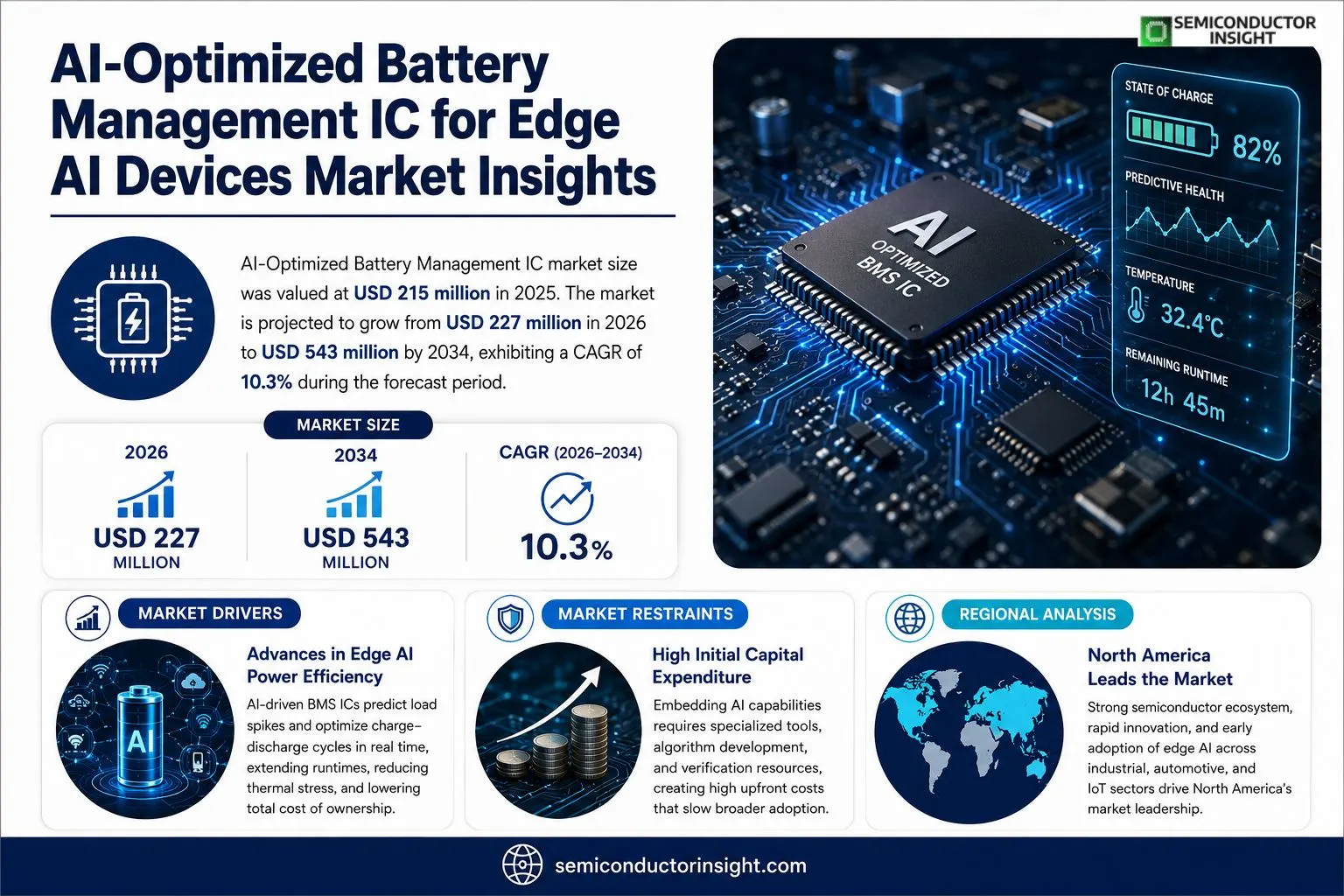
AI‑Optimized Battery Management IC market size was valued at USD 215 million in 2025. The market is projected to grow from USD 227 million in 2026 to USD 543 million by 2034, exhibiting a CAGR of 10.3% during the forecast period.
AI‑optimized battery management integrated circuits combine power‑monitoring functions with on‑chip machine‑learning algorithms that predict state‑of‑charge, health, and temperature trends in real time. By embedding inference capabilities directly into the power controller, these ICs reduce latency and enable edge AI devicessuch as smart cameras, industrial sensors, and autonomous dronesto make energy‑aware decisions without relying on cloud connectivity.The market is gaining momentum because edge deployments demand longer runtimes and tighter power budgets, while advances in low‑power neural processors make on‑chip analytics feasible. Recent collaborations between semiconductor firms and AI startups are accelerating product introductions, positioning the sector for sustained expansion.
MARKET DRIVERS
Advances in Edge AI Power Efficiency
The proliferation of edge AI workloads has forced OEMs to rethink power budgets. AI-Optimized Battery Management IC for Edge AI Devices Market benefits from silicon that can predict load spikes and adjust charge‑discharge cycles in milliseconds, extending device uptime without sacrificing performance. Manufacturers that integrate such intelligence into their power‑train designs are seeing measurable reductions in thermal stress, which translates into longer product lifecycles and lower warranty costs.
Regulatory Incentives for Energy‑Smart Devices
Legislation across Europe and North America now includes efficiency clauses for battery‑powered edge modules. Companies that embed AI‑driven management chips can claim compliance credits, accelerating time‑to‑market for new models. The incentive structure not only reduces the economic burden of certification but also creates a competitive moat for firms that can demonstrate verifiable energy savings.
➤ Customers are increasingly demanding real‑time battery health analytics, prompting a shift from legacy linear regulators to adaptive, learning‑based ICs.
These dynamics compel system architects to adopt platforms that fuse machine‑learning inference with power control. The resulting ecosystem fosters a feedback loop: more data improves algorithmic tuning, which in turn fuels higher adoption rates for AI‑enhanced management solutions.
MARKET CHALLENGES
Integration Complexity with Heterogeneous Sensor Arrays
Designers must reconcile diverse voltage domains, communication protocols, and latency requirements when embedding AI‑optimized battery ICs alongside sensor suites. The need for custom firmware and extensive validation cycles inflates development costs, especially for small‑to‑mid‑size enterprises lacking deep analog expertise.
Other Challenges
Supply‑Chain Volatility
shortages of advanced semiconductor substrates have lengthened lead times for power‑management chips. Even though demand is robust, manufacturers face bottlenecks that can delay product launches and erode margins.
MARKET RESTRAINTS
High Initial Capital Expenditure
Embedding AI capabilities into battery management circuitry requires specialized design tools and talent pools. For many players, the upfront investmentspanning silicon licensing, algorithm development, and verificationremains a deterrent, slowing broader market penetration despite clear long‑term benefits.
MARKET OPPORTUNITIES
AI‑Driven Predictive Maintenance Services
Beyond hardware, there is a growing appetite for subscription‑based analytics that leverage the data generated by intelligent battery ICs. Service providers can monetize predictive maintenance insights, offering enterprises the ability to schedule replacements before failure occurs. This ancillary revenue stream not only enhances the value proposition of the underlying chip but also accelerates adoption across industrial IoT deployments.
AI-Optimized Battery Management IC for Edge AI Devices Market Trends
Embedded AI for Real‑Time Power Management
AI-Optimized Battery Management IC for Edge AI Devices Market recorded a valuation of USD 215 million in 2025. By the close of 2026 the figure reached USD 227 million, and analysts forecast the market will climb to roughly USD 543 million by 2034, implying a steady compound increase of about 10 % annually. This trajectory reflects the growing relevance of on‑chip intelligence that can anticipate state‑of‑charge, health, and thermal behavior without off‑loading data to a cloud server. For manufacturers of smart cameras, industrial sensors, or autonomous drones, the ability to make instantaneous, power‑aware decisions translates into longer field times and reduced reliance on costly connectivity.
Other Trends
On‑Chip Learning Reduces Latency
Embedding machine‑learning inference directly within the battery management controller eliminates the round‑trip delay typical of centralized analytics. Edge AI devices therefore react to voltage dips or temperature spikes in microseconds, a capability that traditional MCU‑based solutions cannot match. The shift toward low‑power neural processors has unlocked this possibility, allowing manufacturers to ship products that balance computational depth with minimal energy draw.
Strategic Partnerships Accelerate Adoption
Recent joint ventures between semiconductor firms and AI‑focused startups have produced a pipeline of commercially viable chips that marry power‑monitoring precision with predictive algorithms. These collaborations not only shorten development cycles but also provide customers with reference designs that integrate seamlessly into existing hardware platforms. As a result, OEMs can adopt AI‑Optimized Battery Management ICs with reduced risk, accelerating the rollout of next‑generation edge solutions across logistics, retail, and manufacturing sectors.
COMPETITIVE LANDSCAPEKey Industry Players
AI‑Optimized Battery Management ICs: Competitive Landscape and Strategic Positioning
The front end of the AI‑optimized BMS IC market is dominated by a handful of semiconductor groups that have historically supplied power‑management silicon to automotive and industrial customers. Texas Instruments leverages its extensive BQ family to embed lightweight neural‑network blocks that predict charge‑state drift under variable loads, allowing OEMs of edge cameras and autonomous drones to tighten energy margins without redesigning the host PCB. STMicroelectronics follows a similar trajectory, repurposing its STPMIC series with on‑chip inference engines that can be re‑trained through OTA updates, a capability that resonates with manufacturers seeking long‑term field adaptability. Infineon’s XENSIV portfolio now incorporates a compact machine‑learning core, positioning the company as a preferred supplier for rugged sensor nodes that must operate on limited battery reserves. Analog Devices rounds out the tier‑one cohort by marrying its high‑precision analog front‑ends with proprietary AI algorithms, delivering a solution that satisfies both accuracy and latency demands of edge AI workloads.The competitive depth widens when smaller specialists enter the fray. Rohm’s DG series, though modest in scale, introduces a configurable AI block that can be tailored to specific power‑profile use cases, attracting niche IoT integrators. Maxim Integrated, now part of Analog Devices, continues to market the MAX32690 family with built‑in predictive analytics, a differentiator for battery‑powered wearables. European startup GreenWaves Technologies supplies ultra‑low‑power GAP8‑based BMS ICs that execute convolutional networks directly on the silicon, a design that aligns with ultra‑compact edge devices. Syntiant focuses exclusively on neural‑processing cores and recently announced a partnership with a leading drone manufacturer to embed its AI‑driven power‑management IP into flight‑control boards. Ambiq’s Apollo line, originally a low‑power microcontroller, now offers a BMS variant that couples its Sub‑threshold Power Optimized Architecture with on‑chip learning, appealing to battery‑critical medical sensors. These niche entrants collectively raise the bar for functional integration and create pressure on the incumbents to accelerate feature roll‑outs.
List of Key AI‑Optimized Battery Management IC Companies Profiled
- Texas Instruments
- STMicroelectronics
- Infineon Technologies
- Analog Devices
- Ambiq Micro
- NXP Semiconductors
- Renesas Electronics
- MediaTek
Segment Analysis:
| Segment Category | Sub-Segments | Key Insights |
| By Type |
|
Predictive BMS ICs
|
| By Application |
|
Smart Surveillance Cameras
|
| By End User |
|
Manufacturing Automation
|
| By Integration Architecture |
|
System‑in‑Package (SiP) with AI Accelerator
|
| By Power Domain |
|
Medium Power (1‑5W)
|
Regional Analysis: AI-Optimized Battery Management IC for Edge AI Devices
North America
Companies are embedding adaptive control loops directly into the IC silicon, enabling real‑time voltage scaling that reacts to AI workload spikes. This approach reduces thermal stress and extends device lifespan, making edge nodes viable in harsh environments where battery swaps are impractical.
The concentration of advanced packaging facilities in the United States and Canada mitigates exposure to overseas disruptions. Firms are also diversifying raw‑material sourcing for rare‑earth components, a move that stabilises lead times for high‑performance power blocks.
Enterprise adopters in logistics and autonomous robotics cite the ability of AI‑Optimized Battery Management ICs to prolong operational cycles as a catalyst for wider deployment, especially where downtime translates directly to revenue loss.
Harmonised safety standards across the United States, Canada, and Mexico streamline certification, encouraging start‑ups to target the continent first before expanding ly, thereby reinforcing the region’s market momentum.
Europe
European manufacturers are leveraging strong governmental incentives for green technology to embed AI‑Optimized Battery Management ICs in smart city sensors. The region’s fragmented but highly specialised semiconductor landscape fosters niche collaborations, particularly between German automotive firms and French AI labs, which produce edge devices capable of predictive maintenance with minimal power draw. Compliance with stringent EU ecodesign directives adds a layer of credibility that appeals to multinational corporations seeking uniformity across borders.
Asia‑Pacific
In Asia‑Pacific, rapid urbanisation and the proliferation of consumer‑grade edge devices create a fertile market for power‑intelligent ICs. Chinese and South Korean fabs are scaling production of mixed‑signal chips that integrate AI inference accelerators, allowing smartphones and wearables to operate longer between charges. Meanwhile, Indian startups focus on low‑cost, ruggedised solutions for agricultural drones, demonstrating the region’s capacity to tailor technology to diverse socioeconomic contexts.
South America
South American players are beginning to adopt AI‑Optimized Battery Management ICs in renewable‑energy micro‑grids, where edge controllers must balance intermittent solar input with storage. Brazil’s emerging semiconductor incubators receive modest public funding, encouraging local design houses to customise power‑management firmware for tropical climates, thereby reducing reliance on imported components and enhancing supply‑chain sovereignty.
Middle East & Africa
The Middle East & Africa region is witnessing nascent interest in edge AI for oil‑field monitoring and remote health diagnostics. Partnerships between UAE venture funds and African research institutes are piloting battery‑management solutions that can survive extreme temperature swings. Although market volume remains limited, early adopters view the technology as essential for extending the operational horizon of off‑grid installations across vast, under‑served territories.
Report Scope
This market research report provides a comprehensive analysis of the AI-Optimized Battery Management IC for Edge AI Devices Market , covering the forecast period 2026–2034. It offers detailed insights into market dynamics, technological advancements, competitive landscape, and key trends shaping the industry.
Key focus areas of the report include:
- Market Overview: The report begins with an overview outlining its current market scenario, key growth indicators, and industry transformation drivers. It discusses macroeconomic factors, demand–supply balance, regulatory landscape, and the strategic role of semiconductors in powering advancements across industries such as automotive, telecommunications, consumer electronics, and industrial automation.
- Market Size & Forecast: Historical data and future projections for revenue, unit shipments, and market value across major regions and segments.
- Segmentation Analysis: Detailed breakdown by product type, technology, application, and end-user industry to identify high-growth segments and investment opportunities.
- Regional Insights: Insights into market performance across North America, Europe, Asia-Pacific, Latin America, and the Middle East & Africa, including country-level analysis where relevant.
- Competitive Landscape: Profiles of leading market participants, including their product offerings, R&D focus, manufacturing capacity, pricing strategies, and recent developments such as mergers, acquisitions, and partnerships.
- Technology Trends & Innovation: Assessment of emerging technologies, integration of AI/IoT, semiconductor design trends, fabrication techniques, and evolving industry standards.
- Market Drivers & Restraints: Evaluation of factors driving market growth along with challenges, supply chain constraints, regulatory issues, and market-entry barriers.
- Stakeholder Insights: Insights for component suppliers, OEMs, system integrators, investors, and policymakers regarding the evolving ecosystem and strategic opportunities.
Primary and secondary research methods are employed, including interviews with industry experts, data from verified sources, and real-time market intelligence to ensure the accuracy and reliability of the insights presented.
FREQUENTLY ASKED QUESTIONS:
What is the current market size of AI-Optimized Battery Management IC for Edge AI Devices Market?
-> AI-Optimized Battery Management IC for Edge AI Devices Market was valued at USD 215 million in 2025 and is expected to reach USD 543 million by 2034.
Which key companies operate in AI-Optimized Battery Management IC for Edge AI Devices Market?
-> Key players include major semiconductor manufacturers and AI‑focused startups collaborating on integrated solutions, among others.
What are the key growth drivers?
-> Key growth drivers include edge device demand for longer runtimes, tighter power budgets, advances in low‑power neural processors, and collaborative product development between semiconductor firms and AI startups.
Which region dominates the market?
-> North America, Europe, and Asia‑Pacific are the leading regions, with widespread adoption of edge AI devices across these markets.
What are the emerging trends?
-> Emerging trends include integration of AI/ML directly into power controllers, on‑chip inference for real‑time energy management, and accelerating collaborations between semiconductor firms and AI startups.
Get Sample Report PDF for Exclusive Insights
Report Sample Includes
- Table of Contents
- List of Tables & Figures
- Charts, Research Methodology, and more...
 Download Sample Report PDF