AI On-Board Optics Module Silicon Market Insights
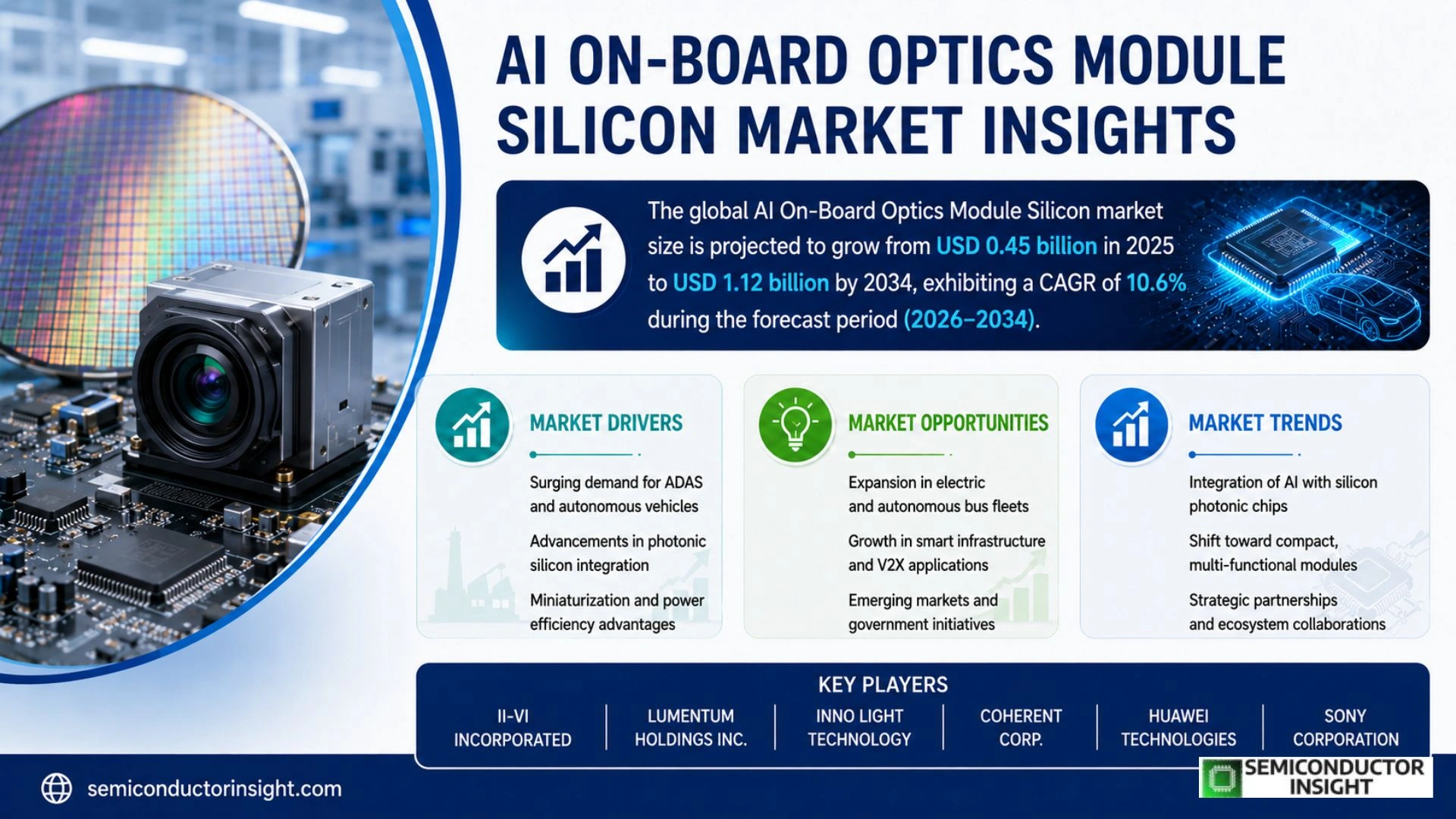
Global AI On-Board Optics Module Silicon Market size was valued at USD 0.45 billion in 2025. The market is projected to grow from USD 0.45 billion in 2025 to USD 1.12 billion by 2034, exhibiting a CAGR of 10.6 % during the forecast period.
AI On‑Board Optics Module Silicon refers to silicon‑based photonic chips designed for integration into autonomous‑vehicle sensor suites, enabling high‑speed data processing for lidar, radar and camera fusion directly on the vehicle’s electronic control unit.
The expansion is fueled by rising adoption of Level‑3/4 autonomous platforms, pressure to lower power consumption compared with traditional optics, and increasing regulatory focus on safety‑critical perception systems. Moreover, partnerships announced in early 2024 between leading semiconductor firms and automotive OEMs are accelerating volume ramp‑up and cost reductions.
MARKET DRIVERS
Rising demand for high‑resolution imaging in autonomous vehicles
The push toward Level 4 and Level 5 autonomy has forced OEMs to seek sensors that can deliver centimeter‑level perception under every lighting condition. AI On-Board Optics Module Silicon Market players that can couple silicon‑based waveguides with AI‑driven image processing are seeing their designs become default choices for next‑generation driver‑assist packages.
Advancements in silicon photonics fabrication
Recent breakthroughs in deep‑ultraviolet lithography have trimmed module footprints by up to 30 % while boosting bandwidth. Manufacturers that have invested in 300‑mm wafer lines can now deliver optics modules at a cost structure compatible with mass‑market vehicle pricing, giving them a decisive edge.
➤ “Silicon‑based optics are reshaping the economics of sensor suites, turning what was once a premium add‑on into a mainstream component.”
These technology gains translate directly into faster time‑to‑market for AI‑enhanced perception stacks, encouraging automakers to lock in long‑term supply agreements that reinforce the growth trajectory of AI On-Board Optics Module Silicon Market.
MARKET CHALLENGES
Integration complexity with existing vehicle architectures
Automotive ECUs are traditionally designed around discrete camera modules. Re‑architecting signal pathways to accommodate silicon‑based optics requires extensive redesign of harnesses and firmware, a process that can add months to development cycles and inflate engineering budgets.
Other Challenges
Supply‑chain constraints
The limited number of fabs qualified for high‑precision silicon photonics creates a bottleneck. Even modest demand spikes can trigger lead‑time extensions, forcing OEMs to hold higher inventory buffers.
MARKET RESTRAINTS
High capital expenditure for manufacturing lines
Establishing a production line capable of delivering automotive‑grade optics at volume requires multi‑million‑dollar investments in cleanroom facilities and precision testing equipment. Smaller entrants often lack the financial backing to compete, narrowing the supplier pool.
Scarcity of specialized engineering talent
The convergence of photonic design, AI algorithm integration, and automotive safety standards is a rare skill set. Companies that cannot attract or develop such expertise face longer development timelines and higher per‑unit costs.
MARKET OPPORTUNITIES
Emerging markets in electric‑bus fleets
Cities adopting electric public‑transport fleets are seeking lower‑cost perception solutions to enable driver‑less operation on fixed routes. Silicon optics modules, with their reduced power draw and compact size, fit the cost‑sensitivity and energy‑efficiency criteria of these programs.
Beyond buses, the modular nature of silicon‑based optics permits retrofitting of existing vehicle platforms. Fleet operators can upgrade sensor suites without a full vehicle redesign, opening a recurring‑revenue stream for module suppliers.
Strategic alliances between silicon photonics manufacturers and AI chipset vendors are emerging as a fast‑track to market. Joint development roadmaps accelerate validation against automotive functional‑safety standards, shortening the certification timeline and creating a clear pathway for new entrants.
AI On-Board Optics Module Silicon Market Trends
Rising Integration of Photonic Silicon in Autonomous Vehicles
AI On-Board Optics Module Silicon Market is witnessing a sharp uptick in adoption as OEMs embed silicon‑based photonic chips directly into vehicle‑level perception stacks. By positioning the optics module on the vehicle’s electronic control unit, manufacturers achieve latency reductions that are essential for fusing lidar, radar and camera feeds in real‑time. The market’s valuation moved from USD 0.45 billion in 2025 to an anticipated USD 1.12 billion by 2034, reflecting the economic incentive of consolidating optical functions on a single silicon substrate. This shift is not merely technological; it represents a strategic response to tighter safety regulations that demand deterministic processing pipelines and to the mounting cost pressure on traditional glass‑based optics.
Other Trends
Power‑Efficiency Pressures
Automotive power budgets have become a decisive factor in component selection. Silicon photonics consume markedly less energy than conventional polymer or glass solutions, enabling vehicles to meet stricter emissions targets without compromising sensor performance. Engineers are therefore gravitating toward silicon waveguide designs that deliver high bandwidth while maintaining a low power envelope, a move that also eases thermal management challenges within densely packed electronic compartments.
Strategic Partnerships Accelerate Volume
Early‑2024 announcements of joint development programs between leading semiconductor manufacturers and major carmakers have catalyzed a more predictable supply chain for AI On-Board Optics Module Silicon Market. These alliances are focused on scaling wafer production, standardizing interface protocols, and sharing validation data across platforms. As a result, component cost curves are beginning to flatten, allowing Tier‑1 suppliers to offer volume pricing that was previously unattainable. For automotive firms, the ability to procure silicon optics at reduced expense directly translates into a competitive edge in the race toward higher levels of autonomous functionality.
COMPETITIVE LANDSCAPE
Key Industry Players
AI On‑Board Optics Module Silicon: Competitive Pressures and Alliances
The most visible force shaping the AI on‑board optics module silicon arena is Intel, chiefly through its Mobileye unit. By leveraging its in‑house silicon‑photonic design capabilities and recent acquisitions in high‑performance computing, Intel supplies integrated photonic chips that sit on the vehicle’s ECU, directly handling lidar‑radar‑camera data streams. This vertical approach gives Intel leverage over both the silicon foundry tier and the autonomous‑vehicle OEM tier, allowing tighter control of cost, power envelope, and timing. The broader market has coalesced around a handful of foundries capable of sub‑50 nm photonic processes, which creates a de‑facto oligopoly wherein design houses gravitate toward these proven nodes to meet automotive reliability standards.
Beyond Intel, a constellation of niche specialists supplies complementary technologies that keep the ecosystem vibrant. Lumentum and its former Finisar assets provide high‑bandwidth waveguide components that are often paired with Intel’s die. GlobalFoundries and Samsung offer advanced silicon‑photonic process lines that cater to customers seeking alternative supply chains. STMicroelectronics and NXP embed mixed‑signal silicon that blends traditional automotive microcontrollers with photonic interfaces. Ambarella focuses on vision‑centric silicon that can route camera data into the optics module, while Qualcomm’s automotive‑grade SoCs increasingly incorporate optical I/O. Sony and Renesas round out the field by delivering sensor‑level integration and power‑management ICs, respectively, ensuring that no single entity can dominate the full stack without strategic partnerships.
List of Key AI On‑Board Optics Module Silicon Companies Profiled
- Intel (Mobileye)
- TSMC
- Samsung Electronics
- NXP Semiconductors
- Lumentum Holdings
- GlobalFoundries
- STMicroelectronics
- Ambarella
- Qualcomm
- Sony Semiconductor
- Renesas Electronics
- Broadcom
- Finisar (now part of Lumentum)
- Innovasic
- Himax Technologies
Segment Analysis:
| Segment Category | Sub-Segments | Key Insights |
| By Type |
|
Silicon Photonic Chipsets
|
| By Application |
|
Full‑Self Driving (FSD) Platforms
|
| By End User |
|
Automotive OEMs
|
| By Integration Level |
|
System‑in‑Package (SiP)
|
| By Power Consumption Profile |
|
Ultra‑Low Power Modules
|
Regional Analysis: AI On-Board Optics Module Silicon Market
North American firms are leveraging domestic silicon wafer capacity to mitigate geopolitical risks, a move that reassures OEMs seeking uninterrupted component flow for AI On-Board Optics Module Silicon Market deployments.
Universities and research institutes in the region generate a pipeline of photonics engineers, enabling rapid iteration of module designs that meet the stringent power‑efficiency targets of next‑generation autonomous platforms.
Federal incentives for advanced driver‑assistance systems (ADAS) dovetail with the technical demands of on‑board optics, prompting early procurement cycles that accelerate market adoption.
Close cooperation between silicon foundries and vehicle manufacturers shortens validation loops, allowing AI On-Board Optics Module Silicon Market solutions to be field‑tested in real‑world driving scenarios faster than in other regions.
Europe
European automotive groups are integrating AI On-Board Optics Module Silicon Market components to satisfy both performance ambitions and stringent carbon‑reduction mandates. While the continent lacks the sheer silicon‑fab density of North America, collaborative consortia across Germany, France, and the Nordics are pooling design expertise, creating a shared intellectual‑property pool that offsets the need for massive capital outlays. The regulatory environment, especially around vehicle safety certification, pushes suppliers to deliver optics modules that can endure diverse climate conditions, prompting a focus on robust packaging solutions. Companies that can navigate these standards while offering modular designs stand to secure long‑term contracts with legacy manufacturers seeking to retrofit existing vehicle lines.
Asia‑Pacific
In Asia‑Pacific, rapid consumer adoption of smart‑mobility services is fueling demand for AI On-Board Optics Module Silicon Market technologies, even though the region’s silicon fabrication landscape remains fragmented. Chinese and Taiwanese foundries are investing heavily in photonic integration, yet they must align with local OEMs’ appetite for cost‑efficient volume production. The strategic challenge lies in balancing price pressure with the need for high‑bandwidth, low‑latency optics that support advanced perception algorithms. Firms that can offer scalable module architectures, adaptable to both mass‑market vehicles and premium autonomous prototypes, are likely to dominate the competitive set.
South America
South American markets exhibit a cautious but growing interest in AI On-Board Optics Module Silicon Market solutions, driven by emerging ride‑hailing fleets and government pilots for intelligent transportation. The region’s limited domestic silicon capacity forces many manufacturers to source modules from abroad, introducing lead‑time considerations that influence procurement strategies. Nevertheless, localized testing facilities are beginning to evaluate optics modules under tropical temperature cycles, creating a knowledge base that could attract niche suppliers focused on durability and low‑maintenance designs.
Middle East & Africa
The Middle East & Africa region is at an early stage of incorporating AI On-Board Optics Module Silicon Market technologies, with a focus on high‑end luxury vehicles and specialized autonomous shuttle projects. Harsh desert environments demand optics modules that retain performance under extreme heat and dust exposure. As sovereign wealth funds allocate capital toward innovative mobility ventures, there is an opening for vendors that can certify their silicon‑based optics for such conditions. Partnerships with local integrators will become a decisive factor for market entry, allowing global players to tailor solutions to the region’s unique operational constraints.
Report Scope
This market research report provides a comprehensive analysis of the AI On-Board Optics Module Silicon Market , covering the forecast period 2026–2034. It offers detailed insights into market dynamics, technological advancements, competitive landscape, and key trends shaping the industry.
Key focus areas of the report include:
- Market Overview: The report begins with an overview outlining its current market scenario, key growth indicators, and industry transformation drivers. It discusses macroeconomic factors, demand–supply balance, regulatory landscape, and the strategic role of semiconductors in powering advancements across industries such as automotive, telecommunications, consumer electronics, and industrial automation.
- Market Size & Forecast: Historical data and future projections for revenue, unit shipments, and market value across major regions and segments.
- Segmentation Analysis: Detailed breakdown by product type, technology, application, and end-user industry to identify high-growth segments and investment opportunities.
- Regional Insights: Insights into market performance across North America, Europe, Asia-Pacific, Latin America, and the Middle East & Africa, including country-level analysis where relevant.
- Competitive Landscape: Profiles of leading market participants, including their product offerings, R&D focus, manufacturing capacity, pricing strategies, and recent developments such as mergers, acquisitions, and partnerships.
- Technology Trends & Innovation: Assessment of emerging technologies, integration of AI/IoT, semiconductor design trends, fabrication techniques, and evolving industry standards.
- Market Drivers & Restraints: Evaluation of factors driving market growth along with challenges, supply chain constraints, regulatory issues, and market-entry barriers.
- Stakeholder Insights: Insights for component suppliers, OEMs, system integrators, investors, and policymakers regarding the evolving ecosystem and strategic opportunities.
Primary and secondary research methods are employed, including interviews with industry experts, data from verified sources, and real-time market intelligence to ensure the accuracy and reliability of the insights presented.
FREQUENTLY ASKED QUESTIONS:
What is the current market size of AI On-Board Optics Module Silicon Market?
-> AI On-Board Optics Module Silicon Market size is projected to grow from USD 0.45 billion in 2025 to USD 1.12 billion by 2034, exhibiting a CAGR of 10.6 %
Which key companies operate in AI On-Board Optics Module Silicon Market?
-> Key players include Intel Corporation, Taiwan Semiconductor Manufacturing Company (TSMC), GlobalFoundries, Samsung Electronics, IMEC, and Photonic Foundry, among others.
What are the key growth drivers?
-> Key growth drivers include rising adoption of Level‑3/4 autonomous vehicle platforms, demand for lower power consumption compared with traditional optics, regulatory pressure for safety‑critical perception systems, and strategic partnerships between semiconductor firms and automotive OEMs.
Which region dominates the market?
-> Asia‑Pacific is the fastest‑growing region, driven by strong semiconductor manufacturing bases in China, Japan, South Korea, and Taiwan, while North America remains the largest market in terms of revenue.
What are the emerging trends?
-> Emerging trends include silicon photonic integration, AI‑driven design automation, heterogeneous integration with electronic drivers, and advanced packaging technologies such as 2.5‑D/3‑D stacking.
Get Sample Report PDF for Exclusive Insights
Report Sample Includes
- Table of Contents
- List of Tables & Figures
- Charts, Research Methodology, and more...
 Download Sample Report PDF