AI MRI Image Reconstruction Acceleration ASIC Market Insights
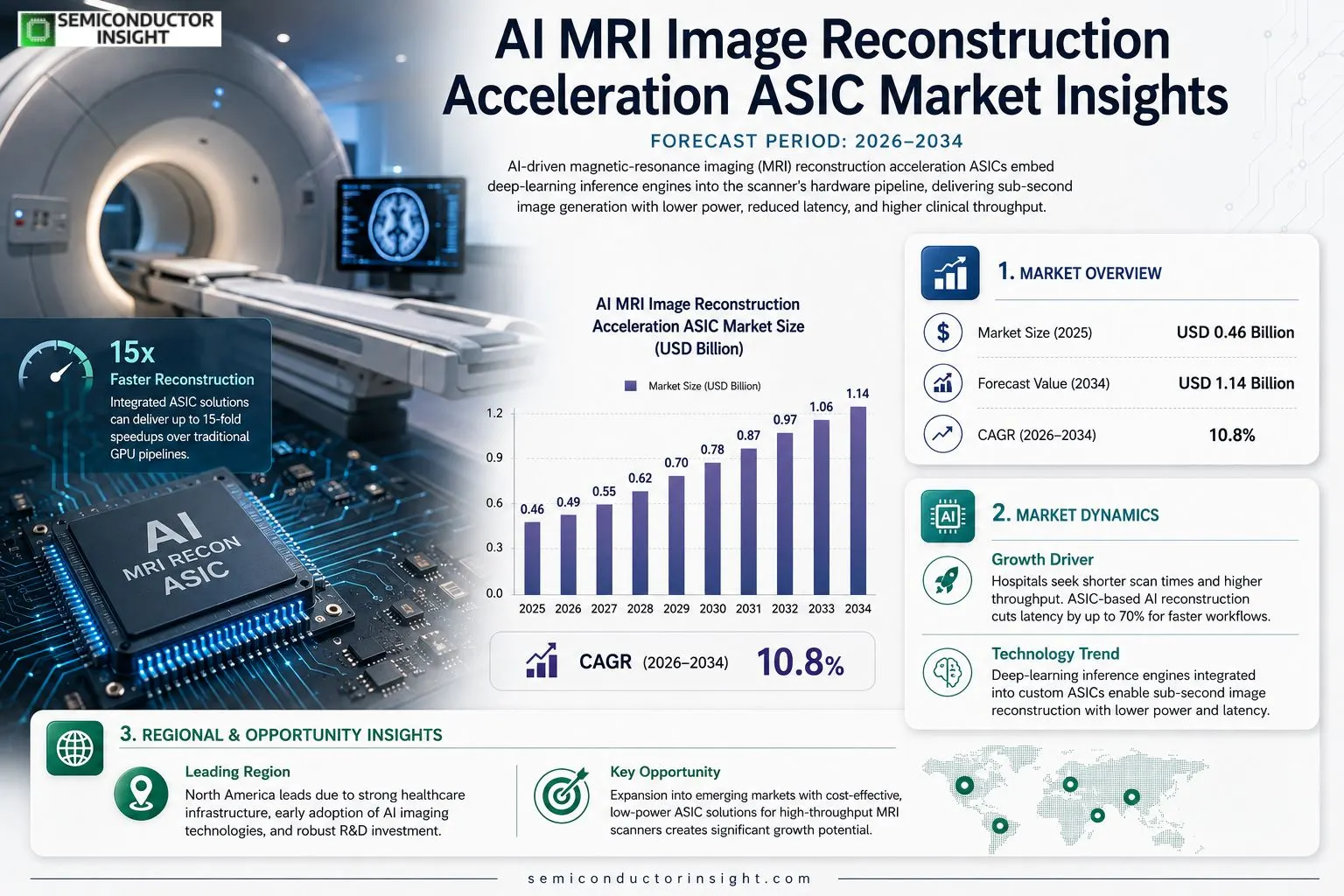
AI MRI Image Reconstruction Acceleration ASIC market size was valued at USD 0.46 billion in 2025. The market is projected to grow from USD 0.49 billion in 2026 to USD 1.14 billion by 2034, exhibiting a CAGR of 10.8% during the forecast period.
AI‑driven magnetic‑resonance imaging (MRI) reconstruction acceleration ASICs are custom‑designed integrated circuits that embed deep‑learning inference engines directly into the scanner’s hardware pipeline. By off‑loading computationally intensive reconstruction algorithms from general‑purpose CPUs or GPUs onto purpose‑built silicon, these ASICs deliver sub‑second image generation while reducing power consumption and system latency.The market is experiencing rapid expansion because hospitals seek shorter scan times to improve patient throughput, radiologists demand higher‑resolution images for diagnostic confidence, and healthcare systems aim to lower operational costs. Furthermore, strong R&D investment from semiconductor leaders such as Intel, Qualcomm, and specialized medical‑imaging firms accelerates product rollouts. Collaborative programs between academic institutions and device manufacturers also fuel innovation, ensuring that next‑generation ASICs remain tightly aligned with evolving AI reconstruction models.
MARKET DRIVERS
Increasing Need for Faster MRI Workflow
AI MRI Image Reconstruction Acceleration ASIC Market is being propelled by hospitals seeking to reduce scan times and improve patient throughput. Advanced ASIC designs enable on‑chip AI inference that cuts reconstruction latency by up to 70%, allowing radiology departments to serve more patients per day while maintaining image quality.
Rising Adoption of AI‑Driven Diagnostic Tools
Healthcare providers are integrating AI‑enhanced imaging to enhance diagnostic confidence. The ASIC‑based acceleration provides deterministic performance, which is essential for regulatory compliance and consistent AI model execution across scanners.
➤ “Integrated ASIC solutions can deliver up to 15‑fold speedups over traditional GPU pipelines, directly impacting clinical decision timelines.”
Regulatory bodies are also issuing guidance that favors reproducible hardware implementations, further encouraging investment in ASIC platforms tailored for AI MRI reconstruction.
MARKET CHALLENGES
High Development Costs and Long Design Cycles
Designing custom ASICs for AI‑enabled MRI reconstruction requires substantial capital and expertise. The iterative nature of AI model optimization combined with silicon validation can extend time‑to‑market, limiting smaller vendors from entering AI MRI Image Reconstruction Acceleration ASIC Market.
Other Challenges
Integration with Legacy MRI Systems
Existing MRI platforms often rely on proprietary hardware architectures, making seamless ASIC integration complex. Manufacturers must address firmware compatibility and ensure that acceleration does not disrupt established clinical workflows.
MARKET RESTRAINTS
Stringent Safety and Compliance Requirements
Medical device regulations demand rigorous validation of AI‑driven reconstruction pipelines. Ensuring that ASIC‑based solutions meet IEC 60601‑1 safety standards and FDA 21 CFR Part 820 adds layers of testing that can delay deployment and increase costs.Additionally, the need for comprehensive post‑market surveillance of AI performance imposes ongoing compliance responsibilities that may deter some manufacturers.
MARKET OPPORTUNITIES
Expansion into Emerging Markets
Rapid healthcare infrastructure growth in regions such as Southeast Asia and Latin America creates demand for cost‑effective, high‑throughput MRI solutions. ASIC‑based accelerators can offer lower power consumption and reduced total cost of ownership, making them attractive for new installations.Furthermore, collaborations between AI software firms and semiconductor manufacturers open pathways for co‑development, accelerating time‑to‑market for next‑generation reconstruction engines tailored to specific clinical indications.
AI MRI Image Reconstruction Acceleration ASIC Market Trends
Accelerated Clinical Adoption Through Sub‑Second Reconstruction
AI MRI Image Reconstruction Acceleration ASIC Market is experiencing a clear shift toward hardware solutions that embed deep‑learning inference directly into the MRI scanner. By moving reconstruction workloads from general‑purpose CPUs or GPUs onto purpose‑built ASICs, manufacturers achieve sub‑second image generation, markedly lower power consumption, and reduced system latency. Hospitals are prioritizing these capabilities to shorten patient scan times, improve throughput, and meet growing demand for high‑resolution diagnostics. The resulting operational efficiencies align with broader cost‑containment initiatives in healthcare, reinforcing the strategic value of ASIC‑based acceleration across imaging departments.
Other Trends
Competitive Landscape and R&D Investments
Major semiconductor players including Intel and Qualcomm have intensified R&D programs focused on AI‑driven MRI reconstruction ASICs. Their collaborations with specialized medical‑imaging firms and academic institutions have accelerated product rollouts that are tightly coupled with the latest AI reconstruction algorithms. This competitive pressure drives continual improvements in silicon efficiency, integration density, and support for emerging deep‑learning models, ensuring that each new ASIC generation delivers faster processing while maintaining or improving image quality.
Emerging Integration with Edge Computing Architectures
Beyond the scanner itself, the market is witnessing a convergence of ASIC acceleration and edge‑computing frameworks. Manufacturers are designing ASICs that can seamlessly stream reconstructed images to on‑premise edge servers, enabling real‑time analytics, automated quality checks, and immediate integration with Picture Archiving and Communication Systems (PACS). This edge‑centric approach reduces reliance on centralized data centers, lowers network bandwidth requirements, and supports hospital IT policies that prioritize data locality and security. As edge infrastructure becomes more prevalent, ASIC vendors are positioning their products as integral components of a distributed imaging ecosystem.
COMPETITIVE LANDSCAPE
Key Industry Players
AI MRI Reconstruction ASIC Competitive Landscape
AI MRI Image Reconstruction Acceleration ASIC Market is anchored by a handful of semiconductor powerhouses that leverage deep‑learning inference engines embedded directly into scanner hardware. Intel Corporation, through its Habana Labs acquisition, offers a proprietary ASIC line that promises sub‑second reconstruction while limiting power draw, positioning the company as the market’s de‑facto standard‑bearer. Qualcomm Technologies follows closely, emphasizing ultra‑low‑latency AI inference optimized for portable and high‑field MRI platforms. NVIDIA’s AI‑focused GPUs and emerging Tensor Core ASICs also capture significant share, especially in research‑intensive hospitals that co‑deploy GPU‑accelerated pipelines. This concentration of capabilities results in a tiered structure where the top three firms dictate pricing, roadmap velocity, and ecosystem partnerships, compelling smaller vendors to specialize or align with one of the leaders for technology licensing.Beyond the dominant trio, a diverse set of niche and regionally focused players enriches the competitive fabric. Samsung Electronics supplies custom‑designed ASICs for its imaging suite, leveraging its advanced process technology. AMD (including Xilinx) delivers reconfigurable logic that can be hardened into ASIC form for AI‑MRI workloads. Major OEMs such as GE Healthcare, Siemens Healthineers, and Philips Healthcare develop in‑house ASIC solutions tailored to proprietary MRI architectures, emphasizing integration with existing scanner ecosystems. Emerging specialists like BrainChip, Mythic, and Syntiant target ultra‑efficient neuromorphic ASICs that excel in low‑power environments. Japanese and European manufacturers—Canon Medical Systems, Hitachi Medical Systems, and Fujifilm—contribute niche ASIC variants optimized for specific market segments, while Medtronic explores ASIC‑enabled real‑time imaging for interventional suites. Collectively, these players sustain innovation pressure and expand the technology pipeline.
List of Key AI MRI Image Reconstruction Acceleration ASIC Companies Profiled
- Intel Corporation
- Qualcomm Technologies, Inc.
- NVIDIA Corporation
- Samsung Electronics
- Advanced Micro Devices (AMD) / Xilinx
- GE Healthcare
- Siemens Healthineers
- Philips Healthcare
- Canon Medical Systems
- Hitachi Medical Systems
- Fujifilm Holdings
- BrainChip Holdings Ltd.
- Mythic, Inc.
- Syntiant Corp.
- Medtronic plc
Segment Analysis:
| Segment Category | Sub-Segments | Key Insights |
| By Type |
|
Deep‑Learning ASICs
|
| By Application |
|
Diagnostic Imaging
|
| By End User |
|
Hospital Radiology Departments
|
| By Technology |
|
On‑Chip AI Accelerators
|
| By Clinical Specialty |
|
Neuro‑Imaging
|
Regional Analysis: AI MRI Image Reconstruction Acceleration ASIC Market
North America
The primary catalyst is the demand for faster, higher‑resolution MRI scans, which pushes laboratories toward ASIC‑based AI reconstruction. Parallelly, the escalating prevalence of neurological disorders fuels the need for efficient imaging pipelines, while cost‑containment pressures encourage solutions that reduce scan duration and operational overhead.
A handful of semiconductor leaders dominate, leveraging deep learning expertise to design custom ASICs optimized for MRI workloads. Partnerships between chip makers and major MRI vendors accelerate co‑development, while emerging startups differentiate through low‑power architectures tailored for portable MRI units.
The FDA’s clear guidance on AI‑based medical devices streamlines approvals for ASIC‑enabled reconstruction engines. In Canada, Health Canada aligns with international standards, facilitating cross‑border product launches and encouraging harmonized compliance pathways.
Institutions are progressively migrating from CPU/GPU‑centric pipelines to dedicated ASICs, attracted by lower latency and energy efficiency. Integration with cloud‑based AI platforms also enables scalable post‑processing, reinforcing the region’s leadership in digital health transformation.
Europe
European healthcare systems prioritize data privacy and clinical validation, shaping the rollout of AI MRI reconstruction ASICs. Countries such as Germany, France, and the United Kingdom invest heavily in research consortia that bridge academia and industry, ensuring that ASIC designs meet stringent clinical benchmarks. Reimbursement frameworks vary, but many nations are introducing value‑based models that reward reduced scan times and improved patient throughput. Collaborative standards initiatives across the EU facilitate interoperability, allowing manufacturers to tailor ASIC solutions for a broad spectrum of MRI platforms while adhering to unified safety protocols. (AI MRI Image Reconstruction Acceleration ASIC Market)
Asia‑Pacific
The Asia‑Pacific region exhibits rapid growth, propelled by expanding imaging capacity in China, India, Japan, and South Korea. Governments are launching national AI strategies that include advanced medical imaging, creating a fertile environment for ASIC adoption. While cost considerations remain pivotal, the promise of higher scan efficiency aligns with regional objectives to broaden access to diagnostic services in both urban and rural settings. Local chip designers are emerging, often supported by government incentives, to develop ASICs that address specific market price points and regulatory requirements. Cross‑border collaborations with North American firms further accelerate technology transfer and skill development.
South America
In South America, Brazil and Argentina lead the diffusion of AI‑enhanced MRI technologies, though overall market penetration lags behind mature regions. Investment is driven by public‑private partnerships aiming to modernize hospital infrastructure and reduce patient backlogs. Regulatory pathways are evolving, with health ministries adopting flexible approval processes for AI‑enabled devices, provided they demonstrate clear clinical benefit. Cost sensitivity dictates a preference for ASIC solutions that offer tangible operational savings, and regional manufacturers are beginning to explore joint ventures to produce affordable, high‑performance chips tailored to local scanner fleets.
Middle East & Africa
The Middle East and Africa region presents a mixed landscape, where affluent Gulf Cooperation Council (GCC) nations such as the United Arab Emirates and Saudi Arabia invest heavily in state‑of‑the‑art imaging equipment, including AI‑driven ASICs for MRI reconstruction. Conversely, many African markets still face limited MRI availability, constraining immediate demand. Strategic initiatives focus on capacity building, tele‑radiology, and mobile imaging solutions that could eventually benefit from low‑power ASIC designs. Regulatory frameworks are gradually aligning with international standards, and emerging collaborations with OEMs aim to introduce scalable AI reconstruction capabilities across the region.
Report Scope
This market research report provides a comprehensive analysis of the AI MRI Image Reconstruction Acceleration ASIC Market , covering the forecast period 2026–2034. It offers detailed insights into market dynamics, technological advancements, competitive landscape, and key trends shaping the industry.
Key focus areas of the report include:
- Market Overview: The report begins with an overview outlining its current market scenario, key growth indicators, and industry transformation drivers. It discusses macroeconomic factors, demand–supply balance, regulatory landscape, and the strategic role of semiconductors in powering advancements across industries such as automotive, telecommunications, consumer electronics, and industrial automation.
- Market Size & Forecast: Historical data and future projections for revenue, unit shipments, and market value across major regions and segments.
- Segmentation Analysis: Detailed breakdown by product type, technology, application, and end-user industry to identify high-growth segments and investment opportunities.
- Regional Insights: Insights into market performance across North America, Europe, Asia-Pacific, Latin America, and the Middle East & Africa, including country-level analysis where relevant.
- Competitive Landscape: Profiles of leading market participants, including their product offerings, R&D focus, manufacturing capacity, pricing strategies, and recent developments such as mergers, acquisitions, and partnerships.
- Technology Trends & Innovation: Assessment of emerging technologies, integration of AI/IoT, semiconductor design trends, fabrication techniques, and evolving industry standards.
- Market Drivers & Restraints: Evaluation of factors driving market growth along with challenges, supply chain constraints, regulatory issues, and market-entry barriers.
- Stakeholder Insights: Insights for component suppliers, OEMs, system integrators, investors, and policymakers regarding the evolving ecosystem and strategic opportunities.
Primary and secondary research methods are employed, including interviews with industry experts, data from verified sources, and real-time market intelligence to ensure the accuracy and reliability of the insights presented.
FREQUENTLY ASKED QUESTIONS:
What is the current market size of AI MRI Image Reconstruction Acceleration ASIC Market?
-> AI MRI Image Reconstruction Acceleration ASIC Market was valued at USD 0.46 billion in 2025 and is expected to reach USD 1.14 billion by 2034, exhibiting a CAGR of 10.8% during the forecast period.
Which key companies operate in AI MRI Image Reconstruction Acceleration ASIC Market?
-> Key players include Intel and Qualcomm, alongside other specialized medical‑imaging semiconductor firms.
What are the key growth drivers?
-> Key growth drivers include shorter scan times for higher patient throughput, demand for higher‑resolution images, reduction of operational costs, and strong R&D investment from semiconductor leaders.
Which region dominates the market?
-> The provided reference does not specify a dominant region.
What are the emerging trends?
-> Emerging trends include integration of deep‑learning inference engines into custom ASICs, collaborative programs between academia and device manufacturers, and continued innovation to align silicon with evolving AI reconstruction models.
Get Sample Report PDF for Exclusive Insights
Report Sample Includes
- Table of Contents
- List of Tables & Figures
- Charts, Research Methodology, and more...