
AI-Integrated Set-Top Box SoC Market Insights
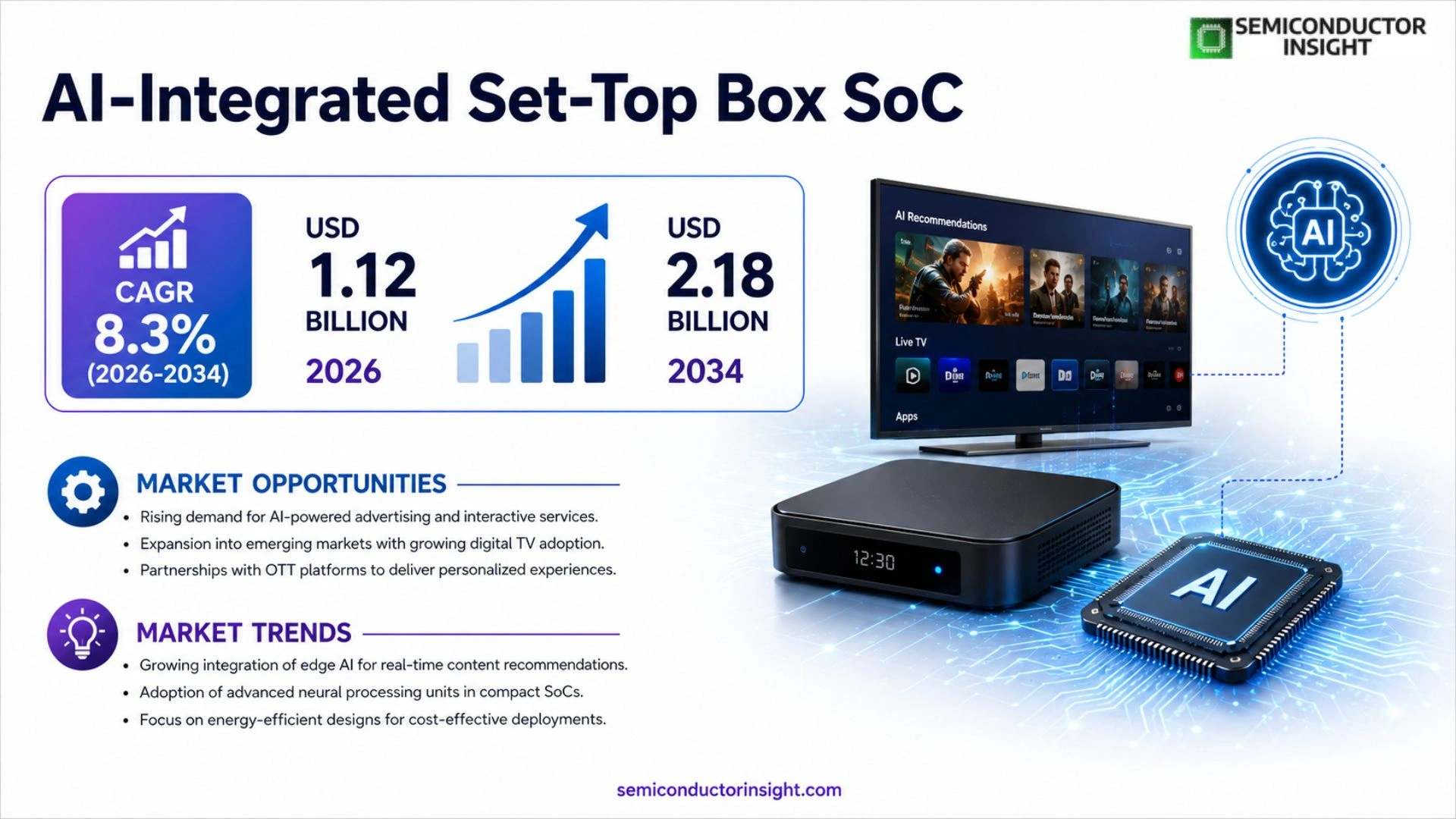
Global AI-Integrated Set-Top Box SoC market size was valued at USD 1.05 billion in 2025. The market is projected to grow from USD 1.12 billion in 2026 to USD 2.18 billion by 2034, exhibiting a CAGR of 8.3% during the forecast period.
AI-integrated set‑top box system‑on‑chips combine high‑performance processors, dedicated neural accelerators, and advanced video decoding units to enable on‑device artificial‑intelligence services such as voice control, recommendation engines, and real‑time content analytics. These SoCs are built on heterogeneous architectures that fuse ARM cores with custom AI cores, supporting frameworks like TensorFlow Lite and ONNX for rapid deployment of edge AI workloads.
The market is gaining momentum because broadband penetration continues to rise worldwide, while OTT platforms demand richer interactive experiences that only AI‑enabled hardware can deliver. Moreover, manufacturers are integrating low‑power AI inference engines to meet energy constraints of consumer electronics, prompting chipmakers such as MediaTek, Broadcom, and Qualcomm to expand their portfolios. Recent collaborations,like the June 2024 partnership between MediaTek and a leading smart TV OEM to co‑develop an AI‑driven set‑top box chipset,illustrate how ecosystem alliances are accelerating adoption.
MARKET DRIVERS
Rising Consumer Demand for Personalized Viewing Experiences
The adoption of AI algorithms within set‑top box system‑on‑chips enables real‑time recommendation engines, content optimization, and voice‑activated navigation. Broadcasters and OTT platforms are leveraging these capabilities to differentiate their services, driving higher unit shipments of AI‑Integrated Set‑Top Box SoC solutions.
Accelerated Deployment of 5G and Edge Computing
5G latency reductions and edge‑node proliferation allow AI workloads to be processed closer to the end‑user, enhancing the performance of set‑top box SoCs. This infrastructure shift expands the addressable market for chips that combine AI inference with traditional video decoding.
➤ “AI‑enabled SoCs are becoming the de‑facto standard for next‑generation home entertainment hardware.”
Manufacturers that integrate low‑power neural processing units (NPUs) into their designs are positioned to capture premium pricing, reinforcing a virtuous cycle of innovation and market expansion for AI‑integrated set‑top box SoC Market.
MARKET CHALLENGES
High Development Costs and Rapid Technology Turnover
Designing silicon that supports advanced AI models while maintaining cost‑effectiveness requires substantial R&D investment. The short product lifecycles typical of consumer electronics exacerbate the financial risk for chip makers.
Other Challenges
Integration Complexity
Combining heterogeneous components,CPU, GPU, NPU, and video codecs,into a single SoC demands sophisticated verification processes, which can delay time‑to‑market.
MARKET RESTRAINTS
Stringent Regulatory and Data‑Privacy Requirements
Regulations governing user data collection and AI transparency impose additional compliance burdens on manufacturers, potentially slowing product rollout in key regions.
Moreover, the need to certify AI‑driven features against emerging standards can increase time and cost, limiting the pace at which new SoCs reach the market.
MARKET OPPORTUNITIES
Emergence of AI‑Powered Advertising and Interactive Services
AI‑integrated set‑top box SoC Market stands to benefit from advertisers seeking dynamic, audience‑specific placements. Real‑time analytics processed on‑chip enable targeted ad insertion without compromising latency.
Additionally, the rise of interactive gaming and AR experiences on television platforms creates new demand for high‑performance, low‑power AI inference engines embedded within set‑top boxes.
AI-Integrated Set-Top Box SoC Market Trends
Primary Trend: Expanding Edge‑AI Capabilities in Home Entertainment
Broadband penetration continues to rise globally, prompting OTT providers to demand richer, interactive experiences that can only be delivered through on‑device intelligence. AI‑integrated set‑top box SoC market responds by embedding high‑performance processors together with dedicated neural accelerators, enabling real‑time voice control, personalized recommendation engines, and content analytics without relying on cloud latency. This convergence of media decoding and AI inference creates a compelling value proposition for manufacturers seeking to differentiate next‑generation set‑top boxes while maintaining a seamless user experience.
Other Trends
Heterogeneous Architecture Evolution
Chip designers are moving toward heterogeneous architectures that blend energy‑efficient ARM cores with custom AI inference blocks. Such designs support popular edge‑AI frameworks like TensorFlow Lite and ONNX, allowing developers to port machine‑learning models directly onto the set‑top box SoC. The resulting balance of compute density and power savings meets the stringent thermal constraints of consumer electronics, while also providing the flexibility to introduce new AI‑driven services through firmware updates.
Low‑Power AI Inference Focus
Energy consumption remains a decisive factor for household devices. Recent silicon generations incorporate low‑power AI inference engines that can execute deep‑learning workloads using less than a few hundred milliwatts. This capability enables continuous background analytics,such as audience measurement and dynamic ad insertion,without noticeably increasing the device’s power draw, thereby extending product lifespans and reducing operational costs for service providers.
Strategic Partnerships and Portfolio Expansion
Major chipmakers,including MediaTek, Broadcom, and Qualcomm,are broadening their SoC portfolios to embed AI functionality as a standard feature. Collaborative initiatives, exemplified by MediaTek’s June 2024 partnership with a leading smart‑TV OEM, are accelerating time‑to‑market for AI‑enabled set‑top boxes. These alliances not only streamline integration for OEMs but also foster a competitive ecosystem where differentiated AI services become a key differentiator in the crowded home‑entertainment landscape.
COMPETITIVE LANDSCAPE
Key Industry Players
AI‑Integrated Set‑Top Box SoC Market Competitive Landscape
AI‑integrated set‑top box SoC market is currently dominated by a few large silicon vendors that combine high‑performance ARM cores with dedicated neural‑processing units. MediaTek has emerged as the clear front‑runner, leveraging its extensive TV‑chip portfolio and the 2024 partnership with a leading smart‑TV OEM to deliver a heterogeneous architecture that integrates a low‑power AI accelerator, advanced video codecs, and on‑device TensorFlow Lite support. Qualcomm follows closely, capitalizing on its Snapdragon compute platform and an aggressive roadmap that adds AI‑centric DSPs tuned for OTT recommendation engines. Broadcom, while historically stronger in broadband and Ethernet IP, has introduced a differentiated AI‑enabled SoC that targets set‑top box manufacturers seeking tight integration with networking stacks. Together, these three firms shape a market structure where scale, ecosystem compatibility, and AI inference efficiency dictate competitive advantage, creating a tiered landscape where Tier‑1 players capture the bulk of volume while setting performance benchmarks for the segment.
Beyond the Tier‑1 cohort, a diverse set of niche and emerging players contributes specialized capabilities that enrich the ecosystem. Samsung Electronics and Intel are expanding their edge‑AI portfolios, offering SoCs that embed high‑bandwidth memory and advanced video processing for premium devices. NVIDIA’s Jetson‑derived modules bring GPU‑level AI inference to set‑top boxes, while AMD’s Ryzen‑based solutions target cost‑sensitive segments with integrated AI cores. Amlogic, Roku, and Amazon (Fire TV) focus on vertically integrated platforms that combine SoC, firmware, and content services, delivering rapid time‑to‑market for streaming operators. STMicroelectronics and Texas Instruments provide ultra‑low‑power AI blocks suited for entry‑level boxes, and Marvell Technology contributes robust networking silicon that complements AI workloads. This breadth of players ensures healthy competition, with each company leveraging distinct strengths,be it power efficiency, AI performance, or ecosystem synergies,to capture specific market niches.
List of Key AI-Integrated Set-Top Box SoC Companies Profiled
- MediaTek
- Qualcomm
- Broadcom
- Samsung Electronics
- Intel
- NVIDIA
- AMD
- Amlogic
- Roku
- Amazon (Fire TV)
- STMicroelectronics
- Texas Instruments
- Marvell Technology
Segment Analysis:
| Segment Category | Sub-Segments | Key Insights |
| By Type |
|
Hybrid ARM + Dedicated AI Core
|
| By Application |
|
Personalized Content Recommendation
|
| By End User |
|
Premium Smart‑TV Manufacturers
|
| By Integration Level |
|
Fully Integrated AI Accelerators
|
| By Deployment Model |
|
OTA AI Model Updates
|
Regional Analysis: AI-Integrated Set-Top Box SoC Market
The U.S. market prioritizes AI‑enhanced user interfaces, with manufacturers focusing on real‑time content recommendation and voice‑controlled navigation. Partnerships between chipset makers and major cable operators accelerate product roll‑outs, reinforcing the region’s leadership.
Canadian broadcasters are piloting AI‑driven analytics to tailor advertising, prompting chipset providers to embed flexible AI modules that can be updated over‑the‑air, ensuring long‑term device relevance.
In Mexico, expanding broadband coverage and rising disposable income fuel demand for smarter set‑top boxes, encouraging local integrators to adopt AI‑centric SoCs that support multilingual voice commands.
The broader Latin American segment shows growing interest in AI‑enabled features that improve picture quality and reduce buffering, positioning the region for incremental market share gains in the coming years.
Europe
European countries exhibit a cautious yet progressive stance toward AI‑integrated set‑top box solutions. Strong data‑privacy regulations shape the design of AI models, prompting vendors to employ on‑device processing rather than cloud reliance. Germany and the United Kingdom lead with pilot programs that embed contextual advertising engines, while France emphasizes multilingual voice assistance to cater to diverse audiences. Industry consortia are harmonizing standards to ensure cross‑border compatibility, which is expected to streamline supply chains and accelerate adoption across the EU.
Asia‑Pacific
The Asia‑Pacific region presents a heterogeneous landscape, with Japan and South Korea driving high‑end AI capabilities, whereas India and Southeast Asian markets focus on cost‑effective implementations. Rapid mobile broadband expansion and a surge in OTT consumption push manufacturers to deliver AI‑enhanced recommendation systems that function on lower‑cost hardware. Collaborative ventures between chipset producers and regional broadcasters aim to localize content algorithms, addressing cultural nuances and language diversity.
South America
South America’s market dynamics are shaped by growing urbanization and increasing investment in fiber networks. Brazil leads with early trials of AI‑enabled set‑top boxes that offer predictive content suggestion based on viewing habits. Argentina and Chile are exploring edge‑AI solutions to mitigate latency in remote areas, emphasizing the importance of on‑device processing to maintain service quality despite variable connectivity.
Middle East & Africa
In the Middle East and Africa, adoption is driven by government initiatives that promote smart‑city infrastructure and digital entertainment. The United Arab Emirates and Saudi Arabia focus on premium AI features such as facial recognition for user profiles, while Sub‑Saharan nations prioritize affordable AI‑integrated devices that enhance basic set‑top box functionality. Partnerships with local telecom operators are crucial for delivering over‑the‑air updates that keep AI models current without extensive hardware replacements.
Report Scope
This market research report provides a comprehensive analysis of the AI-Integrated Set-Top Box SoC Market , covering the forecast period 2026–2034. It offers detailed insights into market dynamics, technological advancements, competitive landscape, and key trends shaping the industry.
Key focus areas of the report include:
- Market Overview: The report begins with an overview outlining its current market scenario, key growth indicators, and industry transformation drivers. It discusses macroeconomic factors, demand–supply balance, regulatory landscape, and the strategic role of semiconductors in powering advancements across industries such as automotive, telecommunications, consumer electronics, and industrial automation.
- Market Size & Forecast: Historical data and future projections for revenue, unit shipments, and market value across major regions and segments.
- Segmentation Analysis: Detailed breakdown by product type, technology, application, and end-user industry to identify high-growth segments and investment opportunities.
- Regional Insights: Insights into market performance across North America, Europe, Asia-Pacific, Latin America, and the Middle East & Africa, including country-level analysis where relevant.
- Competitive Landscape: Profiles of leading market participants, including their product offerings, R&D focus, manufacturing capacity, pricing strategies, and recent developments such as mergers, acquisitions, and partnerships.
- Technology Trends & Innovation: Assessment of emerging technologies, integration of AI/IoT, semiconductor design trends, fabrication techniques, and evolving industry standards.
- Market Drivers & Restraints: Evaluation of factors driving market growth along with challenges, supply chain constraints, regulatory issues, and market-entry barriers.
- Stakeholder Insights: Insights for component suppliers, OEMs, system integrators, investors, and policymakers regarding the evolving ecosystem and strategic opportunities.
Primary and secondary research methods are employed, including interviews with industry experts, data from verified sources, and real-time market intelligence to ensure the accuracy and reliability of the insights presented.
FREQUENTLY ASKED QUESTIONS:
What is the current market size of AI-Integrated Set-Top Box SoC Market?
-> AI-Integrated Set-Top Box SoC market is projected to grow from USD 1.12 billion in 2026 to USD 2.18 billion by 2034.
Which key companies operate in AI-Integrated Set-Top Box SoC Market?
-> Key players include MediaTek, Broadcom, Qualcomm, among others.
What are the key growth drivers?
-> Key growth drivers include rising broadband penetration, increasing demand from OTT platforms for interactive experiences, and the integration of low‑power AI inference engines to meet consumer‑electronics energy constraints.
Which region dominates the market?
-> Asia‑Pacific is emerging as the fastest‑growing region, while North America and Europe remain major contributors to overall market volume.
What are the emerging trends?
-> Emerging trends include heterogeneous SoC architectures that combine ARM cores with custom AI accelerators, support for edge‑AI frameworks such as TensorFlow Lite and ONNX, and strategic partnerships that accelerate AI‑driven chipset development.

Get Sample Report PDF for Exclusive Insights
Report Sample Includes
- Table of Contents
- List of Tables & Figures
- Charts, Research Methodology, and more...
 Download Sample Report PDF


