
AI Inference Chip Market Insights
Global AI inference chip market size was valued at USD 6.3 billion in 2025. The market is projected to grow from USD 6.03 billion in 2025 to USD 16 billion by 2034, exhibiting a CAGR of 11% during the forecast period.
AI inference chips are purpose‑built processors that accelerate the execution of trained neural‑network models, delivering low‑latency responses for applications such as autonomous vehicles, edge devices, and data‑center services. These chips integrate architectures like tensor cores, systolic arrays and specialized accelerators optimized for matrix multiplication.
The market is gaining momentum because enterprises are scaling AI workloads while seeking energy‑efficient solutions; edge computing deployments and generative‑AI services intensify demand for on‑device inference. Moreover, recent collaborations,such as NVIDIA’s February 2024 launch of its L40 Tensor Core GPU aimed at high‑throughput inference,underscore vendor commitment.
Leading firms including NVIDIA, AMD, Intel, Qualcomm and Google continue expanding portfolios to capture this expanding spend.
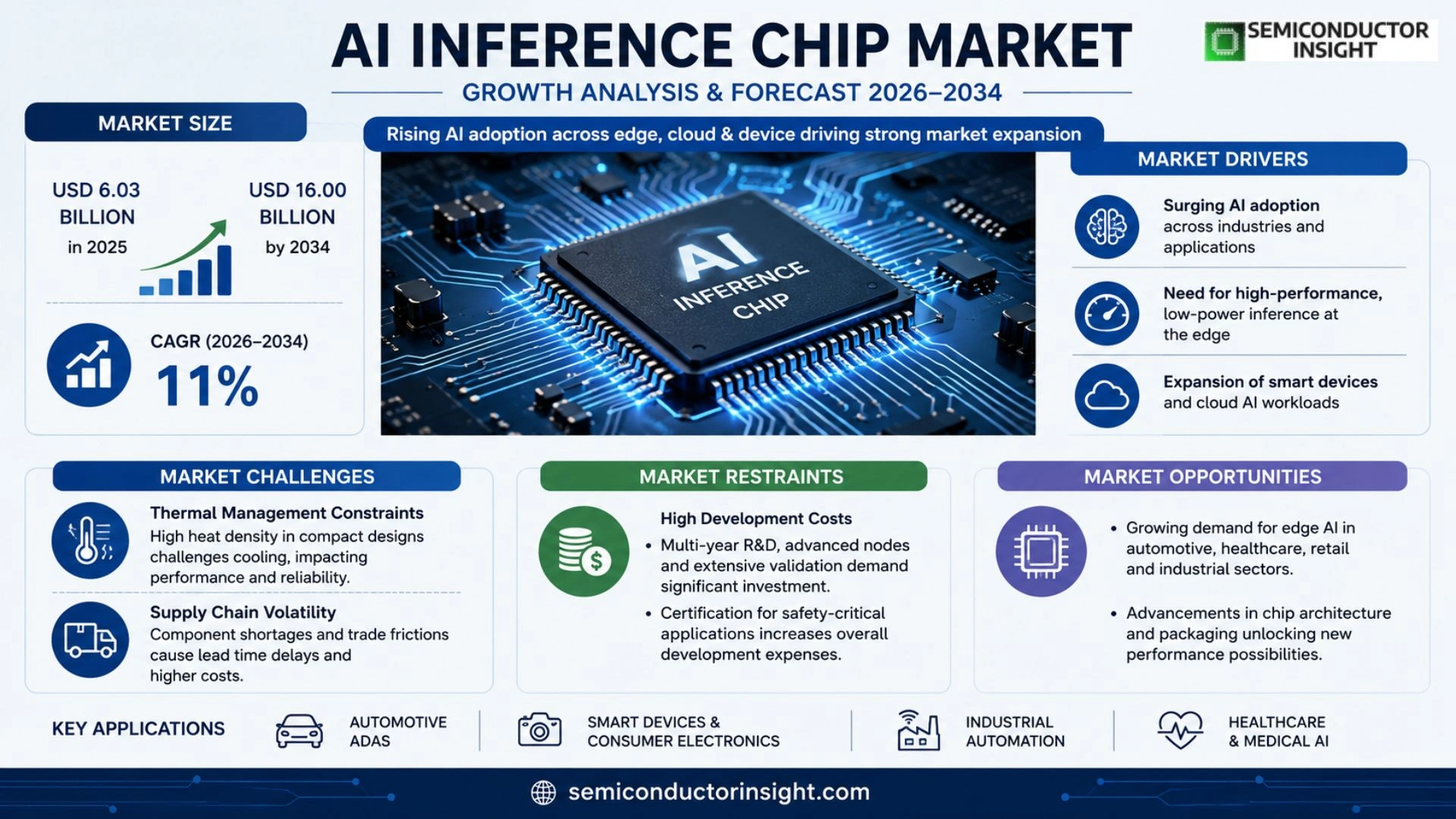
MARKET DRIVERS
Increasing Edge AI Deployments
The surge in on‑device intelligence,spanning autonomous drones, smart cameras, and industrial robotics,requires processors that can execute inference with minimal latency. As manufacturers shift workloads from cloud to edge, AI Inference Chip Market benefits from a clear preference for low‑power, high‑throughput silicon that keeps data local and reduces bandwidth costs.
Advances in Chip Architecture
Next‑generation designs such as heterogeneous compute blocks, sparsity‑aware engines, and fused memory hierarchies unlock efficiency gains previously reserved for large data‑center GPUs. These architectural breakthroughs translate into a measurable uplift in operations per watt, prompting OEMs to replace legacy ASICs with purpose‑built inference chips.
➤ “Clients that integrate inference‑optimized silicon report up to 40% lower power draw while maintaining model accuracy, reshaping cost structures across the supply chain.”
Collectively, the push toward edge analytics and the rapid evolution of chip micro‑architectures generate a durable propulsion mechanism for the sector, encouraging both incumbents and newcomers to double‑down on dedicated inference solutions.
MARKET CHALLENGES
Thermal Management Constraints
Inference processors increasingly concentrate deep‑learning workloads into compact form factors, intensifying heat density. Designers grapple with limited cooling envelopes, especially in automotive and wearable applications where passive dissipation is the norm. Failure to resolve thermal bottlenecks can erode performance margins and heighten failure rates.
Other Challenges
Supply Chain Volatility
Global component shortages and geopolitical trade frictions inflate lead times for high‑performance memory and specialty substrates, forcing manufacturers to hold larger inventories or accept higher unit costs.
MARKET RESTRAINTS
High Development Costs
Creating a custom inference silicon solution demands multi‑year R&D cycles, access to cutting‑edge fabrication nodes, and validation across diverse AI frameworks. The capital outlay often exceeds the threshold for small‑to‑mid‑size enterprises, limiting market participation to well‑funded players.
Moreover, the necessity to certify chips for safety‑critical domains,automotive ADAS, medical imaging, and industrial control,adds another layer of expense. Compliance testing, firmware updates, and long‑term support obligations collectively constrain broader adoption.
MARKET OPPORTUNITIES
Custom ASIC Design Services
Enterprises seeking differentiated performance are outsourcing chip development to specialist foundries that offer turn‑key ASIC design platforms. These services accelerate time‑to‑market and lower upfront engineering costs, creating a growth avenue for AI Inference Chip Market as more firms opt for tailored silicon rather than off‑the‑shelf solutions.
Parallelly, the rise of domain‑specific inference workloads,such as natural language processing at the edge and real‑time video analytics for retail,opens niche segments where highly optimized ASICs can deliver compelling ROI. Early movers that lock in design expertise and secure fab capacity stand to capture substantial market share.
AI Inference Chip Market Trends
Integration of Tensor‑Core and Systolic Array Architectures Accelerates On‑Device Workloads
The latest generation of AI inference chips embeds tightly coupled tensor‑core blocks and systolic‑array pathways that cut the number of clock cycles required for matrix multiplication. By unifying data movement and compute within a single silicon footprint, manufacturers deliver latency reductions that make real‑time perception feasible in autonomous‑driving platforms and smart‑camera arrays. This architectural shift matters because it translates directly into higher throughput per watt, allowing device makers to meet strict power envelopes while still supporting the increasing complexity of vision and language models.
Other Trends
Energy‑Efficiency Imperative
Enterprises deploying AI at the edge are confronting the reality that data‑center‑grade power budgets are unattainable on battery‑operated hardware. Chip designers therefore prioritize low‑leakage process nodes and dynamic voltage‑frequency scaling mechanisms. The result is a class of inference processors that can sustain multi‑giga‑ops performance while drawing less than a hundred milliwatts. For OEMs, this translates into longer device lifecycles and reduced cooling requirements, which in turn opens new revenue streams in wearables and industrial IoT gateways.
Strategic Alliances and Portfolio Diversification
Recent collaboration announcements illustrate a pattern of OEMs and silicon vendors aligning their roadmaps. A notable example is the February 2024 launch of a high‑throughput inference accelerator that targets data‑center workloads while preserving a form factor suitable for rack‑mount edge servers. Simultaneously, leading firms are expanding their product suites to cover everything from ultra‑compact neural‑processing units for smartphones to modular accelerator cards for hyperscale clouds. This breadth of offerings reduces entry barriers for companies that previously relied on a single vendor, fostering a more competitive environment that pressures pricing and accelerates feature innovation.
COMPETITIVE LANDSCAPE
Key Industry Players
AI Inference Chip Market – Competitive Overview
NVIDIA continues to dominate the high‑performance inference segment, leveraging its Tensor Core GPU family and the recently announced L40 accelerator, which targets data‑center workloads that demand both throughput and energy efficiency. Intel’s strategy intertwines its Xeon line with the Habana Gaudi processors, creating a portfolio that spans server‑grade to edge deployments. AMD’s acquisition of Xilinx broadened its capability to offer heterogeneous solutions that blend programmable logic with ASIC‑style inference engines. Qualcomm, with its Snapdragon series, embeds inference accelerators directly into mobile and IoT devices, fostering a seamless transition from cloud to edge. Google’s Tensor Processing Units remain tightly coupled with its Vertex AI services, reinforcing its position in the cloud‑first inference space. Collectively, these firms shape a tiered market where scale, software integration, and ecosystem lock‑in dictate the competitive rhythm.
Beyond the headline names, a cluster of specialized vendors is carving out niches that challenge the incumbents. Graphcore’s IPU architecture emphasizes fine‑grained parallelism, appealing to research‑intensive workloads. Cerebras’ wafer‑scale engine provides unprecedented memory bandwidth for large models, while SambaNova’s DataScale system integrates inference and training in a single chassis. Horizon Robotics focuses on automotive edge, delivering inference silicon optimized for perception tasks. MediaTek’s Dimensity line brings affordable inference to mass‑market smartphones. Apple’s Neural Engine, embedded in its silicon, underscores the trend toward on‑device AI in consumer products. Amazon’s Inferentia ASIC, tailored for AWS services, exemplifies the cloud provider’s push to control the inference stack end‑to‑end. These players, though smaller in revenue, inject innovation that forces the larger firms to adapt their roadmaps.
List of Key AI Inference Chip Companies Profiled
- NVIDIA
- Intel
- AMD
- Qualcomm
- Graphcore
- Cerebras Systems
- SambaNova Systems
- Horizon Robotics
- MediaTek
- Apple
- Amazon Web Services
- Huawei
- Tenstorrent
- Groq
Segment Analysis:
| Segment Category | Sub-Segments | Key Insights |
| By Type |
|
Dedicated ASICs dominate the narrative because they are engineered for maximum energy efficiency and ultra‑low latency. They enable manufacturers to embed inference capabilities directly into silicon, reducing system complexity and power draw. Their design focus on fixed neural‑network kernels fosters predictable performance across a wide range of workloads. |
| By Application |
|
Data‑center inference is the leading segment as enterprises seek to scale AI services while maintaining throughput. High‑density server deployments benefit from chips that balance raw compute with thermal efficiency. The ecosystem around containerized AI workloads encourages rapid integration of new models without extensive hardware redesign. |
| By End User |
|
Cloud service providers lead because they continuously refresh infrastructure to meet the growing demand for on‑demand AI inference. Their scale allows them to experiment with emerging architectures, fostering a feedback loop that pushes chip vendors toward tighter integration with software stacks. |
| By Architecture |
|
Tensor‑core engines are prominent because they excel at dense matrix operations that underpin most deep‑learning inference tasks. Their ability to fuse multiple operations reduces data movement, which in turn improves latency and power consumption across both cloud and edge deployments. |
| By Deployment Model |
|
Edge installations are gaining traction as latency‑sensitive applications such as autonomous vehicles and industrial IoT demand inference close to the data source. The push for on‑device processing drives vendors to produce chips with modest footprints yet robust compute capabilities, reinforcing the overall market dynamism. |
Regional Analysis: AI Inference Chip Market
The region boasts a vertically integrated fab network, from wafer production to advanced test‑and‑pack facilities. This depth reduces lead times for prototype runs, enabling chip designers to iterate rapidly and meet evolving inference workloads without external bottlenecks.
Cloud hyperscalers, autonomous‑driving firms, and consumer‑electronics OEMs dominate demand, each seeking silicon that can deliver high throughput at sub‑watts power budgets, a combination that shapes design priorities across the market.
Federal guidelines on AI transparency and data handling create a predictable compliance backdrop. Chipmakers benefit from early alignment with these standards, avoiding costly redesigns as policy evolves.
Capital inflows remain robust, with both public funds and private equity targeting niche players that demonstrate breakthroughs in low‑latency interconnects and heterogeneous integration, sustaining a pipeline of innovative products.
Europe
European stakeholders are concentrating on sustainability criteria, encouraging chip designs that minimize carbon footprints through advanced low‑power processes. The region’s strong emphasis on open standards fosters collaborative ecosystems between hardware vendors and AI framework developers, smoothing integration for enterprise customers. While funding levels are modest compared with North America, strategic public‑private partnerships catalyze niche projects focused on edge inference for industrial automation, positioning Europe as a specialist hub within the broader AI Inference Chip Market.
Asia‑Pacific
Asia‑Pacific leverages its massive manufacturing capacity to offer cost‑effective inference solutions, particularly for smartphones and IoT devices where price sensitivity is paramount. Nations such as Japan and South Korea prioritize high‑performance memory stacks that complement inference accelerators, creating a competitive edge in latency‑critical applications. Rapid adoption of AI across diverse sectors,from smart cities to healthcare,drives demand for customizable silicon, prompting local fabless firms to pursue partnership models with global design houses, thereby deepening the region’s role in the market’s expansion.
South America
In South America, emerging data‑center projects and growing interest in AI‑enabled agricultural technologies stimulate modest but steady demand for inference chips. Local telecom operators are upgrading edge infrastructure to support real‑time video analytics, which requires energy‑efficient hardware. Although the market remains nascent, government incentives aimed at digital transformation are beginning to attract multinational vendors seeking to establish footholds, hinting at a longer‑term growth trajectory within AI Inference Chip Market.
Middle East & Africa
The Middle East & Africa region is witnessing the early stages of AI deployment in sectors such as oil‑and‑gas monitoring and security surveillance. Investments in sovereign cloud platforms encourage the procurement of inference accelerators optimized for high‑throughput analytics. However, the scarcity of local semiconductor fabrication forces reliance on imports, making cost and supply‑chain resilience central considerations for buyers. Strategic alliances with established global chip makers are emerging as a practical path to access advanced inference technology without extensive domestic R&D.
Report Scope
This market research report provides a comprehensive analysis of the AI Inference Chip Market , covering the forecast period 2026–2034. It offers detailed insights into market dynamics, technological advancements, competitive landscape, and key trends shaping the industry.
Key focus areas of the report include:
- Market Overview: The report begins with an overview outlining its current market scenario, key growth indicators, and industry transformation drivers. It discusses macroeconomic factors, demand–supply balance, regulatory landscape, and the strategic role of semiconductors in powering advancements across industries such as automotive, telecommunications, consumer electronics, and industrial automation.
- Market Size & Forecast: Historical data and future projections for revenue, unit shipments, and market value across major regions and segments.
- Segmentation Analysis: Detailed breakdown by product type, technology, application, and end-user industry to identify high-growth segments and investment opportunities.
- Regional Insights: Insights into market performance across North America, Europe, Asia-Pacific, Latin America, and the Middle East & Africa, including country-level analysis where relevant.
- Competitive Landscape: Profiles of leading market participants, including their product offerings, R&D focus, manufacturing capacity, pricing strategies, and recent developments such as mergers, acquisitions, and partnerships.
- Technology Trends & Innovation: Assessment of emerging technologies, integration of AI/IoT, semiconductor design trends, fabrication techniques, and evolving industry standards.
- Market Drivers & Restraints: Evaluation of factors driving market growth along with challenges, supply chain constraints, regulatory issues, and market-entry barriers.
- Stakeholder Insights: Insights for component suppliers, OEMs, system integrators, investors, and policymakers regarding the evolving ecosystem and strategic opportunities.
Primary and secondary research methods are employed, including interviews with industry experts, data from verified sources, and real-time market intelligence to ensure the accuracy and reliability of the insights presented.
FREQUENTLY ASKED QUESTIONS:
What is the current market size of AI Inference Chip Market?
-> AI Inference Chip Market was valued at USD 6.3 billion in 2025 and is expected to reach USD 16 billion by 2034, reflecting a CAGR of 11% over the forecast period.
Which key companies operate in AI Inference Chip Market?
-> Key players include NVIDIA, AMD, Intel, Qualcomm, and Google, among others.
What are the key growth drivers?
-> Key growth drivers include scaling AI workloads across enterprises, demand for energy‑efficient inference solutions, rapid edge‑computing deployments, and the rise of generative‑AI services.
Which region dominates the market?
-> North America currently leads AI Inference Chip market, driven by a concentration of semiconductor innovators and large‑scale cloud and edge deployments, while Asia‑Pacific shows the fastest growth trajectory.
What are the emerging trends?
-> Emerging trends include integration of specialized tensor cores, development of high‑throughput inference GPUs (e.g., NVIDIA L40), and increasing convergence of AI inference with edge‑AI and generative‑AI workloads.

Get Sample Report PDF for Exclusive Insights
Report Sample Includes
- Table of Contents
- List of Tables & Figures
- Charts, Research Methodology, and more...
 Download Sample Report PDF




