
AI Inference-as-a Service Hardware Market Insights
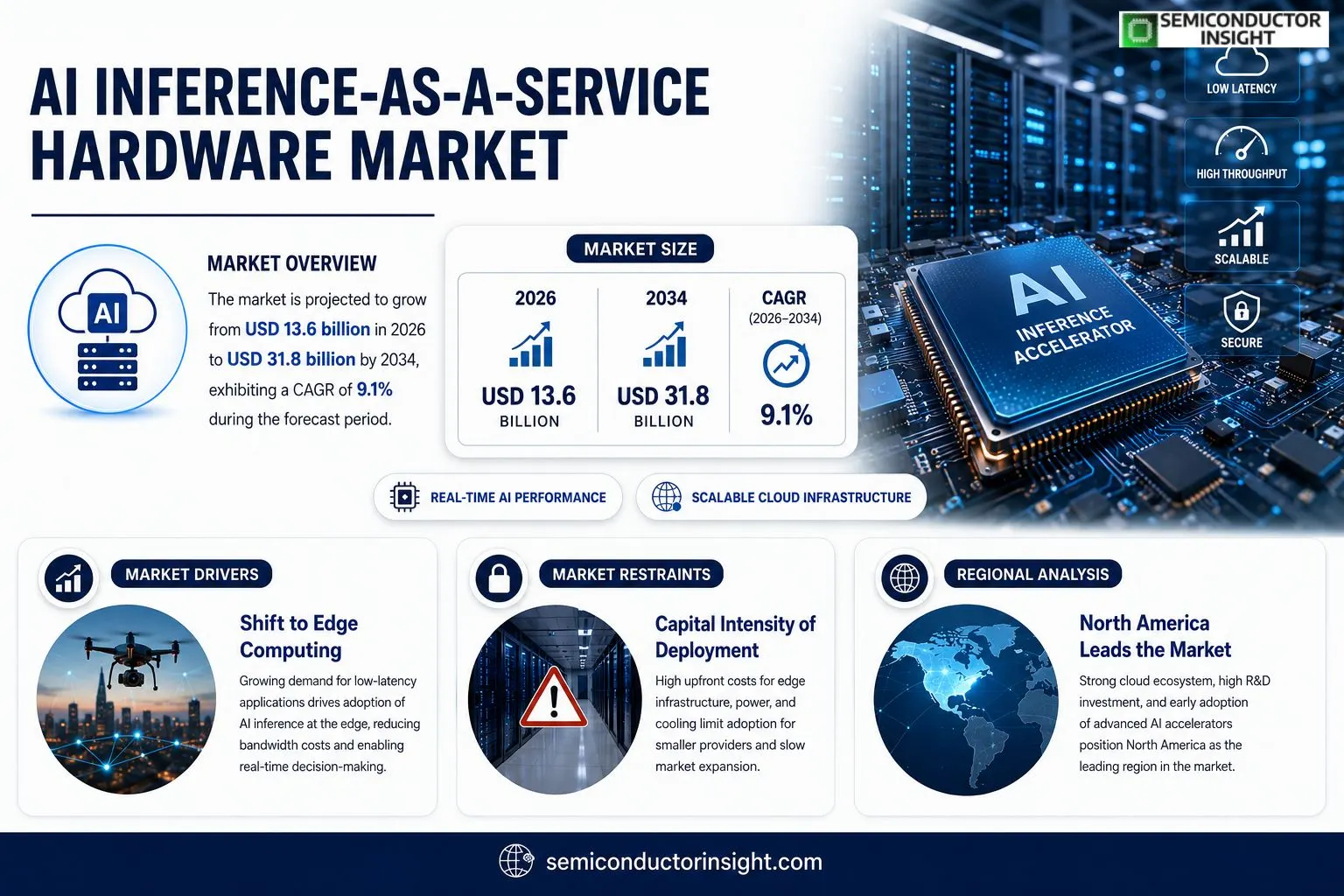
AI Inference-as-a-Service Hardware Market size was valued at USD 12.4 billion in 2025. market is projected to grow from USD 13.6 billion in 2026 to USD 31.8 billion by 2034, exhibiting a CAGR of 9.1 % during forecast period.
AI Inference‑as‑a‑Service hardware comprises purpose‑built acceleratorssuch as GPUs, TPUs and custom ASICsdeployed within cloud infrastructures so customers can run trained models without owning physical equipment. se platforms deliver sub‑millisecond latency and scalable throughput for workloads ranging from recommendation engines to autonomous‑vehicle perception.expansion reflects rising demand for real‑time analytics across sectors because enterprises seek cost‑effective ways to embed intelligence into products and services. Cloud providers have responded by integrating next‑generation silicon; for example, NVIDIA announced a joint offering with Microsoft Azure that leverages its latest Hopper GPUs for inference workloads released in early 2024. Meanwhile, Intel’s Habana Gaudi processors and Google’s TPU v5e are being added to major public clouds, widening choice set for developers.
MARKET DRIVERS
Shift to Edge Computing
proliferation of latency‑sensitive applicationsautonomous drones, real‑time video analytics, and industrial IoTforces enterprises to locate inference workloads closer to data source. This shift reduces round‑trip time, cuts bandwidth costs, and makes AI Inference-as-a-Service Hardware Market offerings a logical alternative to centralized cloud racks.
Economies of Scale in Custom Silicon
Foundries now produce AI‑optimized accelerators in volumes that rival traditional CPUs, driving unit costs down while preserving performance per watt. As a result, service providers can price inference capacity competitively, encouraging mid‑size firms to adopt model without heavy CapEx.
➤ “Performance‑per‑dollar improvements in purpose‑built inference chips are reshaping vendor‑client relationships across sectors.”
Regulatory pressure for data sovereignty also nudges firms toward localized inference nodes. By hosting AI workloads within national borders, providers align with emerging privacy statutes while still offering scalability that defines AI Inference-as-a-Service Hardware Market.
MARKET CHALLENGES
Fragmented Software Ecosystem
Developers must navigate a maze of frameworks, compilers, and runtime libraries that are not uniformly supported across hardware vendors. This disparity raises integration costs and discourages smaller players from experimenting with inference services.
Or Challenges
Talent Shortage
rarity of engineers skilled in both AI model optimization and low‑level hardware programming creates a bottleneck that hampers rapid service rollout.
MARKET RESTRAINTS
Capital Intensity of Deployment
Establishing a geographically diverse inference fabric requires substantial upfront investment in edge datacenters, power infrastructure, and cooling solutions. Organizations with limited cash reserves often defer adoption, opting instead for legacy on‑premise GPUs.Moreover, rapid obsolescence cycle of AI accelerators forces providers to balance inventory risk against need to stay technologically current, a dilemma that can suppress market expansion.
MARKET OPPORTUNITIES
Industry‑Specific Inference Packages
Tailoring inference stacks to verticals such as healthcare imaging, financial fraud detection, and smart manufacturing opens premium pricing corridors. By embedding domain‑specific models and compliance controls, providers can differentiate ir offering within AI Inference-as-a-Service Hardware Market.Additionally, rise of programmable data‑plane ASICs creates a pathway for hybrid solutions that combine real‑time packet processing with AI inference, unlocking new revenue streams for telecom operators and cloud carriers.
AI Inference-as-a-Service Hardware Market Trends
Escalating Cloud Adoption of Specialized Accelerators
AI Inference-as-a-Service Hardware Market is witnessing a clear shift toward purpose‑built accelerators embedded in major cloud platforms. Enterprises that require sub‑millisecond response times for recommendation engines, fraud detection, or autonomous‑vehicle perception are opting for hosted inference rar than maintaining on‑premise racks. This preference lowers capital outlays and aligns expenses with actual usage, which explains why cloud providers are rapidly expanding ir accelerator portfolios. move also reflects a broader industry desire to offload compute‑intensive inference workloads to environments that can guarantee both latency and elasticity.
Or Trends
Integration of Next‑Gen Silicon in Public Clouds
Recent announcements from leading chip makers illustrate how AI Inference-as-a-Service Hardware Market is diversifying its hardware base. NVIDIA’s Hopper GPUs, now available on Azure, deliver higher throughput per watt, while Intel’s Habana Gaudi processors and Google’s TPU v5e have been added to AWS and Google Cloud respectively. By offering a mix of GPUs, TPUs, and custom ASICs, cloud operators give developers ability to match workload characteristics with most efficient silicon, reducing energy costs and improving throughput. strategic partnership between NVIDIA and Microsoft also signals that vendors view hosted inference as a long‑term revenue stream, prompting continued investment in hardware‑optimized APIs and tooling.
Competitive Diversification of Inference Processors
A noticeable trend in AI Inference-as-a-Service Hardware Market is emergence of multiple processor families competing for same inference niches. Companies such as Graphcore and Cerebras are introducing large‑scale matrix engines that challenge dominance of traditional GPUs. ir designs focus on minimizing data movement, which is critical for real‑time analytics in sectors like healthcare imaging and financial trading. As portfolio of available processors widens, cloud providers are compelled to curate ir offerings, creating tiered pricing models that reflect performance differentials. This competitive pressure encourages continuous architectural innovation, ultimately delivering more cost‑effective solutions for end‑users.
COMPETITIVE LANDSCAPE
Key Industry Players
Competitive Positioning of AI Inference‑as‑a‑Service Hardware Providers
Within inference‑as‑a‑service arena, NVIDIA remains dominant force, leveraging its Hopper‑generation GPUs through deep integrations with Microsoft Azure, Amazon Web Services, and Google Cloud. company’s ability to deliver sub‑millisecond latency at scale has forced cloud operators to standardise on its architecture for high‑throughput workloads such as recommendation systems and large‑language‑model serving. This centrality gives NVIDIA both pricing leverage and a privileged roadmap channel, compelling developers to optimise models around its CUDA ecosystem.Beyond flagship tier, a cohort of specialised silicon firms is reshaping competitive set. Intel’s Habana Gaudi line, Google’s TPU v5e, and AMD’s MI200 series add diversity to accelerator portfolio, each targeting distinct performance‑per‑watt niches. Emerging entrants such as Graphcore, Cerebras, SambaNova, Mythic, and Groq focus on novel dataflow or inference‑only architectures, aiming to capture workloads where conventional GPUs exhibit diminishing returns. Regional playersincluding Alibaba Cloud, Huawei, and Baiduextend landscape by bundling proprietary ASICs with domestic cloud services, creating localized ecosystems that challenge incumbents.
List of Key AI Inference-as-a-Service Hardware Companies Profiled
- NVIDIA
- Intel
- AMD
- Graphcore
- Cerebras
- SambaNova
- Mythic
- Groq
- Qualcomm
- Alibaba Cloud
- Huawei
- Baidu
- Microsoft Azure (partner ecosystem)
Segment Analysis:
| Segment Category | Sub-Segments | Key Insights |
| By Type |
|
GPU‑based Inference
|
| By Application |
|
Real‑Time Analytics Applications
|
| By End User |
|
Enterprise Technology Teams
|
| By Deployment Model |
|
Hybrid Cloud Deployment
|
| By Industry |
|
Automotive & Mobility
|
Regional Analysis: AI Inference-as-a-Service Hardware Market
North America
dominant cloud platforms are allocating a sizable portion of ir R&D budgets to custom inference silicon, driven by need to offer differentiated latency tiers. ir rollout of edge‑centric inference nodes reflects a strategic pursuit of markets where sub‑millisecond response times are a competitive moat.
Large corporates are piloting inference‑as‑a‑service to replace entrenched GPU farms, citing improved governance and predictable OPEX models. ir internal cloud‑native teams are re‑architecting data pipelines to exploit higher throughput of purpose‑built ASICs.
While U.S. framework remains flexible, emerging data‑privacy statutes are prompting providers to embed encryption at inference layer, compelling hardware designers to integrate secure enclaves without compromising performance.
region’s universities churn out specialists in low‑latency architecture, and a thriving startup ecosystem translates research breakthroughs into commercial inference chips that quickly find a home on leading service platforms.
Europe
European adopters are balancing aggressive AI ambitions with a cautious approach to data sovereignty. National cloud initiatives are building inference clusters that reside within jurisdictional borders, allowing firms to comply with stringent GDPR extensions while still leveraging cutting‑edge hardware. market is characterized by collaborative consortia between hardware manufacturers and research institutes, which accelerate translation of university‑originated accelerator designs into service offerings. Enterprises in finance and manufacturing are attracted to predictable performance guarantees that inference‑as‑a‑service provides, especially for real‑time fraud detection and predictive maintenance scenarios. Although capital expenditure levels trail North America, emphasis on energy‑efficient hardware aligns with Europe’s broader sustainability goals, creating a niche for low‑power inference solutions.
Asia‑Pacific
Asia‑Pacific region exhibits a heterogeneous landscape, with China’s state‑backed cloud giants rapidly scaling inference hardware alongside burgeoning demand from smart‑city projects. Japan and South Korea prioritize precision‑engineered ASICs for high‑resolution computer‑vision services, driven by strong consumer electronics ecosystems. Meanwhile, Souast Asian markets are still in early adoption phase, where cost‑sensitive enterprises evaluate inference‑as‑a‑service as a pathway to bypass heavy upfront spending required for on‑premise hardware. region’s rapid digitization, coupled with government incentives for AI research, is expected to catalyze a shift toward more specialized inference offerings within next few years.
South America
In South America, rollout of inference‑as‑a‑service is closely tied to improving broadband connectivity and emergence of regional cloud providers. Companies in retail and agritech are experimenting with edge inference to process sensor streams locally, reducing dependence on trans‑continental latency. While overall market size remains modest, continent’s growing startup scene is exploring lightweight inference accelerators that can operate on modest power budgets, aligning with region’s infrastructural constraints. Partnerships with multinational cloud operators are beginning to surface, offering local data centers that host inference hardware tailored to regional compliance requirements.
Middle East & Africa
Middle East & Africa region is witnessing nascent interest in AI inference services, primarily in sectors such as oil‑and‑gas, telecommunications, and fintech. Investment in data‑center infrastructure, often funded by sovereign wealth funds, is creating physical backbone necessary for latency‑sensitive workloads. African nations, leveraging mobile‑first connectivity, are exploring inference at network edge to enable real‑time language translation and health diagnostics. market is still early‑stage, but convergence of government‑led digital transformation programs with private‑sector demand suggests a steady trajectory toward broader adoption of inference‑as‑a‑service hardware solutions.
Report Scope
This market research report provides a comprehensive analysis of AI Inference-as-a-Service Hardware Market , covering forecast period 2026–2034. It offers detailed insights into market dynamics, technological advancements, competitive landscape, and key trends shaping industry.
Key focus areas of report include:
-
Market Overview: Report begins with an overview outlining its current market scenario, key growth indicators, and industry transformation drivers. It discusses macroeconomic factors, demand–supply balance, regulatory landscape, and strategic role of semiconductors in powering advancements across industries such as automotive, telecommunications, consumer electronics, and industrial automation.
- Market Size & Forecast: Historical data and future projections for revenue, unit shipments, and market value across major regions and segments.
- Segmentation Analysis: Detailed breakdown by product type, technology, application, and end-user industry to identify high-growth segments and investment opportunities.
- Regional Insights: Insights into market performance across North America, Europe, Asia-Pacific, Latin America, and Middle East & Africa, including country-level analysis where relevant.
- Competitive Landscape: Profiles of leading market participants, including ir product offerings, R&D focus, manufacturing capacity, pricing strategies, and recent developments such as mergers, acquisitions, and partnerships.
- Technology Trends & Innovation: Assessment of emerging technologies, integration of AI/IoT, semiconductor design trends, fabrication techniques, and evolving industry standards.
- Market Drivers & Restraints: Evaluation of factors driving market growth along with challenges, supply chain constraints, regulatory issues, and market-entry barriers.
- Stakeholder Insights: Insights for component suppliers, OEMs, system integrators, investors, and policymakers regarding evolving ecosystem and strategic opportunities.
Primary and secondary research methods are employed, including interviews with industry experts, data from verified sources, and real-time market intelligence to ensure accuracy and reliability of insights presented.
FREQUENTLY ASKED QUESTIONS:
What is current market size of AI Inference-as-a-Service Hardware Market?
-> AI Inference-as-a-Service Hardware Market was valued at USD 12.4 billion in 2025 and is expected to reach USD 31.8 billion by 2034, reflecting a CAGR of 9.1 % during forecast period.
Which key companies operate in AI Inference-as-a-Service Hardware Market?
-> Key players include NVIDIA, Microsoft (Azure), Intel (Habana Gaudi), and Google (TPU), among ors.
What are key growth drivers?
-> Key growth drivers include rising demand for real‑time analytics, cost‑effective AI deployment, and cloud providers integrating next‑generation silicon.
Which region dominates market?
-> North America is a leading region, while Asia‑Pacific shows fastest growth trajectory.
What are emerging trends?
-> Emerging trends include adoption of Hopper GPUs, custom ASIC accelerators, and expanded edge‑inference capabilities.

Get Sample Report PDF for Exclusive Insights
Report Sample Includes
- Table of Contents
- List of Tables & Figures
- Charts, Research Methodology, and more...
 Download Sample Report PDF


