AI in Hardware Market Insights
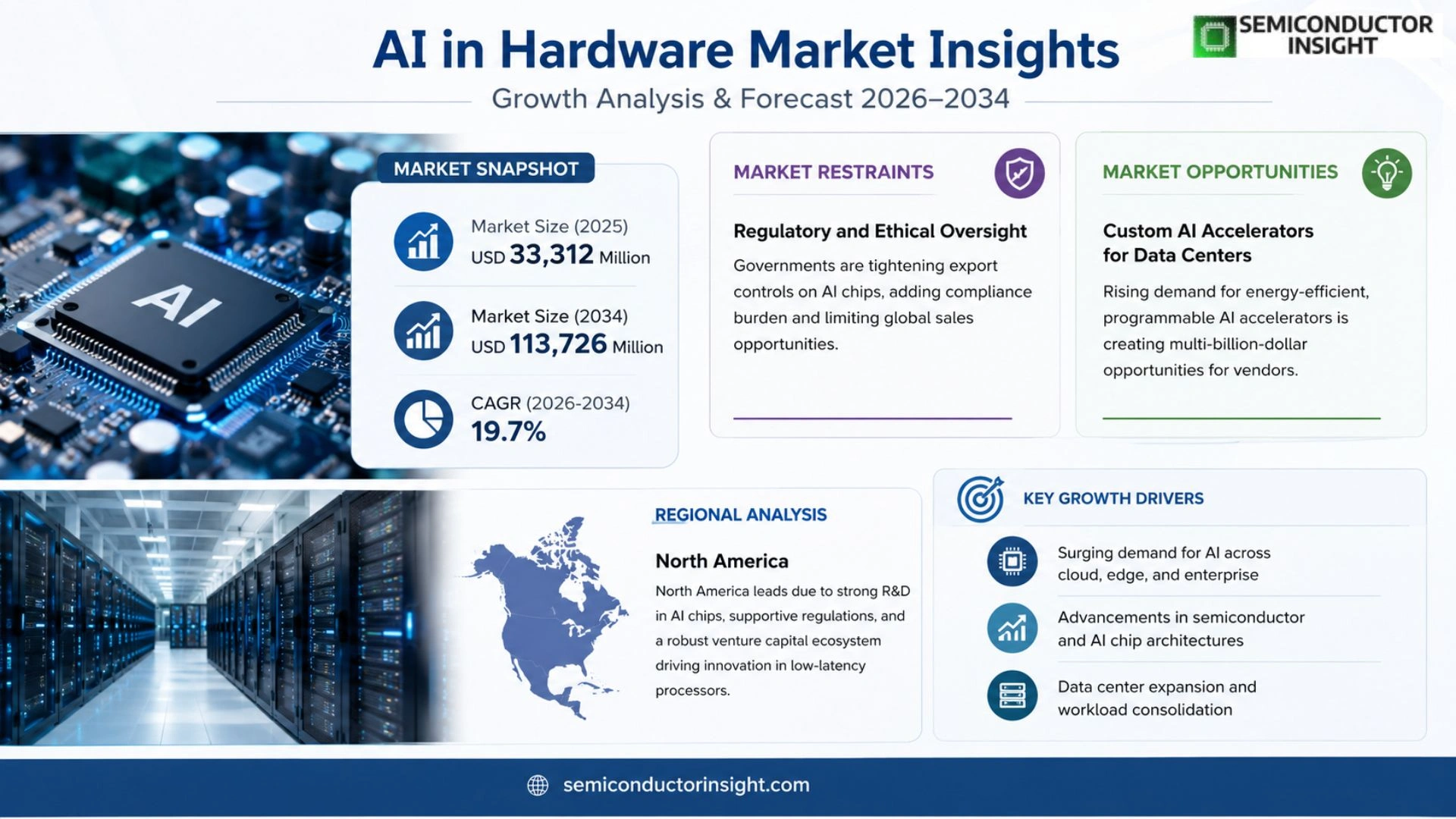
Global AI in Hardware market size was valued at USD 33,312 million in 2025. The market will expand from this level to USD 113,726 million by 2034, showing a CAGR of 19.7% during the forecast period.
Consumer‑grade AI in Hardware denotes smart devices built for everyday users that embed artificial‑intelligence capabilities for perception, understanding and interaction either locally or via cloud services. Products such as AI‑enabled smartphones, smart speakers, home robots, AR/VR headsets and wearables rely on embedded AI chips, sensors and algorithms to deliver voice and image recognition, real‑time translation, behavior prediction and personalized recommendations.
The sector benefits from heightened government support,e.g., the EU’s Digital Europe plan earmarks €9.2 billion for high‑tech initiatives and the United States raised its non‑defense AI R&D budget to USD 1.7 billion in 2022,as well as strong commercial demand reflected by IDC’s report of global AI revenue reaching USD 432.8 billion in 2022 (a year‑on‑year rise of 19.89%). These factors together accelerate adoption across both upstream component supply chains and downstream consumer ecosystems.
MARKET DRIVERS
Rising Edge‑Computing Demand
The proliferation of 5G connectivity and real‑time analytics forces enterprises to shift processing closer to the data source. AI in Hardware Market participants that embed inference engines within edge devices capture latency‑sensitive workloads that traditional cloud infrastructures cannot serve efficiently. This shift fuels investment in purpose‑built ASICs and heterogeneous SoCs, creating a feedback loop of deeper algorithm‑hardware co‑design.
Advances in Semiconductor Design
Modern process nodes now support sub‑10 nm finFETs and advanced packaging such as chip‑let integration, enabling higher transistor density without proportional power penalties. Vendors leverage these capabilities to embed tensor cores directly within CPUs, thereby offering a plug‑and‑play solution for midsize firms that lack AI‑specific design teams. The resulting economies of scale lower entry barriers and expand the addressable user base.
➤ Hardware specialization is no longer optional; it is the primary lever for achieving cost‑effective AI performance at scale.
Enterprise budgeting cycles increasingly treat AI‑accelerated hardware as a strategic cost‑avoidance measure, because the amortized expense of dedicated silicon offsets the operational overhead of cloud‑based inference. Companies that align product roadmaps with these hardware trends are positioned to capture a larger share of AI in Hardware Market in the next fiscal period.
MARKET CHALLENGES
Thermal Management Constraints
High‑performance AI accelerators push silicon to its thermal envelope, and conventional cooling solutions struggle to sustain peak throughput in dense server racks. Designers must allocate silicon area for heat sinks or liquid‑cooling loops, which erodes the performance‑per‑watt advantage that initially justified the hardware investment. The resulting trade‑off can deter cost‑sensitive adopters.
Other Challenges
Supply‑Chain Volatility
The reliance on rare‑earth metals and advanced photo‑lithography equipment creates a bottleneck that amplifies lead times. When component shortages arise, OEMs face delayed product launches, forcing customers to postpone AI projects or revert to legacy CPUs, thereby tempering market momentum.
MARKET RESTRAINTS
Regulatory and Ethical Oversight
Governments worldwide are tightening export controls on AI‑capable chips, citing national security concerns. Compliance frameworks add documentation overhead and restrict the geographic scope of sales, limiting the ability of manufacturers to scale globally without incurring legal risk.
In parallel, industry bodies are drafting standards for algorithmic transparency that may require hardware vendors to embed provenance trackers within silicon. The additional silicon real‑estate and validation cycles can increase development timelines, slowing the rollout of next‑generation products.
Finally, the high upfront R&D expenditure needed to design custom AI accelerators imposes a capital barrier for smaller firms. Even when financing is available, the uncertainty of return on investment in a volatile market may cause investors to favor more conservative technology bets.
MARKET OPPORTUNITIES
Custom AI Accelerators for Data Centers
Data‑center operators are consolidating workloads onto single‑purpose AI chips to minimize energy bills. Vendors that deliver modular accelerator platforms,compatible with existing rack designs yet programmable for diverse models,stand to win contracts worth billions, as hyperscale players redesign their infrastructure for AI‑first workloads.
Edge AI for autonomous systems presents a second growth vector. Vehicles, drones, and industrial robots require on‑board inference that can operate offline and under strict power budgets. Companies that integrate low‑latency neural processors with ruggedized packaging can capture emerging OEM contracts in transportation and logistics.
Neuromorphic computing, inspired by brain architecture, is moving from research labs toward commercial prototypes. Early adopters that combine spiking neural networks with event‑driven sensors can offer ultra‑efficient perception solutions for smart cities, unlocking a niche yet high‑margin segment within the broader AI in Hardware Market.
AI in Hardware Market Trends
Consumer‑Grade Devices Strengthening Adoption
AI in Hardware Market is witnessing a shift from experimental prototypes toward mass‑market products that blend affordability with on‑device intelligence. Smartphones equipped with dedicated neural processing units now handle voice queries, image classification, and predictive text without relying on distant servers, a capability that boosts user responsiveness and reduces data‑exchange costs. Home assistants and smart speakers, leveraging compact AI chips, have moved beyond simple command execution to proactive context‑aware suggestions, creating a feedback loop where richer data fuels algorithm refinement. This migration fuels a virtuous cycle: heightened consumer familiarity encourages OEMs to allocate larger design budgets toward integrated AI, which in turn lowers per‑unit component prices, making advanced features reachable for mid‑tier devices.
Other Trends
Supply‑Chain Evolution
Upstream, semiconductor manufacturers are transitioning from generic GPU designs to purpose‑built AI processors that balance power efficiency with inference speed. The convergence of sensor technology,high‑resolution cameras, multi‑directional microphones, and inertial measurement units,into single package modules cuts board real estate and simplifies BOM management. Parallel to silicon advances, AI framework providers are standardizing model formats, allowing developers to compile a single algorithm for diverse hardware targets. These efficiencies blunt the impact of component shortages that previously inflated lead times for consumer launches.
Policy Support Accelerating Investment
Governments across Europe, North America, and Asia have introduced fiscal incentives and research grants that target AI‑enabled hardware ecosystems. The European Union’s Digital Europe plan earmarks billions for high‑performance computing infrastructure and AI chip R&D, prompting regional manufacturers to expand design studios within member states. In the United States, non‑defense AI funding has risen modestly, encouraging private‑sector partnerships that focus on edge‑compute solutions for consumer products. Such policy backing not only de‑riskes capital deployment for start‑ups but also catalyzes collaboration between chip makers and device assemblers, accelerating time‑to‑market for next‑generation smart gadgets.
COMPETITIVE LANDSCAPE
Key Industry Players
Competitive Overview of Consumer‑Grade AI Hardware
The consumer‑grade AI hardware arena is dominated by a handful of multinational brands that leverage deep pockets and vertically integrated supply chains to ship AI‑enabled smartphones, smart speakers, and wearables at scale. Apple’s custom‑designed silicon, coupled with its tightly controlled software ecosystem, anchors its position as the premier seller of AI‑powered devices in mature markets. Samsung follows closely, exploiting its prowess in display technology and memory to differentiate AI tablets and foldable phones. In parallel, Huawei and Lenovo capitalize on aggressive pricing and strong channel networks across Asia and Europe, reinforcing a fragmented yet competitive structure where scale and component access dictate market share.
Beyond the marquee firms, several niche players inject innovation that reshapes segment boundaries. Google’s focus on AI‑centric Pixel phones and its Tensor processor showcases a software‑first strategy that challenges hardware incumbents. Microsoft, through Surface devices and Azure‑linked AI services, targets productivity‑oriented consumers. Companies such as Realme, Meizu, and Red Magic (ZTE) pursue rapid product cycles and specialized gaming or youth‑oriented devices, carving out loyal micro‑segments. The emergence of AI‑ready wearables from firms like Xiaomi and OPPO illustrates how ecosystem synergies between sensor manufacturers and brand owners can create differentiated value propositions without the need for massive R&D expenditures.
List of Key AI in Hardware Companies Profiled
- Apple
- Samsung
- Huawei
- Lenovo
- Microsoft
- Xiaomi
- OPPO
- Realme
- Meizu
- Red Magic (ZTE)
- ASUS
- HP
- Dell
- Acer
Segment Analysis:
| Segment Category | Sub-Segments | Key Insights |
| By Type |
|
AI Phone
|
| By Application |
|
Personal
|
| By End User |
|
Consumers
|
| By Upstream |
|
AI Processors
|
| By Downstream |
|
Digital Service Ecosystems
|
Regional Analysis: AI in Hardware Market
North America
Leading fabs in the United States and Canada have adopted a modular architecture that separates AI tensor cores from general‑purpose logic, enabling faster design cycles. This approach reduces time‑to‑market for specialized processors used in autonomous vehicles and high‑frequency trading, where latency is a decisive factor.
The emergence of smart factories and industrial IoT hubs has driven demand for compact AI chips that operate at the edge. Vendors are packaging AI accelerators with ruggedized I/O, allowing manufacturers to embed analytics directly on production lines without relying on centralized servers.
Recent disruptions have prompted North American firms to diversify silicon sourcing, establishing secondary foundries in the Midwest. This strategic buffer reduces exposure to geopolitical shocks and ensures steady component availability for AI‑driven product rollouts.
Universities along the West Coast produce a pipeline of engineers skilled in neural‑network compiler design. Collaboration between academia and industry accelerates prototype validation, giving firms a competitive edge in launching next‑generation AI hardware.
Europe
European nations are leveraging strong public‑sector funding to nurture AI‑centric semiconductor projects, especially in Germany and France. The emphasis on open standards encourages cross‑border collaborations, allowing smaller firms to integrate AI accelerators into legacy industrial equipment. While the market lacks the sheer scale of North America, the focus on energy‑efficiency and compliance with stringent data‑privacy regulations differentiates European hardware offerings, making them attractive to enterprises that prioritize governance alongside performance.
Asia‑Pacific
The Asia‑Pacific region boasts a dense manufacturing footprint, with Taiwan and South Korea operating world‑leading fabs that produce AI‑optimized chips at volume. Regional giants are pushing toward system‑on‑chip solutions that embed AI inference engines within consumer electronics, driving mass adoption. Simultaneously, emerging economies such as India are developing AI‑ready microcontrollers for agriculture and education, expanding the market beyond traditional high‑end applications.
South America
In South America, Brazil leads a modest but growing AI hardware ecosystem, driven by local startups targeting fintech and agritech. Limited access to cutting‑edge fabs compels firms to adopt design‑for‑manufacturability practices, focusing on cost‑effective ASICs that can be produced in regional foundries. The market’s evolution hinges on partnerships with multinational vendors that can supply advanced process nodes, enabling local players to enhance product sophistication.
Middle East & Africa
The Middle East & Africa region is gradually entering the AI hardware conversation through sovereign wealth fund investments in data‑center infrastructure. Nations such as the United Arab Emirates are piloting AI‑enhanced edge devices for smart city initiatives, emphasizing low‑power consumption to align with renewable‑energy goals. African markets, while still nascent, are exploring AI chips tailored for mobile health diagnostics, reflecting a strategic focus on affordable, high‑impact solutions.
Report Scope
This market research report provides a comprehensive analysis of the AI in Hardware Market , covering the forecast period 2026–2034. It offers detailed insights into market dynamics, technological advancements, competitive landscape, and key trends shaping the industry.
Key focus areas of the report include:
- Market Overview: The report begins with an overview outlining its current market scenario, key growth indicators, and industry transformation drivers. It discusses macroeconomic factors, demand–supply balance, regulatory landscape, and the strategic role of semiconductors in powering advancements across industries such as automotive, telecommunications, consumer electronics, and industrial automation.
- Market Size & Forecast: Historical data and future projections for revenue, unit shipments, and market value across major regions and segments.
- Segmentation Analysis: Detailed breakdown by product type, technology, application, and end-user industry to identify high-growth segments and investment opportunities.
- Regional Insights: Insights into market performance across North America, Europe, Asia-Pacific, Latin America, and the Middle East & Africa, including country-level analysis where relevant.
- Competitive Landscape: Profiles of leading market participants, including their product offerings, R&D focus, manufacturing capacity, pricing strategies, and recent developments such as mergers, acquisitions, and partnerships.
- Technology Trends & Innovation: Assessment of emerging technologies, integration of AI/IoT, semiconductor design trends, fabrication techniques, and evolving industry standards.
- Market Drivers & Restraints: Evaluation of factors driving market growth along with challenges, supply chain constraints, regulatory issues, and market-entry barriers.
- Stakeholder Insights: Insights for component suppliers, OEMs, system integrators, investors, and policymakers regarding the evolving ecosystem and strategic opportunities.
Primary and secondary research methods are employed, including interviews with industry experts, data from verified sources, and real-time market intelligence to ensure the accuracy and reliability of the insights presented.
FREQUENTLY ASKED QUESTIONS:
What is the current market size of AI in Hardware Market?
-> AI in Hardware market size will expand from this level to USD 113,726 million by 2034
What is the projected CAGR for AI in Hardware Market?
-> The market is projected to grow at a compound annual growth rate of 19.7% during the forecast period.
Which key companies operate in AI in Hardware Market?
-> Key players include Lenovo, Huawei, Apple, Honor, vivo, Xiaomi, OPPO, ASUS, HP, Dell, Realme, Meizu, Samsung, Microsoft, Acer, Red Magic (ZTE), Google.
What are the key growth drivers?
-> Key growth drivers include increasing consumer adoption of AI‑enabled devices, substantial government investments and supportive policies for AI development, and rapid advancements in AI chip, sensor, and edge‑computing technologies.
Which region dominates the market?
-> Asia‑Pacific is the fastest‑growing region, while North America holds a significant market share.
What are the emerging trends?
-> Emerging trends include edge AI processing, integration of AI in wearables and AR/VR headsets, and the rise of native AI terminals.

Get Sample Report PDF for Exclusive Insights
Report Sample Includes
- Table of Contents
- List of Tables & Figures
- Charts, Research Methodology, and more...
 Download Sample Report PDF