AI Hearing Aid Speech Enhancement DSP Market Insights
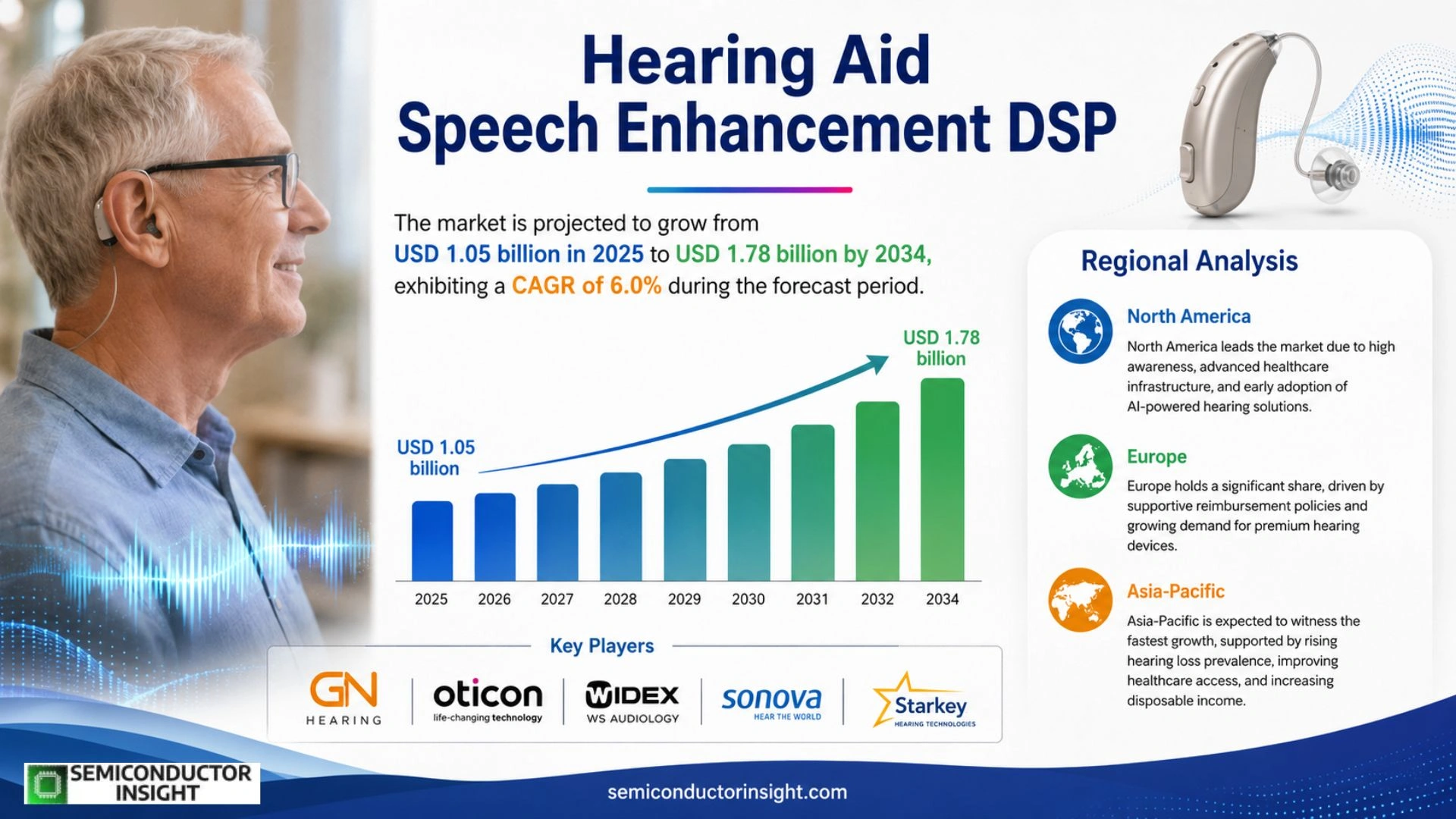
Global AI Hearing Aid Speech Enhancement DSP market size is projected to grow from USD 1.05 billion in 2025 to USD 1.78 billion by 2034, exhibiting a CAGR of 6.0% during the forecast period.
AI Hearing Aid Speech Enhancement DSPs are advanced digital signal processing solutions that leverage machine‑learning algorithms to isolate and amplify speech while suppressing background noise, reverberation and competing voices. These platforms integrate deep‑neural‑network models for acoustic scene analysis, adaptive beamforming and real‑time speech separation directly within the hearing‑aid hardware.
The market is experiencing rapid growth due to several factors, including the rising prevalence of age‑related hearing loss worldwide, increasing consumer demand for seamless connectivity with smartphones and wearables, and breakthroughs in low‑power AI chips that enable on‑device processing. Furthermore, regulatory incentives for accessibility technologies and strategic collaborations,such as Starkey’s partnership with Google announced in March 2023 to embed Voice AI into its hearing devices,are accelerating adoption. Leading players such as GN Hearing, Oticon (Demant), Widex (WS Audiology) and Sonova continue to expand their portfolios through firmware upgrades and cloud‑based analytics services.
MARKET DRIVERS
Advancements in AI Algorithms
AI Hearing Aid Speech Enhancement DSP Market is being propelled by rapid improvements in deep‑learning models that can isolate speech from complex acoustic backgrounds. Modern convolutional and transformer‑based networks deliver real‑time processing with sub‑millisecond latency, allowing users to experience clearer conversation in noisy environments.
Growing Elderly Population
Demographic trends indicate that the proportion of adults aged 65+ is set to exceed 20 % of the global population within the next decade. This shift creates a sizable, health‑conscious consumer base that increasingly seeks hearing solutions equipped with intelligent speech‑enhancement capabilities.
➤ “Intelligent DSPs that adapt to the user’s acoustic environment are becoming the default expectation for premium hearing aids.”
Manufacturers are also leveraging scalable cloud‑based training pipelines, which reduce time‑to‑market for new algorithms. The combined effect of technology maturation and expanding demand positions AI Hearing Aid Speech Enhancement DSP Market for sustained growth.
MARKET CHALLENGES
Regulatory and Certification Hurdles
Medical‑device regulations in major economies require extensive clinical validation and compliance with safety standards. These processes can add 12‑18 months to product launch timelines and increase R&D expenditures, especially for startups lacking established regulatory expertise.
Other Challenges
Cost Sensitivity
Even though AI‑enabled DSPs improve performance, the added silicon and software expenses translate into higher retail prices. Price‑conscious consumers in emerging markets may defer adoption until economies of scale drive costs down.
MARKET RESTRAINTS
High Component Costs
State‑of‑the‑art DSP chips, low‑power neural accelerators, and high‑fidelity microphones command premium prices. Limited supplier options further compress margins, making it challenging for manufacturers to balance performance with affordability.
MARKET OPPORTUNITIES
Integration with Wireless Ecosystems
Emerging standards for Bluetooth Low Energy and 5 G connectivity enable hearing aids to stream directly from smartphones, televisions, and public address systems. Seamless integration creates cross‑selling opportunities for OEMs and opens new revenue streams through subscription‑based speech‑enhancement services, further expanding AI Hearing Aid Speech Enhancement DSP Market.
AI Hearing Aid Speech Enhancement DSP Market Trends
Integration of On‑Device AI for Real‑Time Speech Enhancement
AI Hearing Aid Speech Enhancement DSP Market is increasingly defined by the migration of sophisticated speech‑processing algorithms from cloud servers to the hearing‑aid chipset itself. By embedding deep‑neural‑network models within low‑power DSP cores, manufacturers can separate speech from background noise, suppress reverberation, and adjust gain dynamically,all within milliseconds of audio capture. This on‑device approach eliminates the latency and connectivity risks associated with remote processing, aligning with consumer expectations for instant, reliable performance. At the same time, advances in silicon efficiency allow these AI functions to run on power budgets compatible with daily‑use hearing aids, preserving battery longevity while delivering a clear, natural listening experience across diverse acoustic environments.
Other Trends
Advances in Low‑Power AI Chipsets
Recent generations of AI‑optimized DSP chips consume less than one milliwatt while supporting quantized neural‑network inference with accuracy comparable to full‑precision models. The integration of adaptive beamforming and acoustic‑scene classification on a single die enables devices to focus on the target speaker and suppress competing voices without external microphones. Manufacturers are also moving toward heterogeneous packaging that co‑locates the DSP, microcontroller, and Bluetooth radio, reducing board space and improving thermal management. These hardware improvements are complemented by firmware updates that refine model parameters based on real‑world usage data, delivering incremental performance gains without requiring hardware replacement.
Strategic Partnerships and Ecosystem Expansion
Strategic collaborations between hearing‑aid OEMs and major technology platforms are reshaping AI Hearing Aid Speech Enhancement DSP Market landscape. By embedding voice‑assistant capabilities and cloud‑based analytics directly into hearing‑aid firmware, partners create a seamless bridge between the user’s auditory experience and broader digital services such as messaging, navigation, and health monitoring. Standardized APIs foster a thriving ecosystem of third‑party applications, encouraging innovation in personalized sound profiles and remote tuning. These alliances also support regulatory initiatives that promote accessibility, reinforcing market momentum and expanding the user base for AI‑driven hearing solutions.
COMPETITIVE LANDSCAPE
Key Industry Players
AI Hearing Aid Speech Enhancement DSP Market – Competitive Overview
AI‑driven speech enhancement DSP segment is dominated by a handful of legacy hearing‑aid manufacturers that have escalated their research and development investments to embed deep‑learning models directly into device hardware. GN Hearing leads the space with its ReSound and Beltone families, leveraging proprietary low‑power AI chips that execute real‑time beamforming and noise suppression. Oticon, part of Demant, differentiates through its “Brain‑Hearing” platform, which couples cloud analytics with on‑device inference to improve speech intelligibility in complex acoustic scenes. Widex, under WS Audiology, emphasizes adaptive neural‑network calibration that continuously learns user preferences, while Sonova’s portfolio,including Phonak and Signia,offers modular DSP firmware upgrades that allow manufacturers to roll out AI features without hardware redesign. These incumbents benefit from extensive distribution channels, established reimbursement pathways, and long‑standing relationships with audiologists, creating high entry barriers for newcomers.
Beyond the four market leaders, several specialized firms and emerging players are shaping niche segments of the AI hearing‑aid DSP landscape. Starkey has partnered with Google to integrate Voice AI, positioning its devices for seamless smartphone interaction. Cochlear, traditionally a cochlear‑implant supplier, is expanding into hybrid hearing‑aid solutions that combine implantable and AI‑enhanced DSP technologies. Smaller innovators such as Nuheara and Audifon focus on consumer‑grade personal sound amplifiers that incorporate lightweight AI models for speech‑in‑noise scenarios. ReSound, while part of GN, maintains a distinct brand identity that targets premium audiology clinics. Additional companies like Beltone, Signia, and newer entrants such as Nuheara provide diversified product lines that cater to specific demographic or functional requirements, ensuring a competitive yet fragmented market environment.
List of Key AI Hearing Aid Speech Enhancement DSP Companies Profiled
- GN Hearing
- Oticon (Demant)
- Widex (WS Audiology)
- Sonova
- Starkey
- Cochlear
- Phonak
- Signia
- Beltone
- ReSound
- Nuheara
- Audifon
- WS Audiology
- Eargo
- Unitron
Segment Analysis:
| Segment Category | Sub-Segments | Key Insights |
| By Type |
|
Neural Network DSP
|
| By Application |
|
Conversational Speech Enhancement
|
| By End User |
|
Elderly Individuals
|
| By Connectivity |
|
Bluetooth Low Energy (BLE)
|
| By Regulatory Influence |
|
Accessibility Incentive Programs
|
Regional Analysis: AI Hearing Aid Speech Enhancement DSP Market
Established audiology brands and emerging silicon innovators are intensifying collaborations, sharing algorithmic expertise to accelerate time‑to‑market for next‑generation hearing aids.
The FDA’s digital health pilot program and Canada’s streamlined device approval process create a supportive environment for AI‑enabled hearing solutions, reducing time-consuming compliance hurdles.
Emerging opportunities include integration of cloud‑based analytics for real‑time auditory monitoring and the development of modular DSP platforms that can serve multiple device categories.
Europe
European markets exhibit strong enthusiasm for AI‑enhanced hearing aids, especially in Germany, France, and the United Kingdom, where public health systems prioritize auditory rehabilitation. Collaborative research initiatives funded by the EU foster algorithmic innovation, while stringent data‑privacy rules shape the design of on‑device processing, limiting reliance on cloud services. Manufacturers are adapting to regional reimbursement schemes that reward clinically proven speech‑enhancement outcomes, prompting a shift toward evidence‑based product claims. Cross‑border supply chains and a dense network of audiology clinics enable rapid diffusion of new DSP technologies across the continent.
Asia‑Pacific
The Asia‑Pacific region is transitioning from price‑sensitive adoption to value‑driven demand as rising disposable incomes and growing awareness of hearing health reshape consumer expectations. Markets such as Japan, South Korea, and Australia lead in integrating AI‑based speech enhancement within premium hearing devices. Local manufacturers are investing in homegrown AI talent to reduce reliance on Western IP, while governments in China and India are beginning to recognize hearing aid reimbursement, which could unlock sizable market potential in the near term.
South America
South American countries, notably Brazil and Argentina, are witnessing incremental growth driven by expanding geriatric populations and increasing urbanization. Although price remains a critical factor, the introduction of cost‑effective AI DSP modules is lowering entry barriers. Partnerships between multinational firms and regional distributors help navigate fragmented regulatory environments, while tele‑audiology programs are beginning to introduce advanced speech‑enhancement features to underserved communities.
Middle East & Africa
In the Middle East and Africa, market development is uneven but marked by pockets of rapid adoption, particularly in the Gulf Cooperation Council states where high‑income consumers seek premium hearing solutions. African markets are still nascent, with limited insurance coverage; however, NGOs and public health campaigns are raising awareness of hearing loss, creating a foundation for future AI‑driven DSP uptake as affordability improves.
Report Scope
This market research report provides a comprehensive analysis of the AI Hearing Aid Speech Enhancement DSP Market , covering the forecast period 2026–2034. It offers detailed insights into market dynamics, technological advancements, competitive landscape, and key trends shaping the industry.
Key focus areas of the report include:
- Market Overview: The report begins with an overview outlining its current market scenario, key growth indicators, and industry transformation drivers. It discusses macroeconomic factors, demand–supply balance, regulatory landscape, and the strategic role of semiconductors in powering advancements across industries such as automotive, telecommunications, consumer electronics, and industrial automation.
- Market Size & Forecast: Historical data and future projections for revenue, unit shipments, and market value across major regions and segments.
- Segmentation Analysis: Detailed breakdown by product type, technology, application, and end-user industry to identify high-growth segments and investment opportunities.
- Regional Insights: Insights into market performance across North America, Europe, Asia-Pacific, Latin America, and the Middle East & Africa, including country-level analysis where relevant.
- Competitive Landscape: Profiles of leading market participants, including their product offerings, R&D focus, manufacturing capacity, pricing strategies, and recent developments such as mergers, acquisitions, and partnerships.
- Technology Trends & Innovation: Assessment of emerging technologies, integration of AI/IoT, semiconductor design trends, fabrication techniques, and evolving industry standards.
- Market Drivers & Restraints: Evaluation of factors driving market growth along with challenges, supply chain constraints, regulatory issues, and market-entry barriers.
- Stakeholder Insights: Insights for component suppliers, OEMs, system integrators, investors, and policymakers regarding the evolving ecosystem and strategic opportunities.
Primary and secondary research methods are employed, including interviews with industry experts, data from verified sources, and real-time market intelligence to ensure the accuracy and reliability of the insights presented.
FREQUENTLY ASKED QUESTIONS:
What is the current market size of AI Hearing Aid Speech Enhancement DSP Market?
-> AI Hearing Aid Speech Enhancement DSP Market was valued at USD 1.05 billion in 2025 and is expected to reach USD 1.78 billion by 2034, exhibiting a CAGR of 6.0% during the forecast period.
Which key companies operate in AI Hearing Aid Speech Enhancement DSP Market?
-> Key players include GN Hearing, Oticon (Demant), Widex (WS Audiology) and Sonova, among others.
What are the key growth drivers?
-> Key growth drivers include rising prevalence of age‑related hearing loss, increasing consumer demand for seamless connectivity with smartphones and wearables, breakthroughs in low‑power AI chips enabling on‑device processing, and regulatory incentives for accessibility technologies.
Which region dominates the market?
-> North America and Europe are the primary markets, with strong adoption in both regions, while Asia‑Pacific shows rapid growth potential.
What are the emerging trends?
-> Emerging trends include integration of voice AI platforms, cloud‑based analytics services, on‑device deep‑neural‑network processing, and strategic collaborations between hearing‑aid manufacturers and technology firms.
Get Sample Report PDF for Exclusive Insights
Report Sample Includes
- Table of Contents
- List of Tables & Figures
- Charts, Research Methodology, and more...
 Download Sample Report PDF