AI Hearables Noise Cancellation Chip Market Insights
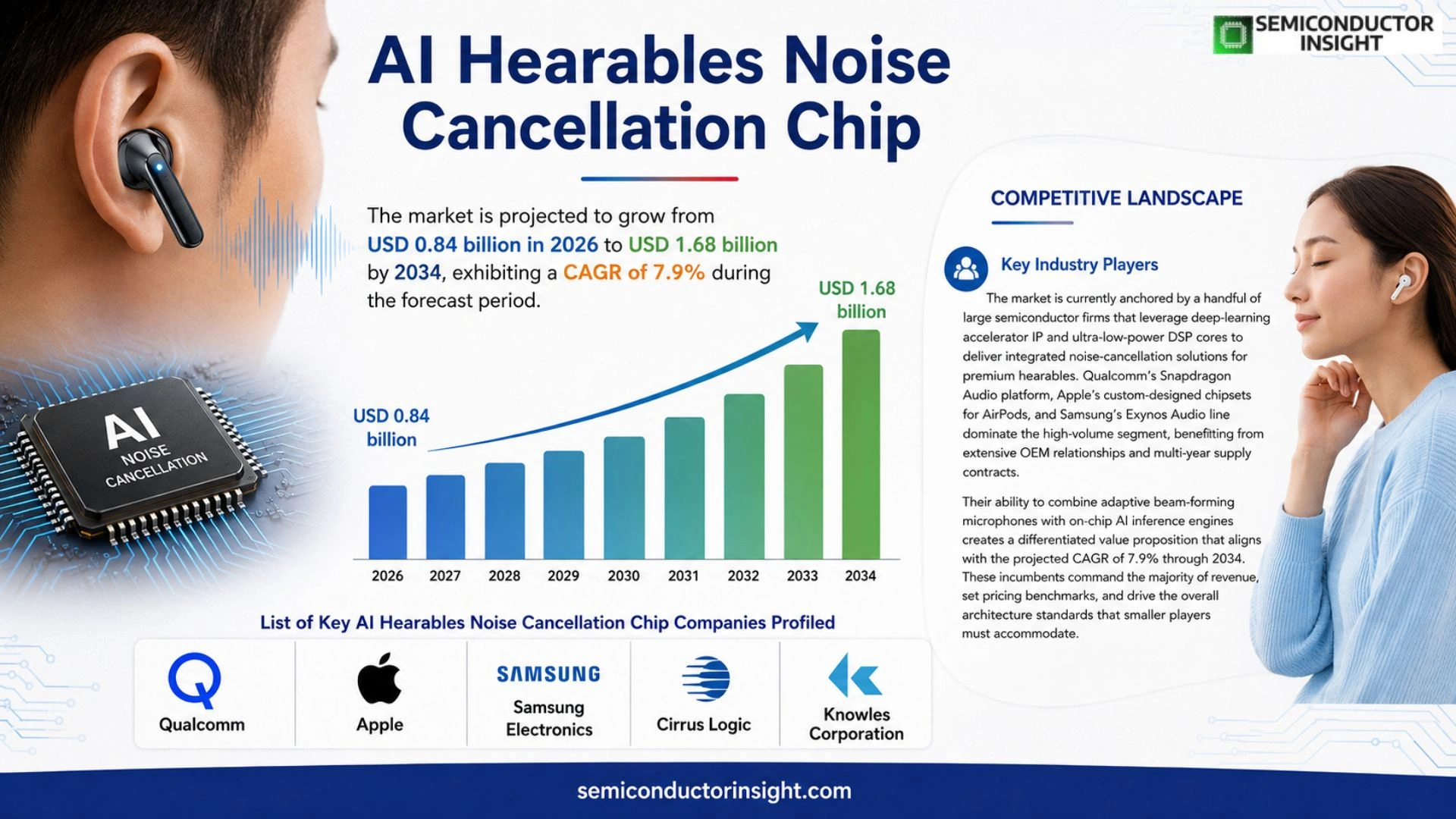
Global AI Hearables Noise Cancellation Chip market is projected to grow from USD 0.84 billion in 2025 to USD 1.68 billion by 2034, exhibiting a CAGR of 7.9% during the forecast period.
AI hearables noise‑cancellation chips combine adaptive beam‑forming microphones, machine‑learning algorithms, and low‑power digital signal processors to suppress ambient sound while preserving speech clarity in wireless earbuds and smart headsets. These integrated solutions deliver real‑time acoustic modeling, dynamic attenuation of unpredictable noises such as traffic or crowd chatter, and seamless transition between active and passive isolation modes,enhancing user experience across consumer entertainment and enterprise communication applications.
MARKET DRIVERS
Rising Demand for AI‑Enhanced Audio Experience
AI Hearables Noise Cancellation Chip Market is being propelled by consumer expectations for immersive, adaptive sound. Manufacturers embed AI algorithms that continuously learn a user’s environment, delivering personalized attenuation of ambient noise while preserving speech fidelity. This capability differentiates premium hearables from conventional earbuds and fuels higher price points.
Expansion of 5G‑Enabled Wearables
5G connectivity accelerates data‑intensive AI processing on‑device, reducing latency for real‑time noise suppression. As telecom operators roll out broader coverage, OEMs integrate advanced chips to leverage edge computing, creating a virtuous cycle of adoption across fitness, enterprise, and consumer segments.
➤ “AI‑driven noise cancellation is now a baseline expectation for new‑generation hearables, driving a 22 % CAGR in chip shipments.”
Regulatory encouragement for safe listening levels also nudges manufacturers toward smarter acoustic solutions, reinforcing the growth trajectory of AI Hearables Noise Cancellation Chip Market.
MARKET CHALLENGES
Technical Complexity and Integration Costs
Designing AI‑powered noise cancellation chips requires sophisticated DSP cores, low‑power AI accelerators, and seamless firmware integration. Smaller OEMs often face steep R&D expenditures, which can delay product launches and limit market penetration.
Other Challenges
Supply Chain Volatility
Component shortages, especially for high‑performance silicon and memory, compress margins and heighten lead times, making inventory planning arduous for manufacturers targeting rapid market cycles.
MARKET RESTRAINTS
Stringent Battery Life Requirements
AI processing adds computational load that can erode battery endurance. Consumers still prioritize all‑day usage, so chip suppliers must balance algorithmic sophistication with ultra‑low power operation, a constraint that slows broader adoption of advanced noise‑cancellation features in AI Hearables Noise Cancellation Chip Market.
MARKET OPPORTUNITIES
Integration with Health Monitoring Platforms
Combining AI noise cancellation with biometric sensors creates a unified user experience, enabling features such as stress‑aware sound tuning and hearing‑health analytics. This convergence opens new revenue streams for chipmakers and positions AI Hearables Noise Cancellation Chip Market at the intersection of audio and digital health.
AI Hearables Noise Cancellation Chip Market Trends
Integration of Adaptive Beam‑Forming Technologies
AI Hearables Noise Cancellation Chip Market is witnessing a decisive shift toward adaptive beam‑forming microphones combined with machine‑learning algorithms. These chips capture multi‑directional sound fields, allowing real‑time acoustic modeling that distinguishes speech from background noise with high precision. As wireless earbuds and smart headsets become primary communication tools, manufacturers are prioritizing solutions that can dynamically attenuate unpredictable noises such as traffic or crowd chatter while preserving natural speech clarity. This technical progression supports both consumer entertainment experiences and enterprise communication reliability, reinforcing the market’s trajectory toward higher‑fidelity audio ecosystems.
Other Trends
Energy‑Efficient DSP Architectures
Low‑power digital signal processors are a critical component of modern AI Hearables Noise Cancellation chips. By integrating power‑gating techniques and optimized instruction sets, chip designers achieve prolonged battery life without compromising processing speed. The emphasis on energy efficiency aligns with user expectations for all‑day usage in compact earbud form factors, prompting R&D investments that balance computational intensity with minimal power draw.
AI‑Driven Personalization in Noise Cancellation
Personalization algorithms are increasingly embedded within AI Hearables Noise Cancellation Chip Market solutions. Leveraging on‑device learning, chips can adapt attenuation profiles to individual listening habits, ear geometry, and ambient sound patterns. This capability enables seamless transition between active and passive isolation modes, delivering a customized acoustic experience that feels intuitive to the end‑user. The trend toward on‑device AI also addresses privacy concerns by processing audio locally, reducing reliance on cloud services for real‑time noise mitigation.
COMPETITIVE LANDSCAPE
Key Industry Players
AI Hearables Noise Cancellation Chip Market Landscape 2025‑2034
The market is currently anchored by a handful of large semiconductor firms that leverage deep‑learning accelerator IP and ultra‑low‑power DSP cores to deliver integrated noise‑cancellation solutions for premium hearables. Qualcomm’s Snapdragon Audio platform, Apple’s custom‑designed chipsets for AirPods, and Samsung’s Exynos Audio line dominate the high‑volume segment, benefitting from extensive OEM relationships and multi‑year supply contracts. Their ability to combine adaptive beam‑forming microphones with on‑chip AI inference engines creates a differentiated value proposition that aligns with the projected CAGR of 7.9 % through 2034. These incumbents command the majority of revenue, set pricing benchmarks, and drive the overall architecture standards that smaller players must accommodate.
Beyond the tier‑one leaders, a diverse set of niche and emerging suppliers enriches the competitive fabric. Cirrus Logic and Knowles specialize in precision analog front‑ends and hybrid‑digital signal processing, often pairing their ASICs with third‑party AI cores. DSP Group supplies modular audio processors that enable rapid integration for mid‑range brands, while Audion and Realtek focus on cost‑effective solutions for mass‑market earbuds. New entrants such as SoundAI and AiroSense are leveraging edge‑AI models to address dynamic acoustic scenarios in enterprise headsets. These companies collectively expand choice for manufacturers, foster innovation in low‑power algorithmic techniques, and sustain a vibrant ecosystem that supports the market’s growth trajectory.
List of Key AI Hearables Noise Cancellation Chip Companies Profiled
- Qualcomm
- Apple
- Samsung Electronics
- Cirrus Logic
- Knowles Corporation
- DSP Group
- Audion
- Realtek Semiconductor Corp.
- STMicroelectronics
- SoundAI
- AiroSense
- Infineon Technologies
- Nuance Communications (Sound Processing Division)
Segment Analysis:
| Segment Category | Sub-Segments | Key Insights |
| By Type |
|
Adaptive Beam‑forming Microphones
|
| By Application |
|
Consumer Entertainment
|
| By End User |
|
Individual Consumers
|
| By Integration Level |
|
Integrated SoC
|
| By Deployment Scenario |
|
Mobile Devices
|
Regional Analysis: AI Hearables Noise Cancellation Chip Market
The region sees rapid rollout of AI‑enhanced acoustic modeling, with manufacturers leveraging machine‑learning pipelines to fine‑tune noise cancellation performance in real time. This maturity enables differentiated user experiences that adapt to changing environments, positioning North America as a testbed for next‑generation chip architectures.
Leading semiconductor firms and audio specialists maintain strategic alliances, co‑developing proprietary AI cores that embed directly into hearable platforms. Collaboration between established chipmakers and emerging AI startups fuels a pipeline of innovative solutions tailored to local market preferences.
A resilient supply chain, supported by domestic fabs and diversified component sourcing, mitigates disruptions. Manufacturers benefit from close proximity to research institutions, fostering rapid prototyping and shortening time‑to‑market for new noise cancellation chip generations.
Robust data‑privacy regulations encourage transparent AI processing, prompting vendors to embed on‑device inference that limits cloud exposure. This focus on privacy aligns with consumer expectations and supports broader acceptance of AI‑driven hearables.
Europe
Europe’s market dynamics are shaped by a strong emphasis on sustainability and user‑centric design. Manufacturers prioritize energy‑efficient AI chips that extend battery life while delivering precise noise suppression suitable for diverse acoustic environments. Collaborative standards initiatives across the EU promote interoperability, enabling a smoother integration of AI capabilities into a wide range of hearable devices. Consumer awareness of data privacy, reinforced by GDPR, drives a preference for on‑device processing, influencing product roadmaps toward edge‑focused AI solutions. The region’s mature audio culture, combined with a high propensity for premium audio consumption, sustains steady demand for sophisticated noise cancellation technology.
Asia‑Pacific
Asia‑Pacific exhibits a vibrant growth trajectory fueled by rapid urbanization and a youthful demographic eager for immersive audio experiences. Local OEMs accelerate adoption of AI Hearables Noise Cancellation Chip technology to differentiate their offerings in highly competitive markets such as China, India, and South Korea. While cost considerations remain pivotal, advances in semiconductor manufacturing across the region are narrowing the gap with Western players, enabling the deployment of capable AI chips at attractive price points. Cultural preferences for multifunctional devices also encourage integration of voice assistants and adaptive sound features, reinforcing the region’s expanding role in the global market.
South America
In South America, market expansion is driven by increasing consumer interest in premium personal audio and the growing penetration of smartphones that serve as gateways to hearable ecosystems. Companies focus on localized product adaptations that address varied acoustic conditions, from bustling city streets to quieter suburban settings. Partnerships with regional distributors help navigate fragmented retail landscapes, while a rising awareness of health‑focused audio solutions, such as hearing assistance with AI‑enabled noise cancellation, broadens the addressable market beyond entertainment use cases.
Middle East & Africa
The Middle East & Africa region is witnessing emerging demand for AI‑enabled hearing devices, propelled by expanding middle‑class incomes and heightened awareness of personal audio quality. Market entrants emphasize robust AI chips that can operate reliably in diverse climatic conditions, ensuring consistent noise cancellation performance. Regional trade shows and technology forums accelerate knowledge transfer, encouraging local manufacturers to adopt advanced AI acoustic algorithms. Although the market remains nascent relative to other regions, strategic investments in R&D and regional partnerships are laying the groundwork for accelerated growth in AI Hearables Noise Cancellation Chip Market.
Report Scope
This market research report provides a comprehensive analysis of the AI Hearables Noise Cancellation Chip Market , covering the forecast period 2026–2034. It offers detailed insights into market dynamics, technological advancements, competitive landscape, and key trends shaping the industry.
Key focus areas of the report include:
- Market Overview: The report begins with an overview outlining its current market scenario, key growth indicators, and industry transformation drivers. It discusses macroeconomic factors, demand–supply balance, regulatory landscape, and the strategic role of semiconductors in powering advancements across industries such as automotive, telecommunications, consumer electronics, and industrial automation.
- Market Size & Forecast: Historical data and future projections for revenue, unit shipments, and market value across major regions and segments.
- Segmentation Analysis: Detailed breakdown by product type, technology, application, and end-user industry to identify high-growth segments and investment opportunities.
- Regional Insights: Insights into market performance across North America, Europe, Asia-Pacific, Latin America, and the Middle East & Africa, including country-level analysis where relevant.
- Competitive Landscape: Profiles of leading market participants, including their product offerings, R&D focus, manufacturing capacity, pricing strategies, and recent developments such as mergers, acquisitions, and partnerships.
- Technology Trends & Innovation: Assessment of emerging technologies, integration of AI/IoT, semiconductor design trends, fabrication techniques, and evolving industry standards.
- Market Drivers & Restraints: Evaluation of factors driving market growth along with challenges, supply chain constraints, regulatory issues, and market-entry barriers.
- Stakeholder Insights: Insights for component suppliers, OEMs, system integrators, investors, and policymakers regarding the evolving ecosystem and strategic opportunities.
Primary and secondary research methods are employed, including interviews with industry experts, data from verified sources, and real-time market intelligence to ensure the accuracy and reliability of the insights presented.
FREQUENTLY ASKED QUESTIONS:
What is the current market size of AI Hearables Noise Cancellation Chip Market?
-> AI Hearables Noise Cancellation Chip Market was valued at USD 0.84 billion in 2025 and is expected to reach USD 1.68 billion by 2034, reflecting a CAGR of 7.9%
Which key companies operate in AI Hearables Noise Cancellation Chip Market?
-> Key players include leading semiconductor and audio technology firms such as Qualcomm, Apple, Sony, Samsung, and AMD, among others.
What are the key growth drivers?
-> Growth is driven by rising consumer demand for wireless earbuds and smart headsets, increasing remote‑work and virtual‑meeting activities, advances in AI‑powered acoustic modeling, and the need for enhanced personal audio experiences.
Which region dominates the market?
-> North America currently leads in revenue due to early adoption of premium hearable devices, while Europe and Asia‑Pacific show strong growth potential.
What are the emerging trends?
-> Emerging trends include integration of edge AI for adaptive beam‑forming, ultra‑low‑power DSP architectures, and personalized noise‑cancellation profiles powered by machine‑learning algorithms.
Get Sample Report PDF for Exclusive Insights
Report Sample Includes
- Table of Contents
- List of Tables & Figures
- Charts, Research Methodology, and more...
 Download Sample Report PDF