
AI Glasses Pivot Hinge Market Insights
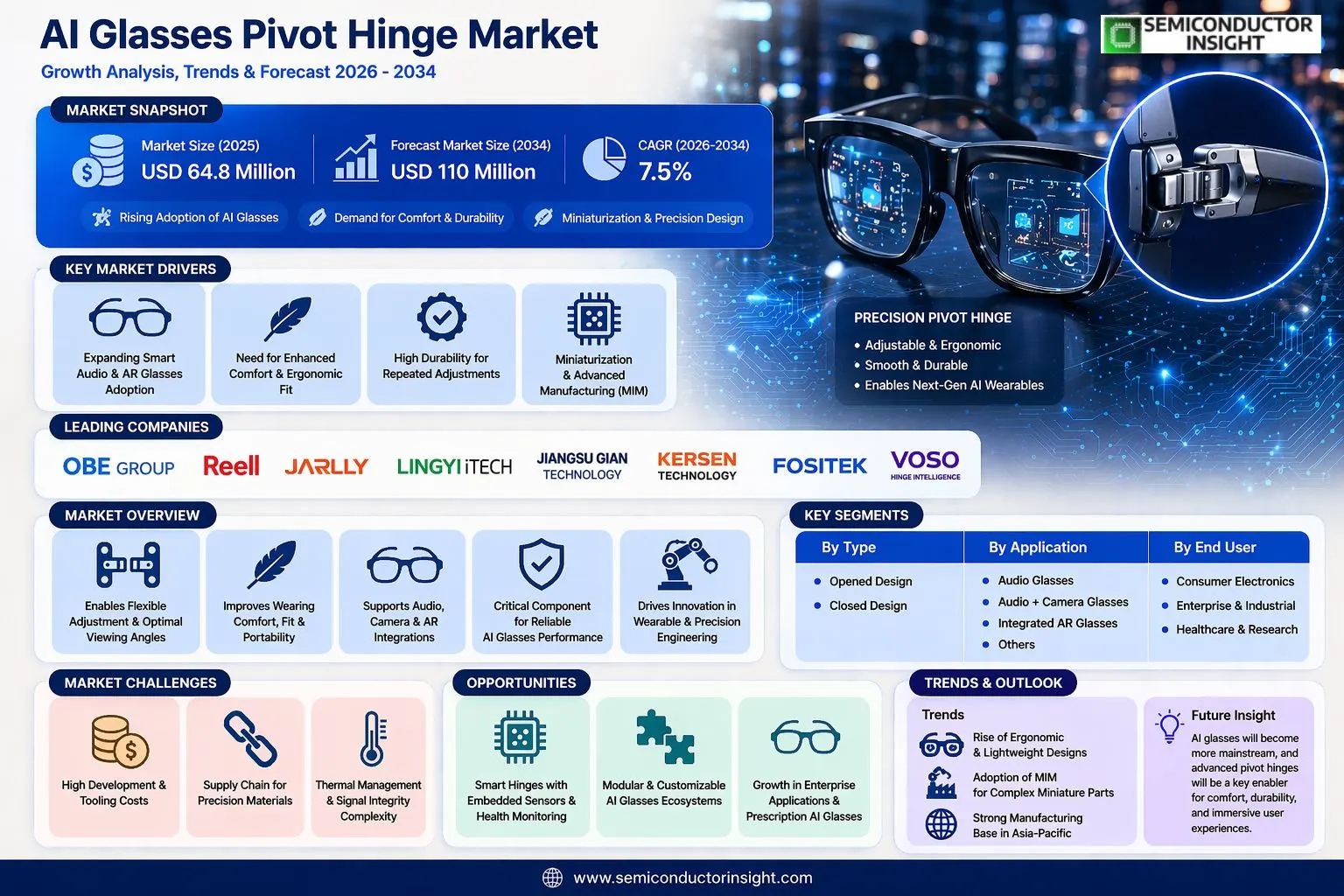
Global AI glasses pivot hinge market size was valued at USD 64.8 million in 2025. The market is projected to grow from USD 69.7 million in 2026 to USD 110 million by 2034, exhibiting a CAGR of 7.5% during the forecast period.
An AI glasses pivot hinge is a critical mechanical component specifically engineered for smart eyewear. This precision mechanism allows the display screen or frame of the glasses to be flexibly adjusted, thereby optimizing wearing comfort, viewing angle adaptability, and portability for the end-user. Its application is crucial as it enables these advanced devices to adapt to different user needs, such as adjusting display angles for augmented reality (AR) overlays or folding for compact storage.
The market is experiencing steady growth driven by several key factors, including the rising adoption of smart audio glasses and the accelerating development of integrated AR glasses by major technology firms. Furthermore, increasing consumer demand for ergonomic and durable wearable designs is pushing manufacturers to invest in high-quality hinge mechanisms. Initiatives by key players are also expected to fuel market expansion. For instance, leading manufacturers like OBE Group and Reell Precision Manufacturing are continuously innovating with compact and robust hinge designs tailored for next-generation wearables. Other significant players operating in this specialized market include LINGYI iTECH, Jiangsu Gian Technology, and Fositek, who provide a wide range of hinge solutions catering to different product segments such as audio-only glasses and full AR systems.
MARKET DRIVERS
The Imperative for Enhanced User Ergonomics and Comfort
The primary driver for the AI Glasses Pivot Hinge Market is the critical need for all-day wearable comfort. High-end smart eyewear integrates numerous components, leading to weight distribution challenges. A sophisticated pivot hinge is essential for achieving a secure, customizable fit that accommodates diverse facial structures and head shapes, directly influencing user adoption rates. Without this mechanical refinement, device fatigue can significantly limit usage time and consumer satisfaction.
Advancements in Compact Form Factor Design
Consumer demand for sleek, non-obtrusive smart glasses is pushing miniaturization. This trend necessitates hinges that offer a wide range of motion and reliable locking positions while occupying minimal internal space. The integration of sensors and micro-displays around the hinge area further complicates design, making the component’s precision a direct bottleneck for overall product aesthetics and functionality. Manufacturers are investing heavily in micro-engineering to overcome this.
➤ The pivot hinge is no longer a simple mechanical joint; it is a critical enabler for the reliable folding and unfolding of devices that house sensitive computing hardware, becoming a focal point for R&D investment exceeding $50 million annually from leading tech firms.
Furthermore, the proliferation of enterprise and industrial applications for AI glasses, such as in logistics and field service, requires hinges with enhanced durability. These hinges must withstand thousands of actuation cycles under variable environmental conditions, creating a distinct market segment focused on robust, industrial-grade hinge mechanisms that ensure long-term device reliability.
MARKET CHALLENGES
Balancing High Performance with Cost Constraints
A central challenge in the AI Glasses Pivot Hinge Market is the engineering trade-off between performance and unit cost. Hinges must exhibit zero plastic deformation over their lifecycle, requiring expensive alloys, advanced coatings for wear resistance, and tight tolerance machining. Achieving this while keeping the component cost-effective for mass-market consumer electronics presents a significant obstacle for manufacturers aiming for competitive retail pricing.
Other Challenges
Supply Chain for Precision Micromechanics
Establishing a resilient supply chain for the specialized materials, such as specific grades of stainless steel and custom miniature springs, required for premium hinges is difficult. Geopolitical factors and raw material price volatility can disrupt production schedules for the entire AI glasses assembly.
Thermal Management and Signal Integrity
As hinges become integrated points for electrical connections between the frame and temples (for audio, power, and data), managing electromagnetic interference and heat dissipation through the hinge mechanism adds layers of complexity to both the electrical and mechanical design protocols, increasing development time.
MARKET RESTRAINTS
High Development and Tooling Costs Limiting New Entrants
The market’s growth is restrained by the substantial upfront investment required for hinge design and manufacturing. The development cycle involves extensive prototyping, fatigue testing, and the creation of high-precision molding or machining tools. This capital intensity creates a high barrier to entry, concentrating expertise and production capacity among a limited number of specialized component suppliers, which can slow overall innovation cycles for new AI glasses models.
A secondary restraint is the current relatively low volume of the overall AI smart glasses market compared to mature consumer electronics. This limits economies of scale for hinge manufacturers, keeping per-unit costs higher than for components used in smartphones or laptops, thereby creating a cyclical constraint on the final product’s market affordability and expansion.
MARKET OPPORTUNITIES
Integration of Smart Hinge Technologies with Health Sensors
A significant opportunity lies in evolving the pivot hinge from a passive component to an active, sensor-integrated module. Advanced hinges could incorporate micro-sensors to monitor fit tension, angle of wear, or even integrate biometric sensors for heart rate or temperature. This transforms the hinge into a data-generating smart component, adding substantial value and creating new intellectual property and revenue streams for AI glasses manufacturers.
The rise of modular and customizable smart eyewear presents another key opportunity. Standardized, yet highly engineered, pivot hinge interfaces could allow consumers to swap temple arms or front frames for style or function, prolonging device life and fostering an ecosystem of accessories. This approach directly addresses electronic waste concerns and builds brand loyalty through upgradability, a trend gaining traction across consumer tech.
Furthermore, the expansion of the market into prescription AI glasses requires hinges that can reliably and securely accommodate prescription lenses, which vary in weight and thickness. Developing universally adaptable and robust hinge solutions for this specific segment opens access to a vastly larger customer base, directly linking the AI Glasses Pivot Hinge Market to the broader vision care industry.
AI Glasses Pivot Hinge Market Trends
Increasing Adoption in Advanced Wearable Form Factors
The pivot hinge is a critical mechanical component in AI glasses, enabling flexible adjustment of the display screen or frame. This functionality directly enhances user comfort, viewing angle adaptability, and device portability. The market for these hinges is being propelled by the innovation and commercialization of advanced wearable form factors, primarily in integrated AR glasses. This segment demands robust and precise hinge solutions to ensure optimal alignment of optical systems and a reliable, comfortable user fit. As AR glasses become more sophisticated and consumer-focused, the requirements for the pivot hinge market become more stringent, driving developments in materials science and precision engineering for this vital component.
Other Trends
Product Segmentation by Design Philosophy
The AI Glasses Pivot Hinge market is defined by distinct product types, chiefly Opened Design and Closed Design hinges. Opened designs allow for a greater range of motion and often enhance heat dissipation around electronic components, a key factor for powerful AI-driven glasses. This segment is growing as developers seek to balance form factor with thermal management. Meanwhile, Closed Design hinges offer a sleek, integrated aesthetic and improved ingress protection against dust and moisture. This segmentation highlights how manufacturers are tailoring hinge solutions to different device architectures and brand positioning strategies within the broader AI glasses ecosystem.
Consolidated Supplier Base with Regional Manufacturing Hubs
Global market for these hinges features a consolidated supplier base with key players such as OBE Group, Reell, Jarlly, LINGYI iTECH, and Fositek exerting significant influence. Geographically, a strong concentration of manufacturing expertise resides in China, with companies like Jiangsu Gian Technology and Kunshan Kersen Science and Technology serving as major production hubs. While North America and Europe are key markets for the final AI glasses products, the pivot hinge’s complex supply chain remains anchored in Asia-Pacific regions renowned for high-volume precision manufacturing. This dynamic underscores the importance of regional supply chain resilience and logistics in the AI Glasses Pivot Hinge Market.
COMPETITIVE LANDSCAPE
Key Industry Players
Market Consolidation and Innovation Drive the Pivot Hinge Niche
The AI glasses pivot hinge market is characterized by a consolidated structure where the top five global players collectively held a significant revenue share in 2025, indicating a high barrier to entry and the dominance of established, technically proficient manufacturers. Leading this segment is OBE Group, a globally recognized expert in high-precision hinges, which commands considerable market influence through its advanced engineering and strategic partnerships with major wearable OEMs. This concentration is driven by the critical technical demands of the component, which requires exceptional durability, micro-size tolerances, and the ability to support thousands of articulation cycles without failure. Competition is intensifying as these players invest heavily in R&D for novel “Opened Design” and “Closed Design” hinge architectures to meet the evolving form factors of audio glasses, camera-integrated models, and full AR systems.
Beyond the top-tier leaders, a diverse group of specialized manufacturers contribute significantly to the market’s competitive depth, often serving specific regional demands or application niches. Companies like Reell (noted for torque-control solutions), Fositek (a major supplier to consumer electronics), and LINGYI iTECH leverage strong supply chain integration and cost-effective manufacturing, particularly within the vital Asia-Pacific region. Furthermore, technically agile firms such as Kunshan Voso Hinge Intelligence Technology and Jiangsu Gian Technology are gaining traction by focusing on intelligent hinge solutions with integrated sensors, catering to the next generation of adaptive AR glasses. This ecosystem ensures a robust supply chain but also pressures margins, compelling continuous innovation in materials science and automated production.
List of Key AI Glasses Pivot Hinge Companies Profiled
- OBE Group
- Reell Precision Manufacturing Corporation
- Jarlly
- LINGYI iTECH (Guangdong) Co., Ltd.
- Jiangsu Gian Technology Co., Ltd.
- Kunshan Kersen Science and Technology Co., Ltd.
- Fositek Corporation
- Kunshan Voso Hinge Intelligence Technology Co., Ltd.
- Dongguan Socen Precision Hardware Co., Ltd.
- Shenzhen Yuanzhao Precision Technology Co., Ltd.
- Suzhou Zhaoxinchi Precision Mold Co., Ltd.
- SHENZHEN HINGESLIM TECHNOLOGY CO., LTD
- ZHUHAI SUNWAVE TECHNOLOGY CO., LTD
- AMPHENOL CORPORATION (via its RF and interconnect divisions)
- ACE HINGES LIMITED
Segment Analysis:
| Segment Category | Sub-Segments | Key Insights |
| By Type |
|
Opened Design is the predominant choice in the market, driven by its superior functionality for advanced AI glasses. This design facilitates easier user interaction and maintenance, allowing for quick access to internal components which is critical for devices integrating complex electronics and cameras. Furthermore, the opened architecture supports better heat dissipation, a key consideration for power-intensive augmented reality applications, and offers manufacturers greater flexibility in modular design and future upgrades, aligning with the rapid innovation cycle in wearable technology. |
| By Application |
|
Integrated AR Glasses represent the most demanding and high-growth application segment, creating specific requirements for pivot hinge technology. The hinges for these devices must support precise and stable alignment of waveguides and displays to ensure a consistent augmented reality overlay, making durability and micron-level precision non-negotiable. This segment drives innovation in materials and miniaturization, as hinges must withstand frequent adjustments while remaining unobtrusive and comfortable for all-day wear, directly impacting the overall user experience and adoption of AR technology. |
| By End User |
|
Consumer Electronics is the primary driver for volume and design trends in the AI glasses hinge market. Demand hinges on aesthetics, lightweight construction, and cost-effective manufacturing to cater to a mass-market audience. Hinge designs for this segment prioritize a sleek, fashionable profile to enhance product appeal, while simultaneously ensuring robust functionality for daily use. The rapid iteration of consumer tech products also pressures hinge suppliers to provide highly reliable components that support fast assembly lines and minimize returns due to mechanical failure. |
| By Manufacturing Complexity |
|
Precision-Engineered Hinges are becoming the industry standard, especially for AR/VR applications. This segment demands advanced manufacturing techniques, such as micro-machining and specialized surface treatments, to achieve the necessary tolerances, smooth torque control, and long cycle life. The complexity creates a significant barrier to entry, consolidating the market around established manufacturers like OBE Group and Reell, who possess the requisite engineering expertise and quality control processes to meet the stringent reliability standards of top-tier AI glasses brands. |
| By Integration Level |
|
Hinges with Integrated Electronics represent a critical and growing frontier, moving the component from a passive part to an active system enabler. This integration allows the hinge to manage wiring for displays and cameras internally, improving durability and aesthetics by eliminating external cables. The development towards Smart Hinges is particularly significant, as embedding sensors can enable features like automatic display activation upon unfolding or adjusting software parameters based on the hinge angle, thereby enhancing intuitive user interaction and creating new product differentiation opportunities for OEMs. |
Regional Analysis: Global AI Glasses Pivot Hinge Market
North America
The dense cluster of tech firms in Silicon Valley and other innovation hubs creates a continuous feedback loop. Hinge manufacturers are deeply integrated into R&D cycles, co-developing prototypes that address specific challenges like weight distribution and heat dissipation from onboard AI processors.
The proliferation of AI glasses in logistics and manufacturing sets demanding performance benchmarks. Pivot hinges for these applications are engineered for extreme durability, thousands of daily adjustments, and stability to ensure augmented reality overlays remain perfectly aligned.
Proximity to advanced materials suppliers and precision machining centers allows for rapid prototyping and small-batch production of complex hinge mechanisms. This agility is crucial for the fast-paced evolution of AI glasses form factors and functionalities.
Market success is heavily dependent on comfort and intuitive use. Hinge designs from this region emphasize a premium feel, smooth adjustment with precise resistance, and silent operation, which are critical for consumer and professional acceptance of AI glasses.
Europe
Europe presents a sophisticated and steadily growing segment for the AI glasses pivot hinge market, characterized by high regulatory standards and a strong industrial base. The region’s emphasis on product longevity, safety, and precision engineering aligns perfectly with the demands for high-quality hinges. Germany, Switzerland, and Italy, with their heritage in precision mechanics and micro-engineering, are becoming important centers for developing and manufacturing advanced hinge components that meet strict EU directives on electronic waste and product durability. The growth of AI glass applications in European automotive design, advanced manufacturing, and healthcare diagnostics is creating specialized demand. Hinges for these markets must not only be reliable but also integrate seamlessly with devices that often adhere to specific aesthetic and ergonomic standards prized by European enterprises and consumers.
Asia-Pacific
The Asia-Pacific region is the fastest-evolving and most competitive arena for the AI glasses pivot hinge market, functioning as Global manufacturing epicenter. Nations like China, South Korea, and Taiwan dominate the mass production of consumer electronics, creating immense scale and cost-efficiency for hinge components. This region excels in rapidly iterating on designs and scaling production to meet the volatile demands of Global AI glasses supply chain. A significant portion of hinges for mid-range and entry-level AI glasses are sourced here. Furthermore, burgeoning local markets, especially in China and Southeast Asia, are seeing increased adoption of AR/VR technologies, driving domestic innovation. The competitive landscape pushes manufacturers to balance cost, speed, and functionality, making the region crucial for defining price-performance benchmarks in the pivot hinge market.
South America
The market for AI glasses pivot hinges in South America is in a nascent but promising stage of development, primarily driven by early adoption in specific industrial and commercial sectors. Countries like Brazil and Argentina are witnessing pilot deployments and increasing interest in AI glasses for mining, agriculture, and technical training applications. This creates a foundational, though currently niche, demand for durable hinges suited to harsh environmental conditions. The market dynamics are influenced by economic factors, import dependencies for high-tech components, and a growing local tech startup scene focused on practical solutions. While not a primary innovation hub, the region’s unique applications provide valuable use-case diversity that informs hinge requirements for ruggedness and simplicity in emerging markets.
Middle East & Africa
The Middle East & Africa region represents an emerging frontier with distinct drivers for the AI glasses pivot hinge market. In the Gulf Cooperation Council (GCC) nations, substantial investments in smart city initiatives, tourism, and oil & gas operations are creating targeted demand for high-end enterprise AI glasses. The hinges for these devices must accommodate designs suitable for use in high-temperature environments and cultural attire. In parts of Africa, pilot projects in healthcare delivery, education, and infrastructure maintenance are exploring the utility of wearable AR. The regional market is characterized by a split between premium, imported solutions for high-value projects in wealthier nations and a growing interest in affordable, durable options for social impact applications, shaping a diverse set of requirements for hinge durability and adaptability.
Report Scope
This market research report provides a comprehensive analysis of the AI Glasses Pivot Hinge Market , covering the forecast period 2026–2034. It offers detailed insights into market dynamics, technological advancements, competitive landscape, and key trends shaping the industry.
Key focus areas of the report include:
- Market Overview: The report begins with an overview outlining its current market scenario, key growth indicators, and industry transformation drivers. It discusses macroeconomic factors, demand–supply balance, regulatory landscape, and the strategic role of semiconductors in powering advancements across industries such as automotive, telecommunications, consumer electronics, and industrial automation.
- Market Size & Forecast: Historical data and future projections for revenue, unit shipments, and market value across major regions and segments.
- Segmentation Analysis: Detailed breakdown by product type, technology, application, and end-user industry to identify high-growth segments and investment opportunities.
- Regional Insights: Insights into market performance across North America, Europe, Asia-Pacific, Latin America, and the Middle East & Africa, including country-level analysis where relevant.
- Competitive Landscape: Profiles of leading market participants, including their product offerings, R&D focus, manufacturing capacity, pricing strategies, and recent developments such as mergers, acquisitions, and partnerships.
- Technology Trends & Innovation: Assessment of emerging technologies, integration of AI/IoT, semiconductor design trends, fabrication techniques, and evolving industry standards.
- Market Drivers & Restraints: Evaluation of factors driving market growth along with challenges, supply chain constraints, regulatory issues, and market-entry barriers.
- Stakeholder Insights: Insights for component suppliers, OEMs, system integrators, investors, and policymakers regarding the evolving ecosystem and strategic opportunities.
Primary and secondary research methods are employed, including interviews with industry experts, data from verified sources, and real-time market intelligence to ensure the accuracy and reliability of the insights presented.
FREQUENTLY ASKED QUESTIONS:
What is the current market size of AI Glasses Pivot Hinge Market?
-> Global AI Glasses Pivot Hinge Market was valued at USD 64.8 million in 2025 and is projected to reach USD 110 million by 2034, growing at a CAGR of 7.5% during the forecast period.
Which key companies operate in AI Glasses Pivot Hinge Market?
-> Key players include OBE Group, Reell, Jarlly, LINGYI iTECH, Jiangsu Gian Technology, Kunshan Kersen Science and Technology, Fositek, Kunshan Voso Hinge Intelligence Technology, Dongguan Socen, Shenzhen Yuanzhao, among others.
What are the key growth drivers?
-> Key growth drivers include the critical function of hinges to improve wearing comfort, viewing angle adaptability, and portability of AI glasses, allowing them to adapt to different user needs such as adjusting display angles, folding, or storing.
Which region dominates the market?
-> The market is analyzed across key regions including North America, Europe, Asia, South America, and the Middle East & Africa. The U.S. and China are significant country-level markets.
What are the emerging trends?
-> Emerging trends and report analysis cover market dynamics, latest developments, driving and restrictive factors, challenges, risks, and relevant industry policies for AI Glasses Pivot Hinge manufacturers and stakeholders.

Get Sample Report PDF for Exclusive Insights
Report Sample Includes
- Table of Contents
- List of Tables & Figures
- Charts, Research Methodology, and more...
 Download Sample Report PDF





