AI FOUP RFID Tracking Anomaly Detection Edge Processor Market Insights
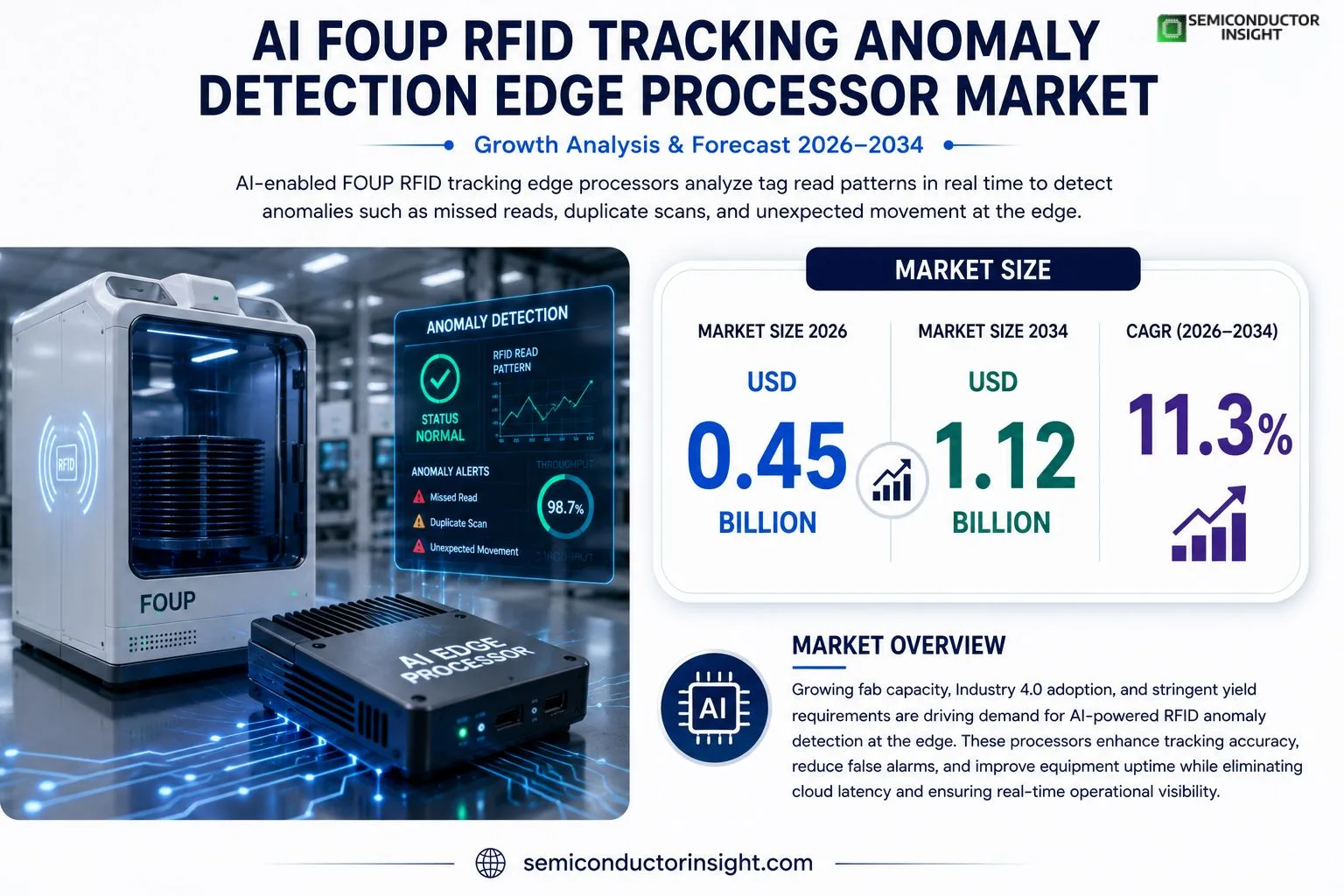
AI FOUP RFID Tracking Anomaly Detection Edge Processor market size was valued at USD 0.42 billion in 2025. The market is projected to grow from USD 0.45 billion in 2026 to USD 1.12 billion by 2034, exhibiting a CAGR of 11.3% during the forecast period.
AI‑enabled Front‑Opening Unified Pods (FOUP) RFID tracking anomaly detection edge processors combine radio‑frequency identification sensors with on‑device artificial‑intelligence algorithms to monitor semiconductor wafer carriers in real time. These edge processors analyze tag read patterns locally, flagging deviations such as missed reads, duplicate scans, or unexpected movement, thereby reducing false alarms and improving equipment uptime without relying on cloud latency.The market is accelerating because semiconductor fabs are expanding capacity, driving demand for higher‑throughput logistics monitoring. Moreover, rising adoption of Industry 4.0 standards and tighter yield requirements push manufacturers toward intelligent edge solutions. However, cost sensitivity remains a challenge for smaller fabs, while ongoing collaborationssuch as Intel’s partnership with Impinj announced in March 2024are expected to broaden ecosystem support. Key players including IBM, NXP Semiconductors, and STMicroelectronics are actively enhancing their portfolios to capture this growth.
MARKET DRIVERS
Increasing Semiconductor Manufacturing Complexity
The rise of advanced logic devices has heightened the need for precise FOUP (Front‑Opening Unified Pods) handling. Manufacturers are turning to AI‑enabled RFID tracking to ensure real‑time visibility, which reduces contamination risks and improves yield. This trend directly fuels growth in AI FOUP RFID Tracking Anomaly Detection Edge Processor Market.
Demand for Real‑Time Anomaly Detection
Edge processors equipped with AI algorithms can identify deviations in temperature, humidity, or motion within seconds, preventing costly equipment downtime. Companies adopting these solutions report up to a 15% reduction in defect rates, reinforcing the market’s expansion.
➤ “Edge‑based analytics delivers actionable insights at the point of data capture, eliminating latency inherent in cloud‑only models.”
Regulatory pressure for traceability in high‑value semiconductor fabs further accelerates adoption, positioning AI FOUP RFID Tracking Anomaly Detection Edge Processor Market as a critical enabler of compliance and operational excellence.
MARKET CHALLENGES
Integration with Legacy Factory Systems
Many fabs operate on legacy equipment that lacks standard communication interfaces. Retrofitting these systems with AI‑driven RFID solutions requires custom middleware, raising implementation costs and extending project timelines.
Other Challenges
High Initial Capital Expenditure
The upfront investment for edge hardware, AI model development, and system integration can be prohibitive for smaller fabs, slowing market penetration despite clear long‑term ROI.
MARKET RESTRAINTS
Skill Shortage in AI and Edge Computing
Deploying sophisticated AI models on edge processors demands specialized talent. The limited pool of engineers proficient in both semiconductor manufacturing and AI edge architectures creates a bottleneck, restricting rapid adoption across the industry.
MARKET OPPORTUNITIES
Expansion into Emerging Fab Locations
New semiconductor fabs in Southeast Asia and Eastern Europe are building state‑of‑the‑art facilities. These greenfield projects present a prime opportunity to embed AI FOUP RFID tracking and anomaly detection from the ground up, bypassing legacy constraints.
Integration with Predictive Maintenance Platforms
Combining edge‑based RFID analytics with broader predictive maintenance ecosystems can unlock cross‑functional efficiencies, offering a compelling value proposition for OEMs and fab operators seeking holistic digital transformation.
AI FOUP RFID Tracking Anomaly Detection Edge Processor Market Trends
Rising Adoption of Edge AI in FOUP Logistics
AI FOUP RFID Tracking Anomaly Detection Edge Processor Market is being reshaped by the need for instant, on‑site analytics within semiconductor fabs. Manufacturers are replacing legacy cloud‑centric monitoring with edge processors that evaluate tag read patterns in real time, instantly flagging missed reads, duplicate scans, or unexpected movements. This shift reduces latency, cuts false alarms, and sustains equipment uptimekey factors as fabs expand capacity to meet demand for advanced chips.
Other Trends
Integration with Industry 4.0 Standards
Industry 4.0 initiatives are driving a unified data architecture that links FOFO RFID tracking with broader manufacturing execution systems. Edge processors now embed OPC UA and MTConnect interfaces, allowing seamless data exchange with predictive maintenance platforms. As a result, operators gain a holistic view of wafer carrier flow, enabling root‑cause analysis without manual data consolidation. The convergence of edge AI and standardized communications is accelerating the adoption curve across both large and mid‑size fabs.
Strategic Partnerships Driving Ecosystem Expansion
Collaborations between semiconductor leaders and RFID technology firms are expanding the solution pool. Notable alliances, such as the Intel‑Impinj partnership announced in early 2024, have introduced modular edge modules that can be retrofitted onto existing carrier handling equipment. Concurrently, IBM, NXP Semiconductors, and STMicroelectronics are broadening their portfolios with processor variants tailored for low‑power, high‑throughput environments. These joint efforts are creating a more competitive ecosystem, shortening time‑to‑market for new edge AI capabilities and lowering entry barriers for smaller fabs that previously struggled with cost‑sensitivity.Overall, AI FOUP RFID Tracking Anomaly Detection Edge Processor Market is moving toward tighter integration, broader standards compliance, and collaborative innovation. Companies that prioritize scalable edge solutions and align with emerging Industry 4.0 frameworks are positioned to capture the most value as the semiconductor industry continues its rapid expansion.
COMPETITIVE LANDSCAPE
Key Industry Players
AI FOUP RFID Tracking Anomaly Detection Edge Processor Market Competitive Overview
Intel remains the market‑defining leader in the AI‑enabled FOUP RFID tracking and anomaly detection segment. The company’s early collaboration with Impinj, announced in March 2024, created a tightly integrated edge‑processor ecosystem that couples high‑frequency RFID front‑ends with on‑device AI inference. This partnership has secured a de‑facto standard for wafer‑carrier monitoring in large‑scale fabs, giving Intel a pronounced advantage in pricing power and roadmap influence. The firm’s vertically integrated design approachcombining silicon‑level AI accelerators with proprietary firmwareprovides superior latency performance, enabling real‑time detection of missed reads, duplicate scans, and unexpected carrier movement. Consequently, Intel’s solutions are broadly adopted by the world’s top semiconductor manufacturers seeking to meet Industry 4.0 yield targets while minimizing equipment downtime.Beyond Intel, a diverse set of established semiconductor and RFID specialists are shaping the competitive landscape. IBM leverages its AI analytics platform to enrich edge‑processor data with predictive maintenance insights, while NXP Semiconductors focuses on secure, low‑power RFID transceivers that complement AI models for anomaly scoring. STMicroelectronics brings mixed‑signal expertise to integrate sensor front‑ends with neural‑network accelerators, and Texas Instruments offers versatile analog front‑ends that can be paired with third‑party AI cores. Additional participants such as Qualcomm, Broadcom, Samsung Electronics, SK Hynix, Toshiba, Renesas Electronics, Infineon Technologies, Analog Devices, Micron Technology, and Impinj contribute niche innovationsranging from ultra‑wideband tagging to specialized power‑management ICsthat collectively broaden the solution pool and drive incremental adoption across mid‑size fabs.
List of Key AI FOUP RFID Tracking Anomaly Detection Edge Processor Companies Profiled
- Intel
- Intel
- IBM
- NXP Semiconductors
- STMicroelectronics
- Impinj
- Texas Instruments
- Qualcomm
- Broadcom
- Samsung Electronics
- SK Hynix
- Toshiba
- Renesas Electronics
- Infineon Technologies
- Analog Devices
- Micron Technology
Segment Analysis:
| Segment Category | Sub-Segments | Key Insights |
| By Type |
|
Processor with Integrated AI
|
| By Application |
|
Wafer Tracking
|
| By End User |
|
Semiconductor Manufacturers
|
| By Architecture |
|
ARM‑Based Edge Processor
|
| By Deployment Model |
|
On‑Premise Edge Node
|
Regional Analysis: AI FOUP RFID Tracking Anomaly Detection Edge Processor Market
North America
OEMs in the United States are piloting AI‑driven RFID tags coupled with edge processors that analyze temperature and humidity anomalies instantly on the shop floor, shortening response cycles and enabling predictive maintenance.
North American standards mandate end‑to‑end traceability for FOUPs, prompting manufacturers to embed secure AI models that flag deviations, thereby meeting compliance without sacrificing throughput.
Major sensor firms and semiconductor equipment suppliers are forming joint ventures to deliver integrated edge‑processor platforms, leveraging each partner’s expertise in AI inference and RFID hardware.
Venture capital and corporate R&D budgets are increasingly earmarked for AI‑enabled tracking solutions, reflecting confidence in the long‑term value of anomaly detection at the edge.
Europe
European semiconductor fabs are emphasizing sustainability, integrating AI FOUP RFID tracking to monitor energy consumption alongside anomaly detection. Collaborative projects under the EU Horizon program foster cross‑border innovation, focusing on low‑power edge processors that can operate within strict emissions targets. Industry consortia are aligning standards to ensure interoperability across different RFID ecosystems, paving the way for broader market penetration.
Asia‑Pacific
The Asia‑Pacific region, home to several of the world’s largest chip manufacturers, is rapidly scaling AI‑driven tracking to cope with high volumes. Nations such as Taiwan and South Korea prioritize edge‑processor miniaturization, enabling dense placement on FOUPs without compromising performance. The competitive landscape fuels continuous improvement in AI algorithms that detect subtle process drifts, strengthening overall manufacturing resilience.
South America
In South America, emerging semiconductor facilities are adopting AI FOUP RFID solutions to bridge the technology gap with more established markets. Early adopters focus on cost‑effective edge processors that deliver reliable anomaly alerts, improving equipment uptime. Partnerships with North American technology vendors provide knowledge transfer, accelerating local expertise in AI‑enabled process control.
Middle East & Africa
The Middle East & Africa are witnessing nascent interest in advanced FOUP tracking as new fab projects come online. Stakeholders are exploring AI edge processors as a means to achieve high‑precision monitoring despite limited local supply chains. Training programs and joint research initiatives with European partners aim to build in‑region capabilities for sophisticated anomaly detection.
Report Scope
This market research report provides a comprehensive analysis of the AI FOUP RFID Tracking Anomaly Detection Edge Processor Market , covering the forecast period 2026–2034. It offers detailed insights into market dynamics, technological advancements, competitive landscape, and key trends shaping the industry.
Key focus areas of the report include:
- Market Overview: The report begins with an overview outlining its current market scenario, key growth indicators, and industry transformation drivers. It discusses macroeconomic factors, demand–supply balance, regulatory landscape, and the strategic role of semiconductors in powering advancements across industries such as automotive, telecommunications, consumer electronics, and industrial automation.
- Market Size & Forecast: Historical data and future projections for revenue, unit shipments, and market value across major regions and segments.
- Segmentation Analysis: Detailed breakdown by product type, technology, application, and end-user industry to identify high-growth segments and investment opportunities.
- Regional Insights: Insights into market performance across North America, Europe, Asia-Pacific, Latin America, and the Middle East & Africa, including country-level analysis where relevant.
- Competitive Landscape: Profiles of leading market participants, including their product offerings, R&D focus, manufacturing capacity, pricing strategies, and recent developments such as mergers, acquisitions, and partnerships.
- Technology Trends & Innovation: Assessment of emerging technologies, integration of AI/IoT, semiconductor design trends, fabrication techniques, and evolving industry standards.
- Market Drivers & Restraints: Evaluation of factors driving market growth along with challenges, supply chain constraints, regulatory issues, and market-entry barriers.
- Stakeholder Insights: Insights for component suppliers, OEMs, system integrators, investors, and policymakers regarding the evolving ecosystem and strategic opportunities.
Primary and secondary research methods are employed, including interviews with industry experts, data from verified sources, and real-time market intelligence to ensure the accuracy and reliability of the insights presented.
FREQUENTLY ASKED QUESTIONS:
What is the current market size of AI FOUP RFID Tracking Anomaly Detection Edge Processor Market?
-> AI FOUP RFID Tracking Anomaly Detection Edge Processor Market was valued at USD 0.42 billion in 2025 and is expected to reach USD 1.12 billion by 2034.
Which key companies operate in AI FOUP RFID Tracking Anomaly Detection Edge Processor Market?
-> Key players include IBM, NXP Semiconductors, and STMicroelectronics, among others.
What are the key growth drivers?
-> Key growth drivers include expansion of semiconductor fab capacity, adoption of Industry 4.0 standards, and tighter yield requirements that demand higher‑throughput logistics monitoring.
Which region dominates the market?
-> The reference does not specify a dominant region.
What are the emerging trends?
-> Emerging trends include edge‑AI integration with RFID, increased collaborations such as Intel‑Impinj partnership, and broader Industry 4.0 adoption driving smarter wafer‑carrier monitoring.

Get Sample Report PDF for Exclusive Insights
Report Sample Includes
- Table of Contents
- List of Tables & Figures
- Charts, Research Methodology, and more...