AI for Semiconductor Raw Material Quality and Purity Prediction Market Insights
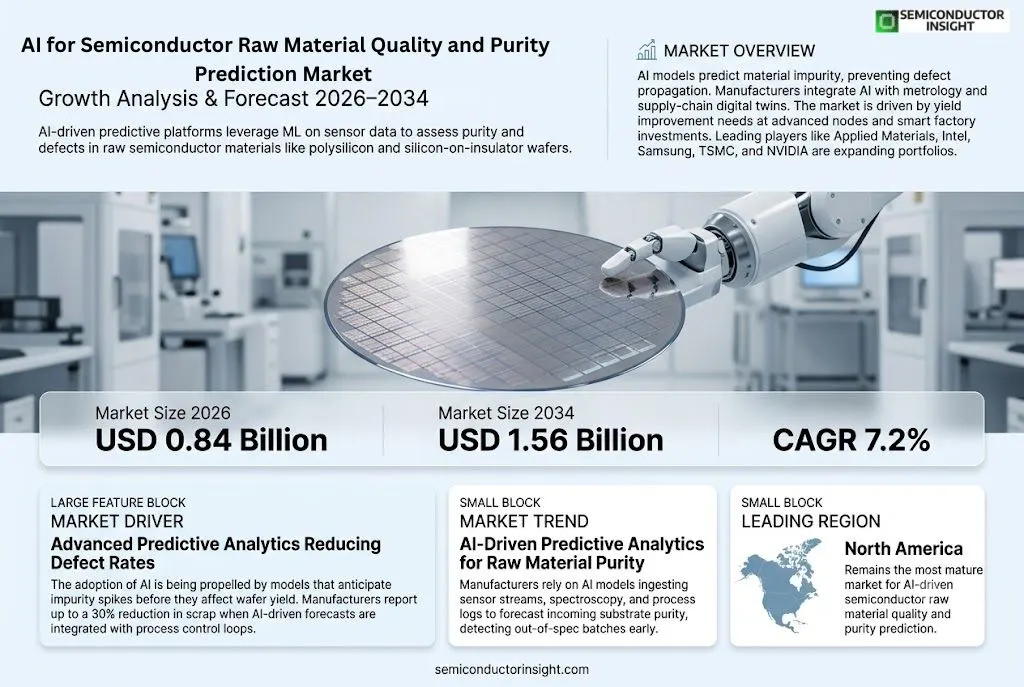
AI for Semiconductor Raw Material Quality and Purity Prediction market size was valued at USD 0.78 billion in 2025. The market is projected to grow from USD 0.84 billion in 2025 to USD 1.56 billion by 2034, exhibiting a CAGR of 7.2% during the forecast period.
AI-driven predictive analytics platforms leverage machine‑learning algorithms on sensor data, spectroscopy outputs and process logs to assess the purity levels and defect probability of raw semiconductor materials such as polysilicon, silicon‑on‑insulator wafers and gallium arsenide substrates. By continuously correlating chemical composition, particle contamination metrics and thermal‑treatment histories, these solutions enable manufacturers to anticipate out‑of‑spec batches before costly downstream processing.The market is accelerating because semiconductor fabs are under pressure to improve yield margins while transitioning to advanced nodes that demand ultra‑high purity inputs. Furthermore, rising capital expenditures on smart factories and the integration of edge‑AI chips into metrology equipment are driving adoption. Leading playersincluding Applied Materials Inc., Intel Corporation, Samsung Electronics Co., TSMC, Lam Research Corp., IBM Research and NVIDIA Corp.are expanding their portfolios through software‑as‑a‑service offerings or strategic alliances with specialty chemical suppliers.
MARKET DRIVERS
Advanced Predictive Analytics Reducing Defect Rates
The adoption of AI for Semiconductor Raw Material Quality and Purity Prediction Market is being propelled by models that anticipate impurity spikes before they affect wafer yield. Manufacturers report up to a 30% reduction in scrap when AI-driven forecasts are integrated with process control loops.
Seamless Integration with MES and IoT Platforms
Modern MES architectures now expose sensor streams that feed directly into AI engines, enabling real‑time purity assessments. This convergence shortens decision cycles and supports continuous improvement initiatives across fabs.
➤ AI models detect 98% of impurity anomalies in real time, cutting investigation time by 45%
Regulatory pressure for higher reliability further reinforces investment, as compliance audits increasingly require data‑driven evidence of material integrity. The combined effect of cost savings, yield improvement, and compliance drives robust growth in AI for Semiconductor Raw Material Quality and Purity Prediction Market.
MARKET CHALLENGES
Data Scarcity and Labeling Complexity
High‑purity material datasets are often limited to a few hundred runs, making it difficult to train deep learning models without over‑fitting. Moreover, accurate labeling of impurity sources demands expert labor, inflating project timelines.
Other Challenges
High Computational Costs
Running convolutional neural networks on terabyte‑scale sensor logs requires specialized GPU clusters, a capital expense that many mid‑size fabs find prohibitive.
MARKET RESTRAINTS
Stringent Validation Protocols
Regulators mandate extensive validation of AI‑based predictions before they can replace traditional analytical methods, extending deployment cycles and discouraging rapid adoption in risk‑averse environments.
MARKET OPPORTUNITIES
Emerging Edge‑AI Solutions for On‑Fabs
Advances in edge‑computing hardware are enabling AI inference directly on production line equipment. This reduces latency, lowers data transfer costs, and opens new revenue streams for vendors offering turnkey purity‑prediction modules tailored to semiconductor fabs.
AI for Semiconductor Raw Material Quality and Purity Prediction Market Trends
AI‑Driven Predictive Analytics for Raw Material Purity
Manufacturers are increasingly relying on AI models that ingest sensor streams, spectroscopy data, and historical process logs to forecast the purity of incoming semiconductor substrates. By mapping chemical composition and particle contamination to defect probability, these platforms enable early detection of out‑of‑spec batches, reducing scrap rates and improving overall equipment effectiveness. The approach aligns with the broader shift toward data‑centric fabs where continuous quality verification is embedded in the production line.Capital spending on smart‑factory initiatives is accelerating the deployment of AI modules that integrate directly with wafer‑fab control systems. As manufacturers move to nodes below 5 nm, the tolerance for impurity‑induced defects narrows dramatically, making real‑time purity assessment a competitive imperative. AI solutions that combine predictive models with automated corrective actions are therefore being piloted in high‑volume fabs to maintain yield targets without sacrificing throughput. Early adopters report average yield improvements of 3‑4% and a measurable decrease in downtime associated with material changeovers.
Other Trends
Edge‑AI Integration in Metrology Equipment
Recent deployments of edge‑AI chips within metrology tools allow real‑time analysis of wafer surface characteristics without routing data to central servers. This local processing speeds up feedback loops, supporting tighter control windows for ultra‑high‑purity materials such as polysilicon and silicon‑on‑insulator wafers. Vendors are collaborating with specialty chemical suppliers to embed predictive models directly into inspection hardware, creating a seamless quality‑assurance workflow.
Strategic Partnerships and SaaS Offerings
Leading equipment manufacturers and semiconductor giants are expanding their AI portfolios through software‑as‑a‑service contracts and joint development agreements. Companies such as Applied Materials, Intel, Samsung, TSMC, Lam Research, IBM Research, and NVIDIA are combining hardware expertise with cloud‑based analytics to deliver scalable purity‑prediction services. These alliances accelerate adoption by lowering entry costs for mid‑size fabs and by providing continuous model updates that reflect evolving process chemistries. Investment in AI‑enabled metrology and material monitoring is reflected in the rising allocation of capital expenditures toward digital twins of the supply chain. By simulating contamination pathways, fabs can pre‑emptively adjust purification steps, shortening cycle time. A notable operational benefit is the reduction of wafer rework, which traditionally accounts for 5‑10% of total manufacturing cost; AI‑driven prediction can cut this figure by half. However, integration challenges persist, including data silos across equipment vendors and the need for standardized data schemas. Addressing these barriers requires collaborative governance frameworks and open‑source model repositories that facilitate cross‑fab learning while protecting intellectual property. Consequently, the market is expected to mature through a combination of technology convergence and regulatory alignment, positioning AI as a core enabler of next‑generation semiconductor quality assurance.
COMPETITIVE LANDSCAPE
Key Industry Players
AI‑Driven Quality Prediction in Semiconductor Raw Materials
AI for Semiconductor Raw Material Quality and Purity Prediction Market is dominated by a handful of vertically integrated technology providers that combine advanced sensor hardware with machine‑learning analytics. Applied Materials Inc. leverages its metrology suite to feed real‑time spectroscopy data into proprietary predictive models, while Intel Corporation embeds edge‑AI processors directly in wafer‑handling equipment to flag out‑of‑spec batches before they enter fab lines. Samsung Electronics Co. and Taiwan Semiconductor Manufacturing Co. (TSMC) have invested heavily in SaaS platforms that aggregate multi‑fab process logs, enabling cross‑site yield optimization. Lam Research Corp. contributes niche expertise in plasma‑based cleaning tools, integrating neural‑network diagnostics that correlate contamination signatures with material purity. Together, these leaders shape a market structure where deep R&D budgets, extensive IP portfolios, and strategic alliances with specialty‑chemical suppliers create high entry barriers for newcomers.Beyond the core conglomerates, a vibrant ecosystem of specialist firms adds depth and innovation to the competitive landscape. KLA Corporation and ASML focus on high‑resolution inspection and lithography metrology, extending AI modules to detect sub‑nanometer defects in raw substrates. Tokyo Electron offers AI‑enhanced furnace controls that predict dopant uniformity. IBM Research and NVIDIA Corp. supply the foundational AI frameworks and GPU acceleration required for large‑scale predictive analytics. Cadence Design Systems and Siemens EDA (formerly Mentor Graphics) provide simulation environments that model material‑process interactions. Hitachi High‑Technologies, BESI and Synopsys round out the field with niche sensor integration and algorithm‑as‑a‑service offerings, creating a competitive tier where differentiation is driven by domain‑specific data sets and the ability to operationalize insights at scale.
List of Key AI for Semiconductor Raw Material Quality and Purity Prediction Companies Profiled
- Applied Materials Inc.
- Intel Corporation
- Samsung Electronics Co.
- TSMC
- Lam Research Corp.
- KLA Corporation
- ASML Holding NV
- Tokyo Electron Ltd.
- IBM Research
- NVIDIA Corp.
- Cadence Design Systems
- Siemens EDA
- Hitachi High‑Technologies Corp.
- BESI
- Synopsys Inc.
Segment Analysis:
| Segment Category | Sub-Segments | Key Insights |
| By Type |
|
Predictive Analytics Platforms dominate this category because they fuse sensor data, spectroscopy outputs and advanced algorithms to anticipate impurity spikes. – Early detection of out‑of‑spec batches enables proactive remediation before downstream loss. – Continuous model refinement isolates root‑cause patterns across production cycles. – Supports tighter control loops essential for ultra‑high‑purity advanced nodes. |
| By Application |
|
Integrated Quality Assurance emerges as the leading application segment. – AI‑driven screening rejects contaminated feedstock before it enters fab lines. – Real‑time monitoring adjusts process parameters to sustain target purity. – Forecasting tools give planners confidence in batch yields, reducing scrap. – Predictive maintenance anticipates sensor drift, preserving data integrity for downstream analytics. |
| By End User |
|
Foundry‑Centric Solutions are the primary driver of adoption. – Predictive purity analytics align with fab throughput goals, enhancing overall yield. – IDMs leverage the technology to safeguard proprietary process windows. – Chemical suppliers use AI insights to refine feedstock formulations and guarantee specifications for downstream customers. |
| By Technology |
|
Edge‑AI Integration leads this segment. – On‑device inference reduces latency for immediate purity alerts. – Cloud platforms aggregate multi‑fab data, enabling cross‑facility learning. – Emerging quantum‑ready analytics promise deeper correlation of complex material signatures, positioning the market for next‑generation predictive capability. |
| By Process Stage |
|
Fabrication‑Stage Analytics is the most impactful. – AI models evaluate raw‑material purity right at the wafer step, preventing defect propagation. – Integrated metrology feeds enrich the dataset, sharpening prediction accuracy. – Early‑stage insights enable rapid process adjustments, protecting yield and cost structures throughout the production flow. |
Regional Analysis: AI for Semiconductor Raw Material Quality and Purity Prediction Market
North America
Strong demand for higher‑performance chips, coupled with tightening yield targets, pushes manufacturers toward AI‑enabled quality prediction. The need to reduce material costs while maintaining purity drives investment in predictive models that can anticipate deviations in raw material batches.
Integration complexities arise from legacy equipment lacking digital interfaces. Additionally, data silos across supply‑chain partners hinder the creation of comprehensive training datasets, slowing model accuracy improvements.
Established semiconductor OEMs partner with AI niche firms, while large cloud providers launch turnkey solutions. This hybrid ecosystem fosters rapid feature rollout but also intensifies competition for talent and proprietary algorithms.
Clear data‑privacy regulations and industry‑specific standards in the United States promote confidence in cloud‑based AI services, encouraging broader adoption across the supply chain.
Europe
Europe’s semiconductor ecosystem is characterized by a strong emphasis on precision manufacturing and strict environmental standards. Major players in Germany, the Netherlands, and France are integrating AI to monitor raw material purity, aiming to meet the European Union’s stringent quality directives. Collaborative research programs funded by the EU encourage cross‑border data sharing, helping to overcome the fragmented data landscape that has traditionally limited AI model training. While the region benefits from a highly skilled workforce and robust industrial policy, slower adoption rates are observed due to legacy plant infrastructure and cautious investment cycles. Nonetheless, growing demand for high‑reliability components in automotive and aerospace sectors is accelerating pilot projects that leverage AI for early defect detection and material optimization.
Asia‑Pacific
The Asia‑Pacific market is driven by rapid capacity expansion in China, South Korea, Taiwan, and Singapore. Manufacturers in this region prioritize AI solutions that can scale with massive production volumes while maintaining stringent purity thresholds. Government initiatives, such as China’s “Made in 2025,” actively promote AI integration in semiconductor fabs, creating a fertile environment for technology providers. However, challenges persist in standardizing data collection across diverse supplier networks, which can hinder model consistency. Talent pipelines in AI and semiconductor engineering are expanding, supported by strong academic‑industry partnerships, positioning the region to become a significant growth engine for predictive quality technologies in the coming decade.
South America
South America’s semiconductor activity is comparatively modest, yet emerging AI adoption signals a shift toward higher‑value manufacturing. Brazil and Chile are beginning to explore AI‑driven quality prediction to improve the reliability of locally sourced raw materials, aiming to reduce dependence on imports. Investment is primarily driven by government‑backed innovation funds that target advanced manufacturing capabilities. The market faces constraints related to limited data infrastructure and a shortage of specialized AI expertise, which slows large‑scale implementation. Nonetheless, pilot collaborations between multinational equipment suppliers and regional research institutes are laying the groundwork for broader AI integration in the near future.
Middle East & Africa
In the Middle East and Africa, AI for Semiconductor Raw Material Quality and Purity Prediction Market is still nascent, with most activity concentrated in UAE and South Africa. These markets focus on leveraging AI to enhance the purity of imported semiconductor materials, driven by efforts to develop local high‑tech manufacturing clusters. Government diversification strategies and emerging tech parks provide incentives for AI startups to partner with global semiconductor firms. Main obstacles include fragmented supply chains and limited historical process data, which impede robust model training. Despite these hurdles, strategic investments in digital infrastructure and skill development are expected to gradually increase the region’s participation in AI‑enabled quality assurance initiatives.
Report Scope
This market research report provides a comprehensive analysis of the AI for Semiconductor Raw Material Quality and Purity Prediction Market , covering the forecast period 2026–2034. It offers detailed insights into market dynamics, technological advancements, competitive landscape, and key trends shaping the industry.
Key focus areas of the report include:
- Market Overview: The report begins with an overview outlining its current market scenario, key growth indicators, and industry transformation drivers. It discusses macroeconomic factors, demand–supply balance, regulatory landscape, and the strategic role of semiconductors in powering advancements across industries such as automotive, telecommunications, consumer electronics, and industrial automation.
- Market Size & Forecast: Historical data and future projections for revenue, unit shipments, and market value across major regions and segments.
- Segmentation Analysis: Detailed breakdown by product type, technology, application, and end-user industry to identify high-growth segments and investment opportunities.
- Regional Insights: Insights into market performance across North America, Europe, Asia-Pacific, Latin America, and the Middle East & Africa, including country-level analysis where relevant.
- Competitive Landscape: Profiles of leading market participants, including their product offerings, R&D focus, manufacturing capacity, pricing strategies, and recent developments such as mergers, acquisitions, and partnerships.
- Technology Trends & Innovation: Assessment of emerging technologies, integration of AI/IoT, semiconductor design trends, fabrication techniques, and evolving industry standards.
- Market Drivers & Restraints: Evaluation of factors driving market growth along with challenges, supply chain constraints, regulatory issues, and market-entry barriers.
- Stakeholder Insights: Insights for component suppliers, OEMs, system integrators, investors, and policymakers regarding the evolving ecosystem and strategic opportunities.
Primary and secondary research methods are employed, including interviews with industry experts, data from verified sources, and real-time market intelligence to ensure the accuracy and reliability of the insights presented.
FREQUENTLY ASKED QUESTIONS:
What is the current market size of AI for Semiconductor Raw Material Quality and Purity Prediction Market?
-> AI for Semiconductor Raw Material Quality and Purity Prediction Market was valued at USD 0.78 billion in 2025 and is expected to reach USD 1.56 billion by 2034, reflecting a CAGR of 7.2% during the forecast period.
Which key companies operate in AI for Semiconductor Raw Material Quality and Purity Prediction Market?
-> Key players include Applied Materials Inc., Intel Corporation, Samsung Electronics Co., TSMC, Lam Research Corp., IBM Research, and NVIDIA Corp.
What are the key growth drivers?
-> Key growth drivers include the need to improve yield margins, transition to advanced nodes demanding ultra‑high purity inputs, rising capital expenditures on smart factories, and integration of edge‑AI chips into metrology equipment.
Which region dominates the market?
-> The reference does not specify a single dominant region; however, adoption is strong across major semiconductor manufacturing hubs worldwide.
What are the emerging trends?
-> Emerging trends include AI‑driven predictive analytics platforms that combine sensor data, spectroscopy, and process logs, as well as SaaS delivery models and strategic alliances with specialty chemical suppliers.
Get Sample Report PDF for Exclusive Insights
Report Sample Includes
- Table of Contents
- List of Tables & Figures
- Charts, Research Methodology, and more...
 Download Sample Report PDF