AI-Enhanced RFIC Design and Optimization Market Insights
Global AI‑enhanced RFIC design and optimization market size was valued at USD 0.85 billion in 2025. Forecasts indicate the market will increase from USD 0.92 billion in 2026 to USD 1 45 billion by 2034, reflecting a compound annual growth rate of approximately 6 % during the forecast period.
AI‑enhanced RFIC (Radio Frequency Integrated Circuit) design integrates machine‑learning algorithms with traditional electromagnetic simulation tools, enabling faster layout synthesis, automated parasitic extraction, and predictive performance tuning across mm‑wave and sub‑6 GHz bands.
The expansion is fueled by rising demand for high‑frequency components in 5G/6G infrastructure, autonomous‑vehicle radar systems, and satellite communications. Because AI models reduce design cycles by up to 40 %, manufacturers gain cost advantages while meeting tighter time‑to‑market pressures. However, challenges such as limited training data for exotic materials persist, prompting collaborations between semiconductor firms and AI startups.
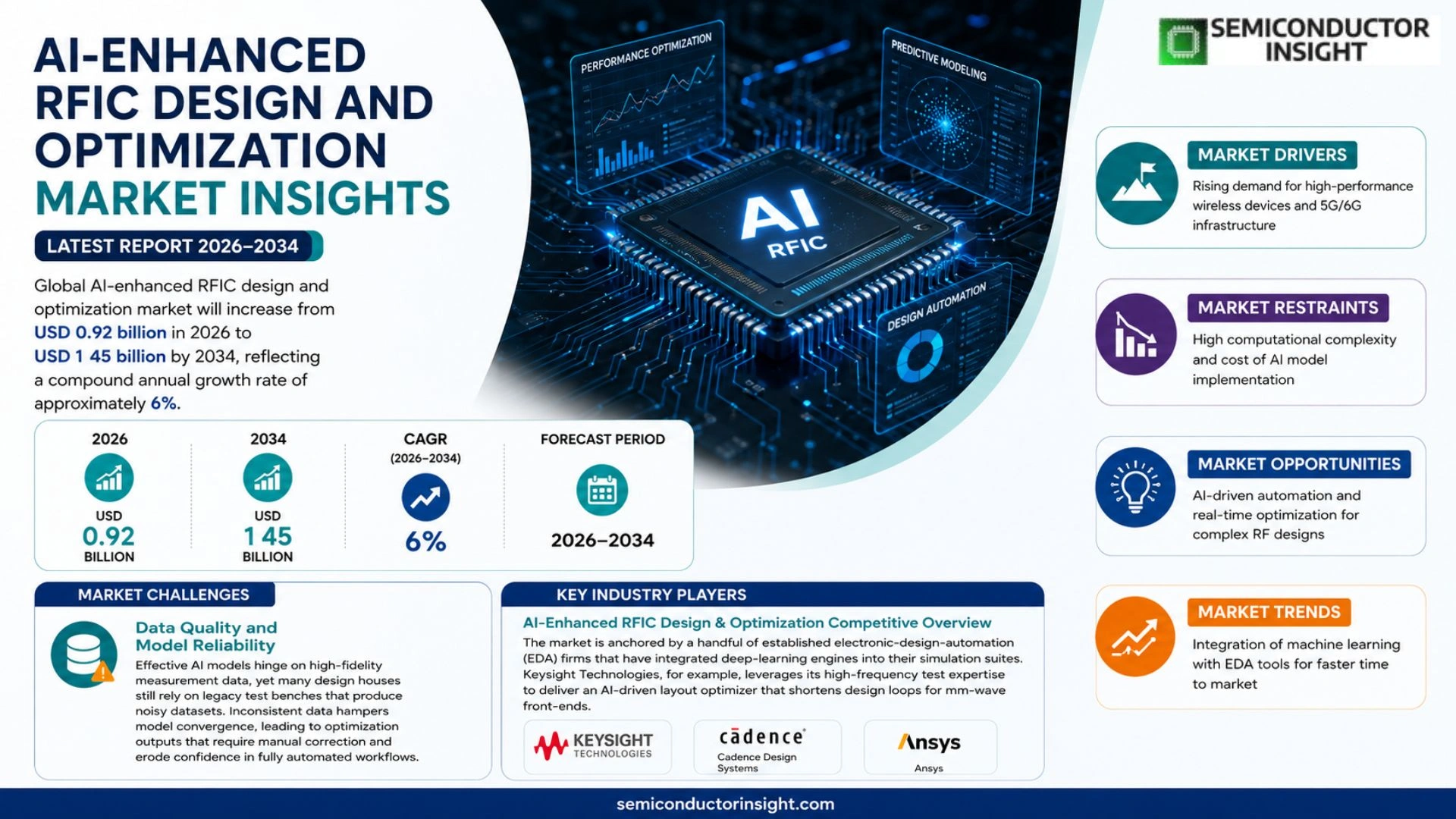
MARKET DRIVERS
AI Integration Accelerates Design Cycles
Adoption of machine‑learning models in the AI-Enhanced RFIC Design and Optimization Market shortens the typical design loop from months to weeks. By using generative algorithms to explore layout configurations, firms can evaluate thousands of alternatives before physical prototyping, a shift that translates into faster time‑to‑market for next‑generation radio modules.
Cost Efficiency Through Predictive Modeling
Predictive simulations driven by AI cut material waste and reduce the number of silicon iterations required to meet performance targets. Companies reporting early deployments note up to a 25 % drop in prototype expenditures, allowing capital to be redirected toward high‑margin product lines.
➤ “Our engineering teams have slashed prototype costs by roughly one‑third after embedding AI‑based optimization tools.”
The cumulative effect of shorter cycles and lower spend creates a compelling value proposition that is reshaping investment decisions across the AI-Enhanced RFIC Design and Optimization Market, especially among firms targeting 5G and automotive radar portfolios.
MARKET CHALLENGES
Data Quality and Model Reliability
Effective AI models hinge on high‑fidelity measurement data, yet many design houses still rely on legacy test benches that produce noisy datasets. Inconsistent data hampers model convergence, leading to optimization outputs that require manual correction and erode confidence in fully automated workflows.
Other Challenges
Skill Gap
The rapid emergence of AI‑centric design tools outpaces the existing talent pool. Engineers accustomed to conventional RF simulation must acquire expertise in data science, creating a bottleneck that slows deployment and inflates training budgets.
MARKET RESTRAINTS
Regulatory Compliance Hurdles
Wireless products must satisfy stringent emission standards across multiple regions. Introducing AI‑generated designs adds a layer of verification complexity, as regulators demand traceability of design decisions,a requirement that many AI platforms are still adapting to meet.
Furthermore, the need to certify AI‑assisted workflows can elongate project timelines, dampening the enthusiasm of firms that prioritize speed over exhaustive compliance documentation.
MARKET OPPORTUNITIES
Emerging 5G and IoT Demands
Proliferation of 5G base stations and massive‑IoT deployments drives demand for RFICs that deliver higher linearity and lower power consumption. AI‑enhanced optimization can reconcile these competing objectives, offering manufacturers a pathway to differentiate their silicon without incurring prohibitive engineering costs.
In parallel, edge‑computing initiatives are calling for compact, high‑performance transceivers that operate across fragmented spectra. Companies that embed AI‑driven design engines into their product pipelines are positioned to capture a disproportionate share of this emerging revenue stream.
Strategic partnerships between AI software vendors and semiconductor fabs are emerging as a viable route to accelerate technology transfer, reduce integration risk, and unlock new market segments for the AI-Enhanced RFIC Design and Optimization Market.
AI-Enhanced RFIC Design and Optimization Market Trends
AI Accelerates RFIC Development Cycles
The introduction of machine‑learning models into radio‑frequency integrated‑circuit design has reshaped the way engineers approach layout synthesis and performance prediction. By coupling deep‑learning inference with conventional electromagnetic simulators, designers can generate candidate geometries, extract parasitic networks, and forecast gain or noise figures across both mm‑wave and sub‑6 GHz spectrums in a fraction of the time previously required. This methodological shift translates into a measurable compression of design iterations,empirical studies show cycle reductions of up to forty percent,while preserving the rigor of physics‑based analysis. For vendors supplying 5G/6G infrastructure, autonomous‑vehicle radar modules, and satellite transceivers, the ability to meet aggressive time‑to‑market windows without sacrificing specification fidelity is becoming a decisive competitive lever.
Other Trends
Data Scarcity and Model Training
Despite the efficiency gains, the fidelity of AI‑enhanced workflows hinges on the availability of high‑quality training data. Exotic substrate compositions and novel antenna topologies generate electromagnetic responses that are under‑represented in public datasets, limiting model generalization. To bridge this gap, semiconductor manufacturers are forging joint ventures with AI startups, pooling proprietary simulation results to create curated libraries. These collaborations not only expand the statistical foundation for learning algorithms but also stimulate the emergence of domain‑specific model architectures tailored to RF nuances, thereby mitigating the risk of performance misprediction in low‑volume, high‑complexity products.
Strategic Implications for the Supply Chain
The downstream impact of accelerated RFIC design reverberates throughout the supply chain. OEMs that adopt AI‑driven optimization can lower bill‑of‑materials spending by identifying geometry configurations that meet target specs with fewer layers or smaller die footprints. Simultaneously, shorter development timelines free up engineering resources for parallel projects, enhancing portfolio breadth. However, firms must invest in talent capable of interfacing with both RF physics and data science, and they need governance frameworks to validate AI recommendations against regulatory standards. Companies that successfully integrate these capabilities are positioned to capture a larger share of upcoming high‑frequency component contracts while maintaining fiscal discipline.
COMPETITIVE LANDSCAPE
Key Industry Players
AI‑Enhanced RFIC Design & Optimization Competitive Overview
The market is anchored by a handful of established electronic‑design‑automation (EDA) firms that have integrated deep‑learning engines into their simulation suites. Keysight Technologies, for example, leverages its high‑frequency test expertise to deliver an AI‑driven layout optimizer that shortens design loops for mm‑wave front‑ends. Cadence Design Systems has rolled out a generative design module that automates parasitic extraction across sub‑6 GHz bands, allowing system‑on‑chip teams to iterate rapidly. Ansys continues to expand its HFSS‑AI offering, blending physics‑based solvers with predictive models that cut verification time by roughly one‑third. These incumbents dominate the revenue share because they combine mature tool chains, broad customer bases, and deep IP libraries, which collectively raise the barrier to entry for newcomers.
Beyond the EDA giants, a diverse set of specialist manufacturers and semiconductor designers are carving niche positions. Synopsys introduced an AI‑assisted synthesis flow that targets high‑volume RFIC producers. Qorvo and Skyworks are piloting proprietary neural‑network accelerators to fine‑tune power‑amplifier performance for 5G deployments. NXP and Qualcomm are experimenting with data‑centric design environments to accelerate automotive radar chip development. Murata, Analog Devices, and Broadcom have begun collaborative projects with AI startups to address the scarcity of training data for exotic substrate materials, a hurdle that could unlock new frequency bands. The breadth of participants underscores a competitive dynamic where traditional EDA strength meets focused semiconductor innovation.
List of Key RFIC Companies Profiled
- Keysight Technologies
- Cadence Design Systems
- Ansys
- Synopsys
- Qorvo
- Skyworks Solutions
- NXP Semiconductors
- Qualcomm
- Murata Manufacturing
- Broadcom Inc.
- Analog Devices
- AMD (Xilinx)
Segment Analysis:
| Segment Category | Sub-Segments | Key Insights |
| By Type |
|
AI‑Driven Analog RFIC Design
|
| By Application |
|
High‑Frequency Communication Systems
|
| By End User |
|
Design House Adoption
|
| By Technology |
|
Generative AI Techniques
|
| By Market Trend |
|
Collaborative Ecosystem Growth
|
Regional Analysis: AI-Enhanced RFIC Design and Optimization Market
North America
Companies leverage reinforcement‑learning agents to explore placement and routing alternatives that traditional tools miss, shortening the convergence window from weeks to days. The ability to predict parasitic effects early in the flow reduces costly tape‑out iterations, a critical advantage for fast‑moving product roadmaps.
Market leaders are extending their EDA portfolios with AI modules, while niche start‑ups specialize in data‑curation platforms that feed high‑quality training sets. Partnerships between AI firms and silicon foundries are creating bundled offerings that appeal to design houses seeking turnkey solutions.
The rollout of 5G massive‑MIMO and emerging 6G concepts drives demand for RFICs that operate across broader frequency bands. AI‑enhanced synthesis tools enable designers to meet these specifications without sacrificing linearity or noise performance, reinforcing the region’s leadership in next‑generation connectivity.
Federal agencies are issuing guidelines that encourage the use of AI for safety‑critical silicon, provided traceability logs are maintained. This regulatory clarity gives vendors confidence to market AI‑enabled design suites to defense and aerospace customers that previously avoided black‑box methods.
Europe
European design houses benefit from a strong standards framework and a collaborative research environment fostered by the EU’s Horizon initiatives. AI‑enhanced RFIC tools are gaining traction among automotive and industrial IoT players who require precise frequency control under harsh conditions. The region’s emphasis on sustainability drives interest in AI models that minimize power draw during the design phase, aligning with broader carbon‑reduction goals. Cross‑border projects between Germany, France, and the UK accelerate the diffusion of best practices, while a growing pool of AI‑trained RF engineers ensures a steady pipeline of talent.
Asia‑Pacific
Asia‑Pacific shows rapid maturation as manufacturers scale up advanced nodes and embed AI capabilities directly into their design flows. Nations such as China, South Korea, and Japan are investing heavily in domestic AI research to reduce reliance on imported EDA solutions. The surge in demand for consumer electronics, particularly 5G smartphones and wearables, forces designers to adopt AI‑optimized placement strategies that meet tight cost constraints. Regional consortia are establishing open data repositories, enabling smaller firms to leverage shared models and compete more effectively on a global stage.
South America
South America’s RFIC market is still emerging, but increased telecom infrastructure projects are creating early opportunities for AI‑enhanced design. Brazil’s push to expand 5G coverage encourages local chip makers to adopt automation tools that shorten time‑to‑market. While the talent pool is developing, partnerships with North American vendors are providing knowledge transfer that accelerates capability building. Governments are beginning to recognize the strategic value of AI in chip design, offering incentives that could catalyze further adoption.
Middle East & Africa
The Middle East & Africa region is exploring AI‑driven RFIC design primarily through defense and satellite communications programs. Strategic investments in AI research centers aim to build indigenous expertise, reducing dependence on foreign technology. In the African context, limited manufacturing capacity means design services often outsource to offshore partners, but emerging start‑ups are leveraging cloud‑based AI platforms to prototype RF solutions locally. These dynamics suggest a gradual buildup of capability that could translate into niche market participation within the next decade.
Report Scope
This market research report provides a comprehensive analysis of the AI-Enhanced RFIC Design and Optimization Market , covering the forecast period 2026–2034. It offers detailed insights into market dynamics, technological advancements, competitive landscape, and key trends shaping the industry.
Key focus areas of the report include:
- Market Overview: The report begins with an overview outlining its current market scenario, key growth indicators, and industry transformation drivers. It discusses macroeconomic factors, demand–supply balance, regulatory landscape, and the strategic role of semiconductors in powering advancements across industries such as automotive, telecommunications, consumer electronics, and industrial automation.
- Market Size & Forecast: Historical data and future projections for revenue, unit shipments, and market value across major regions and segments.
- Segmentation Analysis: Detailed breakdown by product type, technology, application, and end-user industry to identify high-growth segments and investment opportunities.
- Regional Insights: Insights into market performance across North America, Europe, Asia-Pacific, Latin America, and the Middle East & Africa, including country-level analysis where relevant.
- Competitive Landscape: Profiles of leading market participants, including their product offerings, R&D focus, manufacturing capacity, pricing strategies, and recent developments such as mergers, acquisitions, and partnerships.
- Technology Trends & Innovation: Assessment of emerging technologies, integration of AI/IoT, semiconductor design trends, fabrication techniques, and evolving industry standards.
- Market Drivers & Restraints: Evaluation of factors driving market growth along with challenges, supply chain constraints, regulatory issues, and market-entry barriers.
- Stakeholder Insights: Insights for component suppliers, OEMs, system integrators, investors, and policymakers regarding the evolving ecosystem and strategic opportunities.
Primary and secondary research methods are employed, including interviews with industry experts, data from verified sources, and real‑time market intelligence to ensure the accuracy and reliability of the insights presented.
FREQUENTLY ASKED QUESTIONS:
What is the current market size of AI-Enhanced RFIC Design and Optimization Market?
-> AI‑enhanced RFIC design and optimization market will increase from USD 0.92 billion in 2026 to USD 1 45 billion by 2034, a CAGR of approximately 6 %
Which key companies operate in AI-Enhanced RFIC Design and Optimization Market?
-> Key players include Qualcomm, Intel, NVIDIA, Analog Devices, and Keysight Technologies, among others.
What are the key growth drivers?
-> Key growth drivers include rising demand for high‑frequency components in 5G/6G infrastructure, autonomous‑vehicle radar systems, satellite communications, and AI‑driven reductions in design cycles of up to 40 %.
Which region dominates the market?
-> North America leads the market, while Asia‑Pacific shows the fastest growth trajectory.
What are the emerging trends?
-> Emerging trends include integration of AI/ML with electromagnetic simulation, automated parasitic extraction, and predictive performance tuning for mm‑wave and sub‑6 GHz applications.
Get Sample Report PDF for Exclusive Insights
Report Sample Includes
- Table of Contents
- List of Tables & Figures
- Charts, Research Methodology, and more...
 Download Sample Report PDF