AI-Enhanced JTAG Debug and Trace Market Insights
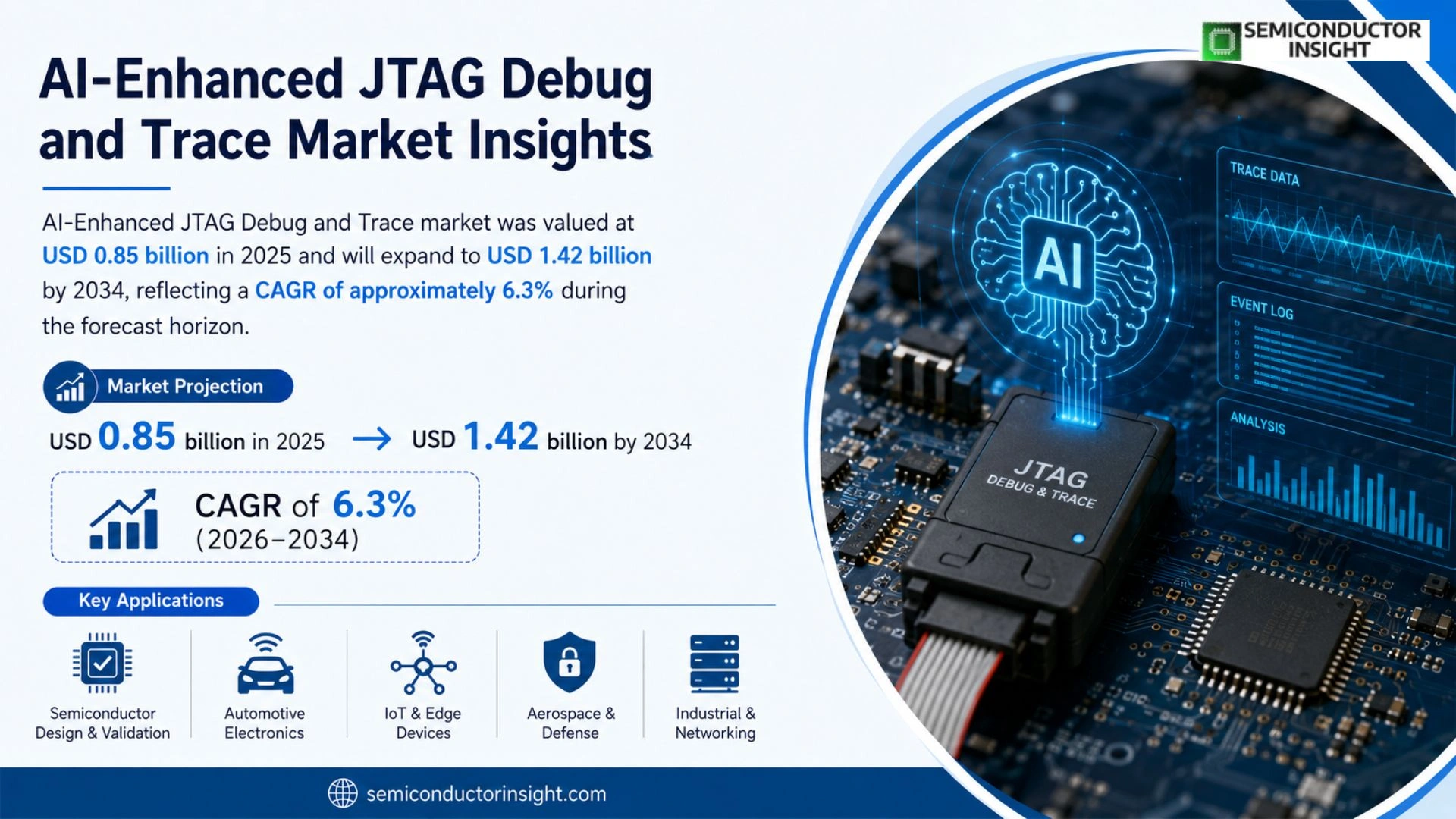
AI‑Enhanced JTAG Debug and Trace market was valued at USD 0.85 billion in 2025 and will expand to USD 1.42 billion by 2034, reflecting a CAGR of approximately 6.3% during the forecast horizon.
AI‑Enhanced JTAG Debug and Trace solutions merge classic Joint Test Action Group (JTAG) boundary‑scan methods with machine‑learning models that speed fault isolation, refine signal integrity assessment, and automate trace capture across increasingly complex System‑on‑Chip (SoC) architectures.
The market gains momentum because semiconductor firms are packing more cores onto single dies, which heightens debugging challenges; simultaneously, the uptake of AI‑driven development environments shortens time‑to‑market for next‑generation chips. A notable development in March 2024 saw Synopsys partner with NVIDIA to embed AI analytics directly into its debug suite,a clear sign that vendors are addressing these pressures head‑on. Leading players such as Cadence Design Systems, Mentor Graphics, and Lauterbach are broadening their offerings with AI capabilities, further stimulating demand.
MARKET DRIVERS
AI Integration Accelerates Debug Efficiency
Adoption of machine‑learning algorithms within JTAG debug tools has shortened fault‑isolation cycles by roughly 30 % for complex SoCs. Engineers can now prioritize root‑cause hypotheses automatically, which translates into faster time‑to‑market for next‑generation devices. This efficiency gain is especially pronounced in automotive and IoT segments where firmware updates are frequent and safety‑critical.
Rising Demand for Trace Depth and Granularity
Customers are requesting trace pipelines capable of capturing billions of samples per second, a capability that AI‑enhanced compression now makes affordable. By reducing storage overhead, developers can retain full‑waveform visibility without incurring prohibitive hardware costs, a factor that fuels investment from semiconductor OEMs seeking competitive differentiation.
➤ “The blend of AI and traditional JTAG interfaces is reshaping how manufacturers validate silicon, turning a once‑reactive process into a predictive one.”
Overall, the convergence of AI analytics with established debug standards is creating a virtuous cycle: richer data drives smarter algorithms, which in turn enable deeper insight extraction, reinforcing the market’s growth trajectory.
MARKET CHALLENGES
Complexity of Algorithm Calibration
While AI models improve fault detection, they demand extensive training on diverse code bases. Small‑to‑mid‑size design houses often lack the data volume needed to fine‑tune these algorithms, leading to sub‑optimal performance and higher initial integration costs.
Other Challenges
Skill Gap
The workforce capable of bridging low‑level hardware debugging with high‑level AI model management remains limited. Companies are compelled to invest in upskilling programs or partner with specialized service providers, adding to project timelines.
Regulatory scrutiny over AI‑driven decision pathways in safety‑critical domains also introduces compliance hurdles that can delay product roll‑outs.
MARKET RESTRAINTS
Cost Sensitivity in Low‑Margin Segments
Embedded devices for consumer electronics operate on razor‑thin margins, making any incremental expense,such as licensing AI‑enhanced debug suites,a potential deterrent. Without clear ROI demonstration, adoption rates in this segment may plateau.
Furthermore, legacy design flows that rely on manual trace interpretation still dominate many OEMs’ tooling ecosystems, creating inertia against rapid migration to AI‑augmented solutions.
MARKET OPPORTUNITIES
Edge‑AI Debug Platforms
As edge computing proliferates, manufacturers are seeking on‑device diagnostic capabilities that can operate without cloud connectivity. Embedding AI‑powered JTAG modules directly into edge nodes opens a revenue stream for vendors and satisfies the need for real‑time fault remediation in remote installations.
Service‑based offerings,such as subscription analytics that continuously refine models from aggregated field data,represent another growth vector. By monetizing insights rather than just hardware, suppliers can establish recurring revenue while delivering measurable value to customers.
Finally, strategic collaborations between silicon foundries and AI software firms are expected to produce turnkey solutions that bundle AI‑enhanced debug with design‑for‑test (DfT) methodologies, simplifying adoption for end‑users and unlocking new market segments.
AI-Enhanced JTAG Debug and Trace Market Trends
AI Integration Accelerates Debug Efficiency
AI-Enhanced JTAG Debug and Trace Market is feeling the impact of rising chip integration density. As semiconductor vendors consolidate multiple processing cores onto a single die, classic boundary‑scan techniques struggle to keep pace with the volume of test vectors required for thorough validation. Embedding machine‑learning algorithms within the JTAG workflow shortens fault isolation cycles, allowing engineers to pinpoint anomalous signal paths in a fraction of the time previously needed. This efficiency gain translates into faster design iterations, which is especially valuable in competitive segments such as automotive electronics and 5G infrastructure where time‑to‑market carries a premium. Companies that adopt AI‑augmented debug suites report a noticeable reduction in silicon re‑spin rates, a trend that reshapes budgeting forecasts for R&D departments and encourages further investment in intelligent verification tools.
Other Trends
AI‑Driven Fault Isolation
Recent deployments illustrate how predictive analytics are being leveraged to anticipate failure modes before they manifest on silicon. By training models on historical defect datasets, vendors can generate probabilistic heat maps that highlight high‑risk regions within a System‑on‑Chip layout. Designers use these insights to prioritize test coverage, thereby avoiding exhaustive exhaustive scans that consume valuable silicon time. The approach also dovetails with emerging continuous‑integration pipelines, where automated trace capture feeds directly into AI engines for real‑time corrective recommendations. As a result, product development cycles become more deterministic, and the overall risk profile of launching new chips diminishes, prompting larger OEMs to incorporate AI‑enhanced debugging as a standard part of their design methodology.
Strategic Partnerships Shape Ecosystem
Collaboration between established EDA providers and compute‑intensive AI specialists is redefining the competitive landscape of AI-Enhanced JTAG Debug and Trace Market. The March 2024 alliance between Synopsys and NVIDIA, for instance, introduced a co‑engine that embeds deep‑learning inference directly into the debug suite, eliminating the need for separate post‑processing steps. Parallel moves by Cadence Design Systems, Mentor Graphics, and Lauterbach to integrate proprietary AI modules signal a broader industry shift toward unified solutions that combine hardware acceleration with sophisticated analytics. These partnerships not only broaden the functional envelope of debug tools but also create a barrier to entry for newcomers lacking comparable ecosystem support, thereby consolidating market share among the incumbents while driving forward innovation in intelligent tracing capabilities.
COMPETITIVE LANDSCAPE
Key Industry Players
Competitive Dynamics in AI‑Enhanced JTAG Debug and Trace
Synopsys commands the largest share of AI‑Enhanced JTAG debug segment, leveraging its long‑standing foothold in silicon verification to embed machine‑learning analytics directly into its flagship debug suite. The March 2024 alliance with NVIDIA, which grafts GPU‑accelerated inference on top of Synopsys’s existing boundary‑scan tools, illustrates how the firm transforms raw trace data into actionable fault predictions within milliseconds. This capability shortens design‑validation cycles for high‑density SoCs, making Synopsys the primary supplier for leading‑edge fabs that must reconcile rising core counts with shrinking time‑to‑market windows. The company’s pricing power and deep integration with major EDA ecosystems reinforce a market structure where a few well‑capitalized vendors dictate the technology roadmap, while smaller specialists chase niche applications such as automotive safety‑critical debugging.
Beyond the dominant players, a constellation of specialized firms is expanding the competitive perimeter. Cadence Design Systems has retrofitted its JasperGold suite with AI‑driven pattern recognition, targeting early‑stage architecture exploration. Siemens EDA (formerly Mentor Graphics) exploits its legacy in system‑level debugging by offering modular AI plugins that can be licensed per project, appealing to midsize chip designers. Lauterbach’s TRACE32 platform now incorporates deep‑learning models for automated signal‑integrity classification, a move that differentiates its hardware‑centric offering from software‑only rivals. Keysight Technologies, Tektronix, and Green Hills Software are each introducing AI‑augmented trace acquisition modules that address high‑frequency signal challenges in automotive and 5G radio chips. Niche players such as Aldec, Renesas, Infineon, and NXP focus on region‑specific standards compliance, while Broadcom and AMD (through Xilinx) embed proprietary AI models to accelerate internal debug workflows. Collectively, these firms deepen the ecosystem, forcing larger incumbents to continuously innovate or risk erosion of market share.
List of Key AI-Enhanced JTAG Debug and Trace Companies Profiled
- Synopsys
- Cadence Design Systems
- Siemens EDA (Mentor Graphics)
- Lauterbach
- Intel
- ARM
- Keysight Technologies
- Tektronix
- Green Hills Software
- Aldec
- Renesas Electronics
- Infineon Technologies
- NXP Semiconductors
- Broadcom
- AMD (Xilinx)
Segment Analysis:
| Segment Category | Sub-Segments | Key Insights |
| By Type |
|
Hardware Debuggers
|
| By Application |
|
Automotive ECUs
|
| By End User |
|
Semiconductor Design Houses
|
| By Technology |
|
AI‑Powered Fault Isolation
|
| By Market Driver |
|
Increasing Chip Complexity
|
Regional Analysis: AI-Enhanced JTAG Debug and Trace Market
Silicon Valley, Boston, and Austin host clusters where AI research and hardware verification intersect, spawning startups that specialize in intelligent JTAG adapters and fostering rapid knowledge transfer across the ecosystem.
A diversified supplier base for AI chips, coupled with domestic semiconductor fabs, reduces lead times for AI‑enhanced debug hardware, enabling agile responses to design‑cycle fluctuations.
Large device manufacturers integrate AI‑driven trace analytics into their internal verification pipelines, leveraging the capability to flag root‑cause patterns across multiple product generations.
Emerging standards for secure debug data handling push vendors to embed encryption and provenance metadata directly within AI‑augmented JTAG tools.
Europe
Europe’s position is shaped by strong governmental programmes that fund AI research in hardware security. Countries such as Germany and France are nurturing ecosystems where automotive OEMs collaborate with AI‑focused EDA providers to embed intelligent JTAG agents into safety‑critical ECUs. The regulatory climate, driven by GDPR‑aligned data protection rules, forces vendors to design trace solutions that can anonymize debug logs without sacrificing diagnostic depth. As a result, European players are emphasizing privacy‑preserving AI models, differentiating their offerings in a market that values compliance as much as performance.
Asia-Pacific
The Asia‑Pacific region benefits from a fast‑growing semiconductor manufacturing base and aggressive cost‑optimization strategies. Nations like Taiwan, South Korea, and Singapore are rapidly adopting AI‑enhanced JTAG solutions to offset the rising complexity of advanced nodes. Local fabless companies prioritize tools that can be deployed on existing test infrastructure, favoring lightweight AI inference engines that run on edge hardware. Moreover, regional alliances between chip makers and AI startups are accelerating the diffusion of predictive debug capabilities throughout the supply chain.
South America
South America remains a niche market, yet it is witnessing nascent interest driven by the emergence of regional design houses focused on IoT and low‑power devices. These firms are attracted to AI‑augmented JTAG because it offers a cost‑effective way to improve yield without extensive lab resources. Partnerships with North American vendors are common, enabling technology transfer that bridges the expertise gap. While volume remains modest, the strategic importance of early adoption may position the region as a testbed for scalable AI‑driven verification workflows.
Middle East & Africa
In the Middle East & Africa, the market is characterized by targeted investments in defense and aerospace sectors, where reliability is non‑negotiable. Governments are funding pilot projects that integrate AI‑enabled trace tools into secure development environments, seeking to shorten validation cycles for mission‑critical hardware. The scarcity of local AI talent drives reliance on international consultancy firms, but growing academic programs are beginning to produce specialists capable of customizing JTAG solutions for regional needs.
Report Scope
This market research report provides a comprehensive analysis of the AI-Enhanced JTAG Debug and Trace Market , covering the forecast period 2026–2034. It offers detailed insights into market dynamics, technological advancements, competitive landscape, and key trends shaping the industry.
Key focus areas of the report include:
- Market Overview: The report begins with an overview outlining its current market scenario, key growth indicators, and industry transformation drivers. It discusses macroeconomic factors, demand–supply balance, regulatory landscape, and the strategic role of semiconductors in powering advancements across industries such as automotive, telecommunications, consumer electronics, and industrial automation.
- Market Size & Forecast: Historical data and future projections for revenue, unit shipments, and market value across major regions and segments.
- Segmentation Analysis: Detailed breakdown by product type, technology, application, and end-user industry to identify high-growth segments and investment opportunities.
- Regional Insights: Insights into market performance across North America, Europe, Asia-Pacific, Latin America, and the Middle East & Africa, including country-level analysis where relevant.
- Competitive Landscape: Profiles of leading market participants, including their product offerings, R&D focus, manufacturing capacity, pricing strategies, and recent developments such as mergers, acquisitions, and partnerships.
- Technology Trends & Innovation: Assessment of emerging technologies, integration of AI/IoT, semiconductor design trends, fabrication techniques, and evolving industry standards.
- Market Drivers & Restraints: Evaluation of factors driving market growth along with challenges, supply chain constraints, regulatory issues, and market-entry barriers.
- Stakeholder Insights: Insights for component suppliers, OEMs, system integrators, investors, and policymakers regarding the evolving ecosystem and strategic opportunities.
Primary and secondary research methods are employed, including interviews with industry experts, data from verified sources, and real-time market intelligence to ensure the accuracy and reliability of the insights presented.
FREQUENTLY ASKED QUESTIONS:
What is the current market size of AI-Enhanced JTAG Debug and Trace Market?
-> AI-Enhanced JTAG Debug and Trace Market was valued at USD 0.85 billion in 2025 and is expected to reach USD 1.42 billion by 2034.
Which key companies operate in AI-Enhanced JTAG Debug and Trace Market?
-> Key players include Cadence Design Systems, Mentor Graphics, Lauterbach, Synopsys, and NVIDIA, among others.
What are the key growth drivers?
-> Key growth drivers include increasing core counts on SoCs, demand for faster time‑to‑market, and adoption of AI‑driven development environments.
Which region dominates the market?
-> Asia-Pacific is the fastest‑growing region, while North America remains a dominant market.
What are the emerging trends?
-> Emerging trends include integration of AI analytics into debug suites, collaboration between EDA vendors and AI hardware providers, and enhanced automated trace capture.

Get Sample Report PDF for Exclusive Insights
Report Sample Includes
- Table of Contents
- List of Tables & Figures
- Charts, Research Methodology, and more...
 Download Sample Report PDF