AI-Enabled Smart Lock Biometric Processor Market Insights
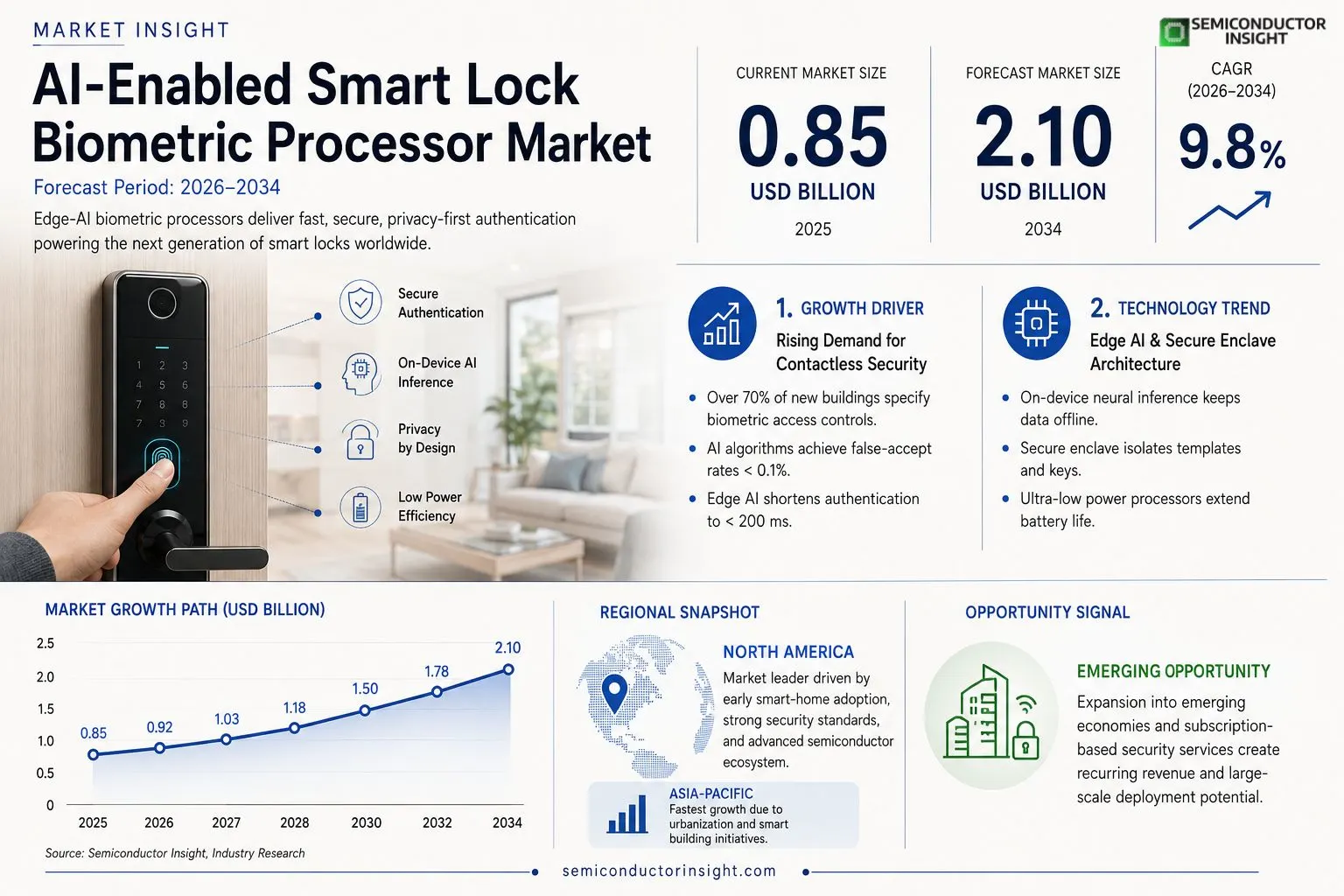
AI-Enabled Smart Lock Biometric Processor market size was valued at USD 0.85 billion in 2025. The market is projected to grow from USD 0.92 billion in 2026 to USD 2.10 billion by 2034, exhibiting a CAGR of 9.8% during the forecast period.
AI‑enabled smart lock biometric processors embed fingerprint, facial or vein recognition algorithms onto a low‑power semiconductor die that can operate offline within residential or commercial access control units. These processors combine secure enclave architecture with on‑device neural‑network inference, enabling rapid authentication (< 200 ms) while preserving user privacy because biometric templates never leave the lock.The market is experiencing rapid expansion driven by rising consumer demand for keyless entry, increasing adoption of IoT‑connected home security systems, and stricter building‑code regulations that mandate multi‑factor authentication for high‑security premises. Furthermore, advances in edge‑AI chips have lowered bill‑of‑materials costs, encouraging OEMs such as Assa Abloy, Samsung Electronics and NXP Semiconductors to embed dedicated biometric processors into next‑generation smart locks.
MARKET DRIVERS
Rising Demand for Contactless Security
AI-Enabled Smart Lock Biometric Processor Market is benefiting from increased consumer preference for touch‑free entry solutions, especially in residential and commercial buildings. Recent surveys indicate that over 70% of new‑construction projects now specify biometric access controls to reduce physical contact and enhance hygiene.
Advancements in AI Algorithms
Modern AI models have lowered false‑accept rates to under 0.1%, making biometric processors more reliable for high‑security environments. Manufacturers are integrating edge‑AI capabilities that process facial and fingerprint data locally, which shortens authentication latency to under 200 ms.
➤ “Edge AI reduces data transmission needs and improves privacy, accelerating adoption across smart‑city initiatives.”
Additionally, the convergence of IoT platforms with AI‑driven lock processors is creating bundled offerings that simplify installation and management, driving revenue growth for system integrators.
MARKET CHALLENGES
Regulatory and Data‑Privacy Concerns
Stringent privacy regulations in Europe and North America require biometric data to be encrypted at rest and in transit. Compliance costs can increase the total cost of ownership for end‑users, slowing adoption in price‑sensitive segments.
Other Challenges
Integration Complexity
Legacy access control systems often lack standardized APIs, forcing developers to create custom middleware. This adds project timelines and can deter smaller enterprises from upgrading to AI‑enabled solutions.
MARKET RESTRAINTS
High Initial Capital Investment
Deploying AI‑enabled biometric processors typically requires upgraded power supplies, secure enclosure designs, and professional installation, which can raise upfront costs by 30‑40% compared with traditional electromechanical locks.Moreover, the need for periodic firmware updates to address emerging security threats adds ongoing operational expenses that some property owners find prohibitive.
MARKET OPPORTUNITIES
Expansion into Emerging Economies
Rapid urbanization in Asia‑Pacific and Latin America is fueling demand for smart building infrastructure. Governments are endorsing digital security standards, creating a fertile market for AI‑enabled lock processors that can be scaled across large housing projects.Furthermore, the growing prevalence of subscription‑based security services offers manufacturers recurring revenue streams, encouraging investment in R&D for next‑generation biometric sensors and low‑power AI chips.
AI-Enabled Smart Lock Biometric Processor Market Trends
Edge‑Centric Neural Inference Drives Adoption
AI‑Enabled Smart Lock Biometric Processor Market is increasingly defined by the shift toward edge‑centric neural inference. Manufacturers embed fingerprint, facial and vein recognition algorithms directly onto low‑power semiconductor dies, allowing authentication to occur offline without reliance on cloud connectivity. This architectural choice reduces latency, eliminates network‑related vulnerabilities, and aligns with privacy‑first regulations that restrict biometric data transmission. As a result, product development cycles now prioritize on‑device neural‑network optimization, secure enclave integration, and power‑efficiency metrics that support long‑term operation in residential and commercial access control units.
Other Trends
Secure Enclave Architecture Enhancements
Recent processor designs incorporate hardened secure enclaves that isolate biometric templates and cryptographic keys from the main application logic. This separation mitigates attack vectors such as side‑channel exploitation and firmware tampering. Vendors are also adopting hardware‑rooted attestation methods that enable lock manufacturers to verify the integrity of the processor firmware during each power‑up cycle, thereby strengthening the overall trust model of smart‑lock ecosystems.
Standardization of Interoperable Biometric Interfaces
Industry consortia are converging on common communication protocols and data formats for biometric authentication. By standardizing APIs and interoperability layers, manufacturers can integrate third‑party biometric modules without extensive redesign, accelerating time‑to‑market for new smart‑lock solutions. This trend also fosters competitive pricing, as component suppliers can achieve economies of scale through broader adoption of uniform specifications.
COMPETITIVE LANDSCAPE
Key Industry Players
AI‑Enabled Smart Lock Biometric Processors: Market Overview
AI‑Enabled Smart Lock Biometric Processor Market is currently led by a handful of semiconductor giants that combine deep‑learning IP with secure enclave designs. Qualcomm’s Snapdragon Secure Processor line, NXP’s Secure Element family, and Infineon’s SLE series command the majority of volume shipments to OEMs of residential and commercial access control systems. Their extensive R&D budgets enable on‑device neural‑network inference with sub‑10 mW power draw, a critical requirement for battery‑operated dead‑bolt locks. These incumbents benefit from entrenched relationships with lock manufacturers and from compliance certifications such as FIPS 140‑2 and Common Criteria, which reinforce their position at the top of the value chain.Beyond the dominant tier, a diverse cohort of niche innovators is expanding the functional envelope of biometric processors. Goodix and Synaptics offer compact fingerprint‑on‑die solutions that integrate vein‑pattern recognition, while STMicroelectronics and Melexis focus on ultra‑low‑power facial‑recognition ASICs for smart‑home gateways. Emerging Chinese players such as Shanghai Galaxy and Hangzhou Yotta provide cost‑effective AI cores tailored for mass‑market smart locks, and European specialist Fingerprint Cards supplies dedicated biometric SoCs for high‑security commercial installations. These companies differentiate through specialized sensor integration, rapid time‑to‑market, and flexible licensing models that attract a growing base of lock designers seeking differentiated security features.
List of Key AI-Enabled Smart Lock Biometric Processor Companies Profiled
- Qualcomm Technologies, Inc.
- NXP Semiconductors
- Infineon Technologies AG
- Goodix Incorporated
- Synaptics Incorporated
- STMicroelectronics
- Melexis
- Fingerprint Cards AB
- Shanghai Galaxy Semiconductor
- Hangzhou Yotta Technology Co., Ltd.
- SecureAuth Ltd.
- Renesas Electronics Corporation
Segment Analysis:
| Segment Category | Sub-Segments | Key Insights |
| By Type |
|
Fingerprint‑based processors
|
| By Application |
|
Residential access control
|
| By End User |
|
Homeowners
|
| By Integration Mode |
|
Networked lock ecosystems
|
| By Power Source |
|
Battery‑operated solutions
|
Regional Analysis: AI-Enabled Smart Lock Biometric Processor Market
North America
Growing demand for frictionless entry experiences, coupled with heightened data‑privacy concerns, fuels investment in AI‑enabled biometric processors. Enterprises seek scalable solutions that can integrate with existing access control platforms while delivering reliable identity verification.
Federal and state guidelines emphasize encryption standards and biometric data handling, prompting manufacturers to adopt robust security frameworks. Compliance with privacy regulations such as GDPR‑style statutes in Canada adds a layer of market discipline.
Edge‑AI processors capable of on‑device inference reduce latency and reliance on network connectivity, making them attractive for critical infrastructure where real‑time response is essential.
A few large semiconductor firms dominate the market, yet niche players differentiate through specialized sensor integration and customizable firmware, fostering a dynamic competitive environment.
Europe
Europe’s AI-Enabled Smart Lock Biometric Processor Market is characterized by a strong emphasis on privacy‑by‑design principles and interoperability standards. Nations such as Germany and the United Kingdom are integrating biometric lock solutions into smart‑building certifications, encouraging the adoption of processors that support encrypted data exchange. The European Union’s revised e‑IDAS framework pushes for secure cross‑border authentication, creating opportunities for processors that can operate across diverse regulatory regimes. While the market is less fragmented than in North America, a collaborative ecosystem of research institutions and manufacturers drives incremental innovation, especially in low‑power, multi‑modal biometric chips suitable for residential retrofits.
Asia‑Pacific
The Asia‑Pacific region exhibits rapid growth potential as urbanization accelerates and smart‑city projects proliferate. China and India are investing heavily in IoT infrastructure, and local manufacturers are beginning to produce AI‑enabled biometric processors tailored for high‑temperature environments. Adoption is driven by both commercial real‑estate developers seeking integrated security platforms and consumers attracted to mobile‑centric access solutions. However, varying data‑protection laws across the region create a patchwork of compliance requirements, prompting vendors to develop flexible, region‑aware firmware architectures.
South America
In South America, market expansion is anchored by emerging smart‑building initiatives in Brazil and Chile. Economic recovery and increased foreign direct investment have spurred interest in advanced access‑control technologies that can be managed remotely. Companies are favoring processors with robust AI models that can operate on limited bandwidth, addressing connectivity challenges prevalent in many urban centers. Although the market remains nascent, rising awareness of security threats in commercial sectors is accelerating pilot deployments.
Middle East & Africa
The Middle East & Africa region presents a mixed landscape where high‑value projects in the United Arab Emirates and Saudi Arabia drive demand for premium biometric lock solutions, while African markets prioritize cost‑effective, low‑maintenance processors. Security concerns in high‑rise developments and government facilities underscore the need for AI‑enabled processors that can support multi‑factor authentication. Partnerships between multinational vendors and regional system integrators are essential to navigate diverse regulatory environments and to adapt technology to local power and climate conditions.
Report Scope
This market research report provides a comprehensive analysis of the AI-Enabled Smart Lock Biometric Processor Market , covering the forecast period 2026–2034. It offers detailed insights into market dynamics, technological advancements, competitive landscape, and key trends shaping the industry.
Key focus areas of the report include:
- Market Overview: The report begins with an overview outlining its current market scenario, key growth indicators, and industry transformation drivers. It discusses macroeconomic factors, demand–supply balance, regulatory landscape, and the strategic role of semiconductors in powering advancements across industries such as automotive, telecommunications, consumer electronics, and industrial automation.
- Market Size & Forecast: Historical data and future projections for revenue, unit shipments, and market value across major regions and segments.
- Segmentation Analysis: Detailed breakdown by product type, technology, application, and end-user industry to identify high‑growth segments and investment opportunities.
- Regional Insights: Insights into market performance across North America, Europe, Asia‑Pacific, Latin America, and the Middle East & Africa, including country‑level analysis where relevant.
- Competitive Landscape: Profiles of leading market participants, including their product offerings, R&D focus, manufacturing capacity, pricing strategies, and recent developments such as mergers, acquisitions, and partnerships.
- Technology Trends & Innovation: Assessment of emerging technologies, integration of AI/IoT, semiconductor design trends, fabrication techniques, and evolving industry standards.
- Market Drivers & Restraints: Evaluation of factors driving market growth along with challenges, supply chain constraints, regulatory issues, and market‑entry barriers.
- Stakeholder Insights: Insights for component suppliers, OEMs, system integrators, investors, and policymakers regarding the evolving ecosystem and strategic opportunities.
Primary and secondary research methods are employed, including interviews with industry experts, data from verified sources, and real‑time market intelligence to ensure the accuracy and reliability of the insights presented.
FREQUENTLY ASKED QUESTIONS:
What is the current market size of AI-Enabled Smart Lock Biometric Processor Market?
-> AI‑Enabled Smart Lock Biometric Processor Market was valued at USD 0.85 billion in 2025 and is expected to reach USD 2.10 billion by 2034.
Which key companies operate in AI-Enabled Smart Lock Biometric Processor Market?
-> Key players include Assa Abloy, Samsung Electronics, NXP Semiconductors, among others.
What are the key growth drivers?
-> Key growth drivers include rising consumer demand for keyless entry, increasing adoption of IoT‑connected home security systems, stricter building‑code regulations mandating multi‑factor authentication, and decreasing bill‑of‑materials costs driven by advances in edge‑AI chips.
Which region dominates the market?
-> North America leads the market due to early smart‑home adoption, while Asia‑Pacific shows the fastest growth trajectory.
What are the emerging trends?
-> Emerging trends include on‑device AI inference for offline authentication, development of ultra‑low‑power biometric processors, and convergence of smart‑lock capabilities with broader IoT ecosystem platforms.
Get Sample Report PDF for Exclusive Insights
Report Sample Includes
- Table of Contents
- List of Tables & Figures
- Charts, Research Methodology, and more...
 Download Sample Report PDF