
AI-Enabled Power Integrity Simulation Market Insights
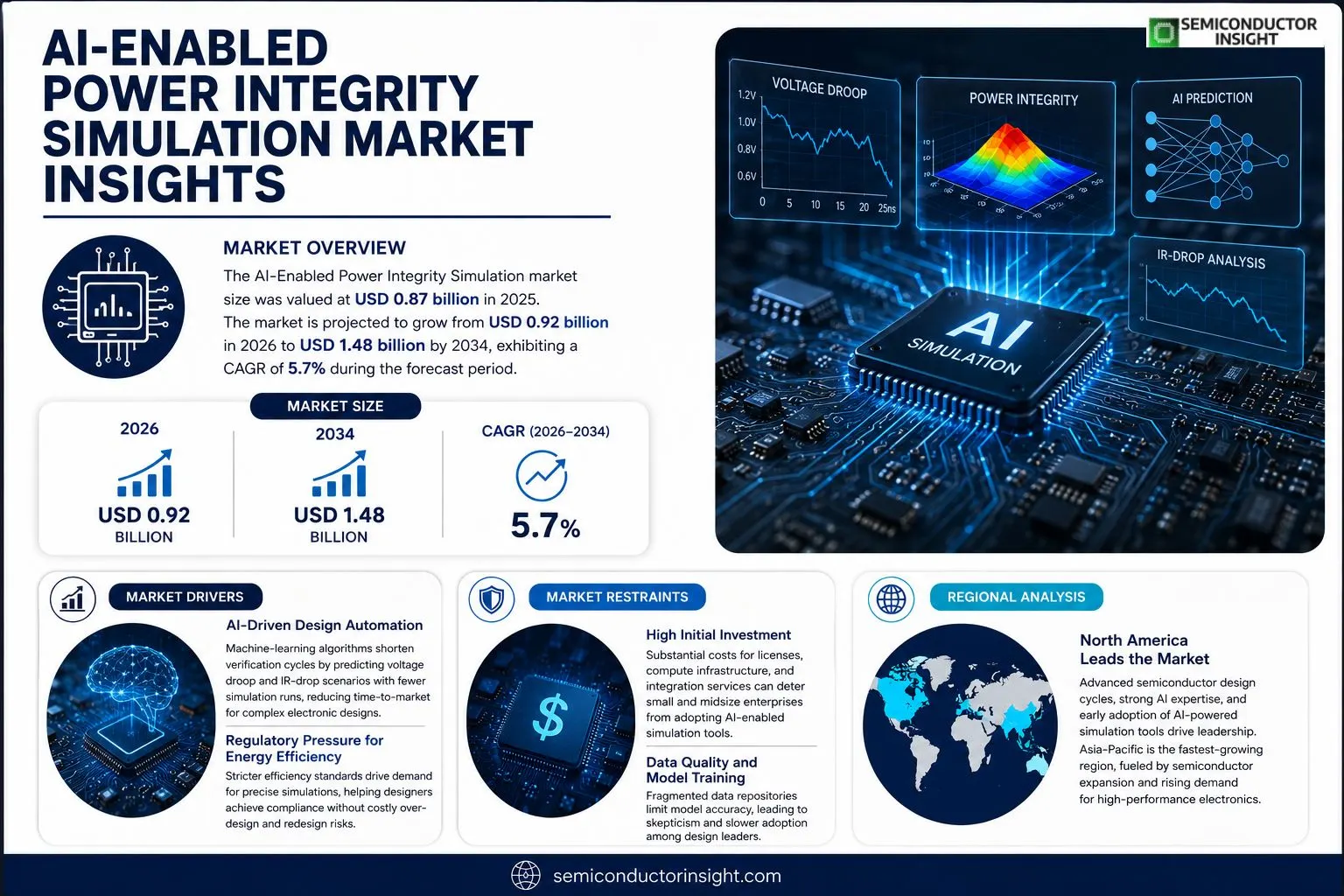
AI-Enabled Power Integrity Simulation market size was valued at USD 0.87 billion in 2025. The market is projected to grow from USD 0.92 billion in 2026 to USD 1.48 billion by 2034, exhibiting a CAGR of 5.7% during the forecast period.
AI‑Enabled Power Integrity Simulation tools integrate electromagnetic solvers with machine‑learning models to anticipate voltage droop, ground bounce and substrate coupling in high‑speed electronic designs. By automating mesh refinement and optimizing signal‑and‑power network parameters, these solutions enable designers to cut board iterations, enhance reliability and satisfy tight timing constraints.
MARKET DRIVERS
AI‑Driven Design Automation
The integration of machine‑learning algorithms into power integrity workflows is shortening verification cycles. Engineers can now predict voltage droop and IR‑drop scenarios with fewer simulation runs, freeing capacity for higher‑complexity board designs. Speed gains translate directly into reduced time‑to‑market for advanced electronic products.
Regulatory Pressure for Energy Efficiency
Stringent efficiency standards across automotive and data‑center sectors are compelling designers to adopt more precise power‑integrity tools. AI‑enhanced simulations provide the granularity required to certify compliance without costly over‑design. Compliance confidence lowers the risk of costly redesigns after production.
➤ Companies that embed AI into their simulation suites report up to a 30 % reduction in engineering effort, reshaping resource allocation strategies.
These dynamics are motivating original equipment manufacturers and EDA vendors to expand their AI‑enabled capabilities, making the AI‑Enabled Power Integrity Simulation Market a focal point for strategic investment.
MARKET CHALLENGES
Data Quality and Model Training
The effectiveness of AI models hinges on the availability of high‑fidelity historical simulation data. Many organizations struggle with fragmented data repositories, which hampers model accuracy and leads to skeptical adoption among senior design leaders.
Other Challenges
Talent Shortage
Finding engineers proficient in both power‑integrity concepts and AI techniques remains difficult. The talent gap forces companies to either upskill existing staff or rely on niche consultancies, inflating project costs.
MARKET RESTRAINTS
High Initial Investment
Deploying AI‑enabled simulation platforms often requires substantial capital outlay for software licenses, compute infrastructure, and integration services. Small and midsize enterprises may deem the expense disproportionate to immediate returns, slowing broader market diffusion.
MARKET OPPORTUNITIES
Edge‑Computing and IoT Expansion
The proliferation of edge devices demands power‑integrity verification at unprecedented scales. AI‑enhanced simulation can process massive component libraries in parallel, offering a scalable solution for IoT manufacturers. Scalable analytics open a revenue stream for vendors willing to tailor their tools to the edge market.
AI-Enabled Power Integrity Simulation Market Trends
AI‑Enhanced Mesh Refinement Reduces Design Iterations
The integration of machine‑learning algorithms with traditional electromagnetic solvers is reshaping how engineers address power‑integrity challenges. By analysing prior simulation runs, adaptive mesh techniques now concentrate computational effort on regions prone to voltage droop or ground bounce, cutting solution times by up to 40 %. This efficiency gain translates into fewer physical prototype cycles, allowing design teams to meet aggressive launch schedules without compromising signal‑integrity margins. The trend reflects a broader shift toward data‑centric engineering, where historical design data becomes a reusable asset rather than a discarded artifact.
Other Trends
Predictive Voltage‑Drop Modeling
Advanced predictive modules now forecast voltage‑drop hotspots before a single layout is completed. Leveraging supervised learning on thousands of verified designs, the models deliver probability‑weighted risk maps that guide early‑stage floor‑planning decisions. Designers report a reduction in late‑stage rework, as potential failures are identified during schematic capture rather than after PCB fabrication. The capability is especially valuable for high‑frequency systems where even marginal voltage sag can compromise timing closure.
Adoption of Cloud‑Based SimulatiSon Platforms
Enterprises are migrating simulation workloads to cloud environments to capitalize on elastic compute resources and collaborative workspaces. Cloud‑hosted AI‑Enabled Power Integrity Simulation solutions enable teams distributed across continents to share simulation data in real time, enforce version control, and scale processing power on demand. This model lowers upfront hardware expenditures and accelerates the onboarding of junior engineers, who can access sophisticated solvers through a web interface without deep tool‑chain expertise. As a result, organizations are able to respond more nimbly to design changes introduced by component shortages or evolving regulatory requirements.
COMPETITIVE LANDSCAPE
Key Industry Players
AI‑Enabled Power Integrity Simulation Market – Competitive Overview
In the AI‑enhanced power‑integrity segment, a handful of EDA leaders have consolidated the bulk of revenue. Cadence Design Systems, with its Voltus‑AI suite, leverages deep‑learning‑driven mesh optimization to shorten board‑level verification cycles. Synopsys follows closely, embedding machine‑learning inference into PrimeSim to predict voltage droop across complex power networks. ANSYS contributes a physics‑first solver augmented by AI‑based parameter tuning, while Siemens EDA (formerly Mentor) integrates reinforcement‑learning loops within its HyperLynx platform. These incumbents benefit from extensive customer bases, cross‑selling opportunities within broader design‑tool portfolios, and sizable R&D budgets that sustain rapid iteration of AI capabilities. The result is a competitive environment where scale and software ecosystem depth are decisive factors for OEMs and contract manufacturers seeking end‑to‑end simulation workflows.Beyond the dominant tier, several specialist firms are carving out niches by focusing on algorithmic innovation or domain‑specific libraries. Altair’s Flux AI module emphasizes rapid substrate coupling analysis using surrogate models trained on high‑frequency data sets. Keysight Technologies offers AI‑assisted signal‑integrity extensions within its ADS environment, targeting high‑speed communications hardware. AWR (part of Cadence) supplies a lightweight, cloud‑native solution that appeals to start‑ups aiming for cost‑effective iteration. Smaller entrants such as Zuken, CST (Dassault Systèmes), and Empyrean Technologies are differentiating through open‑API frameworks that let customers inject proprietary ML models. Their agility enables quick adoption of emerging techniques, though limited sales reach constrains overall market share. Collectively, this second wave creates meaningful pressure on pricing and accelerates feature diffusion across the sector.
List of Key AI-Enabled Power Integrity Simulation Companies Profiled
- Cadence Design Systems
- Synopsys
- ANSYS, Inc.
- Siemens EDA
- Altair Engineering
- Keysight Technologies
- AWR Corporation
- Zuken
- CST (Dassault Systèmes)
- Empyrean Technologies
- Mentor, a Siemens Business
- RapidPower Solutions
- PowerSI
- SimScale
Segment Analysis:
| Segment Category | Sub-Segments | Key Insights |
| By Type |
|
Machine‑learning‑augmented simulators are emerging as the leading type because they enable predictive adjustments to mesh density and automatically refine power‑network parameters.
|
| By Application |
|
High‑speed communication boards dominate this application segment.
|
| By End User |
|
In‑house semiconductor design teams are the primary end‑users, leveraging AI‑enabled tools to embed power integrity checks directly into ASIC development flows.
|
| By Deployment Model |
|
Cloud‑based subscription services are gaining traction because they provide scalable compute resources for intensive AI algorithms.
|
| By Industry |
|
Consumer electronics leads this industry segment as manufacturers chase ever‑higher data rates and miniaturization.
|
Regional Analysis: AI-Enabled Power Integrity Simulation Market
North America
Leading EDA vendors have embedded AI modules directly into power integrity suites, enabling designers to iterate layouts with real‑time anomaly detection. This integration shortens prototype cycles and reduces costly silicon revisions, a benefit that resonates strongly with high‑volume manufacturers seeking tighter time‑to‑market windows.
U.S. and Canadian standards bodies are increasingly referencing AI‑enhanced simulation outcomes in compliance documentation, encouraging broader acceptance of these tools. This regulatory endorsement lowers the perceived risk for adopters and drives investment in verification workflows.
Fortune‑500 semiconductor firms allocate sizable R&D budgets toward AI‑based power integrity platforms, treating them as strategic differentiators. Their procurement choices ripple through the supply chain, prompting niche players to align product roadmaps with enterprise expectations.
The region’s concentration of dual‑skill engineersfluent in both circuit physics and machine learningcreates a talent pool that sustains rapid product iteration. Companies that successfully capture this talent gain a competitive edge in algorithmic refinement.
Europe
European markets exhibit a measured yet confident uptake of AI‑Enabled Power Integrity Simulation tools, driven by stringent energy‑efficiency directives and a strong emphasis on sustainability. Major automotive players leverage AI to assure power distribution networks in electric vehicles, aligning with the EU’s decarbonization agenda. Collaborative research initiatives across Germany, France, and the Nordics blend academic rigor with industrial pragmatism, producing open‑source frameworks that lower entry barriers for midsize firms. While capital availability is modest compared with North America, governmental grants aimed at digital transformation counterbalance funding gaps, encouraging broader diffusion of AI‑centric verification practices.
Asia‑Pacific
In Asia‑Pacific, the AI‑Enabled Power Integrity Simulation Market is propelled by the region’s aggressive semiconductor fabrication expansion, particularly in Taiwan, South Korea, and China. OEMs prioritize design throughput and yield, prompting swift integration of AI‑assisted simulation into their front‑end processes. Local chip foundries partner with software vendors to co‑develop customized models that reflect region‑specific process variations, fostering a tightly coupled ecosystem. Despite the rapid pace, talent scarcity in specialized AI‑physics crossover roles poses a strategic challenge, leading firms to establish offshore training programs and joint ventures with universities to close the skills gap.
South America
South American participation remains nascent, yet growing interest is evident as regional manufacturers seek to upgrade legacy design flows. Brazil’s emerging electronics sector recognizes AI‑driven power integrity analysis as a lever to compete internationally, especially in aerospace and automotive sub‑segments. Limited access to high‑performance computing infrastructure hampers widespread adoption, but public‑private partnerships are emerging to provide cloud‑based simulation platforms, thereby democratizing access to advanced analytics.
Middle East & Africa
The Middle East & Africa region displays cautious optimism, anchored by burgeoning investments in smart‑city and renewable‑energy projects that demand rigorous power integrity verification. UAE and Saudi Arabia have launched technology incubators focusing on AI applications in hardware design, attracting multinational EDA firms to explore pilot deployments. Infrastructure constraints and a fragmented talent pipeline restrict rapid scale‑up, yet strategic training alliances with European institutions are gradually building the necessary expertise to support future growth in AI‑Enabled Power Integrity Simulation capabilities.
Report Scope
This market research report provides a comprehensive analysis of the AI-Enabled Power Integrity Simulation Market , covering the forecast period 2026–2034. It offers detailed insights into market dynamics, technological advancements, competitive landscape, and key trends shaping the industry.
Key focus areas of the report include:
- Market Overview: The report begins with an overview outlining its current market scenario, key growth indicators, and industry transformation drivers. It discusses macroeconomic factors, demand–supply balance, regulatory landscape, and the strategic role of semiconductors in powering advancements across industries such as automotive, telecommunications, consumer electronics, and industrial automation.
- Market Size & Forecast: Historical data and future projections for revenue, unit shipments, and market value across major regions and segments.
- Segmentation Analysis: Detailed breakdown by product type, technology, application, and end-user industry to identify high-growth segments and investment opportunities.
- Regional Insights: Insights into market performance across North America, Europe, Asia-Pacific, Latin America, and the Middle East & Africa, including country-level analysis where relevant.
- Competitive Landscape: Profiles of leading market participants, including their product offerings, R&D focus, manufacturing capacity, pricing strategies, and recent developments such as mergers, acquisitions, and partnerships.
- Technology Trends & Innovation: Assessment of emerging technologies, integration of AI/IoT, semiconductor design trends, fabrication techniques, and evolving industry standards.
- Market Drivers & Restraints: Evaluation of factors driving market growth along with challenges, supply chain constraints, regulatory issues, and market-entry barriers.
- Stakeholder Insights: Insights for component suppliers, OEMs, system integrators, investors, and policymakers regarding the evolving ecosystem and strategic opportunities.
Primary and secondary research methods are employed, including interviews with industry experts, data from verified sources, and real-time market intelligence to ensure the accuracy and reliability of the insights presented.
FREQUENTLY ASKED QUESTIONS:
What is the current market size of AI-Enabled Power Integrity Simulation Market?
-> AI-Enabled Power Integrity Simulation Market was valued at USD 0.87 billion in 2025 and is expected to reach USD 1.48 billion by 2034.
Which key companies operate in AI-Enabled Power Integrity Simulation Market?
-> Key players include Axalta Coating Systems, AkzoNobel, BASF SE, PPG, Sherwin-Williams, and 3M, among others.
What are the key growth drivers?
-> Key growth drivers include railway infrastructure investments, urbanization, and demand for durable coatings.
Which region dominates the market?
-> Asia-Pacific is the fastest-growing region, while Europe remains a dominant market.
What are the emerging trends?
-> Emerging trends include bio-based coatings, smart coatings, and sustainable rail solutions.b
Get Sample Report PDF for Exclusive Insights
Report Sample Includes
- Table of Contents
- List of Tables & Figures
- Charts, Research Methodology, and more...
 Download Sample Report PDF



