AI-Enabled IoT Microcontroller Market Insights
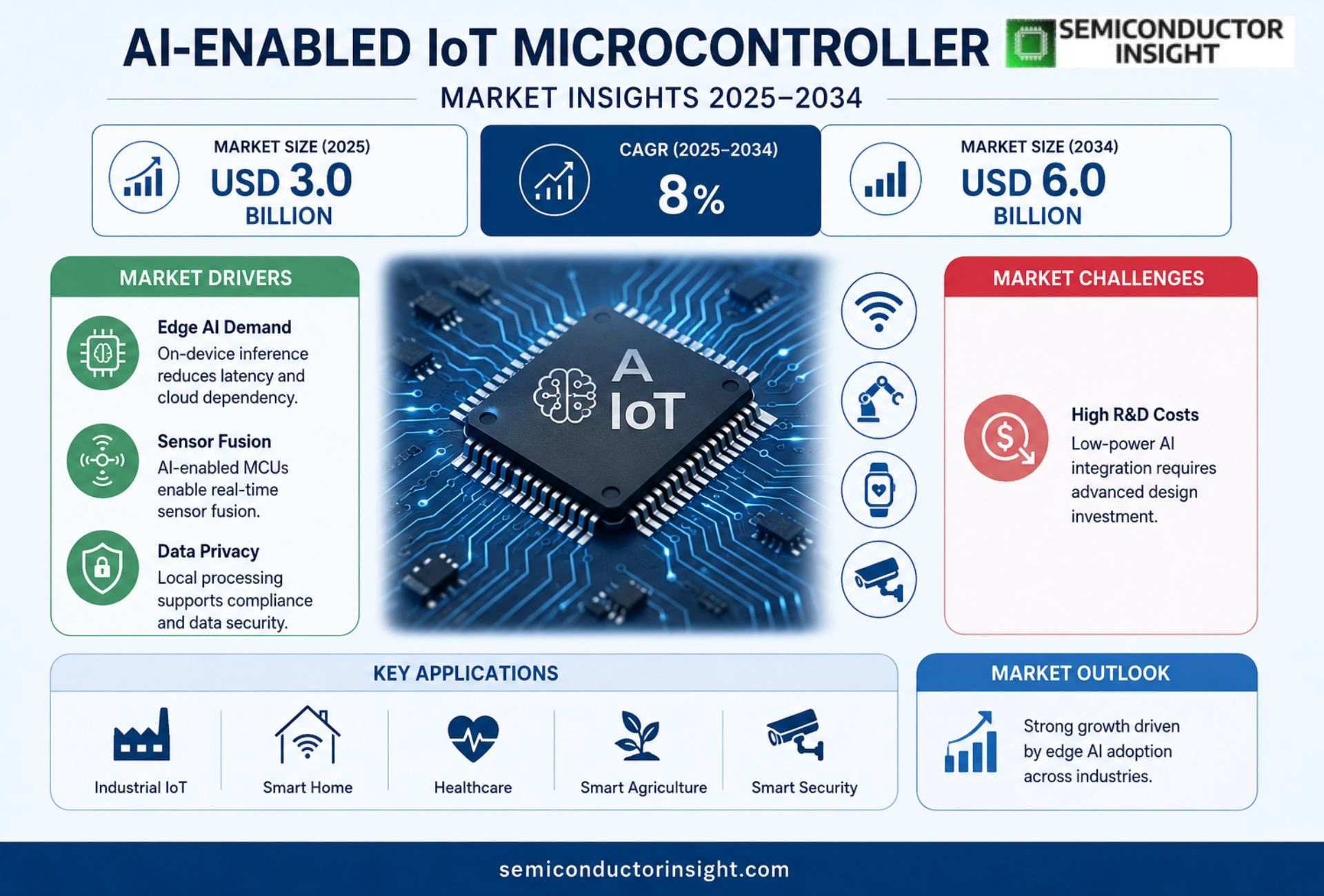
Global AI-enabled IoT microcontroller market size was valued at USD 3 billion in 2025. The market is projected to grow from USD 3 billion in 2025 to USD 6 billion by 2034, exhibiting a CAGR of 8 % during the forecast period.
AI‑enabled IoT microcontrollers are low‑power semiconductor devices that embed neural‑network inference engines directly on the chip while providing built‑in wireless protocols such as Wi‑Fi, Bluetooth LE, LoRa or cellular connectivity. By processing sensor data at the edge, these controllers reduce latency, lower bandwidth costs and enable autonomous decision‑making for applications ranging from smart homes to industrial robotics.
The market is gaining momentum because enterprises are shifting toward edge computing to meet real‑time analytics requirements, while manufacturers seek energy‑efficient solutions for massive device deployments. Advances in compact machine‑learning models and supportive development ecosystems accelerate adoption across sectors like automotive telematics and healthcare wearables.
Key participants such as STMicroelectronics, NXP Semiconductors, Texas Instruments, Renesas Electronics and Infineon Technologies are expanding their portfolios through new product launches and strategic alliances aimed at strengthening AI capabilities on resource‑constrained devices.
MARKET DRIVERS
Edge-Computing Demand Across Industries
The rise of on‑device inference reduces latency for mission‑critical applications such as predictive maintenance and autonomous robotics. Companies that embed AI‑capable microcontrollers can offload cloud processing, resulting in lower bandwidth costs and heightened data privacy,a competitive edge that many manufacturers now deem essential.
Convergence of Sensor Fusion and AI Algorithms
Modern IoT deployments increasingly rely on multiple sensor streams (temperature, vibration, visual) that must be interpreted in real time. AI‑Enabled IoT Microcontroller Market offerings that integrate neural‑net accelerators enable seamless sensor fusion, empowering products to make autonomous decisions without external compute resources.
➤ “Embedding inference at the edge transforms raw data into actionable insights within milliseconds, a shift that redefines product value propositions.”
Regulatory pressures around data sovereignty are prompting firms to keep processing locally. By adopting AI‑enabled microcontrollers, firms satisfy compliance mandates while preserving the agility needed for rapid product iteration.
MARKET CHALLENGES
Escalating R&D Costs for Low‑Power AI Integration
Designing microcontrollers that balance neural‑net performance with sub‑milliwatt power envelopes demands specialized silicon expertise. Smaller OEMs often lack the capital to fund such development, creating a barrier to entry that favors well‑funded incumbents.
Other Challenges
Supply‑Chain Volatility
Global shortages of advanced semiconductor substrates and memory components compress lead times, forcing manufacturers to buffer inventory or risk shipment delays.
Security concerns also surface, as adding programmable AI layers expands the attack surface. Vendors must prioritize robust encryption and secure boot mechanisms, inflating development budgets.
MARKET RESTRAINTS
Limited Standardization Across AI Frameworks
Fragmented support for competing AI inference engines hampers cross‑platform portability. Engineers spend considerable effort adapting models to proprietary toolchains, slowing time‑to‑market for new features.
The learning curve associated with optimizing neural‑net architectures for constrained silicon adds another layer of complexity, deterring firms that lack in‑house AI talent.
Finally, legacy product lines that depend on conventional microcontrollers often cannot be retrofitted with AI capabilities without costly redesigns, limiting overall market penetration.
MARKET OPPORTUNITIES
Growth in Edge‑AI Applications for Smart Infrastructure
Urban planners are increasingly incorporating intelligent traffic control, energy‑grid balancing, and environmental monitoring,all of which benefit from low‑latency decision making at the device level. AI‑Enabled IoT Microcontroller Market solutions that streamline deployment in these contexts stand to capture a sizable share of upcoming municipal contracts.
Healthcare wearables equipped with on‑device anomaly detection represent another fertile segment. By processing biometric signals locally, devices can alert users instantly while preserving patient confidentiality, a value proposition that resonates with both consumers and regulators.
Finally, the emergence of modular AI co‑processor add‑ons opens a pathway for legacy hardware manufacturers to upgrade existing product families without a full silicon redesign, creating an upgrade market that complements new design initiatives.
AI-Enabled IoT Microcontroller Market Trends
Edge‑Centric Intelligence Becomes a Business Imperative
Enterprises are re‑architecting product lines to move inference workloads from cloud data centers to the edge. By embedding neural‑network engines directly in low‑power microcontrollers, manufacturers can react to sensor inputs within milliseconds, avoiding the latency penalties of distant servers. This shift is especially relevant for applications that cannot tolerate network interruptions, such as industrial automation and remote health monitoring. The ability to process data locally also reduces operational spend on bandwidth, because only aggregated insights need transmission. Consequently, product development roadmaps now prioritize chips that combine connectivity stacks,Wi‑Fi, Bluetooth LE, LoRa, or cellular,with on‑chip AI, a combination that directly addresses the twin pressures of responsiveness and cost efficiency.
Other Trends
Hardware‑Level AI Accelerators
Chip designers are integrating dedicated matrix‑multiply units and sparsity‑aware engines to boost inference speed without inflating power budgets. These accelerators are optimized for compact machine‑learning models, enabling tasks such as voice activation, anomaly detection, and predictive maintenance on devices powered by small batteries. Leading suppliers have rolled out families of controllers that feature configurable compute blocks, allowing OEMs to tailor performance to specific use cases while preserving the same silicon footprint. The presence of such hardware primitives reduces reliance on external processors, streamlining bill‑of‑materials and simplifying board design.
Software Ecosystem Expansion
The momentum behind the AI‑Enabled IoT Microcontroller Market is reinforced by a burgeoning suite of development tools, libraries, and pre‑trained models that abstract the complexity of on‑device AI. Open‑source frameworks now support automatic quantization and pruning, translating large‑scale neural networks into formats that fit within a few hundred kilobytes of flash memory. Cloud‑based compilation services further lower entry barriers, allowing engineers to generate optimized binaries with minimal manual tuning. As the software stack matures, start‑ups and established manufacturers alike are able to shorten time‑to‑market, experiment with new form factors, and diversify application portfolios without incurring prohibitive engineering overhead.
COMPETITIVE LANDSCAPE
Key Industry Players
AI‑Enabled IoT Microcontroller Market – Competitive Overview
The upper tier of the AI‑enabled IoT microcontroller arena is dominated by a handful of semiconductor powerhouses that have leveraged deep‑learning inference blocks and integrated wireless stacks to attract high‑volume customers. STMicroelectronics has built a comprehensive portfolio that couples ultra‑low‑power Cortex‑M cores with proprietary neural‑network libraries, positioning it as a first‑choice supplier for automotive telematics and industrial edge gateways. NXP Semiconductors follows a similar trajectory, emphasizing secure edge compute and multi‑protocol radios, which has helped it secure long‑term design‑win agreements with major automotive OEMs. Texas Instruments differentiates through its extensive analog front‑end expertise, enabling seamless sensor integration on the same die as AI accelerators, a combination that resonates with manufacturers of wearables and smart‑home hubs. Renesas Electronics and Infineon Technologies have each announced next‑generation families that embed vector‑processing units, targeting sectors where deterministic latency and functional safety are non‑negotiable. Collectively, these firms shape the market’s pricing cadence, set reference designs, and drive the ecosystem of development tools that smaller entrants must adopt.
Beyond the headline names, a vibrant cohort of specialist firms is expanding the functional envelope of AI‑enabled edge devices. Silicon Labs focuses on secure, low‑energy connectivity, delivering tightly coupled BLE and Thread radios that complement on‑chip AI kernels for smart‑building applications. Nordic Semiconductor has carved a niche in ultra‑low‑power Bluetooth LE solutions, now adding lightweight inference engines tailored for health‑monitoring wearables. MediaTek and Qualcomm are pushing the envelope in cellular‑first IoT modules, embedding AI blocks that can preprocess video streams before uplink, a capability increasingly demanded by smart‑city deployments. Analog Devices brings high‑precision analog front‑ends into the mix, allowing edge AI to operate directly on noisy industrial signals. Murata, Microchip Technology, and Ambarella round out the ecosystem, each supplying domain‑specific packages,ranging from RF‑optimized modules to vision‑centric processors,that deepen the market’s addressable use cases and force the leading vendors to continuously broaden their roadmaps.
List of Key AI‑Enabled IoT Microcontroller Companies Profiled
- STMicroelectronics
- NXP Semiconductors
- Texas Instruments
- Renesas Electronics
- Infineon Technologies
- Silicon Labs
- Nordic Semiconductor
- MediaTek
- Qualcomm
- Analog Devices
- Murata Manufacturing
- Microchip Technology
- Ambarella
Segment Analysis:
| Segment Category | Sub-Segments | Key Insights |
| By Type |
|
Low‑Power MCU is driving adoption because it enables continuous edge inference while preserving battery life. • Designers prioritize ultra‑low static power to support massive sensor networks. • Integration of compact neural‑network kernels allows real‑time decision making without cloud reliance. • Ecosystem support from major silicon vendors accelerates time‑to‑market for AI‑enabled products. |
| By Application |
|
Smart Home emerges as the leading application due to its demand for localized intelligence and seamless connectivity. • Voice‑activated assistants benefit from on‑device speech recognition, reducing latency. • Energy‑optimizing controllers manage HVAC and lighting based on real‑time occupancy data. • Integrated security modules provide privacy‑preserving processing for camera streams. |
| By End User |
|
Consumer Electronics leads the end‑user segment, driven by the proliferation of connected gadgets that require on‑device AI. • Wearable fitness trackers use microcontrollers to interpret motion patterns locally. • Smart appliances incorporate predictive maintenance logic without cloud dependency. • Manufacturers emphasize cost‑effective AI chips to maintain competitive pricing. |
| By Connectivity |
|
Wi‑Fi is the dominant connectivity option for AI‑enabled IoT microcontrollers in consumer and enterprise settings. • High data‑rate links support rapid model updates and firmware over‑the‑air. • Mature ecosystem of routers and cloud services simplifies integration. • Energy‑saving Wi‑Fi standards align with low‑power AI workloads. |
| By AI Capability |
|
On‑Device Inference defines the core value proposition of AI‑enabled microcontrollers. • Immediate processing of sensor streams eliminates round‑trip latency. • Reduces reliance on network bandwidth, cutting operational costs. • Enables deterministic behavior essential for safety‑critical industrial and automotive applications. |
Regional Analysis: AI-Enabled IoT Microcontroller Market
North America
Silicon Valley’s design houses are experimenting with heterogeneous integration, pairing AI cores directly with analog front‑ends. This architecture reduces board footprint and improves power efficiency, which is essential for battery‑constrained IoT nodes. The proximity of design talent, foundry access, and software frameworks creates a rapid prototyping loop that shortens time‑to‑market for next‑generation controllers.
Recent trade disruptions prompted North American firms to diversify component sourcing, emphasizing domestic fabs and multi‑sourcing strategies. This shift mitigates lead‑time volatility and ensures that AI‑enhanced chips remain available for critical defense and infrastructure projects, reinforcing confidence among large‑scale adopters.
Fortune‑500 manufacturers are piloting edge‑AI controllers to extract actionable insights directly from sensor streams, bypassing cloud latency. The resulting operational agility,faster fault detection, dynamic quality control,creates a compelling business case that justifies premium pricing for AI‑enabled silicon.
U.S. agencies have released guidelines on AI transparency and data sovereignty for embedded devices. Compliance requirements are steering vendors toward on‑device inference, which fuels demand for microcontrollers that embed secure AI kernels alongside hardware‑level encryption.
Europe
European manufacturers are capitalizing on the continent’s strong focus on sustainability and data protection. AI-enabled IoT microcontroller Market benefits from a policy environment that encourages energy‑efficient designs, prompting OEMs to select low‑power AI cores that align with the EU’s Green Deal objectives. Moreover, stringent GDPR‑style regulations for edge analytics push vendors to embed privacy‑preserving inference within the chip, reducing the need for data transmission to centralized clouds. Collaborative research programs between German engineering firms and French AI labs have produced domain‑specific models for smart grids, showcasing how cross‑border alliances are translating regulatory pressure into technical advantage. These dynamics position Europe as a fertile ground for applications where compliance and efficiency intersect.
Asia‑Pacific
The Asia‑Pacific region is distinguished by a massive base of device manufacturers and a rapidly expanding consumer IoT segment. While cost remains a decisive factor, AI-enabled IoT microcontroller Market is witnessing a shift toward value‑added differentiation rather than pure price competition. Companies in China, South Korea, and Japan are embedding lightweight neural networks to enable on‑device voice assistants and vision systems in affordable wearables. Meanwhile, the region’s governments are investing in smart city initiatives that demand localized AI processing at the edge, prompting local chipmakers to tailor solutions for dense sensor networks. The convergence of scale, policy support, and emerging use cases is reshaping the competitive landscape across the Asia‑Pacific.
South America
In South America, agricultural technology and remote health monitoring are the primary catalysts for adoption. AI-enabled IoT microcontroller Market finds relevance in precision farming platforms that require on‑site analysis of soil moisture and pest detection without reliable connectivity. Similarly, tele‑medicine devices that perform preliminary diagnostics rely on on‑chip AI to deliver rapid feedback in underserved regions. Local startups are partnering with multinational chip vendors to customize low‑power AI microcontrollers that can endure harsh field conditions, indicating a niche but growing demand driven by sector‑specific challenges.
Middle East & Africa
The Middle East & Africa region sees AI-enabled IoT microcontroller Market gaining traction through infrastructure projects and renewable‑energy deployments. In the Gulf, smart‑building initiatives demand edge AI for predictive maintenance of HVAC and security systems, while in Africa, off‑grid solar solutions incorporate AI-driven power‑management controllers to maximize energy harvest. The scarcity of reliable broadband in many locales incentivizes on‑device inference, which reduces reliance on intermittent networks. Partnerships between regional telecom operators and semiconductor firms are fostering localized design hubs that address both climatic robustness and cost sensitivity, laying groundwork for broader market penetration.
Report Scope
This market research report provides a comprehensive analysis of the AI-Enabled IoT Microcontroller Market , covering the forecast period 2026–2034. It offers detailed insights into market dynamics, technological advancements, competitive landscape, and key trends shaping the industry.
Key focus areas of the report include:
- Market Overview: The report begins with an overview outlining its current market scenario, key growth indicators, and industry transformation drivers. It discusses macroeconomic factors, demand–supply balance, regulatory landscape, and the strategic role of semiconductors in powering advancements across industries such as automotive, telecommunications, consumer electronics, and industrial automation.
- Market Size & Forecast: Historical data and future projections for revenue, unit shipments, and market value across major regions and segments.
- Segmentation Analysis: Detailed breakdown by product type, technology, application, and end-user industry to identify high-growth segments and investment opportunities.
- Regional Insights: Insights into market performance across North America, Europe, Asia-Pacific, Latin America, and the Middle East & Africa, including country-level analysis where relevant.
- Competitive Landscape: Profiles of leading market participants, including their product offerings, R&D focus, manufacturing capacity, pricing strategies, and recent developments such as mergers, acquisitions, and partnerships.
- Technology Trends & Innovation: Assessment of emerging technologies, integration of AI/IoT, semiconductor design trends, fabrication techniques, and evolving industry standards.
- Market Drivers & Restraints: Evaluation of factors driving market growth along with challenges, supply chain constraints, regulatory issues, and market-entry barriers.
- Stakeholder Insights: Insights for component suppliers, OEMs, system integrators, investors, and policymakers regarding the evolving ecosystem and strategic opportunities.
Primary and secondary research methods are employed, including interviews with industry experts, data from verified sources, and real-time market intelligence to ensure the accuracy and reliability of the insights presented.
FREQUENTLY ASKED QUESTIONS:
What is the current market size of AI-Enabled IoT Microcontroller Market?
-> AI-enabled IoT microcontroller market is projected to grow from USD 3 billion in 2025 to USD 6 billion by 2034, exhibiting a CAGR of 8 %
Which key companies operate in AI-Enabled IoT Microcontroller Market?
-> Key players include STMicroelectronics, NXP Semiconductors, Texas Instruments, Renesas Electronics, and Infineon Technologies, among others.
What are the key growth drivers?
-> Key growth drivers include shift toward edge computing, demand for real‑time analytics, and need for energy‑efficient massive device deployments.
Which region dominates the market?
-> Asia-Pacific is the fastest-growing region, while Europe remains a dominant market.
What are the emerging trends?
-> Emerging trends include compact machine‑learning models, supportive development ecosystems, and strategic alliances to strengthen AI capabilities on resource‑constrained devices.

Get Sample Report PDF for Exclusive Insights
Report Sample Includes
- Table of Contents
- List of Tables & Figures
- Charts, Research Methodology, and more...
 Download Sample Report PDF