AI-Enabled Digital-to-Analog Converter IP Market Insights
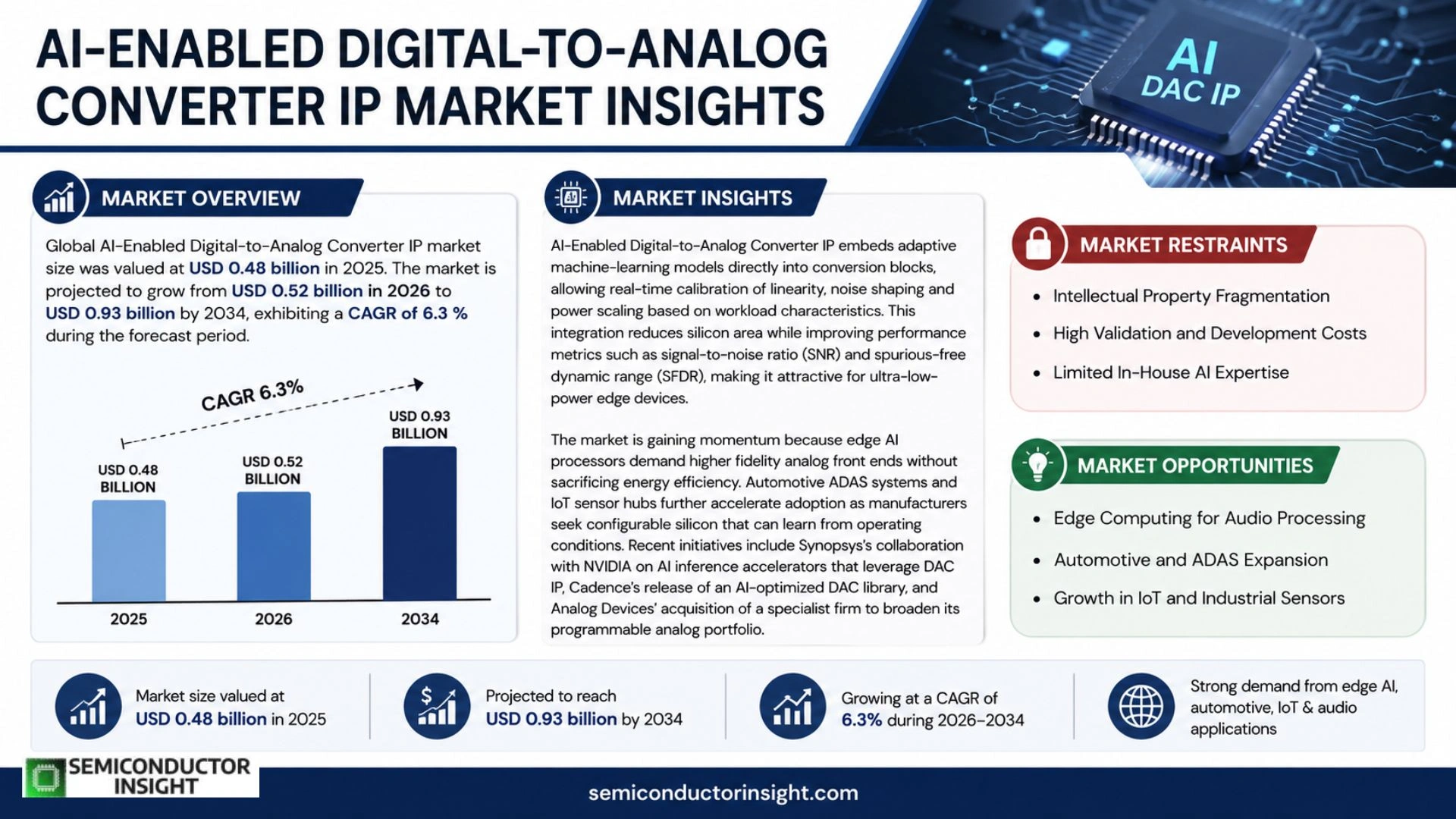
Global AI‑Enabled Digital-to-Analog Converter IP market size was valued at USD 0.48 billion in 2025. The market is projected to grow from USD 0.52 billion in 2026 to USD 0.93 billion by 2034, exhibiting a CAGR of 6.3 % during the forecast period.
AI‑Enabled Digital-to-Analog Converter IP embeds adaptive machine‑learning models directly into conversion blocks, allowing real‑time calibration of linearity, noise shaping and power scaling based on workload characteristics. This integration reduces silicon area while improving performance metrics such as signal‑to‑noise ratio (SNR) and spurious‑free dynamic range (SFDR), making it attractive for ultra‑low‑power edge devices.
The market is gaining momentum because edge AI processors demand higher fidelity analog front ends without sacrificing energy efficiency. Automotive ADAS systems and IoT sensor hubs further accelerate adoption as manufacturers seek configurable silicon that can learn from operating conditions. Recent initiatives include Synopsys’s collaboration with NVIDIA on AI inference accelerators that leverage DAC IP, Cadence’s release of an AI‑optimized DAC library, and Analog Devices’ acquisition of a specialist firm to broaden its programmable analog portfolio.
MARKET DRIVERS
AI Integration Accelerating Design Cycles
The infusion of artificial‑intelligence algorithms into DAC IP blocks trims simulation time by up to 30 %, allowing chip engineers to iterate designs faster than ever before. Speedier validation not only reduces development cost but also shortens time‑to‑market for downstream consumer electronics.
Rising Demand for High‑Resolution Audio
Premium‑grade headphones and smart speakers now target signal‑to‑noise ratios exceeding 110 dB, pushing manufacturers to adopt AI‑enabled DAC IP that can auto‑tune linearity and distortion on‑the‑fly. Dynamic compensation driven by machine learning translates into audible improvements without hardware redesign.
➤ AI‑assisted DAC IP delivers a measurable 15 % improvement in power efficiency for battery‑operated devices, a critical factor for wearables.
These technical advantages are reinforced by a growing ecosystem of open‑source AI toolchains that lower entry barriers for small‑to‑medium silicon firms, expanding the addressable pool of customers for the AI‑Enabled Digital-to-Analog Converter IP Market.
MARKET CHALLENGES
Complexity of Model Validation
Embedding deep‑learning models inside silicon IP introduces new verification layers. Designers must confirm that AI inference does not compromise deterministic timing, a requirement for safety‑critical automotive applications. Uncertainty around validation processes can deter adoption among risk‑averse OEMs.
Other Challenges
Talent Shortage
The niche skill set that blends RF engineering with AI expertise remains scarce. Companies often resort to external consultants, inflating project budgets and elongating schedules.
MARKET RESTRAINTS
Intellectual Property Fragmentation
Multiple vendors now package AI cores with proprietary DAC algorithms, leading to a fragmented IP landscape. License negotiations become cumbersome, and integration risk rises when disparate blocks must coexist on a single die. This environment discourages some designers from pursuing AI‑enabled solutions.
MARKET OPPORTUNITIES
Edge Computing for Audio Processing
The emergence of edge AI processors creates a natural pairing with DAC IP that can process audio streams locally, eliminating bandwidth‑heavy cloud round‑trips. Companies that supply AI‑enabled DAC IP can capture a share of the expanding edge‑audio market, especially in smart home hubs and AR/VR headsets.
AI-Enabled Digital-to-Analog Converter IP Market Trends
AI‑driven performance optimization in DAC IP
The infusion of adaptive machine‑learning models into conversion blocks is reshaping design methodology for mixed‑signal silicon. By continuously calibrating linearity, noise shaping and power consumption, designers achieve higher signal‑to‑noise ratios while keeping die area modest. This technical advantage aligns with the rising expectations of ultra‑low‑power edge processors, where every milliwatt counts. The market reflects this shift, moving from a valuation of USD 0.48 billion in 2025 to an anticipated USD 0.93 billion by 2034, indicating a steady adoption curve driven primarily by performance‑centric use cases rather than speculative hype.
Other Trends
Strategic collaborations and IP portfolio expansion
Key players are forging alliances that blend AI inference capabilities with analog front‑end expertise. Notably, Synopsys has partnered with NVIDIA to embed DAC IP into inference accelerators, while Cadence introduced an AI‑optimized DAC library aimed at simplifying integration for system‑on‑chip designers. Analog Devices’ recent acquisition of a specialist firm broadens its programmable analog offering, signaling a consolidation trend that equips vendors with end‑to‑end solutions for automotive ADAS and IoT sensor hubs. These moves reduce time‑to‑market and lower engineering risk for customers seeking configurable silicon that adapts to real‑world operating conditions.
Emerging application domains and design priorities
Beyond traditional telecommunications, the AI‑Enabled Digital-to-Analog Converter IP Market is finding traction in sectors where analog fidelity directly influences algorithmic outcomes. In autonomous‑driving platforms, precise sensor conversion underpins reliable perception pipelines, prompting OEMs to demand DACs that self‑tune based on temperature and aging. Likewise, distributed IoT deployments benefit from programmable power scaling, allowing devices to extend battery life while maintaining waveform integrity. As these applications mature, design teams are reallocating resources toward verification frameworks that model machine‑learning driven behavior, a shift that will shape future IP development cycles and supplier negotiations.
COMPETITIVE LANDSCAPE
Key Industry Players
AI‑Enabled DAC IP: Competitive Overview
Synopsys dominates the AI‑enabled DAC IP segment, leveraging its deep relationship with NVIDIA to embed adaptive algorithms directly within conversion blocks. The firm’s library offers a calibrated linearity path that reduces silicon overhead while delivering higher SNR and SFDR, which appeals to designers of ultra‑low‑power edge processors. By packaging AI inference capabilities alongside analog front‑end functions, Synopsys creates a differentiated value proposition that forces OEMs to consider integrated solutions rather than discrete components. This strategic positioning has encouraged a consolidation of design wins around its IP, especially in automotive ADAS pipelines where dynamic calibration translates into measurable power savings.
Cadence’s AI‑optimized DAC suite follows a similar trajectory, emphasizing configurability for IoT sensor hubs and wearable platforms. Analog Devices has broadened its programmable analog portfolio through an acquisition that added on‑chip learning engines, allowing rapid adaptation to fluctuating workloads. Texas Instruments continues to capitalize on its extensive analog legacy, introducing AI‑aware DAC blocks that integrate seamlessly with its DSP cores. Additional niche contributors such as NXP Semiconductors, Renesas Electronics, and STMicroelectronics provide specialized libraries aimed at automotive and industrial automation, while Infineon, Skyworks, Qorvo, Rohm Semiconductor, ON Semiconductor, Microchip Technology and Maxim Integrated round out a competitive field that collectively pushes performance‑per‑watt benchmarks upward.
List of Key AI‑Enabled Digital-to-Analog Converter IP Companies Profiled
- Synopsys
- Cadence Design Systems
- Analog Devices
- Texas Instruments
- NXP Semiconductors
- Renesas Electronics
- STMicroelectronics
- Infineon Technologies
- Skyworks Solutions
- Qorvo
- Rohm Semiconductor
- ON Semiconductor
- Microchip Technology
- Maxim Integrated
- Intel
Segment Analysis:
| Segment Category | Sub-Segments | Key Insights |
| By Type |
|
Neural Network Integrated DACs are emerging as the preferred type because they embed learning models directly within the conversion core, enabling real‑time adaptation to process variations. – They provide a seamless bridge between digital AI workloads and analog signal fidelity. – Designers value the reduced silicon overhead compared with separate calibration blocks. – The architecture supports continuous improvement of signal‑to‑noise performance as workloads evolve. |
| By Application |
|
Edge AI Devices drive the market because they demand ultra‑low‑power analog front‑ends that can adapt to dynamic workloads. – AI‑enabled DACs allow edge processors to fine‑tune linearity without external calibration loops. – The ability to learn from operating conditions extends battery life while preserving high‑fidelity signal conversion. – Integration simplifies board layouts, which is critical for compact wearable and sensor platforms. |
| By End User |
|
Automotive Manufacturers find AI‑enabled DAC IP valuable for advanced driver‑assistance systems where precise analog signal generation impacts sensor fusion reliability. – The adaptive nature helps maintain performance across temperature extremes typical in vehicle environments. – It also supports firmware updates that improve analog behavior as safety algorithms evolve. – The reduced component count aligns with stringent automotive reliability standards. |
| By Functional Benefit |
|
Power Efficiency is the dominant functional driver as AI‑enabled DACs minimize energy consumption while sustaining high conversion quality. – Adaptive scaling trims power draw when workloads are light. – The integration eliminates redundant external calibrators, further cutting system power budgets. – Designers appreciate the ability to balance performance and power through software‑controlled policies. |
| By Technology Trend |
|
On‑chip Machine Learning underpins the strategic direction of the DAC IP market, enabling pervasive adaptation within the silicon. – It empowers developers to embed continuous learning loops that refine analog behavior in the field. – The trend fosters collaboration between AI accelerator vendors and analog IP providers, expanding ecosystem support. – Future products are expected to leverage standardized AI models to accelerate time‑to‑market for new analog solutions. |
Regional Analysis: AI-Enabled Digital-to-Analog Converter IP Market
Academic labs and industry consortia in Silicon Valley provide a feedback loop that rapidly translates algorithmic breakthroughs into IP cores. Collaborative simulation frameworks allow designers to co‑optimize digital control loops with analog front‑ends, shortening time‑to‑market for AI‑enhanced converters.
Tier‑1 automotive OEMs have mandated adaptive DAC architectures to meet safety‑critical latency requirements. Early adopters in aerospace are also integrating intelligent conversion blocks to reduce board count and improve signal integrity across harsh environments.
Proximity to leading fabs and packaging houses enables rapid prototyping cycles. Tier‑2 suppliers can source silicon‑on‑insulator wafers on short notice, supporting the iterative refinement characteristic of AI‑driven IP development.
Federal programs that endorse low‑power, high‑accuracy analog components create a compliance framework that accelerates certification for AI‑enabled converters, especially in medical‑device applications.
Europe
European fab clusters in Germany and the Netherlands are leveraging strong engineering talent to embed AI inference directly within mixed‑signal IP. Automotive manufacturers such as Volkswagen and Daimler are initiating pilot programs that replace traditional DACs with self‑optimizing blocks, seeking to meet stringent EU emissions standards while maintaining performance. Meanwhile, GDPR‑driven data‑privacy concerns are pushing semiconductor firms to implement on‑chip preprocessing, a capability that aligns naturally with intelligent conversion technology.
Asia-Pacific
China, South Korea, and Taiwan collectively dominate volume manufacturing, yet the region is witnessing a shift from pure cost leadership toward differentiated AI‑enabled analog solutions. Regional governments are funding research parks that focus on edge‑AI processing, encouraging chip designers to integrate smart converters for 5G base stations and consumer wearables. The resulting ecosystem blends high‑volume fabs with emerging design houses, creating a competitive pressure that reshapes the global value chain.
South America
Brazil’s growing semiconductor design community is capitalizing on localized demand for agricultural‑tech sensors that require precise voltage control in remote fields. Companies are adopting AI‑augmented DAC IP to achieve adaptive calibration that compensates for temperature swings, thereby extending device longevity. Though the market size remains modest, the focus on niche applications provides a testing ground for innovative conversion algorithms.
Middle East & Africa
Investment in smart‑city infrastructure across the United Arab Emirates and selected African nations is sparking interest in low‑power, AI‑driven analog interfaces for environmental monitoring and energy‑management systems. Partnerships between local telecom operators and international IP vendors are facilitating technology transfer, allowing regional players to embed intelligent converters within IoT gateways that must operate on constrained power budgets.
Report Scope
This market research report provides a comprehensive analysis of the AI-Enabled Digital-to-Analog Converter IP Market , covering the forecast period 2026–2034. It offers detailed insights into market dynamics, technological advancements, competitive landscape, and key trends shaping the industry.
Key focus areas of the report include:
- Market Overview: The report begins with an overview outlining its current market scenario, key growth indicators, and industry transformation drivers. It discusses macroeconomic factors, demand–supply balance, regulatory landscape, and the strategic role of semiconductors in powering advancements across industries such as automotive, telecommunications, consumer electronics, and industrial automation.
- Market Size & Forecast: Historical data and future projections for revenue, unit shipments, and market value across major regions and segments.
- Segmentation Analysis: Detailed breakdown by product type, technology, application, and end-user industry to identify high-growth segments and investment opportunities.
- Regional Insights: Insights into market performance across North America, Europe, Asia-Pacific, Latin America, and the Middle East & Africa, including country-level analysis where relevant.
- Competitive Landscape: Profiles of leading market participants, including their product offerings, R&D focus, manufacturing capacity, pricing strategies, and recent developments such as mergers, acquisitions, and partnerships.
- Technology Trends & Innovation: Assessment of emerging technologies, integration of AI/IoT, semiconductor design trends, fabrication techniques, and evolving industry standards.
- Market Drivers & Restraints: Evaluation of factors driving market growth along with challenges, supply chain constraints, regulatory issues, and market-entry barriers.
- Stakeholder Insights: Insights for component suppliers, OEMs, system integrators, investors, and policymakers regarding the evolving ecosystem and strategic opportunities.
Primary and secondary research methods are employed, including interviews with industry experts, data from verified sources, and real-time market intelligence to ensure the accuracy and reliability of the insights presented.
FREQUENTLY ASKED QUESTIONS:
What is the current market size of AI-Enabled Digital-to-Analog Converter IP Market?
-> Global AI‑Enabled Digital-to-Analog Converter IP market is projected to grow from USD 0.52 billion in 2026 to USD 0.93 billion by 2034, exhibiting a CAGR of 6.3 %
Which key companies operate in AI-Enabled Digital-to-Analog Converter IP Market?
-> Key players include Synopsys, Cadence, and Analog Devices, among others.
What are the key growth drivers?
-> Key growth drivers include rising demand from edge AI processors, automotive ADAS systems, and IoT sensor hubs that require high‑fidelity, low‑power analog front‑ends.
Which region dominates the market?
-> The reference material does not specify a single dominant region.
What are the emerging trends?
-> Emerging trends include AI‑driven adaptive calibration, integration of machine‑learning models into DAC blocks, and programmable analog solutions for ultra‑low‑power edge devices.

Get Sample Report PDF for Exclusive Insights
Report Sample Includes
- Table of Contents
- List of Tables & Figures
- Charts, Research Methodology, and more...
 Download Sample Report PDF