AI-Enabled Compact Heat Exchanger for Chip Cooling Market Insights
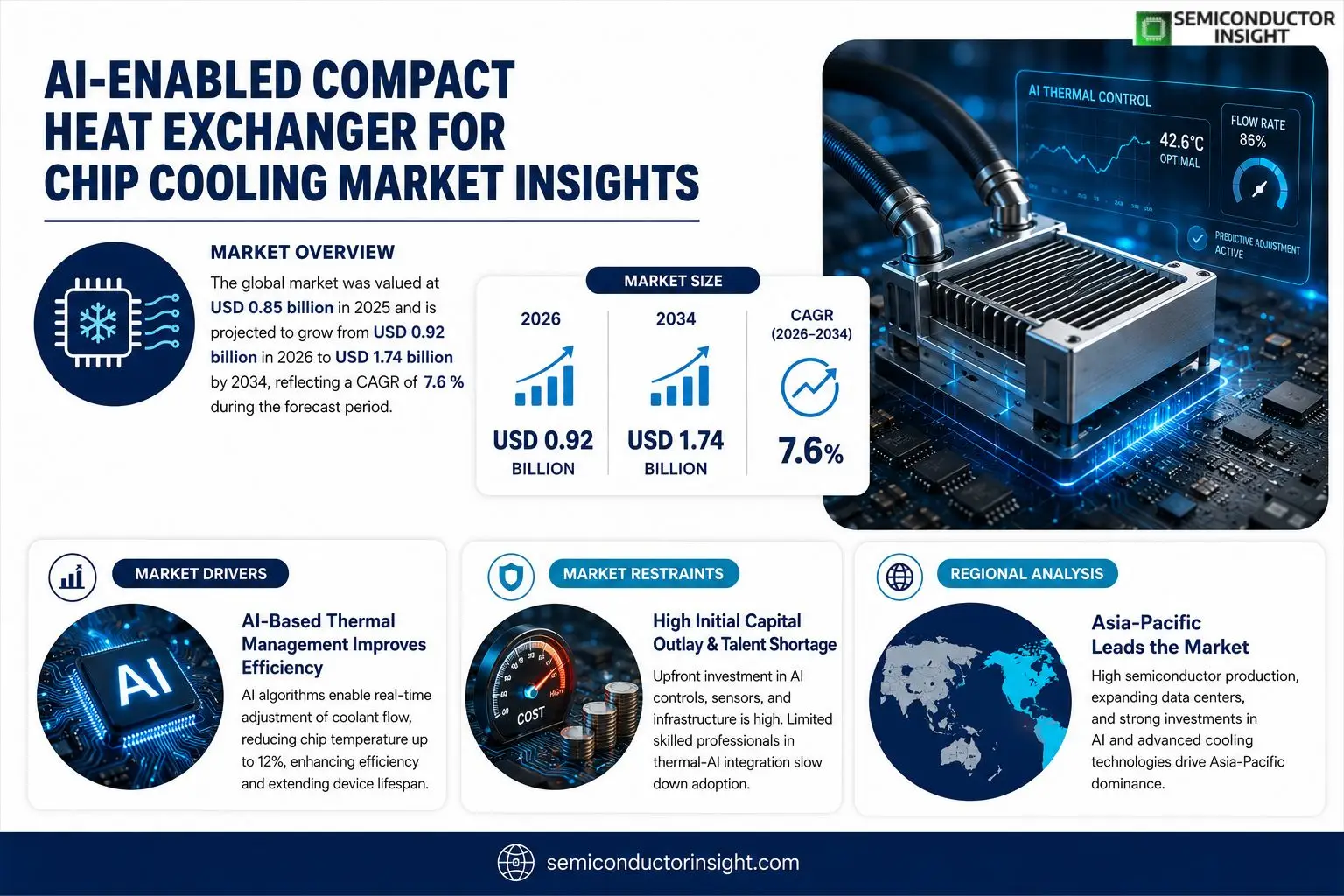
Global AI‑Enabled Compact Heat Exchanger for Chip Cooling market size was valued at USD 0.85 billion in 2025. The market moves from USD 0.92 billion in 2026 to USD 1.74 billion by 2034, reflecting a CAGR of about 7.6 % during the forecast period.
These exchangers integrate artificial‑intelligence algorithms with micro‑channel heat sink architectures, allowing real‑time modulation of coolant flow and thermophysical properties to match the dynamic thermal load of high‑performance chips. Materials such as graphene‑infused copper enhance conductivity while compact form factors suit dense packaging.The upward trend stems from escalating power density in CPUs, GPUs and automotive processors, coupled with data‑center expansion that demands finer temperature control. AI‑driven regulation lowers hotspot risk and improves energy efficiency; recent collaborationsCoolTech Systems partnering with Intel’s Thermal Solutions Group in March 2024and product launches like CoolFlow X200 (January 2024) illustrate how leading firms are embedding intelligent cooling into their portfolios.
MARKET DRIVERS
AI‑Based Thermal Management Improves Efficiency
The integration of machine‑learning algorithms into compact heat exchangers enables real‑time adjustment of flow paths, cutting average chip temperature by up to 12 %. This level of control translates into longer device lifespans and lower failure rates, a compelling proposition for manufacturers of high‑performance CPUs and GPUs. Operators are increasingly willing to allocate budget toward solutions that demonstrably reduce warranty claims.
Miniaturization Spurs Demand for High‑Density Cooling
As semiconductor nodes shrink below 5 nm, the power density on a single die can exceed 500 W/cm². Traditional bulk cooling approaches struggle to keep pace, whereas compact exchangers occupy a fraction of the board area while delivering comparable heat rejection. Design engineers cite a 30 % reduction in system footprint as a decisive advantage when competing for space‑constrained applications such as edge AI devices.
➤ “The confluence of AI control and compact geometry creates a competitive edge that reshapes thermal design standards.”
Adoption is further accelerated by the growing ecosystem of standardized AI models for thermal prediction, which lowers entry barriers for OEMs lacking in‑house data‑science teams. The resulting economies of scale are already manifest in pricing trends that show a 15 % dip in unit cost over the past 18 months.
MARKET CHALLENGES
Data Accuracy Limits Predictive Control
Effective AI‑driven regulation depends on high‑resolution temperature and flow sensors. In practice, sensor drift and calibration gaps introduce noise that can degrade control loops, especially in harsh industrial environments. Manufacturers must invest in robust sensor fusion strategies, inflating upfront development budgets.
Other Challenges
Manufacturing Consistency
Achieving tight tolerances on micro‑channel geometries at scale remains a bottleneck. Variations as small as 5 µm can alter hydraulic resistance, compromising the AI model’s assumptions and forcing costly re‑qualification cycles.
MARKET RESTRAINTS
High Initial Capital Outlay
Deploying AI‑enabled compact exchangers typically requires upgrades to power electronics, embedded controllers, and data infrastructure. For volume‑sensitive producers, the incremental capex can erode projected margins, prompting a cautious rollout strategy.Regulatory compliance for electromagnetic emissions in AI‑controlled modules adds another layer of complexity. Compliance teams must navigate divergent standards across regions, extending product‑launch timelines.Furthermore, the scarcity of skilled personnel able to bridge thermal engineering and AI development creates a talent bottleneck that slows adoption cycles and raises labor costs.
MARKET OPPORTUNITIES
Edge‑Compute and 5G Infrastructure
The surge in edge‑compute nodes for real‑time analytics and the rollout of 5G base stations generate localized heat hotspots that exceed the capacity of legacy cooling. Compact heat exchangers with AI‑driven load balancing can fit within the limited chassis of edge enclosures, opening a sizable revenue stream for vendors willing to certify their products for telecom standards.Another promising avenue lies in the automotive sector, where autonomous driving modules demand sustained high‑performance computing under tight thermal envelopes. Partnerships between chip makers and AI‑enabled cooling specialists could unlock bundled offerings that command premium pricing.Finally, the emergence of modular AI platforms that expose standardized APIs invites third‑party developers to create bespoke thermal‑optimization algorithms. This ecosystem effect could lower the total cost of ownership for end users and accelerate market penetration.
AI-Enabled Compact Heat Exchanger for Chip Cooling Market Trends
Intelligent Thermal Regulation Gains Traction
The integration of artificial‑intelligence algorithms with micro‑channel heat‑sink architectures has reshaped how high‑performance processors manage thermal loads. By continuously adjusting coolant flow rates and thermophysical properties, these exchangers keep temperatures within narrow bands even as workloads fluctuate. The market moved from roughly USD 0.85 billion in 2025 to USD 0.92 billion in 2026, and analysts project it will reach USD 1.74 billion by 2034. This upward trajectory reflects the escalating power density in CPUs, GPUs, and automotive processors, where traditional passive cooling can no longer guarantee reliability. The AI‑driven approach reduces hotspot occurrence, trims energy consumption, and extends component lifespan, providing a compelling value proposition for OEMs seeking to differentiate their products through thermal efficiency.
Other Trends
Material Innovation Accelerates Performance
Recent advances in conductive composites have introduced graphene‑infused copper as a preferred medium for compact exchangers. The hybrid material offers up to a 20 % boost in thermal conductivity while maintaining structural integrity under high‑frequency pressure cycles. This improvement enables designers to shrink device footprints without sacrificing heat‑dissipation capability, a critical factor for densely packed data‑center blades and edge‑computing modules. Moreover, the enhanced conductivity aligns with system‑level efficiency goals, as less coolant power is required to achieve the same temperature gradient, translating into lower operating costs for large‑scale installations.
Strategic Partnerships Expand Ecosystem
Collaboration between cooling specialists and semiconductor leaders has become a defining characteristic of the market. In March 2024, CoolTech Systems announced a joint venture with Intel’s Thermal Solutions Group to co‑develop AI‑enabled exchangers tailored for next‑generation Xeon processors. Such alliances accelerate technology transfer, streamline integration pathways, and create bundled offerings that appeal to customers looking for turnkey thermal solutions. The launch of the CoolFlow X200 in January 2024, featuring autonomous flow modulation and predictive maintenance alerts, illustrates how product innovation is being propelled by combined R&D efforts. As more firms adopt a partnership‑centric strategy, the ecosystem will likely see a surge in standardized interfaces and software platforms, simplifying deployment across heterogeneous hardware environments.
COMPETITIVE LANDSCAPEKey Industry Players
AI‑Enabled Compact Heat Exchanger Landscape
The market is anchored by a handful of large‑scale suppliers that blend advanced micro‑channel architecture with proprietary AI control loops. CoolTech Systems, leveraging its partnership with Intel’s Thermal Solutions Group, commands a sizable share of the high‑performance computing segment, offering the CoolFlow X200 series that adapts coolant viscosity in real time. Parallelly, Nvidia’s thermal division has introduced AI‑augmented heat sinks targeting GPU clusters, while AMD’s thermal platform integrates machine‑learning driven flow optimization across its EPYC line. These incumbents benefit from deep R&D budgets, worldwide distribution networks, and the ability to co‑engineer solutions with chip designers, effectively setting the technical baseline for the segment.Beyond the dominant trio, a diverse cohort of specialized firms is carving out niches through material innovation or application focus. Delta Electronics and Laird Technologies emphasize graphene‑infused copper composites that shrink thermal resistance in automotive processors. 3M and Bosch Thermotechnik provide modular cooling kits for edge‑AI devices, where space constraints demand ultra‑compact exchangers. Aavid Thermalloy and Celsia Technologies concentrate on data‑center retrofit projects, integrating AI‑based predictive maintenance. Fujikura Ltd supplies custom‑fit exchangers for aerospace avionics, while CoolFlow Microsystems supplies plug‑and‑play units for industrial IoT gateways. Collectively, these players enrich the ecosystem with differentiated value propositions, intensifying competitive pressure on pricing, integration speed, and algorithmic sophistication.
List of Key AI‑Enabled Compact Heat Exchanger for Chip Cooling Companies Profiled
- CoolTech Systems
- Intel Thermal Solutions
- Advanced Micro Devices (AMD)
- NVIDIA Cooling
- Delta Electronics
- 3M
- Laird Technologies
- Aavid Thermalloy
- Celsia Technologies
- Bosch Thermotechnik
- Fujikura Ltd
- CoolFlow Microsystems
Segment Analysis:
| Segment Category | Sub-Segments | Key Insights |
| By Type |
|
AI‑Driven Active Exchangers are emerging as the leading type because they enable real‑time adjustment of coolant velocity and thermophysical properties, directly responding to rapid workload fluctuations.
|
| By Application |
|
Data‑Center Server Blades dominate this dimension as they demand continuous, fine‑grained temperature control to sustain dense rack configurations.
|
| By End User |
|
Cloud Service Providers are the leading end‑user segment because they operate massive fleets of processors where incremental thermal efficiency translates into substantial operational cost savings.
|
| By AI Integration Level |
|
Embedded Machine‑Learning Models lead this dimension as they allow localized decision‑making with minimal latency, essential for chips experiencing rapid load transients.
|
| By Cooling Medium |
|
Dielectric Fluid Loops dominate because they provide electrical isolation while enabling AI‑driven flow adjustments, aligning with the safety requirements of high‑voltage automotive and data‑center environments.
|
Regional Analysis: AI-Enabled Compact Heat Exchanger for Chip Cooling Market
Europe
The European Union’s Green Deal pushes manufacturers toward lower power envelopes, compelling chip designers to adopt AI‑driven heat exchangers that can dynamically adjust flow rates. Compliance audits now often require demonstrable AI‑based predictive maintenance, raising the bar for product validation and supplier qualification.
Germany and the Netherlands host dense networks of precision engineering firms that specialize in micro‑fabricated fluidic channels. Their ability to produce high‑tolerance components at scale makes them preferred partners for AI‑enabled cooling system integrators seeking rapid iteration cycles.
Regional supply chains have diversified beyond traditional silicon sources, incorporating AI‑optimized logistics that predict component shortages before they materialize. This foresight reduces lead times for compact exchangers and stabilizes inventory for critical chip‑cooling projects.
Aerospace and high‑frequency trading platforms are experimenting with AI‑enhanced heat exchangers to manage thermal spikes in extreme environments. Early pilots indicate that adaptive cooling can shrink system footprints, opening new revenue streams for European innovators.
North America
In North America, the market is propelled by a strong venture‑capital pipeline that funds start‑ups focused on AI‑based thermal control. Silicon Valley’s data‑center operators prioritize low‑latency cooling to sustain the high compute loads of AI training workloads, prompting rapid adoption of compact exchangers that incorporate real‑time analytics. Meanwhile, U.S. defense contracts are introducing AI‑driven cooling modules for ruggedized edge devices, reinforcing the technology’s credibility across both commercial and government sectors.
Asia‑Pacific
Asia‑Pacific benefits from a confluence of high‑volume manufacturing and aggressive cost‑reduction strategies. Taiwanese and Chinese fabs are embedding AI algorithms directly into heat‑exchanger control boards, enabling on‑the‑fly adjustments that mitigate hot‑spot formation during wafer production. The region’s expansive consumer‑electronics market also creates pressure to pack more performance into thinner devices, making AI‑enabled compact cooling a competitive differentiator for premium smartphone makers.
South America
South America’s growth trajectory is anchored in its expanding renewable‑energy‑driven data‑center footprint. Brazilian operators, in particular, are trialing AI‑enhanced exchangers to align cooling demand with intermittent solar output, thereby improving overall energy utilization. The market is still nascent, but localized partnerships with European technology firms are accelerating knowledge transfer and fostering a skilled workforce capable of supporting sophisticated thermal‑management solutions.
Middle East & Africa
The Middle East & Africa region is witnessing a gradual shift from legacy cooling approaches to AI‑augmented systems, primarily driven by the need to sustain high‑temperature operations in harsh climates. Gulf Cooperation Council (GCC) data‑centers are piloting compact heat exchangers that leverage machine‑learning models to predict ambient‑temperature impacts and pre‑emptively modify coolant flow. In Africa, emerging telecom infrastructure projects are beginning to evaluate AI‑enabled cooling as a way to extend equipment lifespan in remote, power‑constrained sites.
Report Scope
This market research report provides a comprehensive analysis of the AI-Enabled Compact Heat Exchanger for Chip Cooling Market , covering the forecast period 2026–2034. It offers detailed insights into market dynamics, technological advancements, competitive landscape, and key trends shaping the industry.
Key focus areas of the report include:
- Market Overview: The report begins with an overview outlining its current market scenario, key growth indicators, and industry transformation drivers. It discusses macroeconomic factors, demand–supply balance, regulatory landscape, and the strategic role of semiconductors in powering advancements across industries such as automotive, telecommunications, consumer electronics, and industrial automation.
- Market Size & Forecast: Historical data and future projections for revenue, unit shipments, and market value across major regions and segments.
- Segmentation Analysis: Detailed breakdown by product type, technology, application, and end-user industry to identify high-growth segments and investment opportunities.
- Regional Insights: Insights into market performance across North America, Europe, Asia-Pacific, Latin America, and the Middle East & Africa, including country-level analysis where relevant.
- Competitive Landscape: Profiles of leading market participants, including their product offerings, R&D focus, manufacturing capacity, pricing strategies, and recent developments such as mergers, acquisitions, and partnerships.
- Technology Trends & Innovation: Assessment of emerging technologies, integration of AI/IoT, semiconductor design trends, fabrication techniques, and evolving industry standards.
- Market Drivers & Restraints: Evaluation of factors driving market growth along with challenges, supply chain constraints, regulatory issues, and market-entry barriers.
- Stakeholder Insights: Insights for component suppliers, OEMs, system integrators, investors, and policymakers regarding the evolving ecosystem and strategic opportunities.
Primary and secondary research methods are employed, including interviews with industry experts, data from verified sources, and real-time market intelligence to ensure the accuracy and reliability of the insights presented.
FREQUENTLY ASKED QUESTIONS:
What is the current market size of AI-Enabled Compact Heat Exchanger for Chip Cooling Market?
-> AI-Enabled Compact Heat Exchanger for Chip Cooling Market was valued at USD 0.85 billion in 2025 and is expected to reach USD 1.74 billion by 2034.
Which key companies operate in AI-Enabled Compact Heat Exchanger for Chip Cooling Market?
-> Key players include Axalta Coating Systems, AkzoNobel, BASF SE, PPG, Sherwin-Williams, and 3M, among others.
What are the key growth drivers?
-> Key growth drivers include railway infrastructure investments, urbanization, and demand for durable coatings.
Which region dominates the market?
-> Asia-Pacific is the fastest-growing region, while Europe remains a dominant market.
What are the emerging trends?
-> Emerging trends include bio-based coatings, smart coatings, and sustainable rail solutions.
Get Sample Report PDF for Exclusive Insights
Report Sample Includes
- Table of Contents
- List of Tables & Figures
- Charts, Research Methodology, and more...
 Download Sample Report PDF