AI-Enabled Chip Reliability Aging Monitor and Prognostic Market Insights
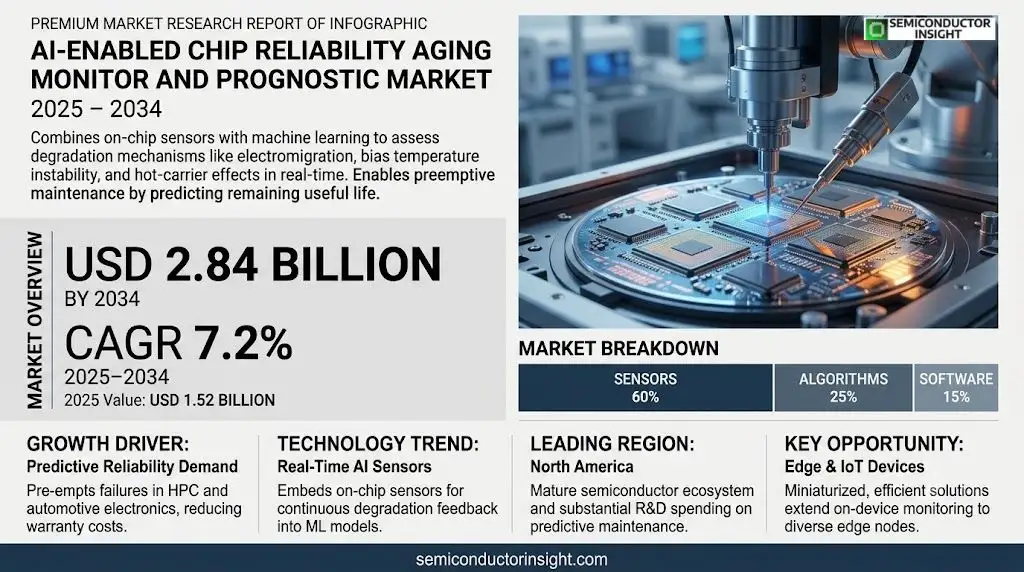
AI-Enabled Chip Reliability Aging Monitor and Prognostic market size was valued at USD 1.52 billion in 2025. The market is projected to grow from USD 1.52 billion in 2025 to USD 2.84 billion by 2034, exhibiting a CAGR of 7.2% during the forecast period.
AI‑enabled chip reliability aging monitors combine on‑chip sensors with machine‑learning algorithms to assess degradation mechanisms such as electromigration, bias temperature instability and hot‑carrier effects in real time. The prognostic layer predicts remaining useful life by correlating sensor data with historical failure patterns, enabling preemptive maintenance and design optimization.The market is accelerating because semiconductor manufacturers are embedding more intelligence into their products to meet stringent quality standards while reducing downtime costs. Furthermore, rising adoption of autonomous systems and edge computing drives demand for predictive reliability solutions that can operate under harsh environmental conditions.
MARKET DRIVERS
Increasing Demand for Predictive Reliability
The rapid adoption of AI-Enabled Chip Reliability Aging Monitor and Prognostic Market solutions is driven by manufacturers’ need to pre‑empt failures in high‑performance computing and automotive electronics. Predictive analytics reduces warranty costs and improves product lifecycles, prompting OEMs to integrate these monitors early in design cycles.
AI Integration Accelerates Failure Prediction
Advances in machine‑learning algorithms enable real‑time analysis of aging signatures, allowing engineers to forecast degradation with greater accuracy than traditional statistical methods. This capability is especially valuable for data‑center processors where downtime translates directly to revenue loss.
➤ Analysts note that the convergence of AI and on‑chip health monitoring is reshaping reliability engineering, creating a new benchmark for proactive maintenance.
Regulatory pressures for safety and environmental compliance further reinforce adoption, as standards increasingly require demonstrable reliability metrics backed by AI‑driven evidence.
MARKET CHALLENGES
Complex Integration with Legacy Systems
Many semiconductor manufacturers operate legacy verification flows that are not readily compatible with AI‑enabled monitoring tools. The need to retrofit existing test benches can extend deployment timelines and increase upfront costs.
Other Challenges
Data Quality and Labeling
Accurate prognostic models depend on high‑quality training data. Inconsistent logging practices across fabs lead to data gaps, limiting model reliability and necessitating additional data‑curation efforts.
MARKET RESTRAINTS
High Initial Capital Expenditure
Implementing AI‑Enabled Chip Reliability Aging Monitor and Prognostic Market platforms requires substantial investment in sensors, compute infrastructure, and skilled personnel. Smaller players often view these costs as a barrier to entry, slowing broader market diffusion.
MARKET OPPORTUNITIES
Expansion into Edge and IoT Devices
As edge computing and IoT deployments proliferate, the need for on‑device reliability monitoring grows. AI‑driven prognostic solutions can be miniaturized and powered efficiently, opening a sizable opportunity to extend AI-Enabled Chip Reliability Aging Monitor and Prognostic Market beyond traditional data‑center and automotive segments.
AI-Enabled Chip Reliability Aging Monitor and Prognostic Market Trends
Real‑Time AI Sensors Accelerate Degradation Detection
The adoption of AI‑enabled chip reliability aging monitors is expanding as semiconductor firms seek to embed on‑chip sensors that feed continuous data into machine‑learning models. These models discriminate between degradation mechanisms such as electromigration, bias temperature instability, and hot‑carrier effects, delivering instant health indicators for each die. By converting raw sensor streams into actionable risk scores, manufacturers can reduce test‑time cycles and avoid costly field failures. The trend is reinforced by stricter quality standards and the need for rapid design iterations, prompting design teams to integrate prognostic blocks early in the silicon development flow.
Other Trends
Predictive Maintenance for Autonomous Vehicles
Autonomous driving platforms depend on uninterrupted operation of high‑performance processors. AI‑based aging monitors enable fleet operators to forecast remaining useful life for critical control chips, aligning maintenance windows with vehicle scheduling. The prognostic layer matches real‑time sensor signatures against a database of historical failure patterns, allowing preemptive part replacement before performance margins erode. This capability reduces unscheduled downtime and supports regulatory compliance for safety‑critical systems, making predictive maintenance a decisive competitive advantage for OEMs.
Edge Computing Fuels On‑Chip Prognostics
Edge devices operate in constrained environments where remote diagnostics are impractical. Embedding AI‑driven reliability monitors directly on the chip permits local assessment of wear and thermal stress without reliance on cloud connectivity. Consequently, edge manufacturers are allocating silicon area to dedicated prognostic engines that continuously evaluate device health. The approach not only improves uptime but also extends the usable lifespan of edge processors, which is critical for applications such as industrial IoT gateways and remote sensing nodes. As edge deployments proliferate, the market for on‑chip aging monitors is expected to deepen.
COMPETITIVE LANDSCAPE
Key Industry Players
AI‑Enabled Chip Reliability Aging Monitor and Prognostic Market Overview
The market is currently dominated by a handful of integrated‑device manufacturers that have embedded AI‑driven reliability blocks directly into high‑volume silicon products. Intel leads the segment with its “SiLeach” sensor suite combined with on‑chip machine‑learning models that continuously track electromigration and bias‑temperature instability. Samsung Electronics follows closely, leveraging its Exynos platform to deliver predictive maintenance APIs for mobile and automotive SoCs. Taiwan Semiconductor Manufacturing Company (TSMC) differentiates itself by offering a foundry‑wide reliability analytics service that aggregates sensor data across multiple customers, creating a shared prognostic database. In parallel, major EDA vendors such as Cadence Design Systems and Synopsys provide the algorithmic foundation that translates raw sensor streams into remaining‑useful‑life (RUL) forecasts, cementing a vertically integrated ecosystem where design‑time tools and fab‑level services reinforce each other.Beyond the tier‑1 players, a constellation of specialist firms and emerging startups is shaping niche segments of the market. KLA Corporation supplies advanced failure‑analysis instrumentation that feeds high‑resolution defect data into AI models. Analog Devices focuses on precision analog front‑ends that improve sensor fidelity for edge‑computing nodes. NXP Semiconductors and STMicroelectronics have launched dedicated reliability‑monitoring IP blocks targeting automotive and industrial IoT markets. Meanwhile, portfolio‑rich innovators such as Keysight Technologies and Mentor, now part of Siemens, provide test‑and‑validation platforms that integrate predictive analytics into compliance workflows. Smaller but highly focused companiesincluding Kion Labs, Prophesee, and Aeternum AIoffer plug‑and‑play prognostic software stacks, often partnering with fabless designers to embed ageing‑aware intelligence without requiring silicon redesign.
List of Key AI-Enabled Chip Reliability Aging Monitor and Prognostic Companies Profiled
- Intel Corporation
- Samsung Electronics
- Taiwan Semiconductor Manufacturing Company (TSMC)
- Cadence Design Systems
- Synopsys, Inc.
- KLA Corporation
- Analog Devices, Inc.
- NXP Semiconductors
- STMicroelectronics
- Keysight Technologies
- Mentor, a Siemens Business
- Kion Labs
- Prophesee
- Aeternum AI
Segment Analysis:
| Segment Category | Sub-Segments | Key Insights |
| By Type |
|
Sensor‑Integrated Solutions have become the dominant type because they embed monitoring directly within the silicon, offering continuous feedback on degradation.
|
| By Application |
|
Predictive Maintenance drives most of the qualitative value.
|
| By End User |
|
OEMs of Autonomous Systems exhibit strong interest.
|
| By Deployment |
|
Hybrid Edge‑Cloud Models are gaining traction because they balance latency with analytical depth.
|
| By Industry |
|
Automotive & Autonomous Driving emerges as a leading industry segment.
|
Regional Analysis: AI-Enabled Chip Reliability Aging Monitor and Prognostic Market
North America
Companies in North America are embedding deep‑learning models directly into chip testing rigs, allowing real‑time anomaly detection. This integration reduces the latency between data capture and diagnostic insight, fostering faster design iterations and lower time‑to‑market for reliable products.
Strategic alliances between AI software firms and silicon manufacturers are common, creating joint solutions that combine predictive analytics with hardware‑level monitoring. These partnerships accelerate the rollout of turnkey prognostic platforms across multiple industries.
Federal agencies promote standards that recognize AI‑driven reliability monitoring as a best practice. Guidance documents encourage manufacturers to adopt prognostic tools, aligning compliance with competitive advantage.
The concentration of AI research institutions and semiconductor fabs creates a fertile environment for talent exchange. Graduates versed in both chip design and machine learning feed a pipeline of innovative solutions for the market.
Europe
Europe’s AI-Enabled Chip Reliability Aging Monitor and Prognostic Market is characterized by strong governmental initiatives that fund reliability research across the EU. Leading chip makers in Germany and France are collaborating with AI startups to develop modular monitoring solutions that can be retrofitted onto existing production lines. The emphasis on sustainability drives interest in extending component lifespans, while standards bodies such as the European Committee for Standardization are revising guidelines to incorporate predictive analytics. Market participants prioritize cross‑border data sharing, fostering a pan‑European ecosystem that balances innovation with regulatory compliance.
Asia‑Pacific
In the Asia‑Pacific region, rapid industrialization and expanding consumer electronics demand have accelerated adoption of AI‑enabled reliability monitoring. Nations like Japan, South Korea, and Taiwan leverage their advanced manufacturing base to integrate prognostic tools into high‑volume chip fabrication. While cost considerations remain important, the region’s focus on high‑performance applicationssuch as 5G infrastructure and autonomous vehiclespropels investment in sophisticated aging monitors. Collaborative research programs between universities and multinational corporations aim to refine AI models that can predict failure modes unique to dense, high‑frequency designs.
South America
South America is emerging as a niche market for AI‑driven chip reliability solutions, driven by the growth of renewable energy projects and automotive assembly plants. Brazilian and Argentine firms are beginning to adopt predictive monitoring to mitigate downtime in power electronics and electric drivetrain components. Although the market is still developing, local initiatives to upskill engineers in data‑science techniques are laying the groundwork for broader adoption. Partnerships with North American technology providers are helping to transfer best practices and accelerate the region’s entry into the AI‑Enabled Chip Reliability Aging Monitor and Prognostic Market.
Middle East & Africa
The Middle East & Africa region shows nascent interest in reliability prognostics, especially within aerospace and defense sectors that require high‑assurance components. United Arab Emirates and South Africa are investing in AI research centers that explore chip aging prediction for critical mission‑critical hardware. While infrastructure constraints limit large‑scale deployment, targeted pilot programs demonstrate the potential for AI‑enabled monitors to reduce maintenance costs and improve safety in harsh operating environments.
Report Scope
This market research report provides a comprehensive analysis of the AI-Enabled Chip Reliability Aging Monitor and Prognostic Market , covering the forecast period 2026–2034. It offers detailed insights into market dynamics, technological advancements, competitive landscape, and key trends shaping the industry.
Key focus areas of the report include:
- Market Overview: The report begins with an overview outlining its current market scenario, key growth indicators, and industry transformation drivers. It discusses macroeconomic factors, demand–supply balance, regulatory landscape, and the strategic role of semiconductors in powering advancements across industries such as automotive, telecommunications, consumer electronics, and industrial automation.
- Market Size & Forecast: Historical data and future projections for revenue, unit shipments, and market value across major regions and segments.
- Segmentation Analysis: Detailed breakdown by product type, technology, application, and end-user industry to identify high-growth segments and investment opportunities.
- Regional Insights: Insights into market performance across North America, Europe, Asia-Pacific, Latin America, and the Middle East & Africa, including country-level analysis where relevant.
- Competitive Landscape: Profiles of leading market participants, including their product offerings, R&D focus, manufacturing capacity, pricing strategies, and recent developments such as mergers, acquisitions, and partnerships.
- Technology Trends & Innovation: Assessment of emerging technologies, integration of AI/IoT, semiconductor design trends, fabrication techniques, and evolving industry standards.
- Market Drivers & Restraints: Evaluation of factors driving market growth along with challenges, supply chain constraints, regulatory issues, and market-entry barriers.
- Stakeholder Insights: Insights for component suppliers, OEMs, system integrators, investors, and policymakers regarding the evolving ecosystem and strategic opportunities.
Primary and secondary research methods are employed, including interviews with industry experts, data from verified sources, and real-time market intelligence to ensure the accuracy and reliability of the insights presented.
FREQUENTLY ASKED QUESTIONS:
What is the current market size of AI-Enabled Chip Reliability Aging Monitor and Prognostic Market?
-> AI-Enabled Chip Reliability Aging Monitor and Prognostic Market was valued at USD 1.52 billion in 2025 and is expected to reach USD 2.84 billion by 2034.
Which key companies operate in AI-Enabled Chip Reliability Aging Monitor and Prognostic Market?
-> Key players include Axalta Coating Systems, AkzoNobel, BASF SE, PPG, Sherwin-Williams, and 3M, among others.
What are the key growth drivers?
-> Key growth drivers include railway infrastructure investments, urbanization, and demand for durable coatings.
Which region dominates the market?
-> Asia-Pacific is the fastest-growing region, while Europe remains a dominant market.
What are the emerging trends?
-> Emerging trends include bio-based coatings, smart coatings, and sustainable rail solutions.
Get Sample Report PDF for Exclusive Insights
Report Sample Includes
- Table of Contents
- List of Tables & Figures
- Charts, Research Methodology, and more...
 Download Sample Report PDF