AI-Enabled Augmented Reality Glasses Processor Market Insights
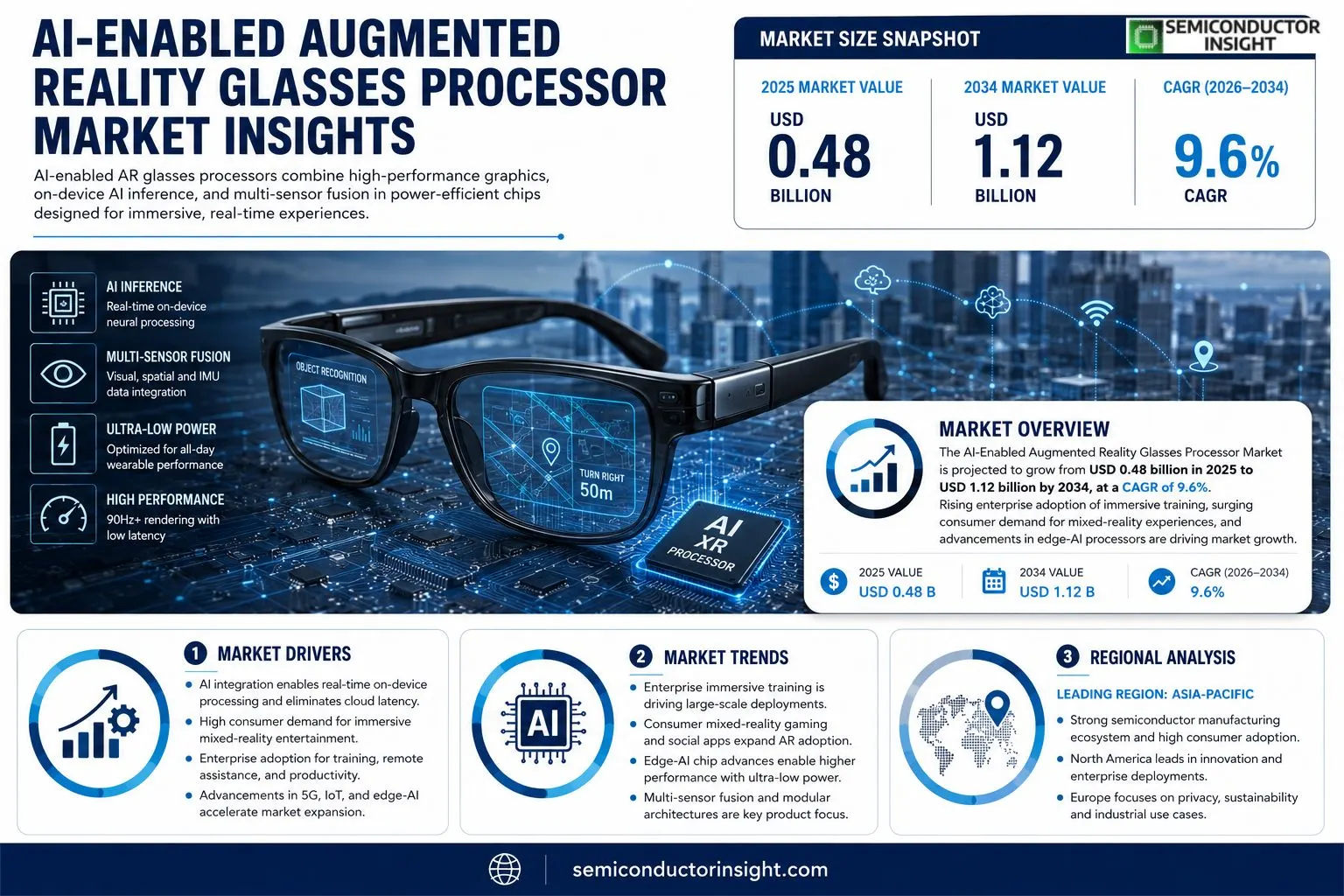
AI-enabled augmented reality glasses processor market size was valued at USD 0.48 billion in 2025. The market is projected to grow from USD 0.48 billion in 2025 to USD 1.12 billion by 2034, exhibiting a CAGR of 9.6% during the forecast period.
AI-enabled augmented reality glasses processors are purpose‑built semiconductor solutions that combine high‑performance graphics rendering, on‑device neural‑network inference, and multi‑sensor data fusion within a power‑efficient package designed for wearable form factors.The market is gaining momentum because enterprises are expanding immersive training programs while consumer interest spikes around mixed‑reality entertainment platforms. Moreover, recent launches such as Qualcomm’s Snapdragon XR2 Gen 3 and MediaTek’s Dimensity XR series illustrate how leading chipmakers are accelerating edge‑AI capabilities for AR eyewear.
MARKET DRIVERS
AI Integration Boosts Real‑Time Processing
AI-Enabled Augmented Reality Glasses Processor Market is being propelled by the need for on‑device inference that eliminates cloud latency. Manufacturers are embedding vision‑AI cores directly into glass‑mounted processors, enabling real‑time object recognition, gesture control, and contextual overlays without external bandwidth constraints. This architectural shift delivers a seamless user experience that is critical for both consumer entertainment and industrial use cases.
Consumer Demand for Immersive Experiences
Modern consumers expect mixed‑reality content that feels natural and responsive. High‑definition displays paired with AI‑driven frame rates above 90 Hz have become a market benchmark, prompting OEMs to adopt processors that can handle parallel AI pipelines and graphics rendering simultaneously. The convergence of gaming, social media, and education apps has created a robust demand pipeline for advanced AR glasses.
➤ “By 2028, AI‑optimized processors will account for more than half of all AR headset shipments, driven by the push for edge intelligence.”
In addition to performance, the price‑performance ratio is improving as semiconductor fabs scale their 7 nm and 5 nm nodes for mixed‑signal AR chips. This cost efficiency is unlocking broader adoption across mid‑range device segments, further accelerating market expansion.
MARKET CHALLENGES
Scalability of Manufacturing Processes
While demand is growing, many fab facilities lack dedicated lines for the tiny form‑factor dies required in lightweight glasses. Transitioning from smartphone‑class production to ultra‑compact, low‑power AR processors involves retooling equipment and redefining testing protocols, which can slow time‑to‑market for new designs.
Other Challenges
Supply Chain Constraints
The reliance on specialty substrates and high‑precision packaging materials has created bottlenecks, especially when semiconductor demand spikes. Shortages in advanced memory stacks and optical sensor modules can inflate bill‑of‑materials costs, pressuring margins for AR glass manufacturers.
MARKET RESTRAINTS
Power Consumption Limits
Battery capacity in head‑mounted displays remains a critical restraint. Even with AI‑optimized instruction sets, processors must stay within a few hundred milliwatts to preserve several hours of continuous operation. Designers often trade off processing depth to meet these power budgets, limiting the complexity of AI models that can run locally.
Thermal Management Issues
High‑performance AI inference generates heat that is difficult to dissipate in a thin glass frame. Inadequate thermal solutions can cause user discomfort and degrade sensor accuracy. As a result, many developers resort to dynamic frequency scaling, which reduces peak performance during intensive tasks.
Regulatory Hurdles
Privacy regulations governing on‑device image processing vary across regions. Compliance requirements may restrict the deployment of certain AI algorithms, compelling manufacturers to implement additional data‑handling safeguards that increase development overhead.
MARKET OPPORTUNITIES
Enterprise Applications in Remote Assistance
Enterprises are adopting AI‑enabled AR glasses to provide real‑time guidance for field technicians. Processors that can overlay step‑by‑step instructions while recognizing equipment components in situ create significant productivity gains, opening a lucrative B2B revenue stream for chip makers.
Healthcare Imaging and Surgery
In medical settings, low‑latency AI processors enable surgeons to visualize patient‑specific anatomy during procedures. The ability to run high‑resolution segmentation algorithms locally reduces reliance on hospital networks and improves procedural safety, positioning the market for rapid adoption in hospitals.
Automotive Heads‑up Displays
Automakers are prototyping AR windshields that combine navigation cues with AI‑driven driver‑attention monitoring. Processors that can fuse sensor data, camera feeds, and predictive models within a single chip offer competitive differentiation, making this a high‑growth segment for the AR glasses processor ecosystem.
AI-Enabled Augmented Reality Glasses Processor Market Trends
Enterprise Immersive Training Fuels Processor Adoption
The rise of immersive, hands‑on training programs in manufacturing, aerospace, and services is prompting enterprises to equip their workforce with AR glasses that rely on high‑performance processors. Companies are prioritizing solutions that can render complex 3D schematics while executing on‑device neural‑network inference for real‑time guidance. Recent product releases such as Qualcomm’s Snapdragon XR2 Gen 3 and MediaTek’s Dimensity XR series illustrate a clear industry shift toward integrated graphics, AI accelerators, and multi‑sensor fusion within a power‑efficient package suitable for wearable form factors. This convergence enables longer session times and reduces latency, directly supporting the operational goals of large‑scale training deployments.
Other Trends
Consumer Mixed‑Reality Entertainment Expands Reach
Consumer interest in mixed‑reality gaming and social experiences is creating a parallel demand trajectory for AR glasses processors. Developers are leveraging edge‑AI capabilities to overlay interactive avatars, dynamic lighting, and context‑aware audio without relying on cloud resources. The availability of chipsets that embed dedicated AI cores and high‑bandwidth memory allows content creators to deliver richer visual fidelity while maintaining battery life acceptable for day‑long usage. Market observers note that the growing ecosystem of third‑party accessoriessuch as haptic feedback modules and spatial audio rigsfurther incentivizes manufacturers to adopt processors that support standardized sensor interfaces and low‑latency data pipelines.
Edge‑AI Chip Advances Accelerate Capabilities
Advancements in edge‑AI architectures are reshaping how AI-Enabled Augmented Reality Glasses Processor Market evolves. New fabrication processes enable silicon that delivers double the inference throughput at the same thermal envelope, opening possibilities for on‑device object recognition, gesture control, and environmental mapping. Integration of heterogeneous compute blocksCPU, GPU, and NPUwithin a single die reduces inter‑module communication overhead, resulting in smoother frame rates and more responsive user interfaces. As OEMs seek to differentiate their products, they are increasingly evaluating processors that offer modular AI libraries and over‑the‑air update mechanisms, ensuring that devices can adapt to emerging applications without hardware redesign.
COMPETITIVE LANDSCAPE
Key Industry Players
Competitive Landscape of AI‑Enabled AR Glasses Processors
The AI‑enabled augmented reality glasses processor market is currently anchored by a handful of large semiconductor firms that combine advanced graphics pipelines with on‑device neural‑network inference. Qualcomm leads the segment with its Snapdragon XR2 Gen 3, delivering a highly integrated solution that addresses power‑budget constraints of wearable form‑factors while supporting multi‑sensor fusion. MediaTek follows closely with the Dimensity XR series, emphasizing cost‑effective integration for consumer‑grade head‑sets. Samsung Electronics, leveraging its Exynos line, is expanding into the enterprise training niche, where high‑throughput edge AI is essential. These incumbents command the majority of forecasted revenue and shape the roadmap for standards such as OpenXR and emerging AR cloud frameworks.Beyond the dominant trio, a cohort of niche but technically sophisticated players enriches the ecosystem. Himax Technologies supplies display‑driver ICs that enable ultra‑low latency eye‑tracking, while Intel’s Mobileye division explores vision‑centric compute stacks for mixed‑reality wearables. NVIDIA contributes its Jetson edge AI platform, adapted for AR glasses that require real‑time ray tracing. AMD, STMicroelectronics, Renesas Electronics, and Texas Instruments each provide specialized analog and mixed‑signal components that improve sensor integration and power management. Google’s Tensor‑based custom silicon, accessible through Android XR partnerships, adds a software‑first dimension that appeals to developers seeking seamless AI services. Collectively, these firms foster a competitive environment that encourages differentiation through miniaturization, energy efficiency, and AI model optimization.
List of Key AI‑Enabled Augmented Reality Glasses Processor Companies Profiled
Segment Analysis:
| Segment Category | Sub-Segments | Key Insights |
| By Type |
|
Vision Processing Units (VPUs)
|
| By Application |
|
Consumer Entertainment
|
| By End User |
|
Enterprises
|
| By Form Factor |
|
Slimline Frames
|
| By AI Capability Level |
|
Edge Inference
|
Regional Analysis: AI-Enabled Augmented Reality Glasses Processor Market
North America
Leading firms are rolling out heterogeneous architectures that embed neural processing units alongside traditional GPU cores, enabling edge AI workloads without compromising battery life. Partnerships with AI software vendors accelerate the integration of domain‑specific models for gesture and environment mapping.
OEMs and chipset manufacturers are forging joint ventures to co‑develop bespoke silicon that aligns with AR hardware form factors, fostering faster time‑to‑market for next‑generation glasses that can process AI inference locally.
Clear guidelines on spectrum usage and data protection have reduced entry barriers, allowing startups to scale deployments in enterprise environments while maintaining compliance with privacy standards.
The convergence of high‑resolution optics, low‑latency AI processing, and ergonomic designs is spurring broader adoption in training, remote assistance, and immersive entertainment sectors.
Europe
Europe’s AR processor market is characterized by a strong emphasis on sustainability and data sovereignty. Leading semiconductor clusters in Germany and France prioritize energy‑efficient chip designs that align with EU environmental directives. Collaborative research programs funded by the Horizon Europe initiative encourage cross‑border development of AI‑enhanced vision processing, particularly for industrial maintenance and smart‑city applications. While adoption rates trail North America, the region’s focus on secure, on‑device AI inference creates a niche for processors that embed privacy‑preserving algorithms directly into the hardware.
Asia‑Pacific
Asia‑Pacific demonstrates rapid growth potential, propelled by sizable consumer bases and aggressive manufacturing capabilities in China, South Korea, and Japan. Local OEMs are integrating AI‑ready processors into mass‑market AR glasses to capture price‑sensitive segments, while governments promote smart‑factory initiatives that rely on edge AI for real‑time visual analytics. Although standards are still evolving, the region benefits from a dense supply chain that can iterate designs quickly, positioning it as an emerging hub for cost‑effective AR processor solutions.
South America
South America remains in an exploratory phase, with pilot projects primarily in Brazil’s logistics and agriculture sectors. Early adopters are leveraging AI‑enabled AR glasses to enhance field inspections and warehouse operations, emphasizing durability and low power consumption. Limited local chip fabrication drives reliance on imported processors, but growing trade agreements are expected to improve access to advanced silicon, gradually expanding market participation.
Middle East & Africa
The Middle East & Africa region is witnessing nascent interest driven by defense and oil‑&‑gas industries that demand rugged AR solutions for remote assistance. Investment in AI research hubs, particularly in the United Arab Emirates and South Africa, is fostering localized expertise in edge inference. While overall market size is modest, strategic government initiatives aimed at digital transformation are laying groundwork for future demand for AI‑enabled AR glasses processors.
Report Scope
This market research report provides a comprehensive analysis of the AI-Enabled Augmented Reality Glasses Processor Market , covering the forecast period 2026–2034. It offers detailed insights into market dynamics, technological advancements, competitive landscape, and key trends shaping the industry.
Key focus areas of the report include:
- Market Overview: The report begins with an overview outlining its current market scenario, key growth indicators, and industry transformation drivers. It discusses macroeconomic factors, demand–supply balance, regulatory landscape, and the strategic role of semiconductors in powering advancements across industries such as automotive, telecommunications, consumer electronics, and industrial automation.
- Market Size & Forecast: Historical data and future projections for revenue, unit shipments, and market value across major regions and segments.
- Segmentation Analysis: Detailed breakdown by product type, technology, application, and end-user industry to identify high-growth segments and investment opportunities.
- Regional Insights: Insights into market performance across North America, Europe, Asia-Pacific, Latin America, and the Middle East & Africa, including country-level analysis where relevant.
- Competitive Landscape: Profiles of leading market participants, including their product offerings, R&D focus, manufacturing capacity, pricing strategies, and recent developments such as mergers, acquisitions, and partnerships.
- Technology Trends & Innovation: Assessment of emerging technologies, integration of AI/IoT, semiconductor design trends, fabrication techniques, and evolving industry standards.
- Market Drivers & Restraints: Evaluation of factors driving market growth along with challenges, supply chain constraints, regulatory issues, and market-entry barriers.
- Stakeholder Insights: Insights for component suppliers, OEMs, system integrators, investors, and policymakers regarding the evolving ecosystem and strategic opportunities.
Primary and secondary research methods are employed, including interviews with industry experts, data from verified sources, and real-time market intelligence to ensure the accuracy and reliability of the insights presented.
FREQUENTLY ASKED QUESTIONS:
What is the current market size of AI-Enabled Augmented Reality Glasses Processor Market?
-> AI-Enabled Augmented Reality Glasses Processor Market was valued at USD 0.48 billion in 2025 and is expected to reach USD 1.12 billion by 2034, exhibiting a CAGR of 9.6% during the forecast period.
Which key companies operate in AI-Enabled Augmented Reality Glasses Processor Market?
-> Key players include Qualcomm, MediaTek, Apple, Samsung Electronics, Intel, and Google, among others.
What are the key growth drivers?
-> Key growth drivers include enterprise adoption of immersive training solutions, rising consumer demand for mixed‑reality entertainment, advancements in edge‑AI processing, and the rollout of 5G networks enabling low‑latency XR experiences.
Which region dominates the market?
-> Asia-Pacific is the fastest‑growing region, driven by strong semiconductor manufacturing bases and high consumer adoption, while North America remains a dominant market in terms of revenue.
What are the emerging trends?
-> Emerging trends include integrated multi‑sensor fusion, ultra‑low‑power AI inference engines, cloud‑edge collaborative XR processing, and the convergence of AR eyewear with 5G and IoT ecosystems.
Get Sample Report PDF for Exclusive Insights
Report Sample Includes
- Table of Contents
- List of Tables & Figures
- Charts, Research Methodology, and more...
 Download Sample Report PDF