AI-Driven Wafer Fab Equipment Predictive Maintenance Software Market Insights
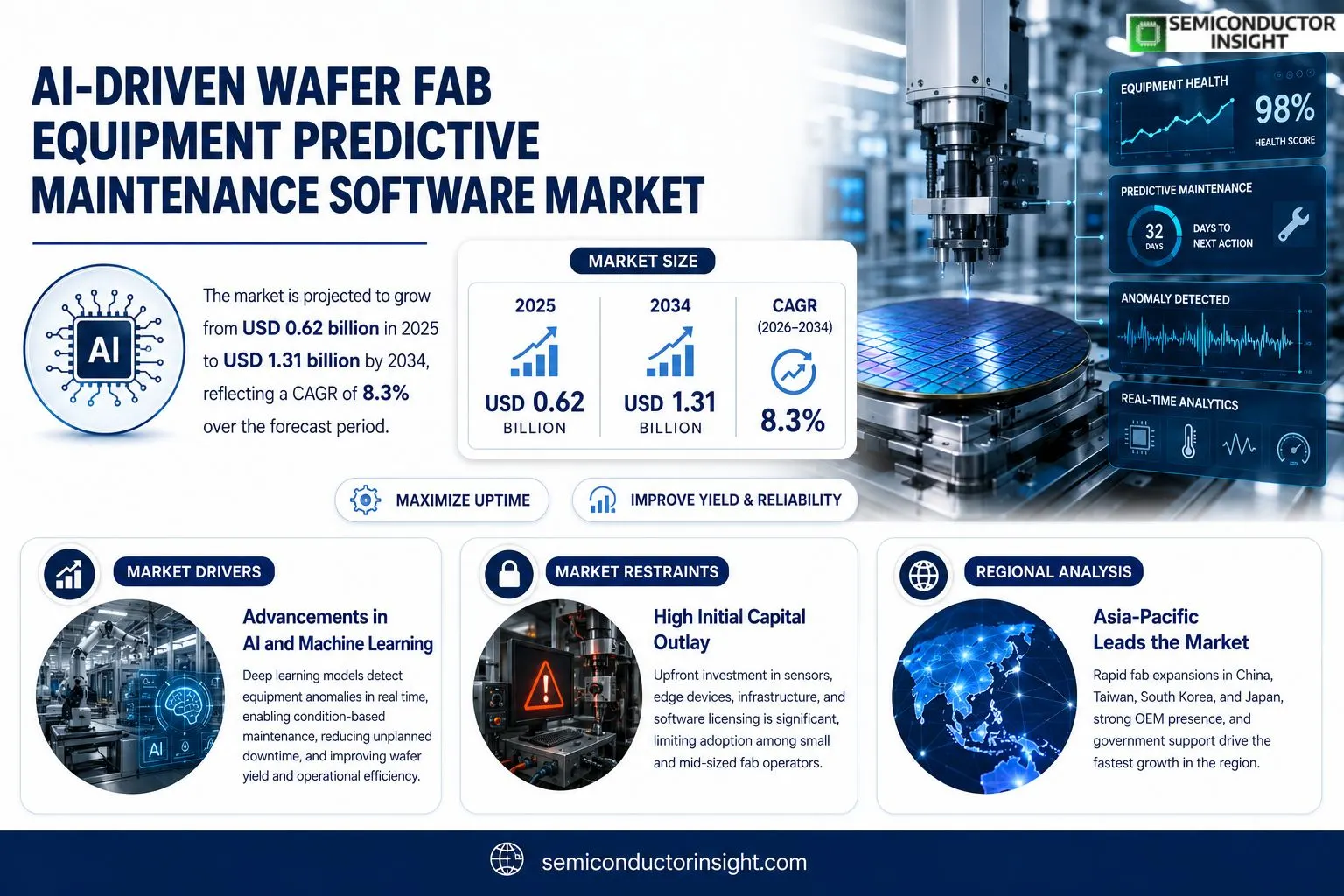
AI-driven wafer fab equipment predictive maintenance software market size was valued at USD 0.62 billion in 2025 and is forecasted to reach USD 1.31 billion by 2034, reflecting a CAGR of approximately 8.3 % over the period.
This software suite applies machine‑learning models to sensor streams from lithography scanners, etchers, deposition tools and metrology instruments. By correlating vibration signatures, temperature trends and process drift, the solution predicts component wear before failure, enabling scheduled interventions rather than emergency repairs.The upward trajectory stems from rising capital investment in advanced semiconductor fabs, where equipment uptime directly influences yield profitability. Moreover, the proliferation of edge‑computing nodes within cleanrooms allows real‑time analytics without compromising data security. In March 2024, Siemens Healthineers announced a partnership with Applied Materials to embed its AI diagnostic engine into next‑generation deposition lines, illustrating how OEMs are embedding intelligence into core toolsets.
MARKET DRIVERS
Advancements in AI and Machine Learning
Recent breakthroughs in deep learning enable predictive models that can detect equipment anomalies in real time. Manufacturers are capitalising on these capabilities to shift from reactive repairs to condition‑based interventions, thereby reducing costly unplanned downtime.
Economic Incentives for Yield Improvement
Semiconductor fabs operate with razor‑thin margins; even a marginal increase in wafer yield translates into significant revenue. The ability of AI‑driven predictive maintenance software to fine‑tune process equipment directly supports this financial pressure.
➤ “Adopting AI‑based maintenance has cut unplanned outages by roughly one‑third in leading fabs, freeing capacity for higher‑value production runs.”
Regulatory scrutiny on energy consumption and waste management pushes operators toward solutions that optimise run‑time efficiency. Compliance‑focused plants view predictive maintenance as a pathway to meet tightening standards while preserving throughput.
MARKET CHALLENGES
Integration with Legacy Control Systems
Many fabs still rely on proprietary PLCs and SCADA platforms that were not designed for modern AI interfaces. Bridging this gap often requires custom middleware, inflating implementation timelines and costs.
Other Challenges
Data Quality and Volume
Effective AI models demand high‑resolution sensor streams and clean historical datasets. Inconsistent logging practices or gaps in data collection can undermine model accuracy, forcing firms to invest in extensive data‑engineering projects.
MARKET RESTRAINTS
High Initial Capital Outlay
The upfront spend for sensor networks, edge compute nodes, and licensing fees remains substantial. Smaller fab operators often struggle to justify the expense without clear, short‑term ROI evidence.
Skilled Workforce Shortage
Deploying and maintaining AI‑driven predictive platforms requires expertise in data science, control engineering, and semiconductor processes. The limited pool of such hybrid talent creates a bottleneck that slows adoption.
Cybersecurity Concerns
Connecting critical fab equipment to networked analytics introduces attack vectors that must be rigorously managed. Companies hesitant to expose core assets may delay or scale back implementation.
MARKET OPPORTUNITIES
Edge‑Based Analytics Platforms
Embedding AI inference at the edge reduces latency and limits data exposure, making it attractive for fabs with stringent real‑time control requirements. Vendors that provide turnkey edge solutions stand to capture a growing segment of the market.
Subscription and Outcome‑Based Pricing Models
Flexible licensing that aligns fees with achieved downtime reductions lowers entry barriers for cost‑conscious operators. This pricing shift encourages broader experimentation and faster scaling across the industry.
Cross‑Domain Data Fusion
Combining equipment telemetry with supply‑chain and yield analytics opens new pathways for holistic optimisation. Companies that can orchestrate such data ecosystems will differentiate themselves and command premium valuations.
AI-Driven Wafer Fab Equipment Predictive Maintenance Software Market Trends
Uptime Imperative Fuelling Predictive Analytics Adoption
The semiconductor sector is channeling sizable capital toward next‑generation fabs, where a single hour of equipment downtime can erode yield margins substantially. By converting raw sensor streamsvibration, temperature, and process driftinto actionable wear forecasts, predictive maintenance platforms are converting what used to be reactive repairs into scheduled interventions. The market’s valuation of USD 0.62 billion in 2025 and its trajectory toward USD 1.31 billion by 2034 illustrate a tangible shift in budgeting priorities, with equipment owners allocating funds to software that directly safeguards productivity.
Other Trends
Edge‑Computing Integration
Cleanroom environments now host micro‑edge nodes that host inference engines close to the equipment. This architecture eliminates latency penalties inherent in cloud‑centric models and addresses data‑privacy concerns that have traditionally slowed adoption. As a result, fabs can execute real‑time anomaly detection without exposing proprietary process data, a capability that is increasingly being mandated by internal compliance frameworks.
OEM Partnerships Accelerating Intelligence Embedding
Recent collaborations, such as the March 2024 agreement between Siemens Healthineers and Applied Materials, signal a broader industry movement where equipment manufacturers embed AI modules directly into tool firmware. This co‑development approach reduces integration overhead for end users and creates a unified data pipeline from the point of measurement to prediction. For operators, the implication is a shorter time‑to‑value: the predictive layer arrives pre‑configured, allowing immediate rollout across deposition lines and lithography scanners.
COMPETITIVE LANDSCAPEKey Industry Players
AI‑Driven Predictive Maintenance Software for Wafer Fabrication – Competitive Overview
Siemens Digital Industries stands out as the market anchor, leveraging its deep integration with equipment OEMs such as Applied Materials and Tokyo Electron. Its portfolio couples edge‑compute nodes with a proprietary machine‑learning engine that ingests vibration, temperature and process‑drift data across lithography scanners, etchers and deposition tools. By embedding analytics directly into the equipment control stack, Siemens reduces latency and sidesteps data‑security concerns that arise when transmitting raw sensor streams to the cloud. This approach has secured multi‑year contracts with leading fabs in Taiwan, South Korea and the United States, where uptime thresholds are tightly linked to yield economics. The firm’s ability to bundle hardware, software and service guarantees a lock‑step value proposition that smaller vendors struggle to replicate, cementing Siemens’ position as the de‑facto standard‑setter in large‑scale fab environments.The remainder of the ecosystem consists of a mix of specialized software houses and emerging analytics platforms that target niche segments or provide complementary capabilities. Companies such as C3.ai and SparkCognition focus on cloud‑native AI models that can be retrofitted to legacy tools, while Altair offers simulation‑driven prognosis for metrology instruments. Cognite and Uptake deliver data‑fabric layers that simplify integration across heterogeneous sensor vendors, creating a plug‑and‑play environment for fabs that prefer best‑of‑breed components. Regional players like Hitachi High‑Tech and KLA Corp. have introduced proprietary predictive modules tailored to their own equipment lines, fostering a fragmented but vibrant landscape where collaboration and OEM‑specific extensions drive adoption.
List of Key Wafer Fab Equipment Predictive Maintenance Companies Profiled
- Siemens Digital Industries
- C3.ai
- Applied Materials
- SparkCognition
- Altair Engineering
- Cognite
- Uptake Technologies
- Hitachi High‑Tech Corporation
- KLA Corp.
- Tokyo Electron Limited
- ASML Holding
- PTC (ThingWorx)
- IBM Watson IoT
- GE Digital
- Intel AI Labs
Segment Analysis:
| Segment Category | Sub-Segments | Key Insights |
| By Type |
|
Software‑only predictive modules are gaining traction because they can be retrofitted onto legacy equipment without extensive hardware changes.
|
| By Application |
|
Deposition equipment is emerging as a focal application because its process windows are highly sensitive to temperature and vibration fluctuations.
|
| By End User |
|
Maintenance engineers benefit most from AI‑driven insights because they can shift from reactive fixes to proactive planning.
|
| By Deployment Model |
|
Hybrid edge‑computing architectures are prized for balancing real‑time analytics with data‑privacy requirements.
|
| By Benefit |
|
Uptime optimization drives strategic focus because every minute of equipment downtime directly erodes fab profitability.
|
Regional Analysis: AI-Driven Wafer Fab Equipment Predictive Maintenance Software Market
Asia‑Pacific
Parallel to this, governmental programmes that subsidise digital transformation reduce the financial barrier for midsize fabs, prompting a cascade of adoption across the supply chain. The resulting ecosystemcomprising semiconductor equipment vendors, AI start‑ups, and fab operatorscreates a feedback loop where field data enriches algorithmic models, and refined models accelerate equipment upgrades.
For service firms, the shift means a re‑allocation of resources from reactive spare‑part logistics to proactive health‑monitoring platforms, opening recurring‑revenue streams tied to software licences and analytics‑as‑a‑service. The competitive advantage of early adopters lies not merely in higher yields but in the ability to schedule maintenance during planned downtimes, thereby reshaping capacity planning.
While the region benefits from a deep talent pool in semiconductor engineering and data science, the greatest challenge remains the integration of AI insights into entrenched fab control systems, which often operate on proprietary protocols. Companies that can bridge this gap stand to secure long‑term contracts with the largest fabs in the world.
AI algorithms are being embedded directly into equipment controllers, reducing latency in fault detection. Operators report that on‑site inference enables decisions within seconds, a pace unattainable with cloud‑only architectures. This local processing trend reflects a broader industry move toward edge intelligence, where data never leaves the fab floor.
Regional standards bodies are issuing guidelines that encourage transparent logging of equipment health metrics. Although compliance remains voluntary, firms that align with these emerging norms gain credibility with multinational customers, who increasingly demand audit‑ready maintenance records.
Predictive insights are reshaping spare‑part inventories, allowing fab managers to shift from safety stock to just‑in‑time replenishment. Vendors that can synchronize their logistics platforms with predictive signals are positioned to become preferred suppliers in the post‑pandemic supply chain.
The convergence of semiconductor process expertise and data‑science skill sets is fueling a niche labor market. Academic programs that blend wafer fabrication fundamentals with AI coursework are emerging, creating a pipeline of professionals ready to drive the next wave of innovation.
North America
North America, anchored by the United States, continues to host a mature base of equipment manufacturers and fab operators. The region’s strength lies in its deep pockets for R&D, enabling partnerships between leading AI firms and semiconductor giants. However, the market’s growth is tempered by a cautious procurement approach; many fabs prefer incremental upgrades over wholesale platform changes. The prevailing business model favours subscription‑based analytics that can be layered onto existing maintenance contracts, allowing operators to test performance without committing to full‑scale redesigns. Intellectual property considerations also shape collaboration strategies, as firms protect proprietary algorithms while seeking joint‑development opportunities.
Europe
European fabs benefit from a regulatory environment that emphasizes sustainability and energy efficiency. Predictive maintenance software that can demonstrably reduce power consumption is therefore attractive to both operators and policymakers. Countries such as Germany and the Netherlands are fostering consortia that pool anonymised equipment data, accelerating model training across the continent. While the market is smaller than in Asia‑Pacific, the emphasis on standards and data governance creates a fertile ground for vendors that can satisfy stringent compliance requirements while delivering tangible cost‑avoidance outcomes.
South America
In South America, the market remains embryonic, with most semiconductor activity concentrated in Brazil and Colombia. Local fabs are primarily focused on legacy nodes, yet they recognize that predictive maintenance can extend the life of aging equipment. Government incentives aimed at modernising manufacturing infrastructure have begun to lower barriers for AI adoption. The principal challenge is the scarcity of skilled personnel, prompting firms to either import expertise or rely on cloud‑based solutions that mitigate the need for on‑site AI talent.
Middle East & Africa
The Middle East & Africa region is gradually entering the semiconductor value chain, driven by sovereign wealth funds investing in high‑tech clusters. Early adopters are exploring predictive maintenance as a way to differentiate nascent fabs from established competitors. Limited local expertise and fragmented supply networks mean that partnerships with software providers are essential. As regional ecosystems mature, the ability to localise AI models to specific equipment fleets will become a decisive factor in securing long‑term contracts.
Report Scope
This market research report provides a comprehensive analysis of the AI-Driven Wafer Fab Equipment Predictive Maintenance Software Market , covering the forecast period 2026–2034. It offers detailed insights into market dynamics, technological advancements, competitive landscape, and key trends shaping the industry.
Key focus areas of the report include:
- ✅ Market Overview: The report begins with an overview outlining its current market scenario, key growth indicators, and industry transformation drivers. It discusses macroeconomic factors, demand–supply balance, regulatory landscape, and the strategic role of semiconductors in powering advancements across industries such as automotive, telecommunications, consumer electronics, and industrial automation.
- ✅ Market Size & Forecast: Historical data and future projections for revenue, unit shipments, and market value across major regions and segments.
- ✅ Segmentation Analysis: Detailed breakdown by product type, technology, application, and end-user industry to identify high-growth segments and investment opportunities.
- ✅ Regional Insights: Insights into market performance across North America, Europe, Asia-Pacific, Latin America, and the Middle East & Africa, including country-level analysis where relevant.
- ✅ Competitive Landscape: Profiles of leading market participants, including their product offerings, R&D focus, manufacturing capacity, pricing strategies, and recent developments such as mergers, acquisitions, and partnerships.
- ✅ Technology Trends & Innovation: Assessment of emerging technologies, integration of AI/IoT, semiconductor design trends, fabrication techniques, and evolving industry standards.
- ✅ Market Drivers & Restraints: Evaluation of factors driving market growth along with challenges, supply chain constraints, regulatory issues, and market-entry barriers.
- ✅ Stakeholder Insights: Insights for component suppliers, OEMs, system integrators, investors, and policymakers regarding the evolving ecosystem and strategic opportunities.
Primary and secondary research methods are employed, including interviews with industry experts, data from verified sources, and real-time market intelligence to ensure the accuracy and reliability of the insights presented.
FREQUENTLY ASKED QUESTIONS:
What is the current market size of AI-Driven Wafer Fab Equipment Predictive Maintenance Software Market?
-> AI-Driven Wafer Fab Equipment Predictive Maintenance Software Market was valued at USD 0.62 billion in 2025 and is expected to reach USD 1.31 billion by 2034, reflecting a CAGR of approximately 8.3 % over the forecast period.
Which key companies operate in AI-Driven Wafer Fab Equipment Predictive Maintenance Software Market?
-> Key players include Siemens Healthineers, Applied Materials, ASML, Lam Research, KLA Corporation, and Tokyo Electron, among others.
What are the key growth drivers?
-> Key growth drivers include rising capital investment in advanced semiconductor fabs, the critical need for equipment uptime to protect yield, and the increasing adoption of AI/ML and edge‑computing for real‑time predictive analytics.
Which region dominates the market?
-> Asia-Pacific is the fastest‑growing region, driven by major fab expansions in China, Taiwan, and South Korea, while Europe remains a significant market with strong OEM presence.
What are the emerging trends?
-> Emerging trends include integration of digital twins for equipment health simulation, edge‑AI deployment inside cleanrooms, and collaborative AI platforms that combine data from lithography, etch, deposition, and metrology tools.
Get Sample Report PDF for Exclusive Insights
Report Sample Includes
- Table of Contents
- List of Tables & Figures
- Charts, Research Methodology, and more...
 Download Sample Report PDF