
AI-Driven Thermal Simulation Software Market Insights
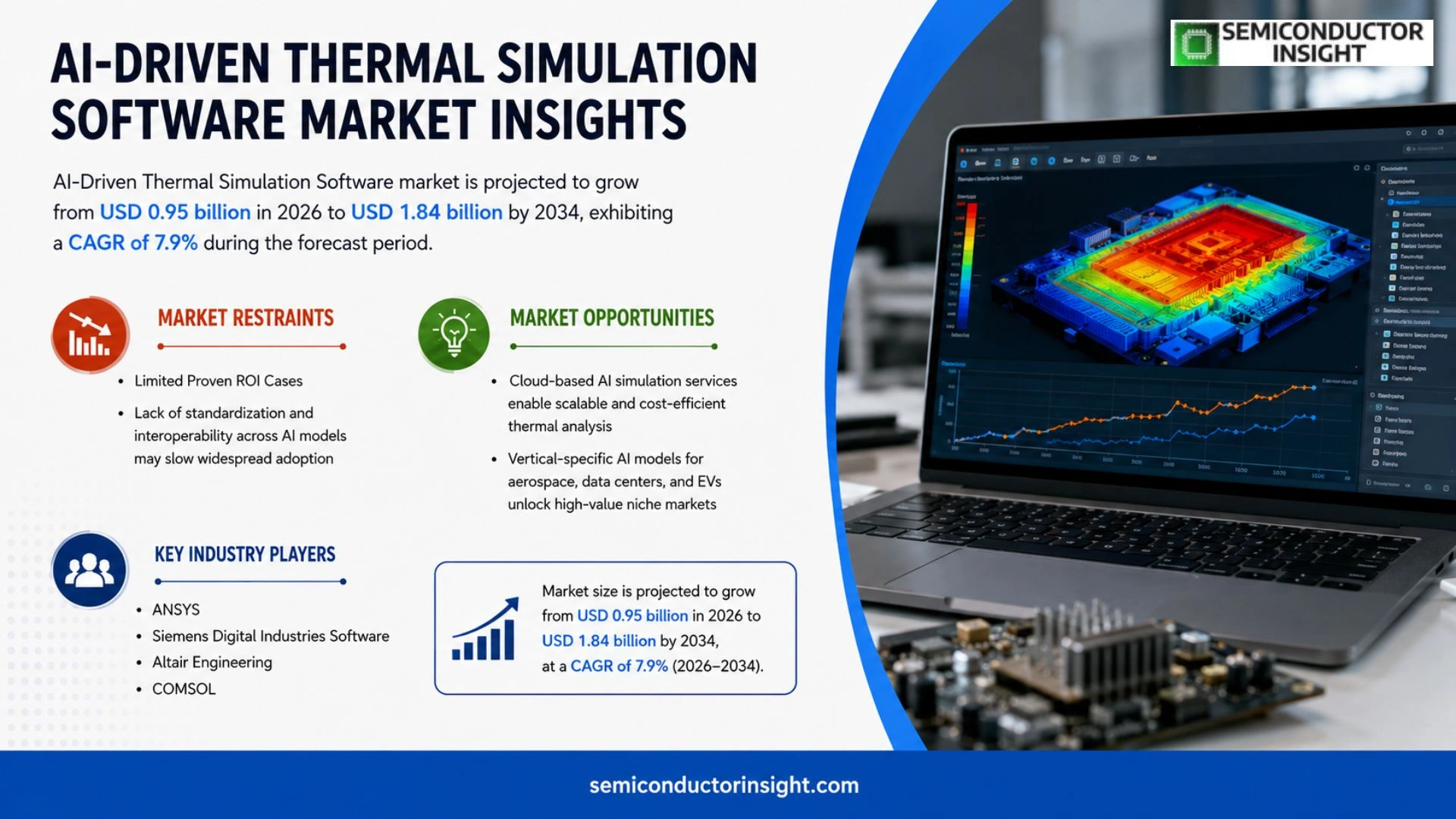
Global AI‑Driven Thermal Simulation Software market size was valued at USD 0.92 billion in 2025. The market is projected to grow from USD 0.95 billion in 2026 to USD 1.84 billion by 2034, exhibiting a CAGR of 7.9% during the forecast period.
AI‑driven thermal simulation software merges computational fluid dynamics engines with machine‑learning models that speed up heat‑transfer calculations and enable predictive optimization throughout design cycles. By learning from prior simulation results, these tools cut mesh‑generation time and raise accuracy for complex geometries common in electronics cooling, automotive powertrain design, and aerospace structures.
The sector is gaining momentum because enterprises are allocating larger budgets toward digital twins and energy‑efficiency initiatives; meanwhile regulatory pressure for lower emissions pushes manufacturers toward more precise thermal management solutions. Recent collaborations illustrate this trend,for example, in March 2024 Siemens partnered with NVIDIA to embed GPU‑accelerated AI kernels into its Simcenter suite, while ANSYS announced an integration of its Fluent solver with OpenAI’s GPT‑4 API for automated scenario generation.
MARKET DRIVERS
Increasing Adoption of AI in Engineering Design
Manufacturers are embedding generative AI models into their thermal analysis pipelines to accelerate design iterations. This shift reduces reliance on manual meshing, enabling engineers to explore more concepts within tight project timelines. The resulting efficiency gains translate into shorter time‑to‑market for heated components such as battery packs and power electronics.
Regulatory Pressure for Energy Efficiency
Stringent emissions standards and the rise of low‑carbon product mandates compel firms to optimize thermal performance. AI‑enhanced simulation delivers finer temperature gradients without proportional compute cost, helping companies meet compliance thresholds while preserving product reliability.
➤ AI algorithms that adapt mesh density in real time have cut simulation cycles by up to 40% in leading automotive projects.
These forces collectively shape purchasing decisions for the AI-Driven Thermal Simulation Software Market, as end‑users prioritize tools that can deliver both speed and fidelity under evolving regulatory expectations.
MARKET CHALLENGES
High Computational Resource Requirements
Although AI reduces manual effort, the underlying deep‑learning models consume considerable GPU capacity. Small and midsize enterprises often lack access to the necessary infrastructure, creating a cost barrier that limits broader market penetration.
Other Challenges
Skill Gap
Engineers accustomed to traditional finite‑element tools must acquire data‑science competencies. The training curve slows adoption rates and can jeopardize project schedules if teams are under‑prepared.
Integration with legacy PLM environments often requires custom APIs, which adds implementation risk. Vendors that provide out‑of‑the‑box connectors gain a competitive edge by smoothing the transition for existing engineering ecosystems.
MARKET RESTRAINTS
Limited Proven ROI Cases
Potential buyers remain cautious because documented return‑on‑investment studies are scarce. Without clear financial benchmarks, decision‑makers hesitate to allocate budget to AI‑centric simulation platforms, preferring incremental upgrades to established tools.
Moreover, the proprietary nature of many AI models raises concerns about vendor lock‑in. Organizations seeking long‑term flexibility may defer adoption until industry standards emerge that ensure interoperability across multiple software suites.
MARKET OPPORTUNITIES
Cloud‑Based AI Simulation Services
The migration of thermal analysis workloads to cloud platforms opens a subscription revenue stream for software providers. Pay‑as‑you‑go pricing lowers the entry threshold for firms lacking on‑premise hardware, while offering scalable compute that aligns with project peaks.
Another avenue lies in vertical specialization. Tailoring AI algorithms for aerospace cooling systems or high‑density data centers positions vendors to capture niche segments where thermal margins are critical. Industry‑specific validation kits can accelerate trust building and expedite sales cycles.
AI-Driven Thermal Simulation Software Market Trends
AI Integration Accelerates Thermal Simulation Turnaround
Recent releases from leading vendors illustrate how machine‑learning layers are reshaping computational fluid dynamics (CFD) workflows. By extracting patterns from historic simulation runs, AI modules can predict optimal mesh densities, prune redundant calculations, and suggest boundary‑condition sets before a single solver iteration begins. The result is a reduction in pre‑processing time that many developers now report as 30 %‑45 % faster than legacy pipelines, while error margins on heat‑transfer predictions shrink by a comparable margin. For manufacturers that iterate design concepts weekly, those efficiency gains translate into shortened product‑development cycles and lower prototype expenditures. The shift also lowers the barrier for smaller engineering teams to adopt high‑fidelity thermal analysis, expanding the addressable market beyond traditional aerospace and automotive strongholds.
Other Trends
AI‑Enhanced Mesh Generation
Mesh creation has long been a bottleneck for complex geometries such as densely packed electronic modules or curved aerospace structures. New AI‑driven generators analyze CAD topology, automatically classify regions that demand finer resolution, and produce hybrid meshes that blend structured and unstructured elements. Early adopters note a cut in mesh‑generation steps from several hours to under fifteen minutes, enabling rapid scenario testing during iterative design reviews. Because the AI engine continuously learns from verification runs, its recommendations improve over time, creating a self‑reinforcing loop that steadily raises simulation fidelity without manual tuning.
Regulatory and Sustainability Drivers
Environmental legislation targeting lower emissions and higher energy efficiency is prompting manufacturers to scrutinize thermal management more closely. In response, firms are allocating larger portions of their R&D budgets to digital‑twin initiatives that embed AI‑augmented thermal models into system‑level simulations. The March 2024 partnership between Siemens and NVIDIA, which embeds GPU‑accelerated AI kernels into the Simcenter suite, exemplifies how hardware acceleration is being leveraged to meet tightening compliance timelines. Likewise, ANSYS’s integration of its Fluent solver with OpenAI’s GPT‑4 API provides automated scenario generation, allowing engineers to explore compliance‑related temperature envelopes with minimal manual intervention. These collaborations signal a broader industry movement toward predictive, regulation‑ready thermal analysis that can be scaled across product families.
COMPETITIVE LANDSCAPE
Key Industry Players
Competitive dynamics in AI‑enhanced thermal simulation
ANSYS and Siemens command the upper tier of AI‑Driven Thermal Simulation arena. ANSYS leverages its long‑standing Fluent solver, now coupled with OpenAI’s GPT‑4, to automate scenario creation and to shorten mesh‑building cycles. Siemens, through its Simcenter portfolio, embeds NVIDIA GPU‑accelerated kernels, delivering sub‑second inference on heat‑transfer patterns that traditionally required hours of CPU time. These two firms benefit from deep integration with OEM design environments, robust support ecosystems, and sizable R&D budgets that allow rapid incorporation of emerging machine‑learning techniques. Their market stature forces downstream users,automotive OEMs, aerospace manufacturers, and electronics designers,to align product development pipelines with the platforms that offer the most mature AI tool‑chains, creating a de‑facto standard that newcomers must match or exceed.
Beyond the leaders, a constellation of specialized vendors is expanding the competitive set. Altair’s Flux and COMSOL Multiphysics introduce AI‑assisted optimization modules tailored to high‑performance computing clusters, while Autodesk embeds predictive thermal analysis directly within its Fusion 360 cloud suite, appealing to small‑to‑medium enterprises. ESI Group and SimScale focus on cloud‑native delivery, reducing upfront capital for users and accelerating adoption in geographically dispersed engineering teams. Legacy brands such as CD‑adapco (now folded into Siemens) and Mentor Graphics continue to service niche segments like power electronics cooling. Emerging players including Coreflow, FlowScience, and CFD Research Corporation differentiate through domain‑specific libraries and subscription‑based pricing that lower entry barriers for startups seeking AI‑augmented simulation capabilities.
List of Key AI-Driven Thermal Simulation Software Companies Profiled
- ANSYS
- Siemens Digital Industries Software
- Altair Engineering
- COMSOL
- Autodesk
- ESI Group
- SimScale
- Coreflow
- FlowScience
- CFD Research Corporation
- Dassault Systèmes
- Mentor Graphics (Siemens)
Segment Analysis:
| Segment Category | Sub-Segments | Key Insights |
| By Type |
|
Physics‑Based AI Solvers
|
| By Application |
|
Electronics Cooling
|
| By End User |
|
OEMs
|
| By Deployment Model |
|
Cloud‑Native Platforms
|
| By Technology Integration |
|
GPU‑Accelerated AI Kernels
|
Regional Analysis: AI-Driven Thermal Simulation Software Market
The confluence of high‑performance computing availability and escalating product complexity has pushed manufacturers toward AI‑enhanced thermal analysis. Early‑stage virtual testing reduces reliance on costly physical prototypes, while predictive models enable designers to explore broader material palettes. Enterprises cite faster design iterations and lower energy consumption as primary incentives for integrating AI into their thermal simulation workflows.
Market leaders such as ANSYS, Siemens, and Altair have expanded their portfolios with AI modules that automate mesh generation and convergence checks. Smaller innovators differentiate through domain‑specific solutions,particularly in battery pack management and data‑center cooling,where they embed proprietary algorithms that outperform generic tools on speed and accuracy.
Federal energy‑efficiency standards and voluntary sustainability pledges compel manufacturers to demonstrate thermal performance across the product lifecycle. Compliance audits increasingly require evidence generated by simulation platforms capable of quantifying heat dissipation under worst‑case operating conditions, nudging firms toward AI‑powered verification methods.
Beyond traditional electronics, AI‑driven thermal tools are being applied to autonomous vehicle powertrain design, high‑density 5G antenna arrays, and quantum‑computing cryogenic systems. In each case, the ability to predict thermal behavior in real time informs dynamic control strategies that enhance reliability and performance.
Europe
European manufacturers are integrating AI‑centric thermal simulation to meet stringent EU eco‑design directives. The region’s collaborative research networks,exemplified by the EU Horizon programs,accelerate knowledge transfer between academia and industry, fostering bespoke solutions for renewable energy hardware and electric vehicle cooling. While adoption lags slightly behind North America due to fragmented market structures, the presence of strong automotive clusters in Germany and France drives a steady increase in AI‑enhanced simulation projects.
Asia-Pacific
Asia‑Pacific’s rapid industrialization fuels demand for AI‑driven thermal analysis, particularly in China, Japan, and South Korea where electronics and semiconductor production are paramount. Low‑cost manufacturing incentives have spurred local software firms to embed AI capabilities directly into CAD environments, enabling small and medium enterprises to compete internationally. The region’s focus on smart‑city infrastructure also creates opportunities for AI‑powered thermal modeling of HVAC and data‑center ecosystems.
South America
In South America, emerging markets such as Brazil and Argentina are beginning to explore AI‑based thermal simulation as part of broader digital transformation initiatives. Government incentives for advanced manufacturing and renewable energy projects encourage early adopters to experiment with AI tools that can optimize thermal performance of wind turbine generators and solar‑panel mounting systems. Adoption remains modest, yet the trajectory points toward incremental growth as local talent gains exposure to global best practices.
Middle East & Africa
The Middle East & Africa region showcases a mixed landscape where oil‑centric economies are diversifying into high‑tech manufacturing and aerospace. UAE and Saudi Arabia have launched national AI strategies that include support for simulation technologies, positioning AI‑driven thermal software as a catalyst for next‑generation data‑center cooling and high‑temperature material testing. In Africa, limited infrastructure constrains widespread uptake, but pilot projects in renewable‑energy installations demonstrate the strategic value of AI‑enhanced thermal analysis for reliability and cost‑effectiveness.
Report Scope
This market research report provides a comprehensive analysis of the AI-Driven Thermal Simulation Software Market , covering the forecast period 2026–2034. It offers detailed insights into market dynamics, technological advancements, competitive landscape, and key trends shaping the industry.
Key focus areas of the report include:
- Market Overview: The report begins with an overview outlining its current market scenario, key growth indicators, and industry transformation drivers. It discusses macroeconomic factors, demand–supply balance, regulatory landscape, and the strategic role of semiconductors in powering advancements across industries such as automotive, telecommunications, consumer electronics, and industrial automation.
- Market Size & Forecast: Historical data and future projections for revenue, unit shipments, and market value across major regions and segments.
- Segmentation Analysis: Detailed breakdown by product type, technology, application, and end-user industry to identify high-growth segments and investment opportunities.
- Regional Insights: Insights into market performance across North America, Europe, Asia-Pacific, Latin America, and the Middle East & Africa, including country-level analysis where relevant.
- Competitive Landscape: Profiles of leading market participants, including their product offerings, R&D focus, manufacturing capacity, pricing strategies, and recent developments such as mergers, acquisitions, and partnerships.
- Technology Trends & Innovation: Assessment of emerging technologies, integration of AI/IoT, semiconductor design trends, fabrication techniques, and evolving industry standards.
- Market Drivers & Restraints: Evaluation of factors driving market growth along with challenges, supply chain constraints, regulatory issues, and market-entry barriers.
- Stakeholder Insights: Insights for component suppliers, OEMs, system integrators, investors, and policymakers regarding the evolving ecosystem and strategic opportunities.
Primary and secondary research methods are employed, including interviews with industry experts, data from verified sources, and real-time market intelligence to ensure the accuracy and reliability of the insights presented.
FREQUENTLY ASKED QUESTIONS:
What is the current market size of AI-Driven Thermal Simulation Software Market?
-> AI‑Driven Thermal Simulation Software market is projected to grow from USD 0.95 billion in 2026 to USD 1.84 billion by 2034, exhibiting a CAGR of 7.9%
Which key companies operate in AI-Driven Thermal Simulation Software Market?
-> Key players include Axalta Coating Systems, AkzoNobel, BASF SE, PPG, Sherwin-Williams, and 3M, among others.
What are the key growth drivers?
-> Key growth drivers include railway infrastructure investments, urbanization, and demand for durable coatings.
Which region dominates the market?
-> Asia-Pacific is the fastest-growing region, while Europe remains a dominant market.
What are the emerging trends?
-> Emerging trends include bio-based coatings, smart coatings, and sustainable rail solutions.
Get Sample Report PDF for Exclusive Insights
Report Sample Includes
- Table of Contents
- List of Tables & Figures
- Charts, Research Methodology, and more...
 Download Sample Report PDF



