
AI-Driven SoC Test Program Generation and Optimization Market Insights
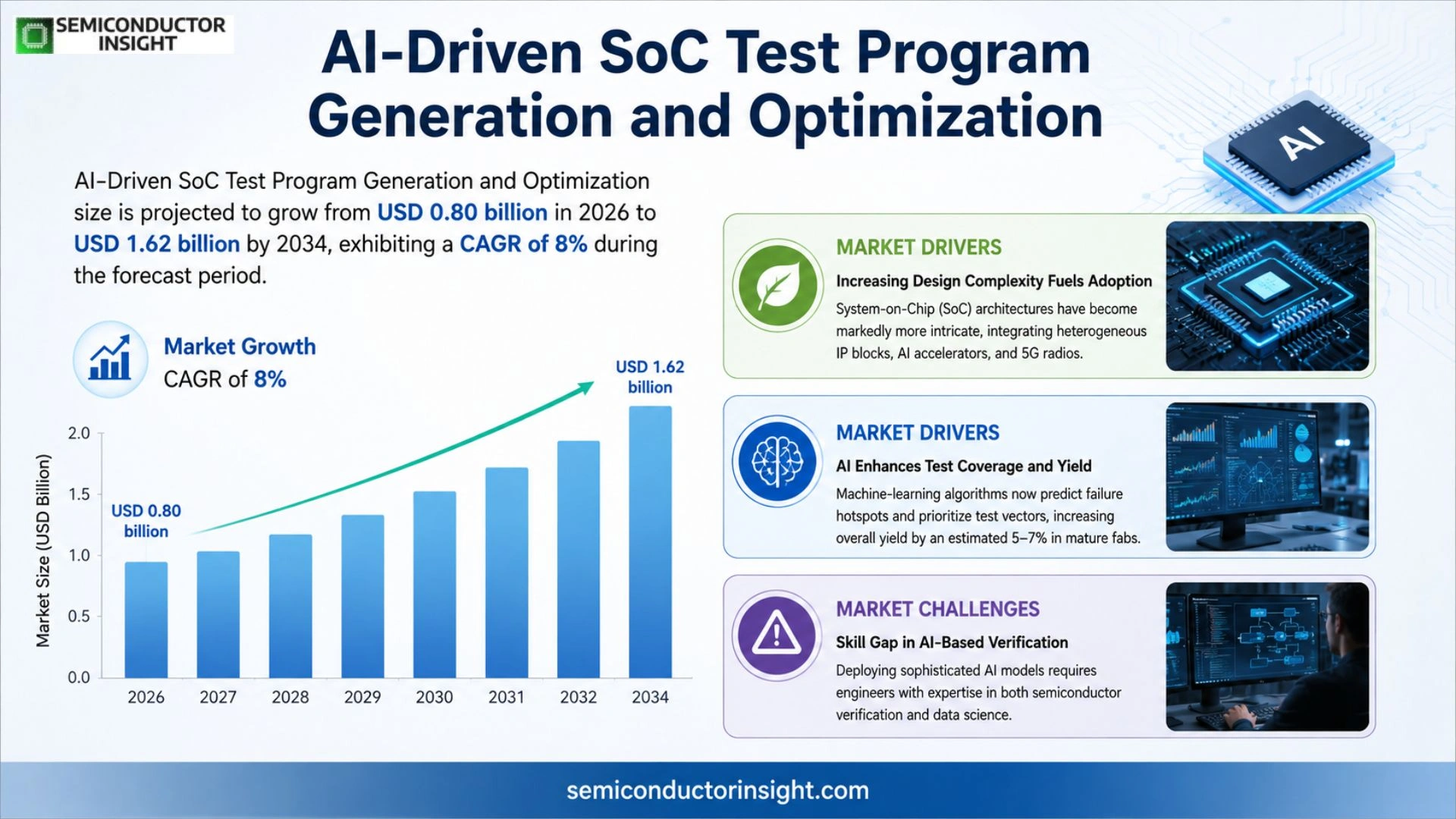
Global AI-Driven SoC Test Program Generation and Optimization Market size was valued at USD 0.78 billion in 2025. The market is projected to grow from USD 0.80 billion in 2026 to USD 1.62 billion by 2034, exhibiting a CAGR of 8% during the forecast period.
This market encompasses software‑driven solutions that automatically create, adapt, and fine‑tune test programs for system‑on‑chip designs using artificial‑intelligence algorithms. By leveraging machine learning models trained on prior verification data, these tools accelerate pattern generation, reduce coverage gaps, and optimize resource allocation across complex heterogeneous IP blocks.
The sector is gaining momentum because semiconductor manufacturers are under pressure to shorten time‑to‑market while maintaining high reliability standards for increasingly intricate chips.
MARKET DRIVERS
Increasing Design Complexity Fuels Adoption
System‑on‑Chip (SoC) architectures have become markedly more intricate, integrating heterogeneous IP blocks, AI accelerators, and 5G radios. Design teams are compelled to shorten verification cycles while maintaining high fault coverage, a need that directly propels AI‑Driven SoC Test Program Generation and Optimization Market.
AI Enhances Test Coverage and Yield
Machine‑learning algorithms now predict failure hotspots and prioritize test vectors, increasing overall yield by an estimated 5‑7 % in mature fabs. Companies that integrate AI‑driven test generation report a 30 % reduction in time‑to‑market for flagship SoCs, underscoring the market’s growth momentum.
➤ “AI‑enabled verification is reshaping how semiconductor firms balance speed and quality, delivering measurable cost savings.”
Regulatory pressures for functional safety in automotive and aerospace applications further compel manufacturers to adopt advanced test automation, reinforcing demand for AI‑Driven SoC Test Program Generation and Optimization Market.
MARKET CHALLENGES
Skill Gap in AI‑Based Verification
Deploying sophisticated AI models requires engineers with expertise in both semiconductor verification and data science. The shortage of such hybrid talent extends project timelines and raises training costs, representing a notable hurdle for market expansion.
Other Challenges
Integration with Legacy Toolchains
Many fabs rely on entrenched EDA suites that lack seamless APIs for AI modules. Bridging this gap often involves custom middleware, adding complexity and delaying ROI.
MARKET RESTRAINTS
High Up‑Front Investment
Initial licensing fees for AI‑driven verification platforms, coupled with the cost of data infrastructure, can exceed US $2 million for large‑scale SoC projects. Smaller design houses may delay adoption until the technology becomes more price‑accessible, tempering overall market velocity.
MARKET OPPORTUNITIES
Emerging Edge‑AI and Autonomous Systems
The surge in edge‑AI processors and autonomous vehicle SoCs creates a fertile environment for AI‑driven test generation. Companies that tailor their solutions to these high‑growth segments can capture double‑digit market share gains within the next five years.
Strategic Partnerships with Cloud Providers
Cloud‑based simulation services are integrating AI verification engines, offering elastic compute resources that lower barriers to entry. This collaboration opens new revenue streams and accelerates the adoption curve for AI‑Driven SoC Test Program Generation and Optimization Market.
AI-Driven SoC Test Program Generation and Optimization Market Trend
Accelerated Verification Through AI Automation
AI‑Driven SoC Test Program Generation and Optimization Market is reshaping verification cycles for system‑on‑chip designs. By applying machine‑learning models trained on historical coverage data, solution providers reduce pattern‑creation time by roughly 30 % while closing coverage gaps that previously required manual intervention. This efficiency gain aligns with semiconductor manufacturers’ pressure to compress product development schedules, especially as design complexity climbs toward multi‑terabit integration and heterogeneous IP ecosystems. Vendors are incorporating reinforcement‑learning techniques to iteratively refine test suites, which leads to better fault detection without expanding test volume. Cost advantages are evident as reduced engineer hours translate into lower verification budgets, an outcome that is increasingly critical amid rising fab expenses. The convergence of these technical and economic factors positions AI‑driven verification as a cornerstone of next‑generation chip development strategies.
Other Trends
Integration with Edge‑AI Workloads
Edge‑AI deployments demand verification pipelines that can handle heterogeneous IP blocks and strict low‑power constraints. AI‑driven tools automatically adapt test vectors to meet power budgets and latency targets, enabling designers to validate edge processors without extensive manual retargeting. Recent field reports indicate up to a 25 % reduction in verification turnaround for automotive radar SoCs, while power‑aware test generation has cut runtime energy consumption by approximately 18 % in wearable‑device chips. The ability to simulate sensor‑fusion workloads and on‑device inference models within the same verification flow further differentiates AI‑enabled solutions from legacy script‑based approaches. As edge devices proliferate across automotive, industrial IoT, and consumer markets, the need for scalable, AI‑augmented verification is expected to accelerate, prompting many design houses to embed these capabilities early in their development roadmaps.
Competitive Landscape and Strategic Partnerships
The market remains concentrated around a handful of established EDA vendors, yet recent acquisitions have intensified the focus on AI capabilities. Synopsys and Cadence have both integrated deep‑learning inference engines into their verification suites, allowing test generation to be guided by predictive coverage models. Siemens EDA announced a joint development program with Arm to embed AI‑optimized test generators directly within ARM processor design flows, creating a seamless hand‑off from architecture to silicon validation. These collaborations not only shorten integration cycles but also produce bundled offerings that large foundries increasingly prefer for end‑to‑end verification. As design cycles shrink and chip heterogeneity rises, the strategic alignment of AI technology with traditional EDA platforms is emerging as a decisive factor for competitive advantage in AI‑Driven SoC Test Program Generation and Optimization Market.
COMPETITIVE LANDSCAPE
Key Industry Players
AI‑Driven SoC Test Program Generation and Optimization Market – Competitive Overview
The market is dominated by a handful of large EDA vendors that have integrated advanced AI modules into their verification suites. Synopsys Inc. leads with its DSO.ai platform, leveraging machine‑learning to prioritize test patterns and compress stimulus sets, thereby shortening time‑to‑market for complex SoCs. Cadence Design Systems Inc. follows closely with its AI‑enabled JasperGold suite, which automates coverage closure and resource allocation across heterogeneous IP blocks. Siemens EDA (formerly Mentor Graphics) augments its Questa platform with predictive analytics that reduce verification gaps in edge‑AI designs. Arm Ltd. contributes domain‑specific optimization engines that align test generation with its CPU and GPU IP portfolios. Collectively, these incumbents shape the market structure through extensive licensing models, strategic acquisitions, and collaborative R&D that reinforce a high‑entry‑barrier environment.
Beyond the core quartet, several niche and emerging players are gaining traction by focusing on specialized AI optimizations or vertical market needs. Qualcomm leverages its AI expertise to tailor test‑generation for 5G and automotive SoCs, while Intel Corporation embeds proprietary neural‑network compilers to streamline verification of heterogeneous architectures. NVIDIA’s AI‑centric verification tools address the unique demands of high‑performance compute and graphics pipelines. MediaTek, GlobalFoundries, and Renesas Electronics provide cost‑effective AI‑driven solutions aimed at mid‑range and IoT products. Analog Devices and Marvell Technology Group introduce AI‑assisted test‑pattern reduction for analog‑mixed‑signal blocks, and Broadcom Inc. and Xilinx (now part of AMD) target networking and FPGA‑centric verification workflows, respectively.
List of Key AI‑Driven SoC Test Program Generation and Optimization Companies Profiled
- Synopsys Inc.
- Cadence Design Systems Inc.
- Siemens EDA
- Arm Ltd.
- Qualcomm
- Intel Corporation
- NVIDIA
- MediaTek
- GlobalFoundries
- Renesas Electronics
- Analog Devices
- Marvell Technology Group
- Broadcom Inc.
- Xilinx (AMD)
Segment Analysis:
| Segment Category | Sub-Segments | Key Insights |
| By Type |
|
ML‑powered Pattern Generators
|
| By Application |
|
Edge‑AI Device Verification
|
| By End User |
|
Semiconductor Design Houses
|
| By Deployment Mode |
|
Cloud‑based SaaS Solutions
|
| By Verification Focus |
|
Functional Verification
|
Regional Analysis: AI-Driven SoC Test Program Generation and Optimization Market
North America
Strong demand for high‑performance computing, 5G infrastructure, and autonomous systems fuels the need for faster test‑program generation. AI techniques accelerate pattern creation, reducing validation time for complex SoCs.
Reinforcement learning and generative AI are being integrated into test‑program synthesis tools, enabling adaptive coverage models that evolve with design complexity.
Minimal regulatory constraints in North America encourage rapid adoption of AI‑driven verification, with standards bodies focusing on interoperability rather than limiting algorithmic approaches.
Major EDA vendors and niche AI startups compete, often forming strategic alliances to combine classic verification suites with advanced AI modules.
Europe
European markets exhibit steady growth, underpinned by strong automotive and industrial automation sectors. Companies invest in AI‑enhanced test tools to meet stringent safety standards, while collaborative research programs across Germany, France, and the UK drive algorithmic innovation. The focus remains on integrating AI with existing verification flows to improve fault detection without extensive redesign.
Asia‑Pacific
In Asia‑Pacific, rapid expansion of consumer electronics and emerging AI chip designers spurs interest in automated test‑program generation. Nations such as China, Japan, and South Korea prioritize government‑backed AI research, translating into higher adoption rates of AI‑driven verification platforms. Cost‑sensitivity drives the pursuit of efficient, scalable solutions.
South America
South America’s semiconductor design activity is modest but growing, with Brazil leading regional initiatives. The market is driven by efforts to localize production and reduce reliance on imports. AI‑based test automation is seen as a lever to accelerate development cycles and improve product competitiveness.
Middle East & Africa
The Middle East & Africa region shows nascent interest, primarily in technology hubs such as the United Arab Emirates and South Africa. Investments in AI research and partnerships with global EDA firms are paving the way for gradual adoption of AI‑enhanced test‑program generation, aligning with broader digital transformation agendas.
Report Scope
This market research report provides a comprehensive analysis of the AI-Driven SoC Test Program Generation and Optimization Market , covering the forecast period 2026–2034. It offers detailed insights into market dynamics, technological advancements, competitive landscape, and key trends shaping the industry.
Key focus areas of the report include:
- Market Overview: The report begins with an overview outlining its current market scenario, key growth indicators, and industry transformation drivers. It discusses macroeconomic factors, demand–supply balance, regulatory landscape, and the strategic role of semiconductors in powering advancements across industries such as automotive, telecommunications, consumer electronics, and industrial automation.
- Market Size & Forecast: Historical data and future projections for revenue, unit shipments, and market value across major regions and segments.
- Segmentation Analysis: Detailed breakdown by product type, technology, application, and end-user industry to identify high-growth segments and investment opportunities.
- Regional Insights: Insights into market performance across North America, Europe, Asia-Pacific, Latin America, and the Middle East & Africa, including country-level analysis where relevant.
- Competitive Landscape: Profiles of leading market participants, including their product offerings, R&D focus, manufacturing capacity, pricing strategies, and recent developments such as mergers, acquisitions, and partnerships.
- Technology Trends & Innovation: Assessment of emerging technologies, integration of AI/IoT, semiconductor design trends, fabrication techniques, and evolving industry standards.
- Market Drivers & Restraints: Evaluation of factors driving market growth along with challenges, supply chain constraints, regulatory issues, and market-entry barriers.
- Stakeholder Insights: Insights for component suppliers, OEMs, system integrators, investors, and policymakers regarding the evolving ecosystem and strategic opportunities.
Primary and secondary research methods are employed, including interviews with industry experts, data from verified sources, and real-time market intelligence to ensure the accuracy and reliability of the insights presented.
FREQUENTLY ASKED QUESTIONS:
What is the current market size of AI-Driven SoC Test Program Generation and Optimization Market?
-> AI-Driven SoC Test Program Generation and Optimization Market size is projected to grow from USD 0.80 billion in 2026 to USD 1.62 billion by 2034, reflecting a CAGR of 8%
Which key companies operate in AI-Driven SoC Test Program Generation and Optimization Market?
-> Key players include Synopsys Inc., Cadence Design Systems Inc., Siemens EDA (formerly Mentor Graphics), and Arm Ltd.
What are the key growth drivers?
-> Key growth drivers include intensified pressure to shorten time‑to‑market for increasingly complex chips and the surge in edge‑AI workloads that demand more efficient verification pipelines.
Which region dominates the market?
-> The reference material does not specify a dominant region; regional leadership was not disclosed.
What are the emerging trends?
-> Emerging trends include greater integration of AI/ML algorithms into verification suites, automation of test‑program generation, and increased focus on handling massive design spaces for edge‑AI applications.
Get Sample Report PDF for Exclusive Insights
Report Sample Includes
- Table of Contents
- List of Tables & Figures
- Charts, Research Methodology, and more...
 Download Sample Report PDF


