AI-Driven Side-Channel Attack Detection and Mitigation IP Market Insights
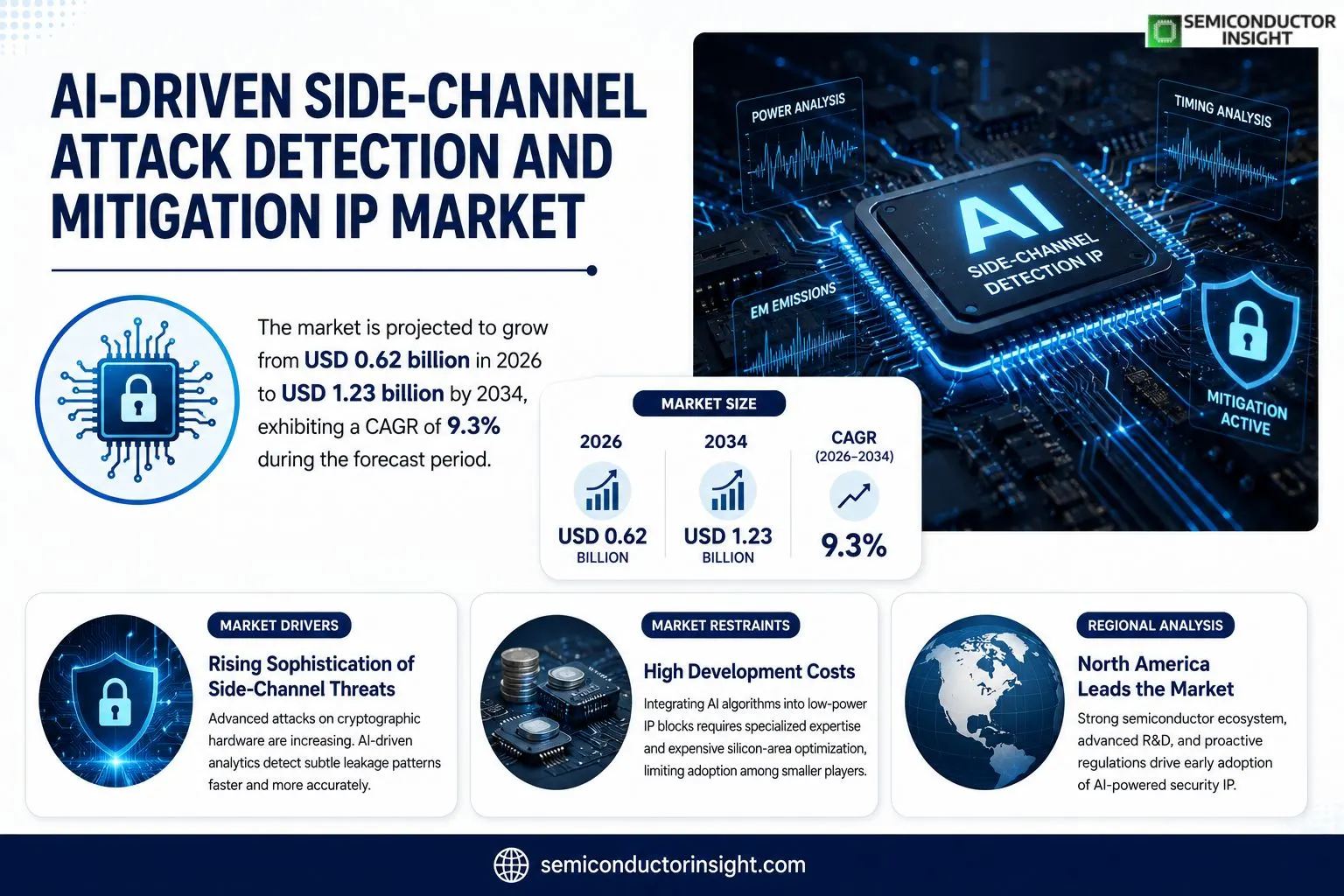
AI-driven side-channel attack detection and mitigation IP market size was valued at USD 0.58 billion in 2025. The market is projected to grow from USD 0.62 billion in 2026 to USD 1.23 billion by 2034, exhibiting a CAGR of 9.3% during the forecast period.
AI-driven side‑channel attack detection and mitigation IPs are specialized intellectual‑property cores that integrate machine‑learning models with hardware monitoring circuits to identify anomalous power consumption, electromagnetic emissions, or timing variations indicative of covert extraction attempts. These IP blocks provide real‑time classification, adaptive countermeasures such as randomization or noise injection, and secure key management interfaces, thereby strengthening the cryptographic resilience of ASICs, FPGAs, and system‑on‑chips.The market is experiencing rapid expansion because semiconductor manufacturers are accelerating adoption of advanced security features amid rising IoT device proliferation and stricter regulatory requirements for data protection. Furthermore, heightened awareness of sophisticated side‑channel techniquesexemplified by recent high‑profile exploits on smart cardsdrives demand for proactive detection solutions. Leading vendors such as Synopsys, Cadence Design Systems, Arm Holdings, and Rambus are investing heavily in R&D collaborations and licensing programs to broaden their portfolios, which further fuels market growth.
MARKET DRIVERS
Rising Sophistication of Side-Channel Threats
The proliferation of advanced side‑channel attacks on cryptographic hardware has forced semiconductor designers to seek more proactive defenses. AI‑driven analytics can identify subtle power‑fluctuation patterns that traditional methods miss, making detection faster and more reliable for AI-Driven Side-Channel Attack Detection and Mitigation IP Market.
Growth of Semiconductor IP Integration
Design houses are increasingly licensing IP blocks to accelerate time‑to‑market. Embedding intelligent mitigation modules directly into these IPs reduces validation cycles and lowers overall system cost, driving strong demand for specialized side‑channel protection solutions.
➤ Analysts estimate that AI‑enabled mitigation IPs will capture over 30% of new ASIC designs by 2028.
Overall, the convergence of heightened security concerns and the strategic shift toward modular IP ecosystems creates a robust growth trajectory for the market.
MARKET CHALLENGES
Complexity of Model Training and Validation
Developing accurate machine‑learning models requires extensive labeled datasets that capture diverse attack vectors. Collecting and curating such data is time‑consuming, and insufficient training can lead to false positives that disrupt normal operation.
Other Challenges
Regulatory and Compliance Barriers
Data‑protection regulations often restrict the use of telemetry needed for real‑time AI monitoring, limiting the scalability of detection solutions across regions.
MARKET RESTRAINTS
High Development Costs
Integrating sophisticated AI algorithms into low‑power IP blocks demands specialized engineering talent and expensive silicon‑area optimization. These cost pressures can deter small‑to‑mid‑size vendors from adopting advanced mitigation IP, slowing overall market expansion.
MARKET OPPORTUNITIES
Emerging Applications in Edge Computing
Edge devices such as autonomous sensors and IoT gateways process sensitive data locally, making them attractive targets for side‑channel exploitation. The need for on‑chip, AI‑driven protection provides a clear growth avenue, allowing AI-Driven Side-Channel Attack Detection and Mitigation IP Market to expand into rapidly scaling edge ecosystems.
AI-Driven Side-Channel Attack Detection and Mitigation IP Market Trends
Integration of Machine Learning for Real‑Time Anomaly Detection
The industry is witnessing a decisive shift toward embedding advanced machine‑learning models within side‑channel detection IP blocks. By continuously profiling power, electromagnetic, and timing signatures, these cores can distinguish legitimate variations from malicious leakage attempts with sub‑microsecond latency. This capability enables semiconductor designers to embed proactive security directly into ASICs, FPGAs and system‑on‑chips, reducing reliance on post‑silicon verification cycles. Vendors are releasing libraries that support online training, allowing devices to adapt to evolving attack vectors without hardware redesign.
Other Trends
Regulatory and Compliance Pressures
data‑protection regulations are increasingly mandating demonstrable resistance to side‑channel exploits, especially in critical IoT and automotive applications. Compliance frameworks now reference cryptographic robustness criteria that implicitly require detection and mitigation capabilities. As a result, design houses are integrating security IP early in the development flow to satisfy audit checkpoints and avoid costly redesigns later in the product lifecycle.
Ecosystem Partnerships Accelerate Adoption
Strategic collaborations among IP vendors, EDA tool providers and foundries are creating end‑to‑end solution stacks. Joint programs enable seamless integration of detection IP with verification suites, while foundry‑level support for secure libraries streamlines qualification. These alliances reduce time‑to‑market and lower the barrier for smaller design teams to adopt sophisticated protection schemes. Consequently, the market is expanding beyond traditional high‑value segments into consumer‑grade devices where cost constraints previously limited security investment.
COMPETITIVE LANDSCAPE
Key Industry Players
AI‑Driven Side‑Channel Attack Detection & Mitigation IP Market Overview
The market is anchored by a handful of vertically integrated semiconductor IP vendors whose AI‑enabled security blocks have become de‑facto standards for ASIC and FPGA designers. Synopsys leads with its “SiliconSecure” portfolio, combining deep‑learning classifiers with on‑chip power‑analysis engines; Cadence’s “SecureIP” suite offers real‑time timing anomaly detection integrated into its hardware description flow; Arm extends its “Platform Security Architecture” with AI‑driven side‑channel monitoring modules that are pre‑qualified for ARM Cortex‑M and Cortex‑A families; and Rambus supplies a cloud‑ready mitigation IP that injects adaptive noise based on predictive models. These leaders benefit from extensive design‑tool ecosystems, large OEM relationships, and robust licensing models that create high entry barriers for new entrants.Beyond the core incumbents, a growing cohort of specialized firms is expanding the competitive set. Infineon Technologies provides AI‑augmented detection IP bundled with its secure microcontroller families, emphasizing automotive compliance. NXP Semiconductors integrates side‑channel analytics into its EdgeLock solutions for IoT devices. Microchip Technology offers low‑power detection kernels targeting the edge market. Green Hills Software focuses on embedded safety‑critical environments, while Trusted Design delivers a plug‑and‑play AI detection engine for FPGA platforms. Emerging startups such as CertiK AI and S3C Labs are gaining traction by licensing lightweight models that can be embedded in custom ASIC flows, thereby diversifying the market and increasing pressure on pricing and feature differentiation.
List of Key AI‑Driven Side‑Channel Attack Detection and Mitigation IP Companies Profiled
- Synopsys
- Cadence Design Systems
- Arm Holdings
- Rambus Inc.
- Infineon Technologies
- NXP Semiconductors
- Microchip Technology
- Green Hills Software
- Trusted Design
- CertiK AI
- S3C Labs
- SC
- Elpida Security (acquired by Micron)
Segment Analysis:
| Segment Category | Sub-Segments | Key Insights |
| By Type |
|
Machine‑Learning Based Detection IP
|
| By Application |
|
IoT Device Security
|
| By End User |
|
Semiconductor Designers
|
| By Threat Vector |
|
Power Analysis
|
| By Deployment Stage |
|
Design‑Time Integration
|
Regional Analysis: AI-Driven Side-Channel Attack Detection and Mitigation IP Market
North America
AI‑powered side‑channel detection has moved beyond research labs into production silicon, with many foundries offering design‑for‑security services that embed neural‑network accelerators. Companies are leveraging on‑chip telemetry to feed continuous learning loops, allowing the IP to adapt to emerging attack vectors while maintaining low power overhead. The rapid adoption curve is reinforced by open‑source frameworks that accelerate model integration, shortening time‑to‑market for new generations of secure chips.
Federal agencies have issued guidance emphasizing the use of AI‑driven security measures for critical infrastructure, prompting vendors to certify their IP against emerging standards. The convergence of cybersecurity directives with semiconductor export controls creates a compliance incentive that accelerates deployment of advanced detection and mitigation solutions across government‑sponsored projects and commercial supply chains.
Established IP providers such as Synopsys, Cadence, and Arm have expanded their portfolios with AI‑focused side‑channel modules, while a wave of startups is delivering niche analytics engines specializing in power‑trace classification. Strategic partnerships between these vendors and cloud service providers enable seamless data pipelines for model training, further reinforcing North America’s ecosystem leadership.
Venture capital flows remain robust, with funding rounds targeting AI‑enhanced security startups and joint ventures that embed detection IP into next‑generation processors. At the same time, corporate R&D budgets are allocating a larger share to predictive analytics, recognizing the long‑term cost benefits of early threat mitigation in silicon design cycles.
Europe
European manufacturers are capitalising on strong data‑privacy regulations to differentiate their AI‑Driven Side‑Channel Attack Detection and Mitigation IP offerings. The region’s emphasis on standards such as GDPR and the upcoming EU Cybersecurity Act has encouraged a risk‑averse approach, prompting design houses to embed AI‑based safeguards early in the development process. Collaborative research programmes, notably those funded by Horizon Europe, bring together universities, chip vendors, and cybersecurity firms to refine machine‑learning models that can operate within stringent power budgets typical of automotive and industrial IoT applications. While the market size trails North America, Europe’s focus on compliance‑driven innovation ensures a steady pipeline of high‑integrity security IP solutions.
Asia‑Pacific
The Asia‑Pacific region exhibits fast‑growing interest in AI‑enabled side‑channel protection, fueled by expanding semiconductor manufacturing hubs in Taiwan, South Korea, and Singapore. OEMs are increasingly seeking to integrate intelligent detection capabilities to meet rising demand for secure consumer electronics and 5G infrastructure. However, differing levels of regulatory maturity result in a heterogeneous adoption landscape, with some markets prioritising cost‑effective solutions over sophisticated AI models. Regional partnerships between local foundries and IP providers are helping to bridge this gap, delivering tailored solutions that balance performance with price sensitivity.
South America
In South America, market momentum is anchored by governmental initiatives aimed at strengthening critical‑infrastructure security, particularly in the energy and telecommunications sectors. While the region lacks the depth of AI research ecosystems found elsewhere, it leverages strategic alliances with North American and European vendors to access mature side‑channel detection IP. Adoption is driven by the need to protect legacy systems undergoing digital transformation, prompting integrators to opt for modular AI‑based add‑ons that can be retrofitted with minimal disruption.
Middle East & Africa
Middle East & Africa are witnessing a nascent yet promising uptake of AI‑driven side‑channel mitigation technologies, largely propelled by sovereign wealth funds allocating capital toward cybersecurity ventures. National security programs in several Gulf states prioritize the integration of intelligent detection mechanisms within defense‑grade silicon, creating a niche market for high‑assurance IP. In Africa, early‑stage pilots focus on securing mobile payment platforms, where the cost‑effective deployment of AI models on low‑power devices is a key differentiator. Collaborative training initiatives with partners aim to build local expertise and accelerate market readiness.
Report Scope
This market research report provides a comprehensive analysis of the AI-Driven Side-Channel Attack Detection and Mitigation IP Market , covering the forecast period 2026–2034. It offers detailed insights into market dynamics, technological advancements, competitive landscape, and key trends shaping the industry.
Key focus areas of the report include:
- Market Overview: The report begins with an overview outlining its current market scenario, key growth indicators, and industry transformation drivers. It discusses macroeconomic factors, demand–supply balance, regulatory landscape, and the strategic role of semiconductors in powering advancements across industries such as automotive, telecommunications, consumer electronics, and industrial automation.
- Market Size & Forecast: Historical data and future projections for revenue, unit shipments, and market value across major regions and segments.
- Segmentation Analysis: Detailed breakdown by product type, technology, application, and end-user industry to identify high-growth segments and investment opportunities.
- Regional Insights: Insights into market performance across North America, Europe, Asia-Pacific, Latin America, and the Middle East & Africa, including country-level analysis where relevant.
- Competitive Landscape: Profiles of leading market participants, including their product offerings, R&D focus, manufacturing capacity, pricing strategies, and recent developments such as mergers, acquisitions, and partnerships.
- Technology Trends & Innovation: Assessment of emerging technologies, integration of AI/IoT, semiconductor design trends, fabrication techniques, and evolving industry standards.
- Market Drivers & Restraints: Evaluation of factors driving market growth along with challenges, supply chain constraints, regulatory issues, and market-entry barriers.
- Stakeholder Insights: Insights for component suppliers, OEMs, system integrators, investors, and policymakers regarding the evolving ecosystem and strategic opportunities.
Primary and secondary research methods are employed, including interviews with industry experts, data from verified sources, and real-time market intelligence to ensure the accuracy and reliability of the insights presented.
FREQUENTLY ASKED QUESTIONS:
What is the current market size of AI-Driven Side-Channel Attack Detection and Mitigation IP Market?
-> AI-Driven Side-Channel Attack Detection and Mitigation IP Market was valued at USD 0.58 billion in 2025 and is expected to reach USD 1.23 billion by 2034, reflecting a CAGR of 9.3% over the forecast period.
Which key companies operate in AI-Driven Side-Channel Attack Detection and Mitigation IP Market?
-> Key players include Synopsys, Cadence Design Systems, Arm Holdings, and Rambus, among others.
What are the key growth drivers?
-> Key growth drivers include rising IoT device proliferation, stricter data‑protection regulations, and increasing adoption of advanced hardware security features by semiconductor manufacturers.
Which region dominates the market?
-> North America holds the largest market share, while Asia‑Pacific is emerging as the fastest‑growing region.
What are the emerging trends?
-> Emerging trends include AI‑enhanced detection algorithms, integration with secure enclaves, and widespread deployment of noise‑injection countermeasures.

Get Sample Report PDF for Exclusive Insights
Report Sample Includes
- Table of Contents
- List of Tables & Figures
- Charts, Research Methodology, and more...
 Download Sample Report PDF