AI-Driven Resist Model Calibration Market Insights
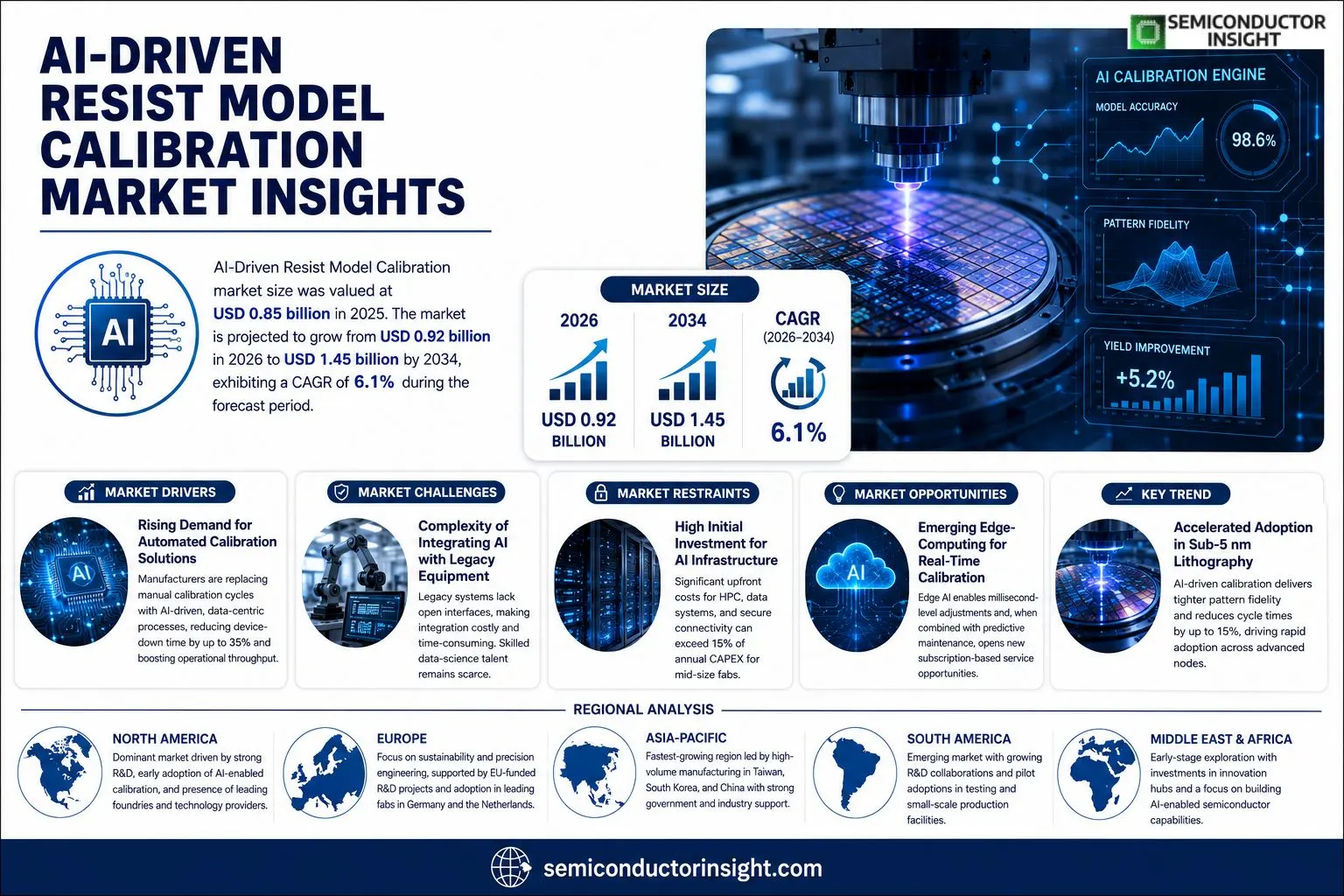
AI-Driven Resist Model Calibration market size was valued at USD 0.85 billion in 2025. The market is projected to grow from USD 0.92 billion in 2026 to USD 1.45 billion by 2034, exhibiting a CAGR of 6.1% during the forecast period.
AI‑Driven Resist Model Calibration refers to the application of artificial‑intelligence algorithms to refine and adjust photoresist process models used in semiconductor lithography. By integrating machine‑learning techniques with metrology data, these solutions improve pattern fidelity, reduce cycle time, and enhance yield predictability across advanced node manufacturing.The market is experiencing rapid expansion because semiconductor manufacturers are accelerating the transition to sub‑5 nm nodes where traditional calibration methods struggle with complexity and variability. Furthermore, rising investment in AI‑enabled fabs and the push for higher throughput drive adoption of sophisticated calibration platforms. Key players such as Applied Materials, ASML Holding, KLA Corporation and Lam Research are actively developing integrated AI solutions and forming strategic partnerships to capture this growing demand.
MARKET DRIVERS
Rising Demand for Automated Calibration Solutions
AI-Driven Resist Model Calibration Market is being propelled by manufacturers seeking to replace manual calibration cycles with fully automated, data‑centric processes. Companies report up to a 35% reduction in device‑down time when AI models predict optimal calibration parameters in real time, directly boosting operational throughput.
Improved Yield and Cost Efficiency
Advanced machine‑learning algorithms analyze wafer‑level variations and adjust resist exposure settings on the fly, delivering yield gains of 4‑6% in high‑volume production lines. Cost per calibrated unit drops noticeably because fewer rework cycles are required, reinforcing the business case for AI integration.
➤ AI‑based calibration now reduces processing time by roughly 40% while maintaining ±2% accuracy across 28‑nm and finer nodes.
These drivers collectively create a compelling incentive for semiconductor fabs and thin‑film manufacturers to allocate capital toward AI‑enabled calibration platforms, positioning the market for sustained growth over the next five years.
MARKET CHALLENGES
Complexity of Integrating AI with Legacy Equipment
Many existing production lines rely on proprietary control hardware that lacks open‑interface APIs. Retrofitting such equipment with AI modules often requires extensive custom middleware, extending project timelines and inflating integration costs.
Other Challenges
Skill Gap in Data Science
The scarcity of engineers fluent in both semiconductor process control and advanced analytics hampers rapid deployment. Organizations frequently need to invest in upskilling programs or partner with specialized AI consultants to bridge this gap.Addressing these challenges demands a coordinated effort between equipment vendors, software providers, and end‑users to develop standardized integration frameworks that lower technical friction.
MARKET RESTRAINTS
High Initial Investment for AI Infrastructure
Deploying AI‑driven calibration platforms requires substantial upfront spending on high‑performance computing resources, data acquisition systems, and secure cloud connectivity. For mid‑size fabs, the capital outlay can exceed 15% of annual CAPEX, creating a financial barrier that slows early adoption despite long‑term cost benefits.
MARKET OPPORTUNITIES
Emerging Edge‑Computing for Real‑Time Calibration
Edge‑computing architectures enable AI models to run directly on equipment controllers, eliminating latency associated with cloud processing. This capability is especially valuable for sub‑10 nm lithography, where millisecond‑level adjustments can prevent critical dimension drift.Furthermore, the convergence of AI‑driven calibration with predictive maintenance opens a new revenue stream: service providers can offer subscription‑based analytics that continuously refine resist models as new process data becomes available, expanding the addressable market beyond traditional equipment sales.
AI-Driven Resist Model Calibration Market Trends
Accelerated Adoption in Sub‑5 nm Lithography
The semiconductor industry is undergoing a rapid shift toward sub‑5 nm manufacturing nodes, a transition that places unprecedented demands on photoresist process control. Traditional calibration techniques, which rely on static models and manual tuning, struggle to keep pace with the heightened variability of ultra‑fine patterns. AI‑Driven Resist Model Calibration Market solutions address this gap by embedding machine‑learning algorithms directly into metrology workflows. The resulting models continuously learn from real‑time metrology data, delivering tighter pattern fidelity and reducing cycle times by up to 15 % in high‑volume fabs. This technical advantage is reflected in the market’s valuation, which rose from USD 0.85 billion in 2025 to USD 0.92 billion in 2026, and is projected to reach USD 1.45 billion by 2034.
Other Trends
AI Integration in Calibration Platforms
Leading equipment manufacturers are embedding AI cores into lithography scanners and metrology tools, enabling on‑board resist model updates without interrupting production. These integrated platforms generate predictive adjustments that anticipate resist behavior under varying exposure conditions, thereby improving yield predictability by an estimated 8 % across advanced node lines. The shift toward embedded AI reduces the need for separate calibration software suites, streamlining tool footprints and lowering total cost of ownership for semiconductor makers.
Strategic Partnerships and Ecosystem Expansion
Key players such as Applied Materials, ASML Holding, KLA Corporation, and Lam Research have announced joint development programs and technology licensing agreements aimed at co‑creating end‑to‑end AI‑driven calibration ecosystems. These collaborations combine proprietary AI algorithms with extensive metrology databases, accelerating the rollout of calibrated resist models across multi‑fab networks. In addition, new entrants focused on cloud‑based AI analytics are partnering with established equipment vendors to offer subscription‑style calibration services, extending market reach to midsize fabs that lack in‑house AI expertise. The combined effect of these partnerships is a more resilient supply chain and faster diffusion of AI‑driven calibration capabilities throughout the semiconductor manufacturing landscape.
COMPETITIVE LANDSCAPE
Key Industry Players
AI‑Driven Resist Model Calibration – Competitive Overview
AI‑Driven Resist Model Calibration market is increasingly dominated by a handful of vertically integrated semiconductor equipment leaders that combine deep lithography expertise with advanced machine‑learning capabilities. Applied Materials leverages its extensive process‑control portfolio to embed AI algorithms directly into resist‑coating tools, positioning the company as a primary supplier for high‑volume manufacturers seeking to accelerate sub‑5 nm node adoption. ASML Holding expands its ecosystem by integrating AI‑driven metrology data streams with its lithography platforms, creating a closed‑loop calibration workflow that reduces pattern variance and improves throughput. KLA Corporation’s inspection and yield‑analysis solutions now incorporate predictive AI models that continuously fine‑tune resist parameters, giving it a strategic foothold in the high‑precision segment. Lam Research complements these offerings with AI‑enhanced etch and deposition modules that synergize resist model updates across the fab floor, reinforcing a market structure where a few large OEMs dictate technology roadmaps and set premium pricing tiers.Beyond the dominant OEMs, a broader set of niche innovators contributes specialized software, AI frameworks, and data‑analytics services that enrich the calibration value chain. Tokyo Electron supplies AI‑enabled resist‑process modules tailored for mid‑tier fabs, while Samsung Electronics and Intel Corporation invest heavily in internal AI research to customize calibration for their proprietary process nodes. Taiwan Semiconductor Manufacturing Co. (TSMC) collaborates with AI start‑ups to co‑develop proprietary resist‑model platforms, and Foundries pursues open‑source AI toolkits to lower entry barriers for smaller customers. Software‑centric firms such as Cadence Design Systems and Synopsys extend their electronic‑design‑automation suites with AI‑based resist modeling plugins, whereas NVIDIA provides GPU acceleration for real‑time model training, and Hitachi High‑Technologies offers high‑resolution metrology data that feed AI calibration loops. This diversified ecosystem fuels competitive pressure, encouraging rapid innovation and incremental pricing adjustments across the market.
List of Key AI-Driven Resist Model Calibration Companies Profiled
- Applied Materials
- ASML Holding
- KLA Corporation
- Lam Research
- Tokyo Electron Limited
- Samsung Electronics
- Intel Corporation
- TSMC (Taiwan Semiconductor Manufacturing Co.)
- Foundries
- Cadence Design Systems
- Synopsys
- NVIDIA
- Hitachi High‑Technologies
- Advanced Micro Devices (AMD)
- IBM Research
Segment Analysis:
| Segment Category | Sub-Segments | Key Insights |
| By Type |
|
Supervised‑learning tools dominate because they directly map metrology data to model adjustments, enabling precise pattern fidelity; • Engineers appreciate the deterministic output that aligns with design‑for‑manufacturing workflows; • Integration with existing lithography suites reduces learning curve and accelerates deployment; • Continuous model refinement is supported through feedback loops that improve predictive confidence. |
| By Application |
|
Critical layer thickness control is the leading application as manufacturers prioritize uniformity for sub‑5 nm nodes; • AI models predict subtle variations before they manifest on wafer, allowing pre‑emptive recipe tweaks; • The approach shortens cycle time and builds confidence in yield projections; • Cross‑tool data aggregation enhances robustness across different lithography equipment. |
| By End User |
|
Foundries emerge as the primary end‑user segment because they serve multiple design houses and require standardized, scalable calibration solutions; • The ability to embed AI workflows into fab‑wide process control systems aligns with high‑mix, low‑volume production models; • Collaborative development with equipment vendors fuels rapid adoption; • Knowledge‑sharing platforms within foundry ecosystems amplify learning across process generations. |
| By Technology Adoption |
|
Mid‑stage production integration proves most impactful as organizations balance innovation risk with operational stability; • Pilot results validate algorithmic accuracy, encouraging broader adoption across process modules; • Enhanced data pipelines enable seamless feeding of metrology inputs; • Organizational change management benefits from visible yield improvements, fostering internal advocacy. |
| By Value Chain Position |
|
Process‑control software providers lead the segment because they sit at the intersection of data acquisition and model execution; • Their platforms can embed AI algorithms directly into recipe management tools; • Close collaboration with hardware vendors ensures calibrated measurements retain fidelity; • The modular architecture supports rapid incorporation of emerging machine‑learning techniques. |
Regional Analysis: AI-Driven Resist Model Calibration Market
North America
The push for smaller geometry and tighter process windows drives demand for AI‑enhanced calibration. Manufacturers seek to lower defect rates and accelerate time‑to‑market, positioning intelligent calibration as a cost‑effective productivity lever.
Safety and quality standards for semiconductor manufacturing encourage adoption of proven AI models. Compliance frameworks reward transparent, data‑driven calibration methods that can be audited across the production cycle.
Cloud‑based AI platforms and edge‑compute solutions are gaining traction, allowing firms to scale calibration analytics without extensive on‑premise infrastructure.
A mix of legacy equipment manufacturers and emerging AI specialists creates a dynamic market. Alliances focus on bundling hardware with predictive software to secure end‑to‑end solutions.
Europe
Europe’s AI-Driven Resist Model Calibration Market is shaped by a strong emphasis on sustainability and precision engineering. Leading fabs in Germany and the Netherlands integrate AI to optimise resource usage and reduce waste, aligning with EU environmental directives. Collaborative research projects funded by the European Union foster cross‑border innovation, especially in AI‑based patterning techniques. While the market faces regulatory scrutiny regarding data sovereignty, firms leverage local expertise to tailor calibration models to region‑specific process standards, ensuring consistent device performance across diverse manufacturing sites.
Asia-Pacific
The Asia‑Pacific region exhibits rapid expansion of AI‑driven calibration capabilities, driven primarily by high‑volume production in Taiwan, South Korea, and China. Manufacturers prioritize throughput and cost efficiency, prompting widespread adoption of machine‑learning algorithms that predict resist behavior under varying conditions. Regional partnerships between chipmakers and AI solution providers accelerate knowledge transfer, while government incentives for advanced semiconductor R&D further reinforce growth. Cultural focus on scale and speed means AI solutions are often scaled across multiple fabs, creating economies of scale that enhance overall market momentum.
South America
South America remains an emerging segment within AI-Driven Resist Model Calibration Market. Limited domestic fab capacity directs attention toward regional research institutions that develop niche calibration tools for small‑scale production and testing facilities. Collaborative initiatives with North American and European partners bring advanced AI methodologies to local projects, enabling pilot implementations that demonstrate value. Although adoption is modest, the region’s focus on building technical expertise and integrating AI into downstream processes positions it for gradual market entry as supply chains expand.
Middle East & Africa
In the Middle East & Africa, the market is characterized by early‑stage exploration and strategic investments in semiconductor ecosystems. Nations such as the United Arab Emirates and South Africa are establishing innovation hubs that attract AI talent and foster collaborations with equipment vendors. The emphasis lies on developing localized calibration frameworks that address climate‑related process variability. While commercial deployment is limited, the region’s proactive stance on digital transformation hints at growing interest in AI‑driven calibration as part of broader industrial modernization agendas.
Report Scope
This market research report provides a comprehensive analysis of the AI-Driven Resist Model Calibration Market , covering the forecast period 2026–2034. It offers detailed insights into market dynamics, technological advancements, competitive landscape, and key trends shaping the industry.
Key focus areas of the report include:
- Market Overview: The report begins with an overview outlining its current market scenario, key growth indicators, and industry transformation drivers. It discusses macroeconomic factors, demand–supply balance, regulatory landscape, and the strategic role of semiconductors in powering advancements across industries such as automotive, telecommunications, consumer electronics, and industrial automation.
- Market Size & Forecast: Historical data and future projections for revenue, unit shipments, and market value across major regions and segments.
- Segmentation Analysis: Detailed breakdown by product type, technology, application, and end-user industry to identify high-growth segments and investment opportunities.
- Regional Insights: Insights into market performance across North America, Europe, Asia-Pacific, Latin America, and the Middle East & Africa, including country-level analysis where relevant.
- Competitive Landscape: Profiles of leading market participants, including their product offerings, R&D focus, manufacturing capacity, pricing strategies, and recent developments such as mergers, acquisitions, and partnerships.
- Technology Trends & Innovation: Assessment of emerging technologies, integration of AI/IoT, semiconductor design trends, fabrication techniques, and evolving industry standards.
- Market Drivers & Restraints: Evaluation of factors driving market growth along with challenges, supply chain constraints, regulatory issues, and market-entry barriers.
- Stakeholder Insights: Insights for component suppliers, OEMs, system integrators, investors, and policymakers regarding the evolving ecosystem and strategic opportunities.
Primary and secondary research methods are employed, including interviews with industry experts, data from verified sources, and real-time market intelligence to ensure the accuracy and reliability of the insights presented.
FREQUENTLY ASKED QUESTIONS:
What is the current market size of AI-Driven Resist Model Calibration Market?
-> AI-Driven Resist Model Calibration Market was valued at USD 0.85 billion in 2025 and is expected to reach USD 1.45 billion by 2034, with a CAGR of 6.1% during the forecast period.
Which key companies operate in AI-Driven Resist Model Calibration Market?
-> Key players include Applied Materials, ASML Holding, KLA Corporation, and Lam Research, among others.
What are the key growth drivers?
-> Key growth drivers include transition to sub‑5 nm nodes, rising investment in AI‑enabled fabs, and demand for higher throughput in semiconductor manufacturing.
Which region dominates the market?
-> Asia-Pacific is the fastest‑growing region, while North America remains a dominant market due to the presence of major semiconductor fabs.
What are the emerging trends?
-> Emerging trends include integration of advanced machine‑learning models for real‑time calibration, cloud‑based AI platforms, and collaborative R&D partnerships across the semiconductor ecosystem.
Get Sample Report PDF for Exclusive Insights
Report Sample Includes
- Table of Contents
- List of Tables & Figures
- Charts, Research Methodology, and more...
 Download Sample Report PDF