AI-Driven Programmable Optical Network ASIC Market Insights
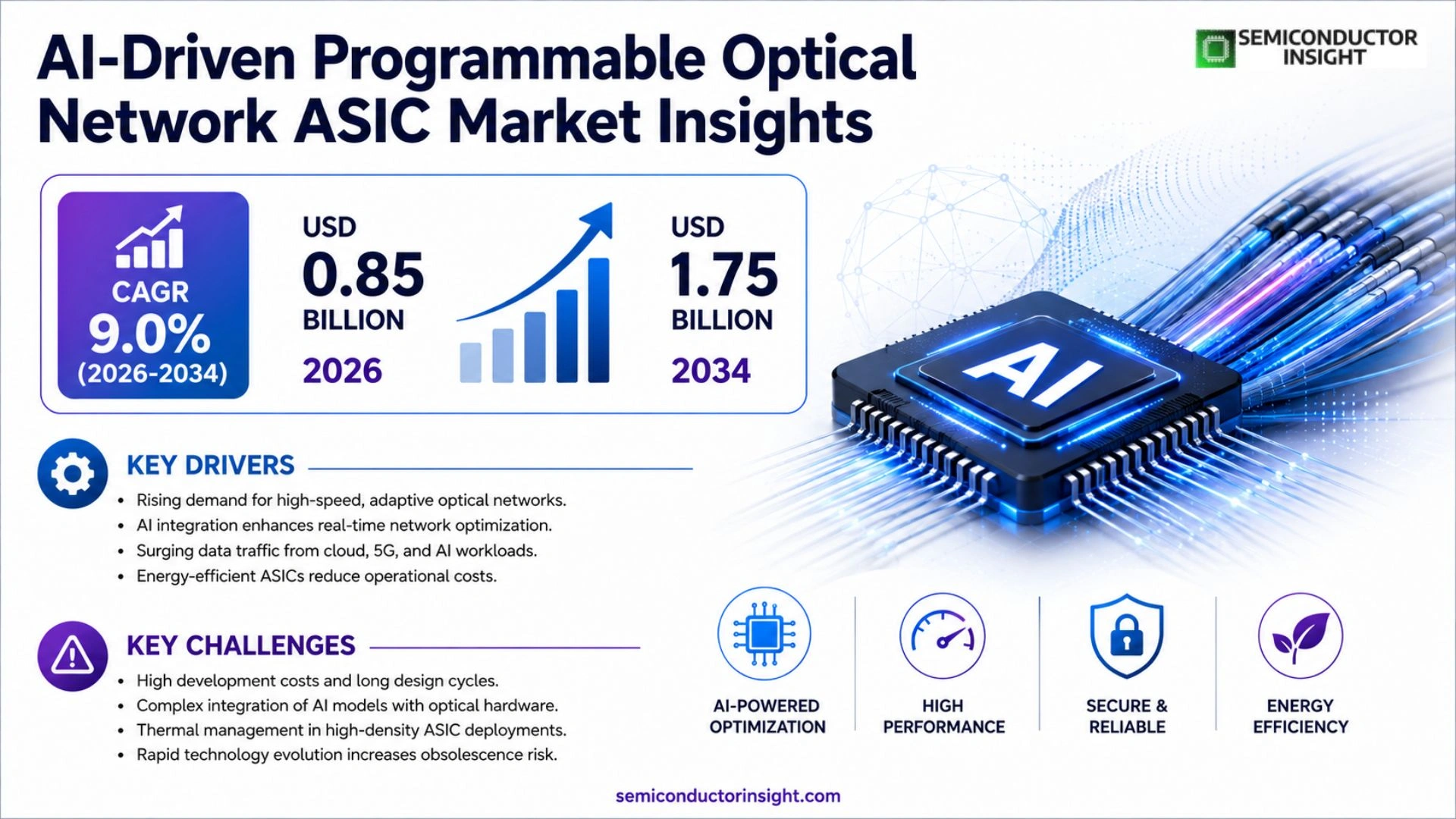
Global AI‑Driven Programmable Optical Network ASIC market size was valued at USD 0.85 billion in 2025. The market will grow from USD 0.85 billion in 2025 to USD 1.75 billion by 2034, delivering a CAGR of approximately 9 % over the horizon.
These chips are specialized integrated circuits that combine silicon photonics with configurable logic blocks, enabling dynamic bandwidth allocation and on‑the‑fly signal processing for high‑speed fiber links. They embed transceiver functions, wavelength routing and machine‑learning inference capabilities within a single die, allowing carriers and hyperscale data centers to adapt network performance in real time.
The expansion is fueled by surging demand for low‑latency connectivity in AI workloads, the rollout of 5G and edge computing infrastructures, and sizable capital spending by telecom operators on next‑generation transport networks. Moreover, collaborations such as the March 2024 joint development between Cisco and Broadcom on a programmable silicon‑photonic module illustrate how ecosystem partnerships accelerate adoption. Companies including Intel, Marvell Technology and Acacia Communications are actively extending their product portfolios to capture this momentum.
MARKET DRIVERS
AI Integration Accelerates ASIC Functionality
Enterprises are layering deep‑learning inference directly onto optical switching silicon, turning static bandwidth provision into a self‑optimizing service. This shift lets the AI-Driven Programmable Optical Network ASIC Market deliver sub‑microsecond latency while dynamically reallocating spectrum, a capability that traditional fixed‑function ASICs cannot match. Operators that adopt this model report lower packet‑loss rates and higher end‑user satisfaction, underscoring the commercial upside of embedding intelligence at the hardware layer.
Programmable Optics Reduce Capital Expenditure
By decoupling hardware from firmware, vendors enable a single ASIC family to support multiple transport protocols and evolving standards. This programmability curtails the need for periodic chassis replacements, translating into measurable CAPEX relief for carriers expanding fiber footprints. The flexibility also accelerates time‑to‑market for new services, allowing providers to monetize demand spikes without waiting for a new silicon spin‑off.
➤ Operators that integrate AI‑enabled programmable ASICs can shrink network provisioning cycles by up to 40 % while preserving performance margins.
Combined, these forces create a self‑reinforcing loop: smarter chips drive service differentiation, which in turn fuels investment in next‑generation programmable optics. Stakeholders that recognize this dynamic are positioning themselves to capture the upside of a market that is rapidly moving beyond static bandwidth provisioning.
MARKET CHALLENGES
Complexity of Algorithm Deployment
Embedding sophisticated AI models into ASIC pipelines introduces a software‑hardware integration challenge rarely seen in legacy photonic gear. Engineers must reconcile the deterministic timing of optical paths with the stochastic nature of neural‑net inference, a mismatch that can erode the promised latency gains if not meticulously managed.
Other Challenges
Talent Shortage
The niche skill set that blends photonic design, ASIC verification, and machine‑learning optimization remains scarce. Companies are competing for a limited pool of professionals capable of translating algorithmic intent into silicon‑level instructions, driving up recruitment costs and extending development timelines.
Regulatory ambiguity surrounding data‑privacy in optical transport layers adds another layer of uncertainty. While standards bodies are advancing encryption mandates, the interplay between encrypted traffic and AI‑driven routing decisions is still being defined, potentially delaying large‑scale rollouts.
MARKET RESTRAINTS
High Development Costs
Designing an ASIC that can host reconfigurable AI kernels while maintaining optical fidelity demands multiple design iterations, advanced simulation environments, and extensive silicon validation. The upfront capital required for mask sets and prototype runs remains a barrier for emerging players, limiting market concentration to firms that can sustain multi‑year R&D investment cycles.
MARKET OPPORTUNITIES
Emerging Edge Computing Demand
Edge data centers are proliferating at the network periphery to meet real‑time analytics requirements. These sites need ultra‑low‑latency, high‑capacity links that can be dynamically tuned as workloads shift. AI‑driven programmable optical ASICs provide the requisite agility, allowing edge operators to scale bandwidth on demand without over‑provisioning. Companies that align their product roadmaps with this edge‑centric shift stand to capture a sizable share of the upcoming wave of distributed compute.
AI-Driven Programmable Optical Network ASIC Market Trends
Silicon‑Photonic Integration with Configurable Logic
AI‑Driven Programmable Optical Network ASIC Market lies in chips that fuse silicon‑photonic transceivers with reconfigurable logic blocks. This convergence permits real‑time bandwidth steering and on‑the‑fly signal conditioning across high‑speed fiber links. As AI inference workloads demand sub‑millisecond latency, operators are gravitating toward ASICs that can embed machine‑learning inference alongside wavelength routing on a single die. The financial footprint of the market illustrates the momentum: revenue is measured at roughly USD 0.85 billion in 2025 and is slated to rise to about USD 1.75 billion by 2034, implying an average annual increase close to 9 percent. The upward trajectory reflects the urgency of delivering low‑latency connectivity for hyperscale data centers and the rollout of 5G‑enabled edge nodes.
Other Trends
Ecosystem Alliances Spur Early Adoption
Strategic collaborations are shaping the speed of market uptake. In March 2024, Cisco partnered with Broadcom to release a programmable silicon‑photonic module that showcases how joint engineering can compress development cycles. Parallel efforts by Intel, Marvell Technology, and Acacia Communications to broaden their ASIC portfolios further illustrate an industry‑wide push to standardize programmable optics. These alliances lower entry barriers for telecom carriers, allowing capital expenditures on next‑generation transport networks to be amortized across a broader ecosystem of compatible solutions.
Competitive Landscape and Business Implications
Beyond partnerships, the competitive environment is sharpening. Companies that can integrate advanced machine‑learning accelerators within the optical ASIC stack are likely to capture premium contracts with hyperscale providers seeking to offload AI workloads from conventional CPUs. For investors, the shift toward programmable optics signals a transition from legacy fixed‑function transceivers to a software‑defined hardware paradigm, where revenue streams depend on both silicon sales and recurring licensing of configuration models. Enterprises that fail to embed programmability may find their network equipment outpaced by rivals able to re‑tune spectral efficiency in response to traffic spikes, potentially eroding market share.
COMPETITIVE LANDSCAPE
Key Industry Players
Competitive forces shaping AI‑Driven Programmable Optical Network ASIC market
Intel retains the dominant position, leveraging its deep silicon‑photonic expertise and extensive foundry capacity to ship integrated ASICs that blend configurable logic with high‑speed transceiver blocks. Its recent roadmap stresses on‑chip machine‑learning inference engines, a capability that appeals to hyperscale operators seeking real‑time traffic steering. By aligning product development with major carrier roadmaps, Intel has built a supply chain that can meet the volume requirements of 5G back‑haul and edge deployments, establishing a clear advantage over newer entrants.
Beyond the market leader, a cohort of specialist firms is carving out niches through differentiated technology stacks or strategic partnerships. Broadcom, in concert with Cisco, announced a joint silicon‑photonic module that targets programmable wavelength routing for data‑center interconnects. Marvell Technology, following its acquisition of Inphi, offers a portfolio that couples PAM‑4 transceivers with programmable DSP cores. Meanwhile, Acacia Communications, Lumentum, Ciena, Nokia, Huawei, Xilinx (AMD), Mellanox (NVIDIA), Achronix and Aurrion each focus on particular segments such as carrier‑grade reliability, low‑power edge modules, or high‑density wavelength‑division multiplexing. Their collective activity sustains a vibrant ecosystem where collaboration and modularity drive incremental adoption.
List of Key AI-Driven Programmable Optical Network ASIC Companies Profiled
- Intel
- Broadcom
- Cisco
- Marvell Technology
- Acacia Communications
- Lumentum
- Ciena
- Nokia
- Huawei
- Xilinx (AMD)
- Mellanox (NVIDIA)
- Achronix
- Aurrion
Segment Analysis:
| Segment Category | Sub-Segments | Key Insights |
| By Type |
|
Programmable Logic ASICs
|
| By Application |
|
Data Center Interconnect
|
| By End User |
|
Hyperscale Cloud Providers
|
| By Integration Approach |
|
Monolithic Integration
|
| By Network Layer |
|
Physical Layer (PHY)
|
Regional Analysis: AI-Driven Programmable Optical Network ASIC Market
The FCC’s recent spectrum‑allocation reforms encourage programmable optical solutions that can adjust to shifting bandwidth demands without hardware overhaul, reducing compliance overhead for network operators.
Universities in Massachusetts and California now offer joint AI‑hardware curricula, feeding a pipeline of engineers fluent in both photonic design and machine‑learning algorithms.
Fortune‑500 firms are piloting AI‑driven ASICs to streamline internal data pipelines, citing faster model training cycles and lower total cost of ownership as primary drivers.
Proximity to advanced silicon foundries and a diversified supplier base cushions North America against geopolitical disruptions that could affect component availability.
Europe
European operators are capitalizing on the EU’s Digital Strategy, which earmarks funding for programmable optical infrastructure that can support AI‑enhanced services. The region’s strong standards bodies foster cross‑border interoperability, encouraging vendors to develop ASICs that meet common latency and security benchmarks. While investment cycles are more measured than in North America, the emphasis on sustainability drives demand for hardware that can intelligently throttle power consumption based on real‑time traffic analytics. Collaborative clusters in Germany and the Nordics blend telecom expertise with AI research, positioning Europe as a hub for reliable, regulation‑compliant deployments.
Asia‑Pacific
Asia‑Pacific exhibits a rapid rollout of 5G and burgeoning data‑center construction, prompting telcos to seek programmable optical solutions capable of scaling with AI‑generated traffic patterns. Countries such as Japan and South Korea lead in integrating AI inference directly onto ASICs, reducing latency for critical applications like autonomous transport. Although capital availability varies across the region, government‑backed programs in China and India accelerate prototype development, creating a competitive landscape where speed-to-market outweighs absolute performance. The diverse demand profile—from high‑frequency trading hubs to remote edge sites—forces manufacturers to tailor ASICs to a wide spectrum of use cases.
South America
In South America, the market is driven by a need to modernize aging fiber backbones while leap‑frogging to AI‑enabled networking. Brazil’s public‑private partnerships prioritize programmable hardware that can be reconfigured as service providers adopt new AI‑driven analytics tools. Cost sensitivity remains a central concern, encouraging vendors to offer modular ASIC designs that allow incremental upgrades. The region’s emerging AI talent pool, bolstered by university‑industry collaborations, is gradually enhancing local design capabilities, reducing reliance on imported solutions.
Middle East & Africa
Middle East & Africa are witnessing a strategic push to diversify economies through digital transformation, with sovereign wealth funds allocating capital toward intelligent networking. Programmable optical ASICs are viewed as enablers for smart‑city initiatives and large‑scale cloud services targeting the continent’s growing mobile user base. Regulatory frameworks are evolving to accommodate AI‑driven traffic management, while partnerships with established North American vendors facilitate technology transfer. Despite infrastructural challenges, the emphasis on future‑proofing networks drives interest in ASICs that can adapt to evolving AI workloads without extensive hardware replacement.
Report Scope
This market research report provides a comprehensive analysis of the AI-Driven Programmable Optical Network ASIC Market , covering the forecast period 2026–2034. It offers detailed insights into market dynamics, technological advancements, competitive landscape, and key trends shaping the industry.
Key focus areas of the report include:
- Market Overview: The report begins with an overview outlining its current market scenario, key growth indicators, and industry transformation drivers. It discusses macroeconomic factors, demand–supply balance, regulatory landscape, and the strategic role of semiconductors in powering advancements across industries such as automotive, telecommunications, consumer electronics, and industrial automation.
- Market Size & Forecast: Historical data and future projections for revenue, unit shipments, and market value across major regions and segments.
- Segmentation Analysis: Detailed breakdown by product type, technology, application, and end-user industry to identify high-growth segments and investment opportunities.
- Regional Insights: Insights into market performance across North America, Europe, Asia-Pacific, Latin America, and the Middle East & Africa, including country-level analysis where relevant.
- Competitive Landscape: Profiles of leading market participants, including their product offerings, R&D focus, manufacturing capacity, pricing strategies, and recent developments such as mergers, acquisitions, and partnerships.
- Technology Trends & Innovation: Assessment of emerging technologies, integration of AI/IoT, semiconductor design trends, fabrication techniques, and evolving industry standards.
- Market Drivers & Restraints: Evaluation of factors driving market growth along with challenges, supply chain constraints, regulatory issues, and market-entry barriers.
- Stakeholder Insights: Insights for component suppliers, OEMs, system integrators, investors, and policymakers regarding the evolving ecosystem and strategic opportunities.
Primary and secondary research methods are employed, including interviews with industry experts, data from verified sources, and real-time market intelligence to ensure the accuracy and reliability of the insights presented.
FREQUENTLY ASKED QUESTIONS:
What is the current market size of AI-Driven Programmable Optical Network ASIC Market?
-> AI‑Driven Programmable Optical Network ASIC market will grow from USD 0.85 billion in 2025 to USD 1.75 billion by 2034
Which key companies operate in AI-Driven Programmable Optical Network ASIC Market?
-> Key players include Intel, Marvell Technology, Acacia Communications, Cisco, and Broadcom, among others.
What are the key growth drivers?
-> Key growth drivers include surging demand for low‑latency connectivity in AI workloads, the rollout of 5G and edge‑computing infrastructures, and substantial capital spending by telecom operators on next‑generation transport networks.
Which region dominates the market?
-> North America shows strong adoption driven by major telecom investments, while Europe and Asia‑Pacific also exhibit significant growth.
What are the emerging trends?
-> Emerging trends include integration of silicon‑photonic modules with AI inference engines, collaborative ecosystem partnerships such as Cisco‑Broadcom joint development, and the evolution of programmable optical transceiver architectures.

Get Sample Report PDF for Exclusive Insights
Report Sample Includes
- Table of Contents
- List of Tables & Figures
- Charts, Research Methodology, and more...
 Download Sample Report PDF