AI-Driven Memory BIST Market Insights
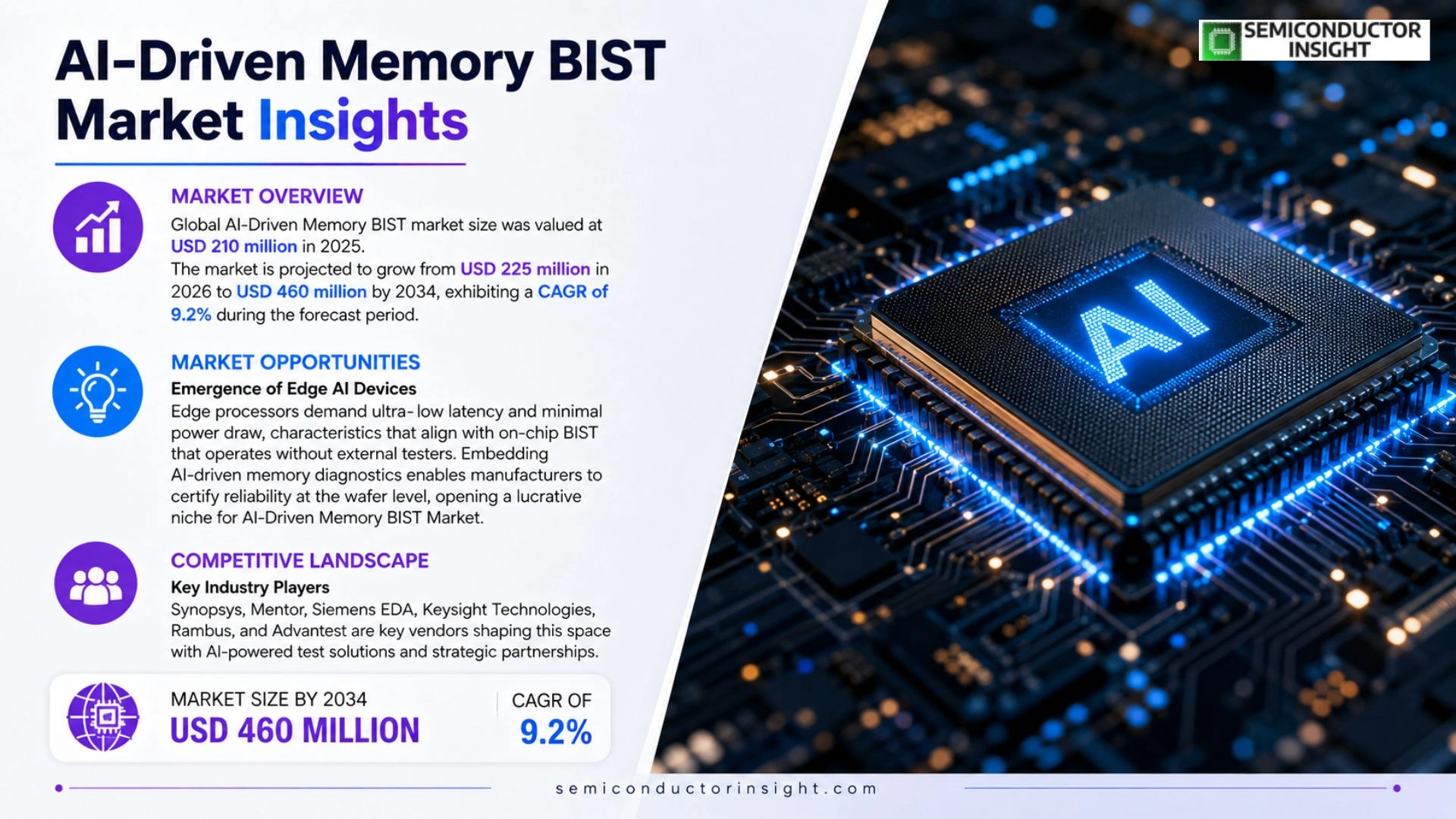
Global AI-Driven Memory BIST market size was valued at USD 210 million in 2025. The market is projected to grow from USD 225 million in 2026 to USD 460 million by 2034, exhibiting a CAGR of 9.2% during the forecast period.
AI‑driven Memory Built‑In Self‑Test (BIST) solutions embed intelligent algorithms within semiconductor memory arrays to autonomously detect faults, reduce test time, and improve yield. By leveraging machine‑learning models that predict defect patterns, these systems can adapt test vectors in real time, offering higher fault coverage than conventional deterministic BIST approaches.
The market is gaining momentum because chip manufacturers are seeking higher reliability amid shrinking process nodes and increasing system complexity. Moreover, automotive and IoT applications demand stringent safety standards, prompting investment in adaptive test technologies. Leading vendors such as Synopsys, Cadence Design Systems, and Mentor Graphics are expanding their portfolios with AI‑enhanced BIST modules, further accelerating adoption.
MARKET DRIVERS
Rising Demand for On‑Chip Self‑Test Solutions
The proliferation of high‑performance processors in data‑center servers and AI accelerators forces manufacturers to embed self‑test capabilities directly onto silicon. By moving test logic into the memory array, designers cut board‑level testing time and reduce overall product cost. In AI-Driven Memory BIST Market, this shift translates into faster time‑to‑market for next‑gen chips.
Advancements in AI Algorithms for Test Pattern Generation
Machine‑learning models now predict fault patterns with a precision that classic deterministic methods cannot achieve. These algorithms generate compact test vectors that cover a larger fault space, allowing memory vendors to meet stringent yield targets without inflating test time. The ability to continuously improve pattern quality through data‑driven feedback loops strengthens the value proposition of AI‑enabled BIST solutions.
➤ Deploying adaptive AI models reduces diagnostic cycles by up to 30 % while preserving fault coverage.
Consequently, system integrators see a direct impact on product reliability, which in turn drives procurement of smarter test engines. As design cycles tighten, the competitive edge belongs to those who can integrate AI‑driven memory self‑test without sacrificing performance.
MARKET CHALLENGES
Escalating Complexity of Heterogeneous Memory Architectures
Modern SoCs combine DRAM, SRAM, and emerging non‑volatile memories in a single package. Each technology demands distinct test strategies, and aligning AI‑generated patterns across this mosaic creates tooling friction. Companies that lack a unified verification framework struggle to reap the efficiency promised by AI‑driven BIST.
Other Challenges
Proprietary Algorithm Licenses
Licensing restrictions on AI models can lock OEMs into costly contracts, limiting flexibility when tailoring test suites for new memory families.
MARKET RESTRAINTS
High Up‑Front Development Costs
Implementing AI‑based BIST engines requires investment in both hardware accelerators and data‑science talent. For mid‑size fabless players, the capital outlay can exceed the budget allocated for traditional test infrastructure, slowing adoption rates.
Limited Skilled Workforce
The intersection of semiconductor test engineering and AI expertise is narrow. Talent shortages force companies to either outsource critical functions or postpone migration to AI‑centric solutions, thereby tempering market momentum.
MARKET OPPORTUNITIES
Emergence of Edge AI Devices
Edge processors demand ultra‑low latency and minimal power draw, characteristics that align with on‑chip BIST that operates without external testers. Embedding AI‑driven memory diagnostics enables manufacturers to certify reliability at the wafer level, opening a lucrative niche for AI-Driven Memory BIST Market.
Strategic partnerships between AI software vendors and memory foundries are gaining traction, allowing co‑development of test models that are pre‑validated for specific process nodes. Such collaborations shorten integration cycles and create new revenue streams for both parties.
Standards bodies are drafting unified interfaces for AI‑enhanced BIST, which promises to lower entry barriers for smaller adopters. Early movers that align product roadmaps with these emerging specifications stand to capture a disproportionate share of future design wins.
AI-Driven Memory BIST Market Trends
Adaptive Fault Coverage Through AI
The integration of machine‑learning models directly into memory Built‑In Self‑Test (BIST) engines reshapes how manufacturers address defect detection. By continuously learning from failure signatures, these solutions can refine test vectors on‑the‑fly, delivering fault coverage that exceeds the limits of static deterministic patterns. This capability reduces overall test time, which in turn lifts production yields without compromising reliability. The shift reflects a broader industry move toward smarter verification stacks, where the test apparatus itself becomes a predictive component rather than a passive observer.
Other Trends
Impact of Node Shrinkage on Test Strategies
As process nodes descend below 10 nm, variability and susceptibility to soft errors rise sharply. Traditional BIST schemes, designed for larger geometries, struggle to keep pace with the tighter timing margins and heightened defect density. AI‑enhanced BIST mitigates this mismatch by auto‑adjusting stimulus based on real‑time silicon feedback, thereby preserving yield even as manufacturers push the envelope of miniaturization. Companies that embed such intelligence into their test flow are better positioned to meet the yield targets demanded by high‑volume fabs.
Automotive & IoT Demand as Growth Engine
Safety‑critical sectors such as automotive electronics and industrial‑grade IoT devices impose strict fault‑tolerance standards. The requirement for on‑chip self‑diagnosis in these environments fuels investment in adaptive test solutions that can certify memory blocks under diverse operating conditions. Leading EDA vendors have responded by bundling AI‑derived BIST modules with their broader design suites, simplifying qualification for OEMs. This alignment between supply‑side innovation and downstream compliance pressures creates a virtuous cycle: enhanced test capabilities lower qualification costs, which encourages broader adoption across safety‑sensitive product lines.
COMPETITIVE LANDSCAPE
Key Industry Players
AI‑Driven Memory BIST Competitive Landscape Overview
Synopsys commands the most visible share of the AI‑driven Memory BIST arena, largely because its verification suite already embeds deep‑learning classifiers that anticipate defect patterns across advanced‑node SRAM and DRAM blocks. By integrating these models into its DesignWare Test IP, Synopsys offers customers a unified flow that cuts test latency while preserving yield, a combination that resonates with high‑volume fabs seeking to offset the cost of finer geometries. The company’s aggressive acquisition strategy,most recently adding a boutique AI‑hardware startup,has expanded its algorithmic toolbox and reinforced its position as the de‑facto standards‑setter for adaptive BIST solutions.
Beyond the headline player, a constellation of specialist and diversified firms enriches the market. Cadence Design Systems leverages its cloud‑based Palladium platform to deliver on‑demand AI inference for BIST, targeting automotive ASICs that must satisfy functional‑safety mandates. Siemens EDA (formerly Mentor Graphics) continues to monetize its long‑standing BIST legacy by overlaying reinforcement‑learning modules that fine‑tune test vectors in situ. Meanwhile, semiconductor giants such as Intel, Qualcomm and NXP embed AI‑enhanced BIST directly into their SOC roadmaps to guarantee reliability for edge‑AI and IoT devices. Regional champions,including Infineon Technologies, STMicroelectronics, Renesas Electronics and Texas Instruments,focus on niche process‑specific adaptations, while fab‑centric players like TSMC, GlobalFoundries and Samsung provide foundry‑level validation services that incorporate proprietary machine‑learning analytics. This diversified competitive fabric ensures that end‑users can select solutions aligned with their design cadence, cost structure, and safety requirements.
List of Key AI‑Driven Memory BIST Companies Profiled
- Synopsys
- Cadence Design Systems
- Siemens EDA (Mentor Graphics)
- Intel Corporation
- Qualcomm
- NXP Semiconductors
- Infineon Technologies
- STMicroelectronics
- Renesas Electronics
- Texas Instruments
- Analog Devices
- Marvell Technology Group
- GlobalFoundries
- TSMC
- Samsung Electronics
Segment Analysis:
| Segment Category | Sub-Segments | Key Insights |
| By Type |
|
AI‑augmented Hybrid BIST is emerging as the preferred architecture because it combines deterministic coverage with adaptive intelligence; it enables test patterns to evolve in response to observed defect trends; it reduces test cycle time while preserving high fault detection confidence. |
| By Application |
|
Automotive safety systems drive the most rigorous demand; safety‑critical standards push manufacturers toward AI‑enhanced BIST for predictive fault avoidance; the technology aligns with functional safety verification cycles; it offers a path to certify memory subsystems without extensive external testing. |
| By End User |
|
Chip manufacturers are the primary adopters; they embed AI‑driven BIST directly into design flows to improve yield; the approach supports rapid design‑for‑test adjustments; it also enhances differentiation by offering higher reliability assurances to downstream partners. |
| By Technology Integration |
|
Machine‑learning fault prediction stands out as the catalyst for next‑generation BIST; it enables early identification of systematic defect patterns; it supports continuous learning as process nodes shrink; it harmonizes with existing verification ecosystems without disrupting flows. |
| By Market Drivers |
|
Yield improvement focus underpins adoption; AI‑driven BIST reduces re‑work cycles and enhances first‑pass success; it aligns with cost‑sensitivity of high‑volume semiconductor production; it also delivers confidence that emerging node complexities are being validated efficiently. |
Regional Analysis: AI-Driven Memory BIST Market
North America
AI‑enhanced diagnostic engines are being embedded directly into memory controllers, allowing continuous health monitoring without external test equipment. This shift reduces latency in fault detection and aligns with broader trends toward autonomous system maintenance.
Standards bodies in the United States are updating reliability criteria to incorporate AI‑driven test metrics, prompting manufacturers to certify their products against more stringent benchmarks that emphasize predictive failure analysis.
The convergence of AI software and memory hardware has led to tighter integration among component suppliers, reducing the need for intermediate validation stages and smoothing the overall production flow.
Leading chipmakers are differentiating their portfolios by offering proprietary BIST solutions that leverage AI, creating a competitive edge focused on reliability guarantees and lifecycle cost savings for end users.
Europe
European firms are capitalizing on strong collaborations between research institutions and industrial partners to advance AI‑driven testing methodologies. The region benefits from a regulatory environment that encourages innovation while safeguarding data integrity, prompting manufacturers to embed sophisticated self‑checking capabilities within memory modules. This alignment of policy and technology nurtures a market where reliability is a decisive factor for automotive and industrial automation customers, who demand predictable performance over long service periods. As a result, European players are positioning themselves as providers of highly trusted memory solutions, often leveraging cross‑border R&D networks to accelerate feature rollout.
Asia‑Pacific
In Asia‑Pacific, rapid expansion of consumer electronics and emerging AI workloads is driving demand for smarter memory testing. Local manufacturers are investing heavily in AI training datasets tailored to regional usage patterns, enabling BIST algorithms that adapt to diverse operating conditions. The competitive pressure from low‑cost producers is balanced by a growing emphasis on quality, as OEMs seek to differentiate their devices through enhanced durability. Consequently, the market sees a blend of cost efficiency and incremental intelligence embedded in memory products, fostering a dynamic environment where innovation and price sensitivity coexist.
South America
South American markets are witnessing a gradual shift toward AI‑augmented memory validation as manufacturers aim to meet the reliability expectations of expanding telecom and renewable‑energy sectors. While infrastructure constraints pose challenges, partnerships with global technology providers are facilitating knowledge transfer and enabling local assembly lines to adopt advanced BIST techniques. The result is a nascent yet promising segment where early adopters can achieve operational stability without the need for extensive external testing facilities.
Middle East & Africa
In the Middle East & Africa, strategic investments in smart‑city projects and defense applications are creating niche demand for AI‑driven memory diagnostics. Governments are encouraging technology adoption through incentives that lower entry barriers for firms introducing intelligent test solutions. This policy support, combined with a growing pool of engineering talent, is allowing regional participants to experiment with self‑learning BIST frameworks that cater to harsh environmental conditions common in the area. The emerging ecosystem hints at a future where AI‑enhanced memory reliability becomes a baseline requirement for mission‑critical deployments.
Report Scope
This market research report provides a comprehensive analysis of the AI-Driven Memory BIST Market , covering the forecast period 2026–2034. It offers detailed insights into market dynamics, technological advancements, competitive landscape, and key trends shaping the industry.
Key focus areas of the report include:
- Market Overview: The report begins with an overview outlining its current market scenario, key growth indicators, and industry transformation drivers. It discusses macroeconomic factors, demand–supply balance, regulatory landscape, and the strategic role of semiconductors in powering advancements across industries such as automotive, telecommunications, consumer electronics, and industrial automation.
- Market Size & Forecast: Historical data and future projections for revenue, unit shipments, and market value across major regions and segments.
- Segmentation Analysis: Detailed breakdown by product type, technology, application, and end-user industry to identify high-growth segments and investment opportunities.
- Regional Insights: Insights into market performance across North America, Europe, Asia-Pacific, Latin America, and the Middle East & Africa, including country-level analysis where relevant.
- Competitive Landscape: Profiles of leading market participants, including their product offerings, R&D focus, manufacturing capacity, pricing strategies, and recent developments such as mergers, acquisitions, and partnerships.
- Technology Trends & Innovation: Assessment of emerging technologies, integration of AI/IoT, semiconductor design trends, fabrication techniques, and evolving industry standards.
- Market Drivers & Restraints: Evaluation of factors driving market growth along with challenges, supply chain constraints, regulatory issues, and market-entry barriers.
- Stakeholder Insights: Insights for component suppliers, OEMs, system integrators, investors, and policymakers regarding the evolving ecosystem and strategic opportunities.
Primary and secondary research methods are employed, including interviews with industry experts, data from verified sources, and real-time market intelligence to ensure the accuracy and reliability of the insights presented.
FREQUENTLY ASKED QUESTIONS:
What is the current market size of AI-Driven Memory BIST Market?
-> AI-Driven Memory BIST market size is projected to grow from USD 225 million in 2026 to USD 460 million by 2034, exhibiting a CAGR of 9.2% iod.
Which key companies operate in AI-Driven Memory BIST Market?
-> Key players include Synopsys, Cadence Design Systems, and Mentor Graphics, among others.
What are the key growth drivers?
-> Key growth drivers include increasing reliability requirements, shrinking process nodes, and rising safety standards in automotive and IoT applications.
Which region dominates the market?
-> North America leads the market due to the concentration of major semiconductor firms, while Asia-Pacific shows rapid adoption driven by automotive and IoT demand.
What are the emerging trends?
-> Emerging trends include AI‑enhanced adaptive test vectors, real‑time fault prediction using machine‑learning models, and integration of BIST modules with advanced node designs.

Get Sample Report PDF for Exclusive Insights
Report Sample Includes
- Table of Contents
- List of Tables & Figures
- Charts, Research Methodology, and more...
 Download Sample Report PDF